Interview Questions Generator

Craft customized interview queries according to the job role and preferred competencies.

Interview Questions

Learn how toprovide the job position, role, and any specific skills or qualities you want to assess in the candidate for generating relevant interview questions

Optional

Java
web development
problem-solving
teamwork
Login to generate for free

The Interview Questions Generator template helps you quickly come up with structured and relevant interview questions that match a specific role using AI. It’s a simple but powerful AI interview question generator that saves you time, keeps things consistent, and helps you run better interviews for pretty much any team or industry.

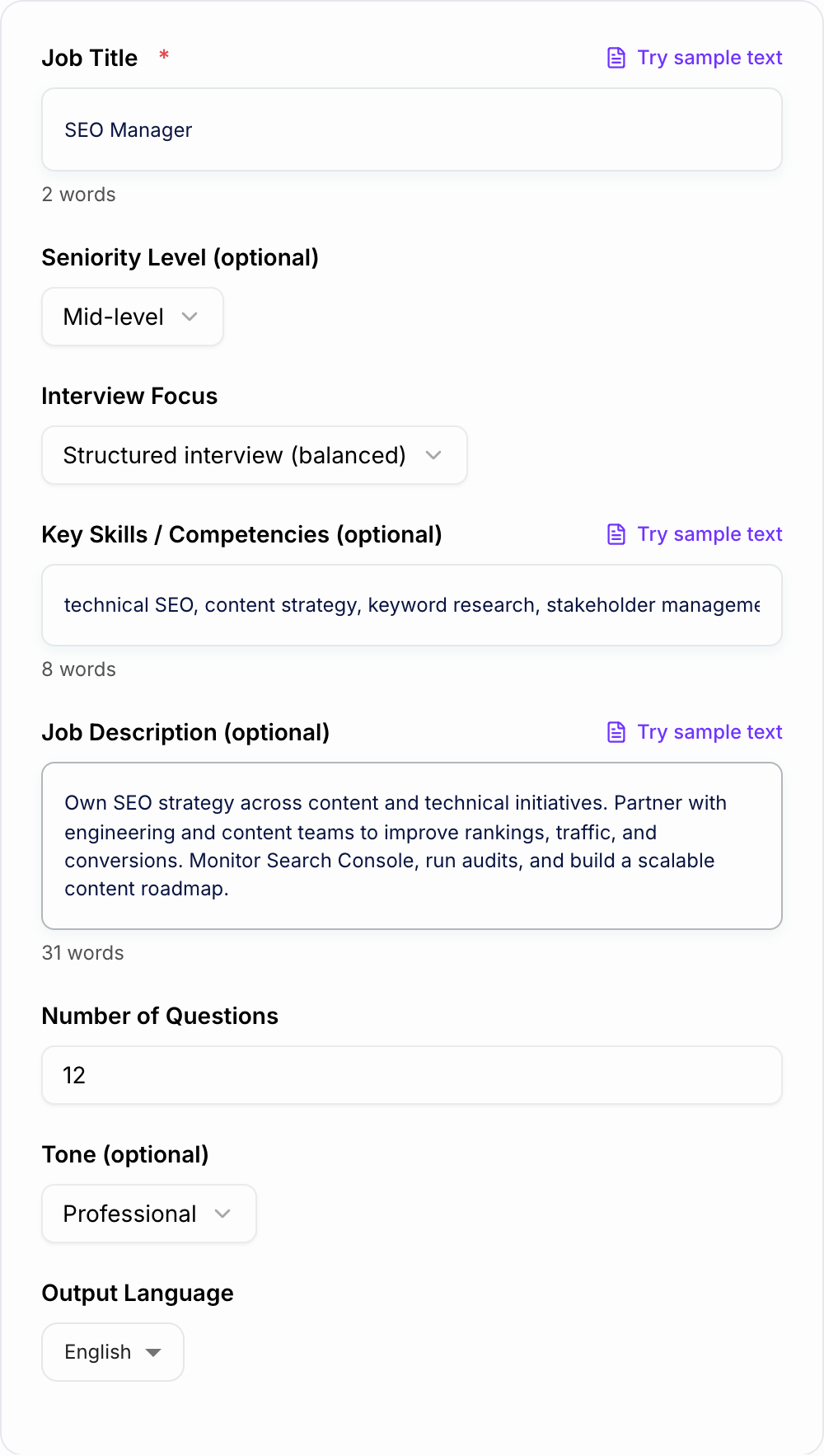
You just share a few details like the job title, seniority level, tech stack or domain, and any company values or cultural notes that matter to you. Then Junia AI looks at all that and generates:

  • Behavioral and situational questions
  • Technical and role-specific questions
  • Culture and values-based questions
  • Follow-up and probing questions

If the results don’t feel quite right, you can easily tweak them by:

  • Regenerating a new set of questions
  • Adjusting the role description or seniority level
  • Adding more details about required skills or tools
  • Saying what you want to focus on (e.g., problem-solving, communication, leadership, ownership, adaptability)

This makes it super easy to build complete interview guides and interview question lists in seconds, instead of spending hours researching and brainstorming and writing everything from scratch. You can use the Interview Questions Generator to prepare questions for:

  • First-round screening interviews
  • Technical or coding interviews
  • Behavioral interviews
  • Culture-fit or values interviews
  • Panel interviews
  • Executive and leadership interviews

Use this template whenever you want consistent, unbiased, and tailored questions for interviews, screenings, or other hiring tasks in almost any role, function, or industry, from software engineering and product management to marketing, sales, HR, operations, and more.

What Is an Interview Questions Generator?

An Interview Questions Generator is an AI-powered tool that automatically creates customized interview questions based on the role and criteria you give it. Instead of using random generic lists you find online, an interview questions generator uses artificial intelligence and natural language processing to create questions that are:

  • Specific to the job description and responsibilities
  • Aligned with required skills, tools, and technologies
  • Tailored to the seniority level (junior, mid, senior, lead, manager, executive)
  • Reflective of your company culture and core values

The AI Interview Questions Generator by Junia AI works as a free interview questions generator for a lot of different use cases, helping recruiters, hiring managers, and founders quickly build structured interview frameworks without having to start from a blank page.

Why Use an Interview Questions Generator?

Using an Interview Questions Generator tool gives hiring teams and interviewers a bunch of very practical benefits:

  • Saves Time: Making interview questions manually takes a while. An interview questions generator automates it, so you can create a big variety of questions in way less time.
  • Ensures Consistency: When multiple interviewers are involved, you want the questions to be consistent. An interview questions generator gives everyone the same core set of questions, which helps with fairness and objectivity.
  • Expands Question Variety: If you only rely on your own experience, you might repeat the same types of questions. An interview questions generator opens you up to more question styles and topics, so you can assess candidates more fully.
  • Customizable Options: Many interview questions generators let you customize questions based on things like job role, required skills, or industry. That way the questions fit your exact hiring needs.
  • Reduces Bias: Unconscious bias can creep into interviews. When you use an interview questions generator, you can ask more standardized questions that focus on relevant skills and qualifications instead of personal preferences.

Bringing an Interview Questions Generator tool into your hiring process can really boost how efficient and effective your interviews are.

1. Save Time and Effort

Creating a solid list of interview questions for every single new role can be slow and honestly kind of repetitive. An AI interview question generator can:

  • Turn a simple role summary into a full interview question bank in seconds
  • Cut down the time you spend hunting for examples and rewriting questions
  • Help you standardize your interview process across multiple roles

2. Improve Consistency and Fairness

The Interview Questions Generator helps you run more consistent interviews by:

  • Giving you the same core questions for all candidates for the same role
  • Reducing last minute, random ad hoc questions
  • Supporting a more structured and objective evaluation process

This kind of structure helps reduce unconscious bias and gives each candidate a more equal shot at showing their skills.

3. Get Role-Specific and Skills-Based Questions

A good AI interview generator does more than just throw “tell me about yourself” at people. When you add your tech stack, tools, and main responsibilities, you get:

  • Targeted skills-based questions
  • Detailed technical interview questions
  • Domain-specific questions for things like finance, health, SaaS, ecommerce, and so on

You can quickly prepare tailored questions for software engineers, data scientists, designers, marketers, sales reps, customer support specialists, and a whole lot of other roles.

4. Align with Your Culture and Values

Hiring for culture add and values fit is just as important as hiring for skills. The Interview Questions Generator can:

  • Work in your company mission, values, and principles
  • Suggest questions that assess teamwork, ownership, integrity, and communication
  • Help you spot candidates who align with how your team actually works day to day

5. Support Non-Expert Interviewers

Not everyone interviewing candidates is a trained recruiter. A free AI interview question generator helps:

  • New managers or first-time interviewers feel more prepared
  • Small startups and growing teams build a professional interview process
  • Subject-matter experts (like engineers or designers) focus more on evaluating answers instead of trying to write questions

What Are Good Interview Questions?

Good interview questions are clear, actually relevant, and help you see how a candidate thinks, behaves, and performs in real situations. Most high-quality questions fall into a few main types.

1. Behavioral Interview Questions

Behavioral questions look at what the candidate has done before. Examples:

  • “Tell me about a time you had to manage conflicting priorities under a tight deadline.”
  • “Describe a situation where you received critical feedback. How did you respond?”

These questions help you understand the candidate's problem-solving skills, resilience, communication, and how they work with others.

2. Situational Interview Questions

Situational questions explore how candidates would react in hypothetical situations. Examples:

  • “If a key stakeholder strongly disagreed with your approach, how would you handle it?”
  • “What would you do if you noticed a recurring issue that no one else seemed to be addressing?”

These types of questions show judgment, decision-making, and ownership.

3. Technical or Role-Specific Questions

These questions test the candidate’s hard skills and subject-matter expertise. For example:

  • For engineers: “How would you design a scalable API for a high-traffic application?”
  • For marketers: “Walk me through how you would structure and measure a multi-channel campaign.”

A strong AI technical interview question generator will adapt these questions to your specific tech stack or domain.

4. Values, Culture, and Team Fit Questions

These questions look at how well someone matches how your team works and what the company cares about. Examples:

  • “What kind of team environment helps you do your best work?”
  • “Tell me about a time you went above your formal responsibilities for the benefit of the team.”

They’re really important for long-term success and keeping people around.

5. Follow-Up and Probing Questions

Good interviewers don’t just stop at the first answer. Follow-up questions like:

  • “Can you walk me through your thinking step-by-step?”
  • “What would you do differently if you had to handle that situation again?”

help you go deeper and understand the candidate’s reasoning, not just the end result. The Interview Questions Generator can also suggest these kinds of probing follow-ups automatically.

How to Write a Good Interview Question

Even if you’re using a powerful AI interview questions generator, it still helps to know how to write strong questions yourself. Good interview questions usually:

1. Start with a Clear Objective

Know what you actually want to measure.

Is it technical skill, communication, leadership, ownership, learning ability, or culture fit?

For example:

  • Objective: Assess problem-solving and collaboration
  • Question: “Tell me about a difficult problem you solved with your team. What was your role and what was the outcome?”

2. Ask Open-Ended Questions

Try not to ask yes or no questions. Instead of:

  • “Are you good at dealing with deadlines?”

Ask:

  • “Tell me about a time you had an unexpectedly tight deadline. How did you handle it?”

Open-ended questions get people to share more details and real examples.

3. Anchor Questions in Real Scenarios

Make your questions about realistic work situations, like:

  • “Describe a time when you disagreed with your manager’s decision. What did you do?”
  • “Walk me through a project you’re proud of from start to finish.”

This pushes candidates to share concrete experiences instead of just theory.

4. Keep Questions Clear and Focused

Good interview questions are usually:

  • Short and direct
  • Light on jargon (unless it’s actually part of the role)
  • Focused on one main idea at a time

If a question feels like it has too many parts, break it up or use follow-ups.

5. Balance Difficulty and Fairness

Questions should be:

  • Challenging enough to tell strong candidates apart
  • Still answerable in a reasonable amount of time
  • Relevant to what the role will actually need

A job interview question generator like Junia AI helps with this by tailoring questions to the candidate level (junior vs senior vs lead).

6. Use Consistent Core Questions for Comparison

For each role, define a set of core questions you ask every candidate. That way you can:

  • Compare candidates more fairly
  • Keep your process structured and repeatable
  • Spot patterns in strong or weak answers

The Interview Questions Generator makes this easy by generating a reusable set of questions you can keep adjusting over time.

How the AI Interview Questions Generator by Junia AI Helps

The AI Interview Questions Generator by Junia AI pulls all these best practices together into one simple tool. By entering a few details like:

  • Job title and level
  • Required skills, tools, or tech stack
  • Responsibilities and key outcomes
  • Company values, principles, or culture notes

You get a structured list of:

  • Behavioral interview questions
  • Situational and scenario-based questions
  • Technical and domain-specific questions
  • Culture, values, and collaboration questions
  • Follow-up and probing questions

Because it’s a free interview question generator for many use cases, you can try things out, iterate, and refine your interview guides until they really match how you want to hire.

Whether you’re a recruiter, HR professional, hiring manager, startup founder, or team lead, an AI-powered interview question generator like Junia AI can become your go-to helper for building professional, effective interview processes in a fraction of the usual time.

Use Cases

Discover how this tool can be used in various scenarios

  • Building a complete interview guide for a new role

    Create a structured list of technical, behavioral, and culture-fit questions for a new or evolving position without any existing interview framework.

  • Standardizing interview panels

    Provide all interviewers with the same core set of questions so every candidate is assessed on comparable criteria, improving fairness and decision quality.

  • Preparing for technical interviews

    Generate role-specific technical questions (e.g., backend engineer, data analyst, DevOps) to evaluate skills aligned with your current stack and challenges.

  • Designing phone screen and first-round interviews

    Quickly produce concise question lists tailored to short screening calls that focus on must-have skills and deal-breakers.

  • Creating role-specific question banks

    Maintain reusable question libraries for frequently hired roles so future hiring rounds can be launched in minutes.

  • Supporting new interviewers

    Equip first-time or occasional interviewers with curated question sets and suggested follow-ups to keep interviews structured and effective.

  • Candidate practice and mock interviews

    Job seekers or coaches generate realistic questions based on a target job description to rehearse answers and improve confidence.

Benefits

  • Save time and effort
    Instead of sitting there trying to think of questions from nothing, you can get a full list of solid interview questions in under a minute. It’s way faster and just less work overall.

  • Improve question relevance
    The questions are automatically matched to the job description, the skills you need and the seniority level. So every question actually has a reason to be there and not just random stuff.

  • Standardize your hiring process
    You can use the same sets of questions for different candidates, which helps cut down on bias and makes it easier to compare people in a more fair and kind of objective way.

  • Cover both hard and soft skills
    You get a mix of technical, behavioral, situational and culture fit questions. That way you see more of the whole person, not just what’s on their resume or whatever.

  • Adapt to any role or industry
    Whether it’s software engineers, marketers, HR, operations or something else, you can quickly generate questions that fit your exact area and the role you’re hiring for.

  • Enhance candidate experience
    Having more organized and thoughtful questions makes the interview feel smoother and less awkward. It also gives candidates a better impression of your company.

  • Support less-experienced interviewers
    This gives hiring managers and team members a ready made guide they can lean on, so even people who are new to interviewing can run decent, pretty professional interviews.

Who's this tool for?

Hiring managers

Managers who need structured, role-specific interview questions to assess candidates consistently without spending hours preparing.

Recruiters and talent acquisition teams

Recruitment professionals who want to streamline their workflow with fast, high-quality question sets for different roles and clients.

Startup founders and small business owners

Leaders without a dedicated HR team who still need professional, fair, and effective interview questions to make strong early hires.

Technical leads and engineering managers

Tech leaders who must evaluate technical depth, problem-solving, and collaboration skills for engineering and product roles.

HR professionals and people ops teams

HR teams looking to standardize interview processes, reduce bias, and ensure compliance with internal hiring guidelines.

Career coaches and interview trainers

Coaches who need varied, realistic interview questions to prepare clients for real-world job interviews.

Job seekers practicing interviews

Candidates who want to anticipate likely interview questions for specific roles and practice stronger, more focused answers.

Why Choose Our Interview Questions Generator?

Junia AI’s Interview Questions Generator template was made to get rid of one of the most time consuming and honestly pretty error prone parts of hiring, which is sitting there trying to come up with good questions.

So instead of depending on random lists, guesswork or some old template you found somewhere, Junia AI:

  • Reads and understands your job description so the questions actually match the real responsibilities and the skills you really need.
  • Balances depth and breadth, mixing technical questions with behavioral ones and also some that are more about culture, so you get a full picture of each candidate.
  • Promotes fairness and consistency by giving every candidate a similar kind of question setup, which makes it easier to compare people without things getting too messy.
  • Adapts instantly to different jobs, levels of seniority and even different industries, so you can pretty much reuse the same template for almost any hiring situation.

We made this template to help teams, especially smaller or stretched thin teams and fast growing startups, run interviews in a more professional way, cut down on bias and make better hiring decisions with less hassle. With Junia AI, interviews stop being this stressful manual thing and start to feel more like a repeatable and kind of data informed process.

Frequently asked questions
  • The Interview Questions Generator is an AI powered tool that helps make it easier to come up with solid interview questions that fit the job. It uses artificial intelligence to help hiring teams quickly create different, relevant and pretty consistent questions. This way it kind of speeds up the whole process and also makes the interviews feel more fair for everyone.
  • Junia AI's Interview Questions Generator has a few really important benefits. It can quickly come up with lots of different interview questions, usually in under 30 seconds. It also lets you match the questions to the job description and the candidate’s profile, so the questions feel more relevant. Plus, it helps keep things consistent so every candidate is treated fairly. And it also goes into technical skills with questions that fit the industry, which makes it easier to figure out how suitable a candidate really is.
  • Good interview questions really matter because they help show if a candidate actually knows what they’re doing and what they’re good at. They also check how someone deals with problems by asking about different situations and what they would do. On top of that, they kind of test soft skills too, like how well a person talks with others and if they can adapt when things change. All of this together gives you a fuller picture and helps you see if the candidate has the right mix of skills and the right attitude for the job.
  • Interview questions can help figure out cultural fit by asking about how candidates like to work and what their past team experiences were like. These kinds of answers give clues about how well someone might blend in with the current team and match the company’s values. This way, you can see if they’ll fit in smoothly with the culture of the organization and, you know, work well with everyone there.
  • AI is changing how interview questions get made. Instead of people doing all the work, it can now collect info about job roles and what skills are needed, kind of automatically. Then it uses that data to train algorithms so they start to understand what good questions look like, and it can quickly come up with sets of questions that fit specific situations. Because of this, things get more efficient and faster, and the questions can be better matched to the job description and the candidate’s profile. It also keeps the questions more consistent, which can help cut down on unconscious bias when people are judging or comparing different applicants.
  • Good interview questions can really help you make better hiring choices. They help you see if candidates not only have the right skills but also the right attitude to actually add something good to the team. This kind of careful questioning cuts down on expensive hiring mistakes because you check their qualifications closely against what the job really needs. It also makes picking people faster and easier, since you can spot the strongest candidates more quickly and, you know, with less guessing.