
Free Page Rank Improver
Use the AI Page Rank Improver to generate a prioritized SEO action plan for a specific page. Paste a URL or page content, add a target keyword and goal, then get practical fixes for search intent, content gaps, internal linking, on-page SEO, snippets, and topical depth.
SEO Ranking Improvement Plan
Your prioritized SEO action plan will appear here...
How the AI Page Rank Improver Works
Get results in seconds with a simple workflow.
Add a URL or Paste Your Page Content
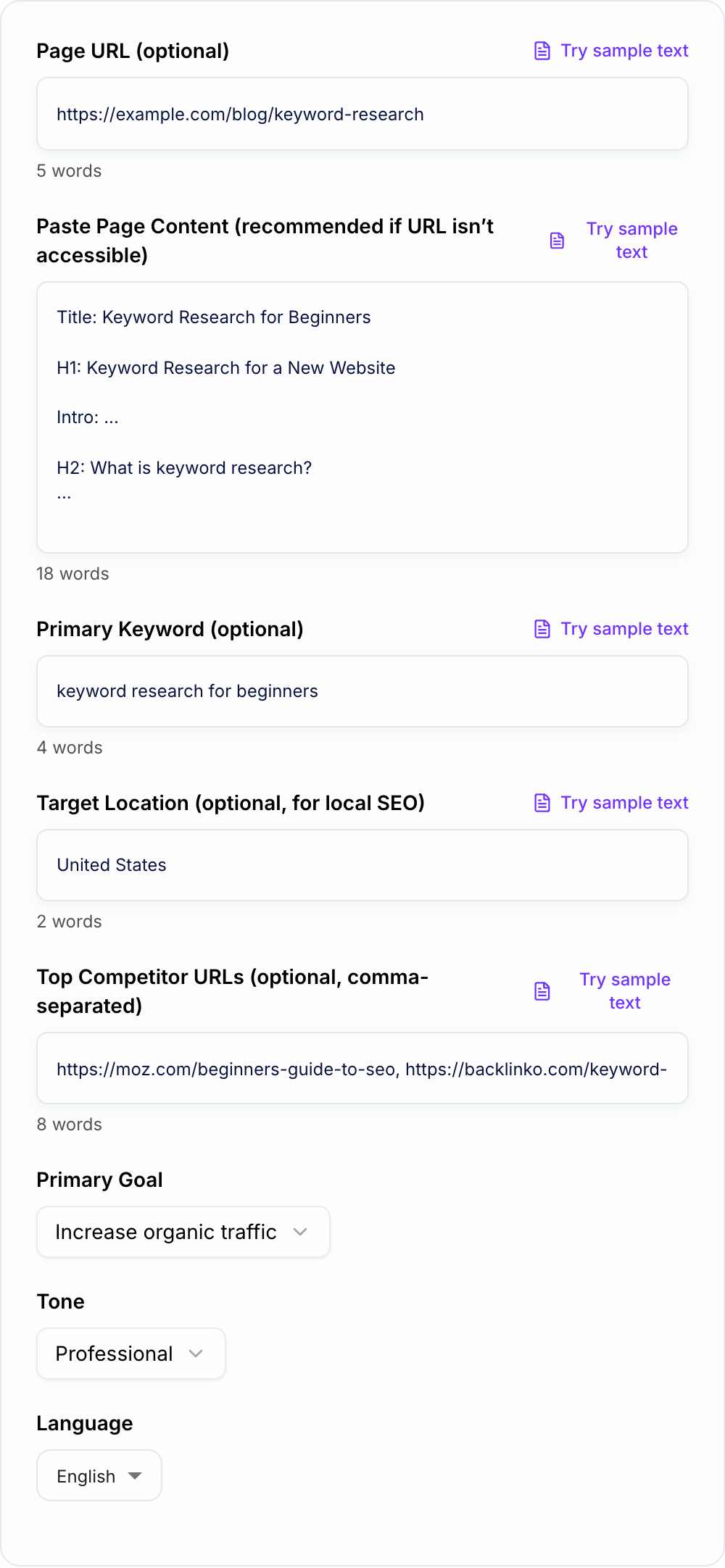
Provide your page URL (optional) and/or paste the page’s title, headings, and body content so the tool can generate page-specific SEO improvements.
Set a Keyword (Optional) and Goal
Add a primary keyword if you have one and choose a goal like increasing organic traffic, recovering rankings, or winning featured snippets.
Get a Prioritized SEO Action Plan
Receive a ranked list of fixes with examples (title/H2 rewrites, missing sections, internal links, FAQ ideas) plus a checklist you can implement immediately.
See It in Action
Example of turning a weak, under-optimized page into an SEO-focused plan with clear priorities and copy updates.
Title: SEO Tips
This page shares some SEO tips to help your website rank better. We talk about keywords, content, and links.
Prioritized fixes (High impact):
- Rewrite title to match intent + keyword: “On-Page SEO Checklist: 17 Fixes to Improve Rankings (Step-by-Step)”
- Add a clear H1 and intent-matching intro (who it’s for + outcome)
- Expand content gaps: add sections for search intent, internal linking strategy, title tag formulas, and common on-page SEO mistakes
- Add an FAQ block targeting PAA questions (5–7 Q/A)
- Add 5 internal links from relevant posts + 3 contextual links out to authoritative sources
Suggested structure: H2: What On-Page SEO Is (and Why It Improves Rankings) H2: Step-by-Step On-Page SEO Checklist H3: Title tags and meta descriptions H3: H1/H2 structure and topical coverage H3: Internal links and anchors H3: Image alt text and accessibility H2: Common Mistakes That Keep Pages From Ranking H2: FAQ
Why Use Our AI Page Rank Improver?
Powered by the latest AI to deliver fast, accurate results.
Prioritized On-Page SEO Recommendations
Get a ranked list of fixes (high/medium/low impact) covering titles, meta descriptions, headings, keyword alignment, internal links, and content gaps to improve Google rankings efficiently.
Search Intent & SERP Alignment
Adjust your page to match informational, commercial, or transactional intent with section suggestions, angle changes, and SERP feature targeting (featured snippets, People Also Ask).
Content Gap & Topical Coverage Builder
Identify missing subtopics, related terms, and entities to improve topical relevance and semantic SEO without keyword stuffing—ideal for content refreshes and ranking lifts.
Internal Linking & Anchor Text Plan
Generate internal link opportunities, recommended anchor text variations, and placement ideas to strengthen site architecture, distribute authority, and improve crawlability.
Snippet Optimization (CTR Improvements)
Improve organic CTR with rewritten SEO titles, meta descriptions, and on-page snippet copy suggestions that reflect the keyword, benefits, and intent—without clickbait.
Pro Tips for Better Results
Get the most out of the AI Page Rank Improver with these expert tips.
Fix intent mismatch before adding more words
If the SERP is mostly guides and your page is a sales pitch (or vice versa), rewrite the structure and angle first. Intent alignment often creates bigger ranking lifts than small on-page tweaks.
Strengthen internal links with intentional anchors
Add 3–8 internal links from relevant pages using descriptive, varied anchor text. Avoid repeating the exact same anchor everywhere—use close variants and natural phrasing.
Upgrade your H2s into a complete outline
Use H2s that map to sub-intents (definitions, steps, tools, mistakes, FAQs). Better section coverage increases topical relevance and keeps users engaged.
Optimize for CTR without clickbait
Include the primary keyword, a clear benefit, and a specificity cue (year, checklist, template, step-by-step). Match what the page actually delivers to reduce bounce and pogo-sticking.
Add evidence and examples to improve E-E-A-T
Where possible, include firsthand steps, screenshots, mini case studies, and practical examples. Specificity makes content more trustworthy and less “generic AI.”
Who Is This For?
Trusted by millions of students, writers, and professionals worldwide.
Improve a Page with an AI Page Rank Improver
A ranking problem is rarely solved by adding random words. Most underperforming pages need the right fixes in the right order: intent alignment first, then content gaps, internal links, snippet copy, and polish.
The AI Page Rank Improver turns a URL, pasted page content, target keyword, and ranking goal into a prioritized SEO action plan. Use it when you want clear next steps instead of a vague audit.
What to Enter Into the Page Rank Improver
The more page context you provide, the more specific the recommendations become.
Useful inputs include:
- Page URL: the live page you want to improve
- Pasted content: title, H1, headings, intro, body copy, FAQs, and key sections if the URL is not enough
- Primary keyword: the query you want the page to win or recover
- Goal: increase traffic, recover lost rankings, win featured snippets, improve conversions, or refresh outdated content
- Known constraints: keep the same URL, preserve product messaging, avoid a full rewrite, or prioritize quick fixes
If you only paste a keyword, the output will be broad. If you paste the page structure and explain the goal, the generator can recommend specific title changes, missing sections, internal links, and priority levels.
How to Choose the Right Optimization Mode
Use Quick Wins when you need changes you can make today. Expect title, meta description, intro, heading, and internal-link recommendations.
Use Content Refresh when the page is old, thin, repetitive, or missing important subtopics. This mode should help you expand coverage without turning the page into generic filler.
Use On-Page SEO Audit when you want a fuller pass across title tags, headings, keyword use, snippet clarity, content structure, and user intent.
Use Internal Linking when the page needs more authority from related pages. The tool can suggest anchors and placements, but you should still choose links that help readers move naturally through the site. For deeper link discovery, an internal linking audit can reveal pages that already have topical overlap.
Use Advanced SEO Strategy when you need hypotheses, trade-offs, and measurable follow-up actions for an important page.
How to Review the Generated SEO Fixes
Do not implement every recommendation blindly. Prioritize fixes that match both the SERP and the page's business role.
Start with these checks:
- Does the suggested angle match what currently ranks?
- Does the title promise what the page actually delivers?
- Are the missing sections useful to readers, or just extra words?
- Do internal links point to genuinely relevant next steps?
- Will the change improve clarity, trust, or conversion as well as search relevance?
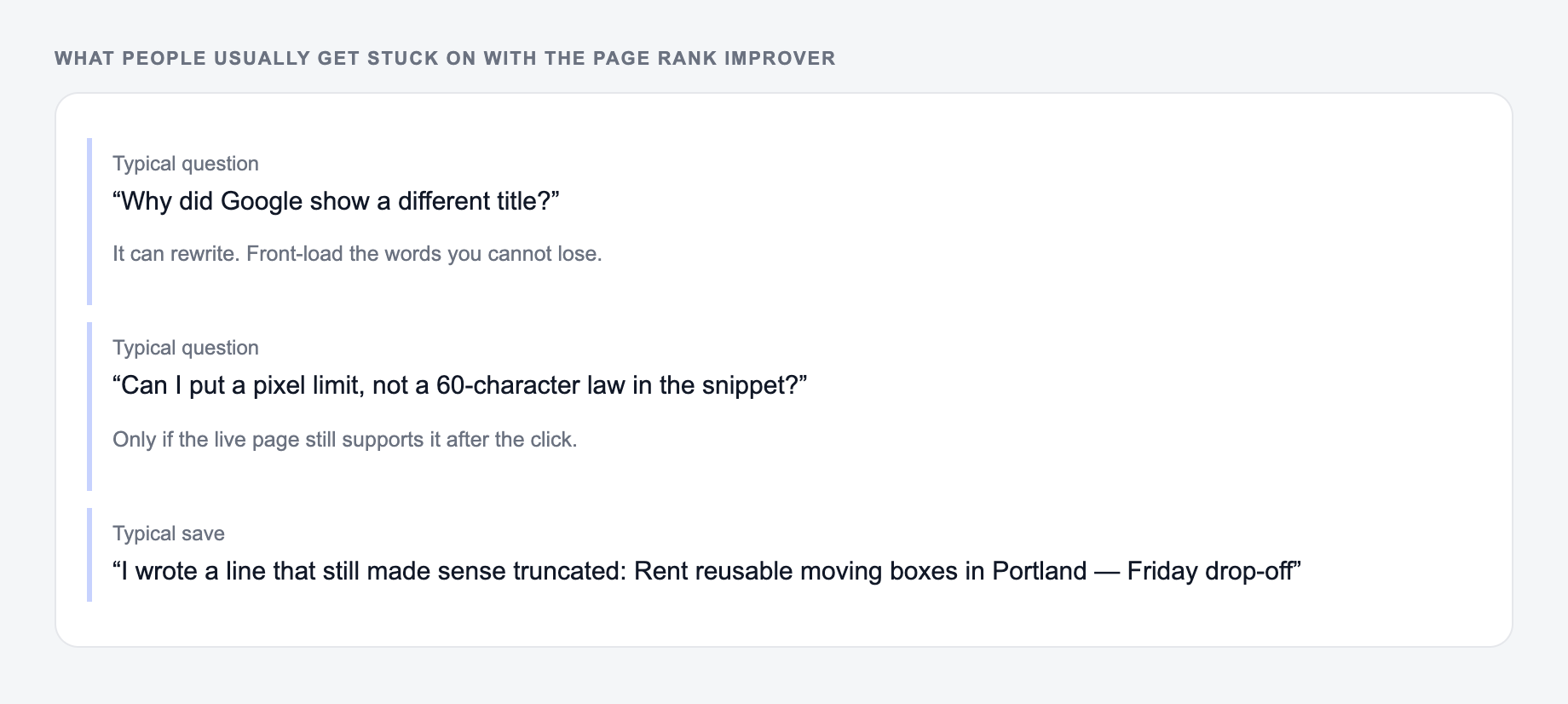
For snippet work, rewrite the title and meta description together so the search result has one clear promise. A stronger title can raise interest, but the description must confirm the page is worth clicking.
Example Input and Action Plan
The plan is only as specific as the URL, keyword, and page copy you give it.
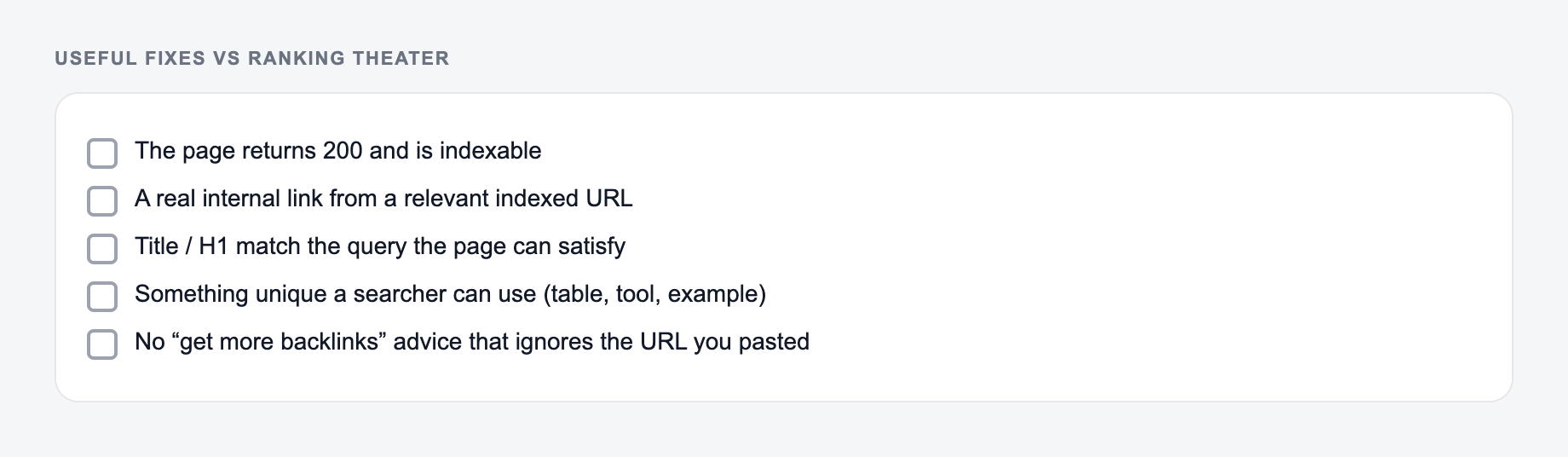
Publish checklist for page rank improver output:
Same keyword, different page types — the AI Page Rank Improver should not emit the same line:
-
Guide: how-to or step language, no “buy now.”
-
Product / service: noun + qualifier the page can fulfill.
-
Local: city only if you serve it.
-
Comparison: only if the page actually compares.
-
Input: Target keyword · What a useful fix looks like: Intent match in H1 and first screen · Limitation: The tool cannot raise Domain Rating
-
Input: Page copy · What a useful fix looks like: Gaps vs the current SERP format · Limitation: It cannot see unpublished CMS drafts unless you paste them
-
Input: Goal · What a useful fix looks like: Ordered fixes, not 40 equal tips · Limitation: Rankings still depend on competition and links
Example input:
- URL: a service page that has slipped from position 5 to position 14
- Keyword: on-page SEO checklist
- Goal: recover rankings and improve CTR
- Notes: page has a weak intro, thin internal links, and no FAQ section
A useful generated output might prioritize:
- Rewrite the title tag around the main keyword and outcome
- Rework the intro so it matches search intent in the first few lines
- Add missing H2s for title tags, headings, internal links, image alt text, and common mistakes
- Add contextual internal links from related SEO pages
- Add an FAQ section based on People Also Ask style questions
- Add examples or screenshots so the page feels tested, not generic
That order matters. If the page is misaligned with intent, tiny copy edits will not fix the core problem.
Turning Recommendations Into a Repeatable Workflow
Run the tool once before editing, implement the highest-impact recommendations, then run the page through it again after the update. The second pass often catches leftover gaps created by the rewrite.
For larger sites, page updates, link improvements, and publishing checks often become a recurring process. An AI SEO agent workflow can help coordinate those repeatable optimization tasks when manual tracking starts slowing the team down. At that point, we recommend letting an AI SEO agent run the routine checks on a schedule, so your team only reviews the pages that actually changed.
Final Checklist Before Publishing SEO Fixes
Before you ship the changes, confirm:
- The title, H1, and intro all match the primary intent
- The page answers the main query faster than before
- New sections add specific value, examples, or proof
- Internal links use natural anchors and relevant destinations
- The meta description is click-worthy but accurate
- You have a date, annotation, or note for measuring results later
No Page Rank Improver can guarantee rankings. Its value is prioritization: it helps you decide which fixes are most likely to matter first.
Build a Page-Specific Decision Log
For every recommendation, record evidence, expected reader benefit, implementation cost, risk, and measurement plan. A missing section supported by SERP and customer questions may deserve priority; a generic request to “add 500 words” does not. Separate discoverability changes from conversion changes so later analysis does not credit the wrong edit.
Frequently Asked Questions
What is a Page Rank Improver tool?+
A Page Rank Improver generates a practical SEO plan to help a specific page rank higher in search engines. It focuses on on-page SEO, content quality, search intent, internal linking, and snippet optimization—factors you can directly control.
Do I need to paste my URL or my content?+
You can provide either. If your page URL isn’t accessible to the model, paste the page title, headings, and main body content for the most accurate, page-specific recommendations.
Will this tool guarantee higher Google rankings?+
No tool can guarantee rankings. Results depend on competition, backlinks, site authority, technical SEO, and content quality. This tool helps by giving you prioritized actions that commonly improve relevance, crawlability, and user satisfaction.
How do I choose the right primary keyword?+
Pick the query that best matches the page’s main topic and search intent. If you’re unsure, leave it blank—this tool will infer a likely primary keyword and suggest related secondary keywords and variants.
Does improving titles and meta descriptions help ranking?+
Titles and meta descriptions mostly impact click-through rate (CTR), which can improve traffic and sometimes reinforce performance when paired with strong content. The biggest ranking lifts typically come from intent match, content depth, internal links, and authority.
Is this useful for ecommerce and landing pages?+
Yes. You can optimize category pages, product pages, and service landing pages by clarifying intent, improving on-page copy, adding FAQs, strengthening internal links, and tightening titles for commercial and transactional searches.