
Free Research Summary Generator
Break down academic papers, reports, and technical studies into clear summaries without losing important context. Generate concise explanations of objectives, methods, findings, limitations, and practical implications for students, researchers, analysts, and content teams.
Research Summary
Your research summary will appear here...
How the AI Research Summary Generator Works
Get results in seconds with a simple workflow.
Paste Your Research Text
Add an abstract, paper excerpt, report section, or article content. Including objectives, methods, and results leads to the most complete research summary.
Choose Summary Type and Constraints
Pick a summary format (concise, detailed, bullets, executive brief, literature notes). Optionally set language, tone, target word count, and terms you want preserved.
Generate, Verify, and Cite
Review the output for accuracy—especially numbers, statistical values, and proper nouns. If you publish or reference the summary, cite the original source and avoid overstating conclusions.
See It in Action
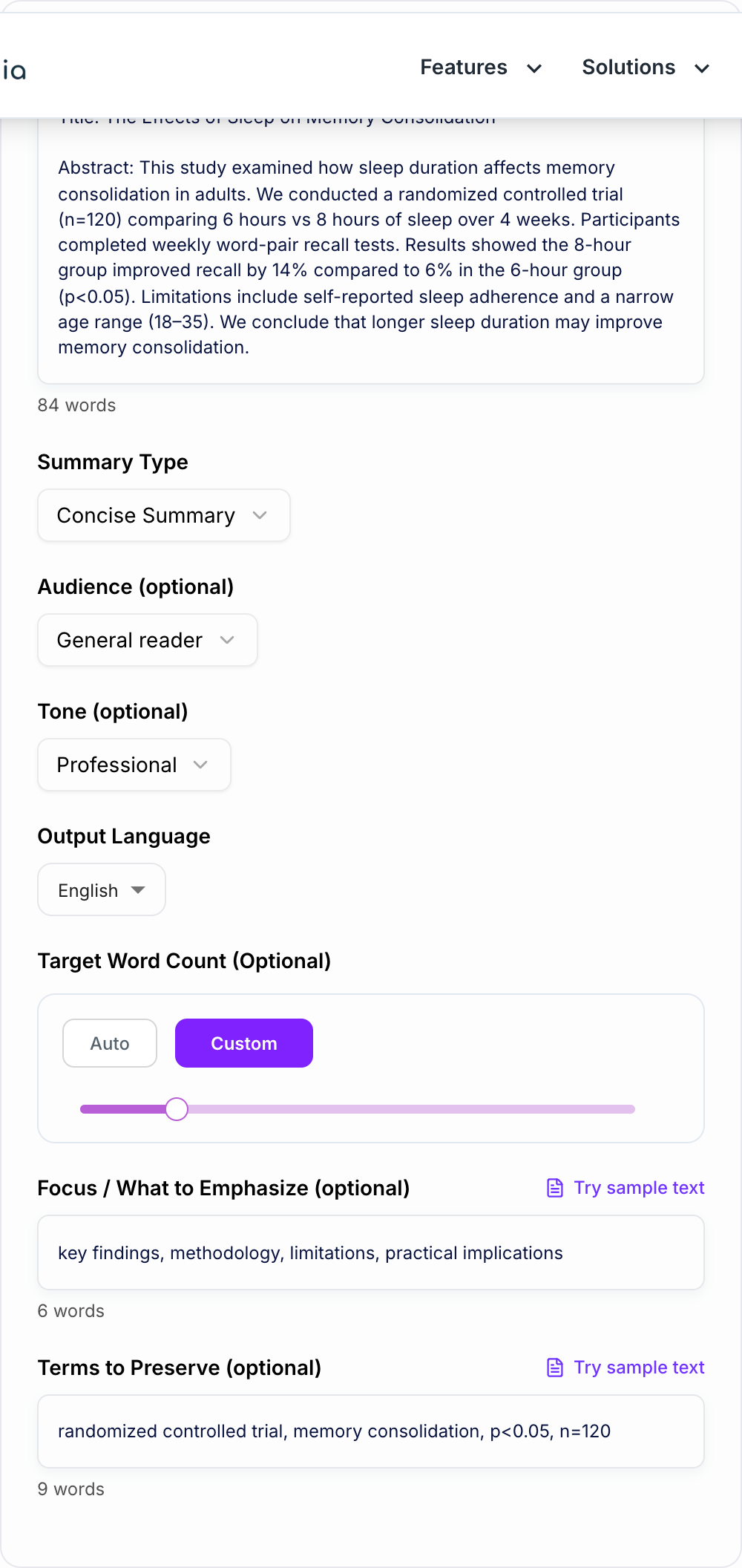
Example of converting a research abstract into a clear, structured summary while preserving key numbers and limitations.
This study examined how sleep duration affects memory consolidation in adults. We conducted a randomized controlled trial (n=120) comparing 6 hours vs 8 hours of sleep over 4 weeks. Participants completed weekly word-pair recall tests. Results showed the 8-hour group improved recall by 14% compared to 6% in the 6-hour group (p<0.05). Limitations include self-reported sleep adherence and a narrow age range (18–35). We conclude that longer sleep duration may improve memory consolidation.
This randomized controlled trial (n=120) tested whether sleep duration affects memory consolidation in adults over four weeks. Participants assigned to 8 hours of sleep showed greater improvement on weekly word-pair recall tests (14%) than those assigned to 6 hours (6%), with a statistically significant difference (p<0.05). The authors conclude that longer sleep duration may support better memory consolidation, though results are limited by self-reported sleep adherence and the study’s narrow age range (18–35).
Why Use Our AI Research Summary Generator?
Powered by the latest AI to deliver fast, accurate results.
Accurate Research Summaries (No Hallucinations)
Generates an accurate summary of research papers, academic articles, and reports while preserving original meaning, key claims, and the study’s conclusions—without adding new facts.
Structured Outputs: Findings, Methods, Limitations, Implications
Creates publish-ready summaries that clearly separate objective, methodology, results, limitations, and practical takeaways—ideal for literature reviews, research briefs, and SEO content research.
Multiple Summary Types (Concise, Detailed, Bullet, Executive)
Choose the format that matches your workflow: short abstract-style summaries, scannable bullet takeaways, executive research briefs, or literature review notes.
Terminology Preservation for Technical & Academic Writing
Optionally lock important terms (acronyms, measures, statistical values, proper nouns) so summaries keep domain accuracy for scientific, clinical, and technical content.
Multilingual Research Summarization
Summarize research in many languages for global teams, multilingual students, and international content localization—while keeping meaning and critical details intact.
Pro Tips for Better Results
Get the most out of the AI Research Summary Generator with these expert tips.
Paste the abstract + key results for better accuracy
If you only paste the introduction, the summary can’t reflect outcomes. Add the abstract and results (or key tables described in text) to capture findings and conclusions.
Lock critical terms and numbers
Use “Terms to Preserve” for acronyms, sample size (n=), p-values, effect sizes, model names, and key entities to prevent accidental changes in technical summaries.
Use Literature Review Notes to speed up synthesis
Generate consistent, structured notes for each paper so you can compare methods, populations, and findings across sources more quickly.
Don’t let a summary replace critical reading
Summaries are great for triage and recall, but always verify methodology quality, limitations, and whether conclusions match the evidence before using it in decisions or writing.
For SEO content, add your own interpretation and citations
Use summaries to extract evidence, then add unique analysis, examples, and proper citations to strengthen E-E-A-T and avoid generic “AI-written” content.
Who Is This For?
Trusted by millions of students, writers, and professionals worldwide.
Research Summary Generator: How to Summarize Papers, Studies, and Reports (Accurately)
Summarizing research is harder than it looks. A good summary must be short, readable, and still faithful to the evidence.
This free Research Summary Generator helps you turn dense academic papers, scientific studies, whitepapers, and long reports into clear summaries that keep the original meaning—without adding new claims.
What a Strong Research Summary Includes
Most high-quality research summaries capture the same core elements:
- Objective / research question (what the study tried to find out)
- Context (why it matters)
- Methods (design, sample size, data source, timeframe)
- Key findings (including important numbers when provided)
- Limitations (what could weaken confidence or generalizability)
- Conclusion / implications (what the results suggest)
If your input text contains these sections, the tool can produce a much more accurate and complete summary.
Choose the Right Summary Type (Quick Guide)
Concise Summary
Best for quick understanding, study prep, or turning a long section into a short paragraph.
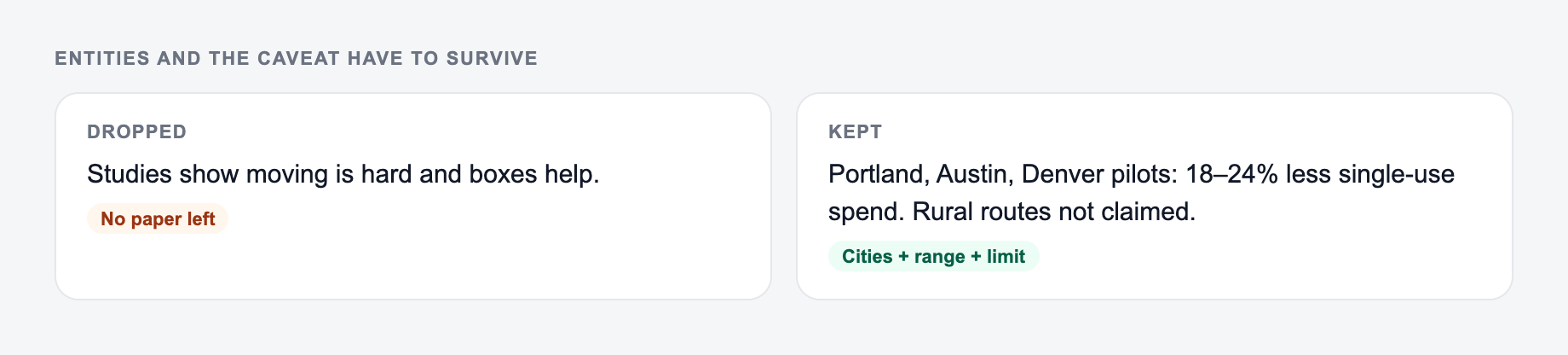
Paste the paper and the claims you must not distort. A summary should never state a finding the paper does not support.
Detailed Summary
Best when you need methods + results + limitations in a publish-ready summary.
Key Takeaways (Bullets)
Best for scannable reading, newsletters, internal notes, and slide decks.
Executive Brief
Best for business decisions—what was found, why it matters, and what to do next (without inventing facts).
Literature Review Notes
Best for researchers and students building a literature review—structured fields make it easier to compare studies.
How to Avoid Mistakes When Summarizing Research
- Don’t guess missing details. If the text doesn’t specify sample size, measurement methods, or outcomes, a summary should not invent them.
- Keep numbers exact. Changing a percentage, p-value, or time period can change the meaning.
- Separate findings from interpretation. A summary should reflect what the study reports, not what you wish it concluded.
- Check limitations. Most research has constraints; including them improves accuracy and credibility.
Using Research Summaries for SEO Content (E-E-A-T)
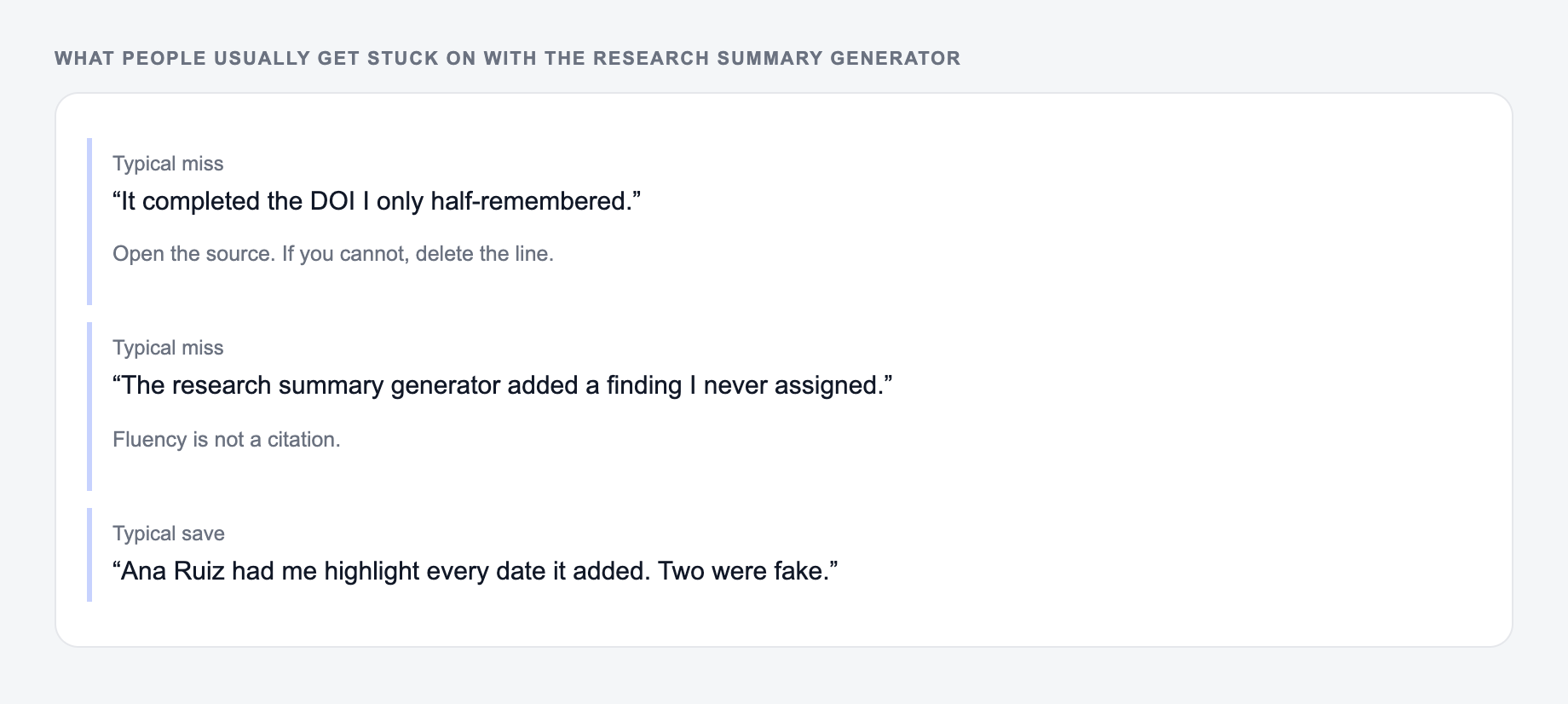
If you’re using research to write SEO content, summaries can speed up your workflow by extracting key evidence quickly. But to create high-performing, trustworthy pages you should still:
- verify claims against the original source
- cite the study properly
- add original analysis, examples, and real-world experience
- avoid overstating conclusions
That combination helps your content be more helpful, credible, and aligned with E-E-A-T expectations.
Best Practices
- Paste the abstract + results for a more accurate summary.
- Use Terms to Preserve for acronyms, statistics, and domain-specific terminology.
- Generate consistent literature notes for each paper so synthesis becomes faster.
If you want clean, accurate summaries you can reuse across writing, research, and SEO workflows, this tool is built for exactly that.
Frequently Asked Questions
What is a research summary generator?+
A research summary generator is an AI tool that condenses a research paper, article, or report into a shorter, clearer summary. It typically highlights the objective, methodology, key findings, conclusions, and important limitations.
Will the summary be accurate and meaning-preserving?+
The tool is designed to preserve meaning and only use information from your input text. For best results, include the abstract, results, and any key numbers you want reflected in the summary.
Can it summarize scientific papers and technical reports?+
Yes. You can summarize scientific studies, academic papers, whitepapers, and technical reports. If there are required terms (acronyms, metrics, statistical values), add them to the “Terms to Preserve” field.
Does it include methods, results, and limitations?+
Yes—especially in Detailed Summary, Literature Review Notes, and Critical Summary modes. If the input includes methods/results/limitations, the summary will reflect them. If they’re missing, the tool won’t invent them.
Can I use this for literature reviews?+
Yes. Use the “Literature Review Notes” mode to generate structured notes (question, methods, findings, contribution, limitations, keywords) that are easier to synthesize across multiple sources.
Can it help with SEO content research?+
Yes. Research summaries can speed up content research by extracting key points and evidence from sources. You should still verify claims, cite sources properly, and add original analysis and experience to meet E-E-A-T expectations.