
Free Abstract Generator
Create concise academic abstracts for research papers, theses, dissertations, proposals, and conference submissions. Add your topic, method, findings, and target style to get a draft that is easier to edit into submission-ready academic prose.
Abstract
Your abstract will appear here...
How the AI Abstract Generator Works
Get results in seconds with a simple workflow.
Enter Your Topic (and Optional Title)
Provide your research topic or area. Add a title if you have one to improve specificity and keyword alignment in the abstract.
Add Key Details (Methods + Results if Available)
Paste bullet points about your research question, methodology, dataset/participants, and findings. More detail produces a more accurate, publication-ready abstract.
Choose Abstract Type and Generate
Select Structured (IMRaD), Unstructured, Proposal, or Conference style, set the target word count, then generate and lightly edit to match your venue’s guidelines.
See It in Action
Transform rough research notes into a concise, structured abstract suitable for academic submission.
Topic: churn prediction We used machine learning on telecom data. It worked better than baseline. We also explain predictions. This helps companies target customers.
Background: Customer churn reduces revenue and complicates retention planning in subscription-based telecom services. Objective: This study evaluates whether explainable machine learning can improve churn prediction performance and support actionable retention decisions. Methods: We trained an XGBoost classifier on a telecom customer dataset and compared performance to a logistic regression baseline. Model explanations were generated using SHAP to identify the most influential drivers of churn. Results: The proposed approach improved predictive performance over the baseline and highlighted interpretable factors associated with churn, including contract characteristics and customer support interactions. Conclusion: Explainable ML can strengthen churn modeling by combining accuracy with transparency, enabling stakeholders to prioritize retention interventions while maintaining trust in model-driven decisions.
Why Use Our AI Abstract Generator?
Powered by the latest AI to deliver fast, accurate results.
Structured Abstracts (IMRaD) for Journals
Generate structured abstracts with Background, Objective, Methods, Results, and Conclusion—aligned with common journal and conference submission guidelines.
Academic Clarity + Concise Technical Writing
Transforms rough notes into polished academic prose with clear research framing, precise terminology, and tight, readable sentences.
Discipline-Aware Abstract Generator
Adapts language and conventions for computer science, business, medicine, engineering, social sciences, and humanities—without unnecessary jargon.
Word-Count Control (80–350 Words)
Hit typical abstract length requirements (150, 200, 250, 300 words) and keep content dense, specific, and submission-ready.
Non-Hallucination Safeguards for Results
Avoids inventing statistics, sample sizes, p-values, and findings. If results aren’t provided, the abstract is framed as expected outcomes or general findings language.
Pro Tips for Better Results
Get the most out of the AI Abstract Generator with these expert tips.
Include concrete methods and measures
Even one line on design (experiment, survey, case study), model/algorithm, dataset size, or evaluation metrics makes an abstract more credible and easier to understand.
Avoid overclaiming in the conclusion
Keep conclusions proportional to the evidence. Use precise verbs (suggests, indicates, demonstrates) and note limitations when relevant.
Match the venue’s abstract format
Many journals require structured abstracts; humanities often prefer unstructured. Use the correct style to reduce desk rejections and revisions.
Optimize for scannability
Front-load the problem and objective, keep sentences short, and remove background that belongs in the introduction—not the abstract.
Use keywords naturally for discoverability
Include your core topic terms (methods, domain, and main outcome) once or twice. This helps indexing and search visibility without keyword stuffing.
Who Is This For?
Trusted by millions of students, writers, and professionals worldwide.
Generate Publication-Ready Abstracts with an AI Abstract Generator
The fastest way to get a useful abstract from this AI Abstract Generator is to treat it like a drafting assistant, not a mind reader. Give it the research details a reviewer would expect, choose the abstract format that matches your venue, then edit the output against your actual paper before you submit.
That workflow matters because abstract drafts fail when they sound polished but vague. The generator can shape your notes into academic prose, but the strongest results still come from specific inputs: the research problem, method, data, findings, and the claim you are comfortable making.
What to Enter into the Abstract Generator
Start with rough notes. They do not need to be elegant, but they should be concrete.
- Research topic: what the paper, thesis, dissertation, or proposal is about
- Problem or gap: what is unresolved, underexplored, or worth studying
- Objective: what the study investigates, tests, compares, or proposes
- Methods: study design, dataset, sample, model, measures, or analysis approach
- Results: the most important findings, metrics, or observed patterns
- Conclusion: what the results mean and why they matter
- Constraints: word limit, discipline, journal style, conference rules, or required headings
If you do not have results yet, leave the results field blank and use proposal or study-plan mode. That gives the tool permission to write about expected contribution without inventing completed findings.
How to Choose the Right Abstract Mode
Use the mode that matches where the abstract will be used.
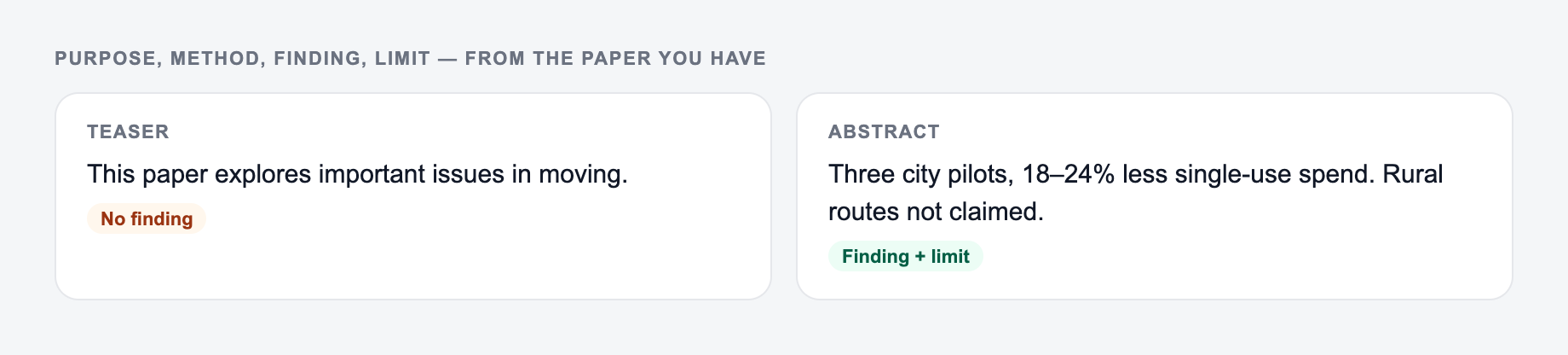
Structured IMRaD
Choose this for empirical research, STEM papers, medicine, psychology, engineering, and many thesis abstracts. The generator will separate the draft into familiar sections like background, objective, methods, results, and conclusion. This is the safest option when reviewers expect a clear research sequence.
Unstructured Abstract
Use this when the venue wants one paragraph without labels. The generator still follows the same logic, but it blends the parts into a cohesive academic paragraph. Add a word limit so the output does not become too expansive.
Conference Abstract
Pick conference mode when novelty and contribution matter most. Include the audience, track, theme, or submission category if you have it. The generated abstract should make the research gap and contribution obvious quickly.
Proposal or Study Plan
Use this for grant applications, preregistrations, internal approvals, and studies that are not finished. The generator should avoid completed-results language and focus on what the study will do, why the design makes sense, and what the expected contribution is.
Example Input, Output, and Edit Notes
Input notes:
Topic: Remote work and software team productivity.
Method: Survey of 420 engineers plus interviews with 24 team leads.
Finding: Hybrid teams reported faster focus work but slower cross-team decisions.
Discipline: Information systems.
Word limit: 150.
Enter only methods and findings you have. The form cannot invent a result.
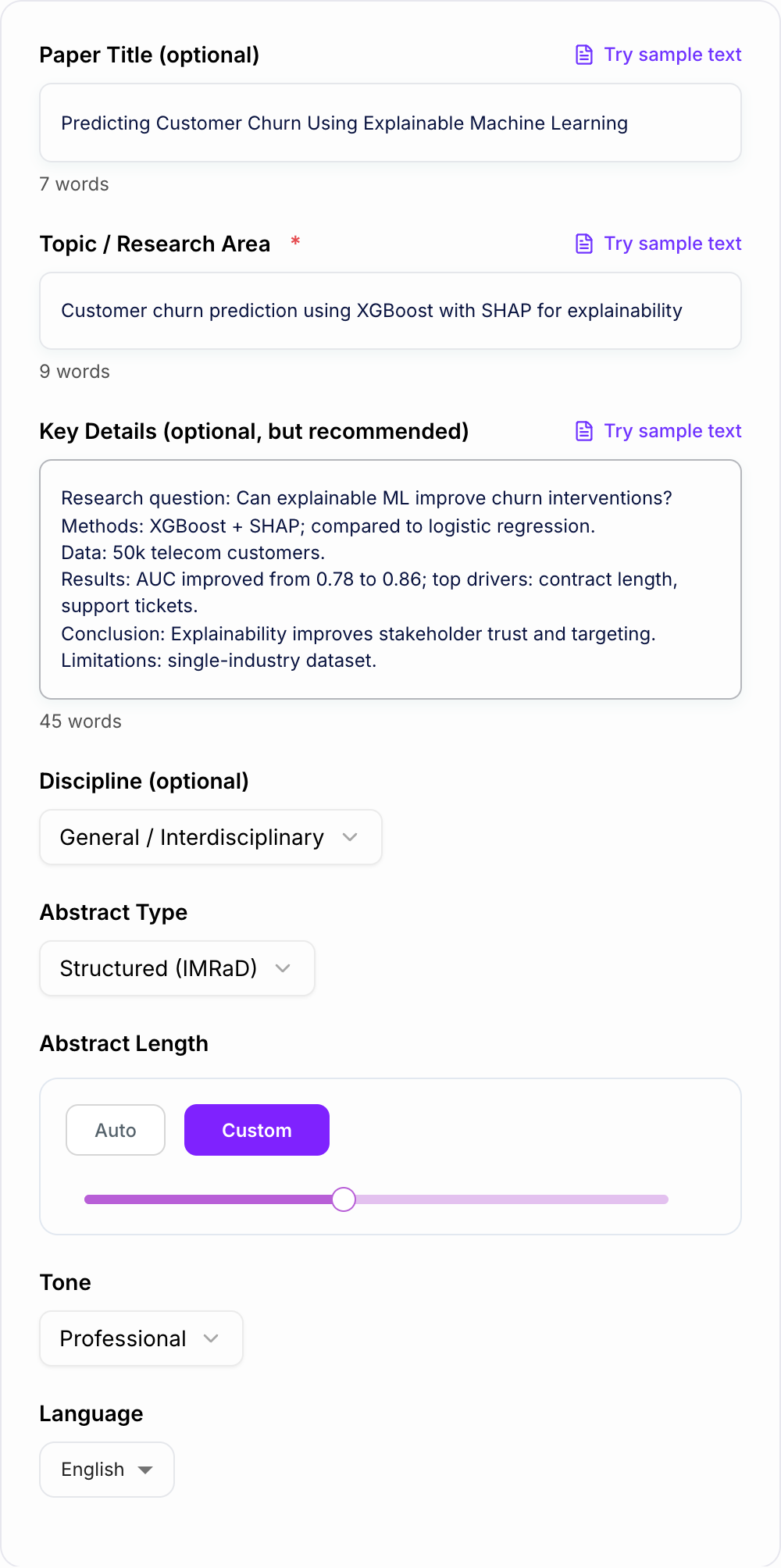
Use the AI Abstract Generator to get a shape on the page. Then do the slow part: open the source, check the number, and cut unsourced certainty.
If the task is graded, cited, or used with students, the named writer still owns the claims.
Generated abstract direction:
The abstract should mention the productivity tradeoff, the mixed-method design, the sample, the focus-work finding, the coordination drawback, and the practical implication for hybrid team policy.
What to edit before using it:
Check that the generator did not overstate causation, invent p values, or make "remote work improves productivity" sound broader than your data supports. If the study is correlational, keep the conclusion careful.
How to Review an AI-Generated Abstract
Answer these before you generate a second batch. A reroll will not fix a vague brief.
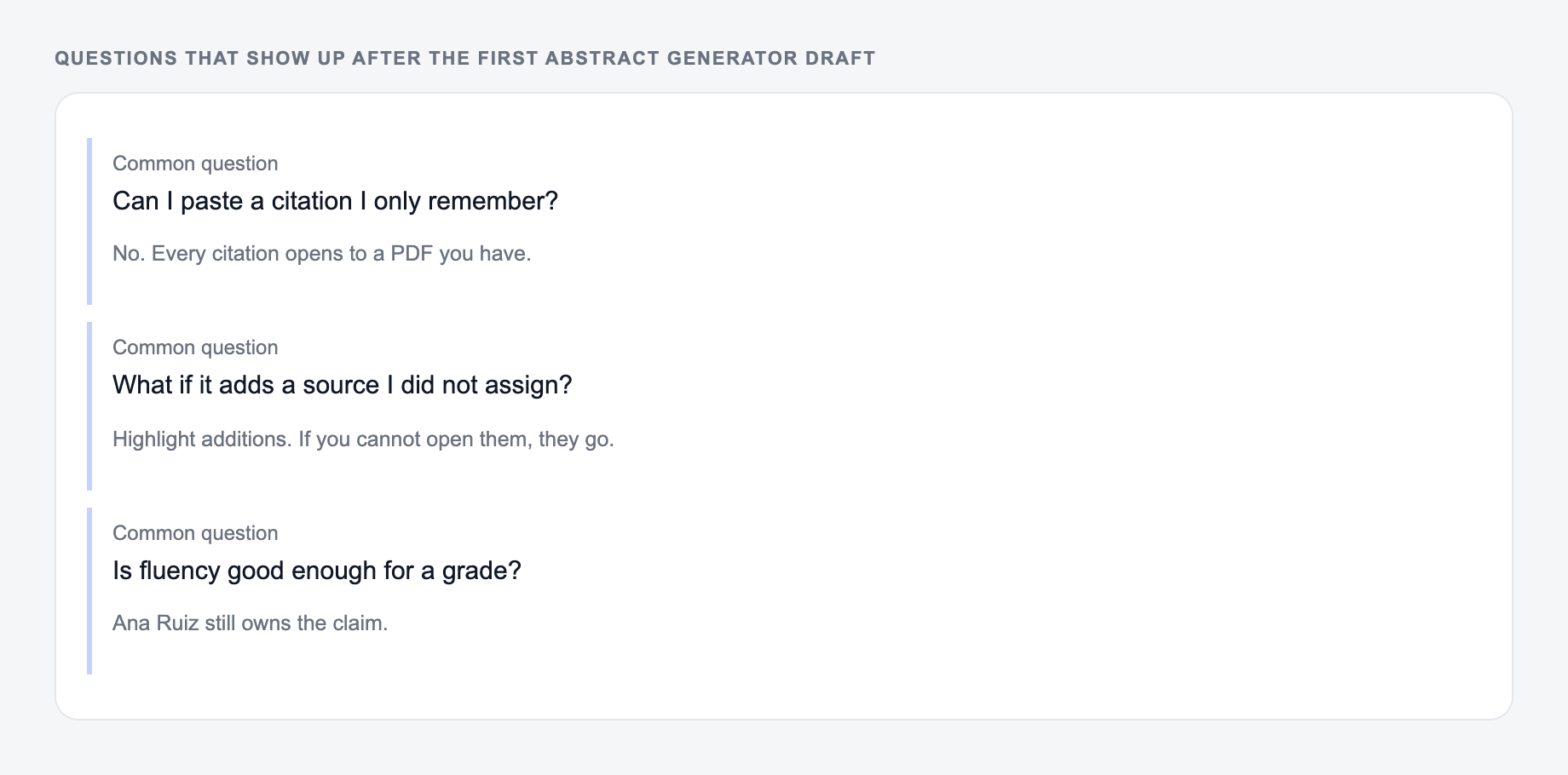
Before you copy the result into a submission form, run a quick integrity pass.
- Facts: sample sizes, methods, datasets, names, and numbers match the paper
- Claims: the conclusion does not go beyond the evidence
- Results: no findings were invented or made more precise than your notes
- Venue fit: the word count, headings, and tone match the journal or conference rules
- Discipline language: key terms sound natural for your field
- Balance: the abstract is not all background with one thin sentence on methods or results
The abstract generator gets the structure moving. Your job is to make sure every sentence is defensible.
How to Improve Weak Abstract Output
If the draft feels generic, the input is usually missing something important.
- Add the actual method instead of writing "we analyzed the issue."
- Add the main result instead of writing "results are discussed."
- Add the population, dataset, material, or context.
- Add a target word count.
- Add the venue type: journal, thesis, dissertation, proposal, or conference.
- Add phrases the abstract must avoid, such as "proves," "revolutionary," or "significant impact" if you cannot support them.
If you are using the generator as part of a larger drafting workflow, Junia AI can also help refine tone, expand supporting sections, and rewrite awkward academic phrasing after the abstract draft is in place.
Accuracy caveats:
Final Checklist Before Submitting the Abstract
Use the generated abstract only after it passes these checks:
- The first sentence sets up the research problem without wasting space.
- The objective is explicit.
- The method is specific enough for a reviewer to understand the study design.
- The results are concrete when results exist.
- The conclusion is useful but not inflated.
- The abstract follows the required structure and word limit.
That is the right role for an AI abstract maker: turn your research notes into a strong draft, then help you refine it into a version that is accurate enough to submit.
Frequently Asked Questions
What is an abstract generator?+
An abstract generator creates a concise summary of a research paper, thesis, or proposal. It typically includes the research problem, objective, methods, key results, and conclusion—formatted for academic writing.
Can I generate a structured abstract (IMRaD)?+
Yes. Choose Structured (IMRaD) to generate Background, Objective, Methods, Results, and Conclusion sections. This is common in STEM fields, medical research, and many journals.
Do I need to paste my whole paper?+
No. You can generate an abstract using just a topic, but you’ll get the best results by adding key details (research question, methods, data, findings, and conclusion).
Will the tool invent results or statistics?+
It’s designed to avoid fabricating results. If you don’t provide findings, it will use careful wording (for example, expected outcomes) rather than making up numbers, p-values, or claims.
What length should my abstract be?+
Many journals and conferences require 150–250 words, but requirements vary. Use the word count control to match submission guidelines (for example, 200 or 250 words).
Is this abstract generator suitable for thesis and dissertation abstracts?+
Yes. Add your objectives, methods, key results, and contribution. The generator will produce a clear, formal abstract suitable for thesis or dissertation requirements.