
Free Advertisement Copy Generator
Generate advertisement copy for search, social, display, and short-form video campaigns. Add your product, audience, offer, and differentiators to create sharper hooks, headlines, descriptions, CTAs, and variations you can test across Google, Meta, LinkedIn, TikTok, and YouTube.
Ad Copy Variations
Your ad copy variations (headlines, primary text, CTAs, and platform-specific formats) will appear here...
How the AI Advertisement Copy Generator Works
Get results in seconds with a simple workflow.
Enter Your Product and Pick a Platform
Add what you’re advertising and choose a platform like Google Search, Facebook/Instagram, LinkedIn, or TikTok so the generator can follow the right ad format.
Add Offer, Audience, and Benefits (Optional)
Optionally include your offer (trial/discount), target audience, and key value props. These inputs help the AI write more relevant, higher-converting ad copy.
Generate Variations and A/B Test
Get multiple ad copy variations with different angles and CTAs. Test top performers, then iterate by refining benefits, adding proof points, and aligning copy with your landing page.
See It in Action
Example of turning a generic ad into platform-ready, benefit-led advertisement copy with clearer positioning and a stronger CTA.
Try our scheduling software. It’s easy to use and helps your business. Sign up today.
Headline: Stop the Scheduling Back-and-Forth Primary Text: Book meetings in seconds with an AI scheduler that syncs to your calendar, sends reminders, and reduces no-shows. Save hours every week and keep your day on track. CTA: Start Free Trial
Why Use Our AI Advertisement Copy Generator?
Powered by the latest AI to deliver fast, accurate results.
Platform-Specific Ad Formats (Google, Meta, LinkedIn, TikTok)
Generates ad copy tailored to major advertising platforms—like Google Search headlines/descriptions, Meta primary text + headline, and LinkedIn intro text—so your message fits the placement and character expectations.
Conversion-Focused Messaging (Benefits, Objections, CTA)
Creates clear, benefit-led ad copy designed to drive clicks and conversions, with strong calls-to-action and optional objection-handling phrasing (risk reversal, guarantees, ease-of-use).
Multiple Variations for A/B Testing
Outputs multiple ad copy variations with distinct angles (pain point, outcome, feature-to-benefit, social proof) to support split testing and reduce ad fatigue.
Audience and Intent Alignment
Adapts language for your audience (job role, industry, or persona) and campaign goal (awareness, traffic, leads, sales) to improve relevance and click-through rate.
Brand-Safe, Claim-Aware Copy
Avoids inventing statistics or unverifiable claims. If you provide proof points (ratings, numbers, guarantees), it weaves them in naturally while staying compliant and realistic.
Pro Tips for Better Results
Get the most out of the AI Advertisement Copy Generator with these expert tips.
Match your ad copy to the landing page headline
Keep message match strong: reuse the same promise and key terms from the ad in your landing page headline to improve conversion rate and Quality Score (for Google Ads).
Test one variable at a time (hook, offer, or CTA)
For cleaner learnings, run A/B tests where only one element changes—like the opening hook or the offer—so you can identify what actually improves CTR and CVR.
Lead with outcomes, not features
Turn features into benefits (what the user gets). For example: “Automated reminders” becomes “Fewer no-shows and more revenue.” Outcome-led copy often performs better in paid ads.
Use specificity to boost credibility
If you have real proof points (rating, number of customers, time saved), include them. Specific claims can improve trust—just avoid exaggeration or unverified stats.
Write for the scroll
For social ads, keep the first line punchy and value-dense. Use short sentences and avoid long intros so the benefit is visible before the “see more” truncation.
Who Is This For?
Trusted by millions of students, writers, and professionals worldwide.
Create Test-Ready Ad Copy with an AI Advertisement Copy Generator
This AI Advertisement Copy Generator turns your product, audience, offer, benefits, and CTA into platform-ready ad copy variations. Use it to get sharper hooks, clearer headlines, stronger descriptions, and more angles to test across search, social, B2B, and video campaigns.
The tool works best when you give it campaign context. Generic inputs create generic ads. Specific inputs create copy you can actually compare, edit, and launch.
What to Enter into the Ad Copy Generator
Give the generator the same details you would give a copywriter before a campaign.
- Product or offer: what you are promoting
- Target audience: who should care
- Platform: Google Search, Meta, LinkedIn, TikTok, YouTube, or another channel
- Primary benefit: what changes for the user
- Differentiator: why this offer is not interchangeable
- Proof point: rating, customer count, case result, guarantee, or certification if true
- CTA: start a free trial, book a demo, get the checklist, claim the offer, or compare plans
- Avoid list: words, claims, tones, or phrases the copy should not use
Example input: "AI scheduling software for small clinics. Audience: dental office managers. Benefit: fewer no-shows. Differentiator: automatic reminders and calendar sync. CTA: Book a demo. Avoid hype."
Choose the Right Platform Mode
Each platform needs a different kind of output, so choose the mode before generating.
Google Search Ads
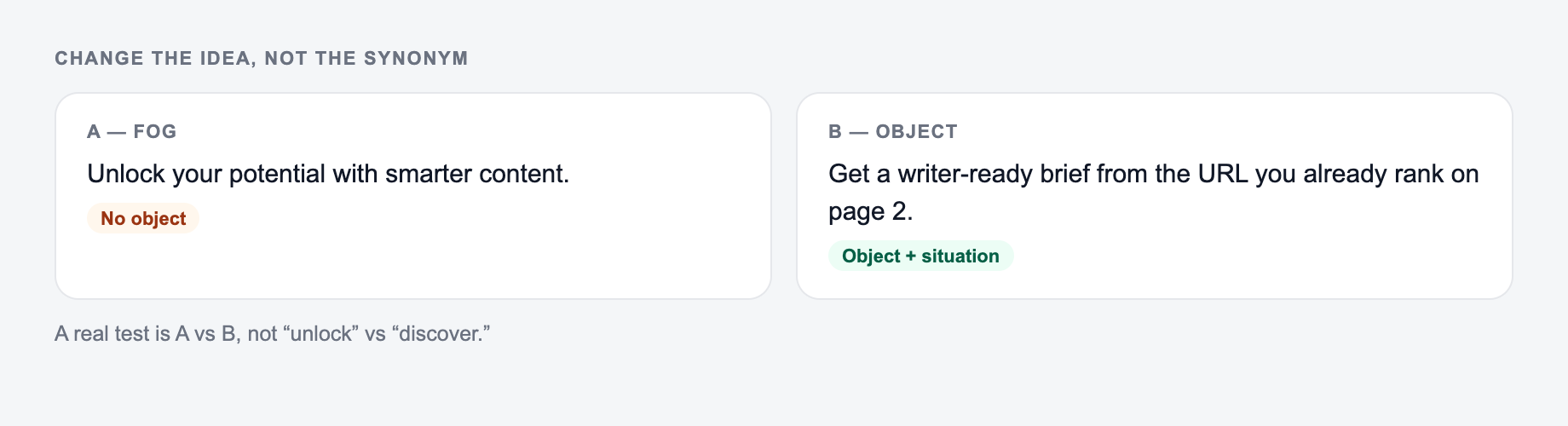
Use this for high-intent search traffic. The generator should create concise headlines and descriptions that match the searcher's problem and the landing page promise. Review character limits and make sure the copy does not drift away from the keyword intent.
Facebook and Instagram Ads
Use Meta mode for feed copy, hooks, primary text, headlines, and CTAs. The first line matters most. Give the tool the audience's pain point, desire, or objection so it can generate scroll-stopping variations without turning the ad into empty hype.
LinkedIn Ads
Use LinkedIn mode for B2B campaigns, demos, audits, reports, webinars, and lead magnets. Keep claims grounded. The generated copy should make the audience, business problem, and offer obvious fast.
TikTok and YouTube Scripts
Use video mode when you need a spoken hook and short script. Add the visual setup if you know it. The output should sound like something a person can say on camera, not a brochure paragraph.
A/B Test Variations
Use variation mode when you want different angles: pain-led, outcome-led, proof-led, offer-led, or objection-led. Test one major idea at a time so you know what actually changed performance.
Example Input, Generated Direction, and Edit Notes
Input: AI scheduling software for small clinics that reduces no-shows with automated reminders. Audience: dental office managers. CTA: Book a demo. Platform: Google Search.
Generated direction to expect:
- Headlines around fewer no-shows, easier scheduling, and clinic-ready reminders
- Descriptions that mention automated reminders and calendar sync
- CTA language built around booking a demo
What to edit before launch: Check every claim. If you have not proven "reduces no-shows by 30%," do not run that line. Use "reduce no-shows" or add the real number you can support.
How to Avoid Generic AI Ad Copy
If the generated copy sounds like every other ad, add better constraints.
- Replace "great software" with the real use case.
- Replace "business owners" with the exact audience.
- Replace "save time" with the task or amount of time.
- Add the offer and CTA.
- Add what the ad must avoid: "do not use revolutionary, best-in-class, or game-changing."
- Add the landing page angle so the ad and page match.
If you are already building writing and marketing workflows in Junia AI, keep the same product positioning across your ads, landing pages, emails, and supporting content so the message does not fragment.
Review the Generated Copy Before Running Ads
Answer these before you generate a second batch. A reroll will not fix a vague brief.
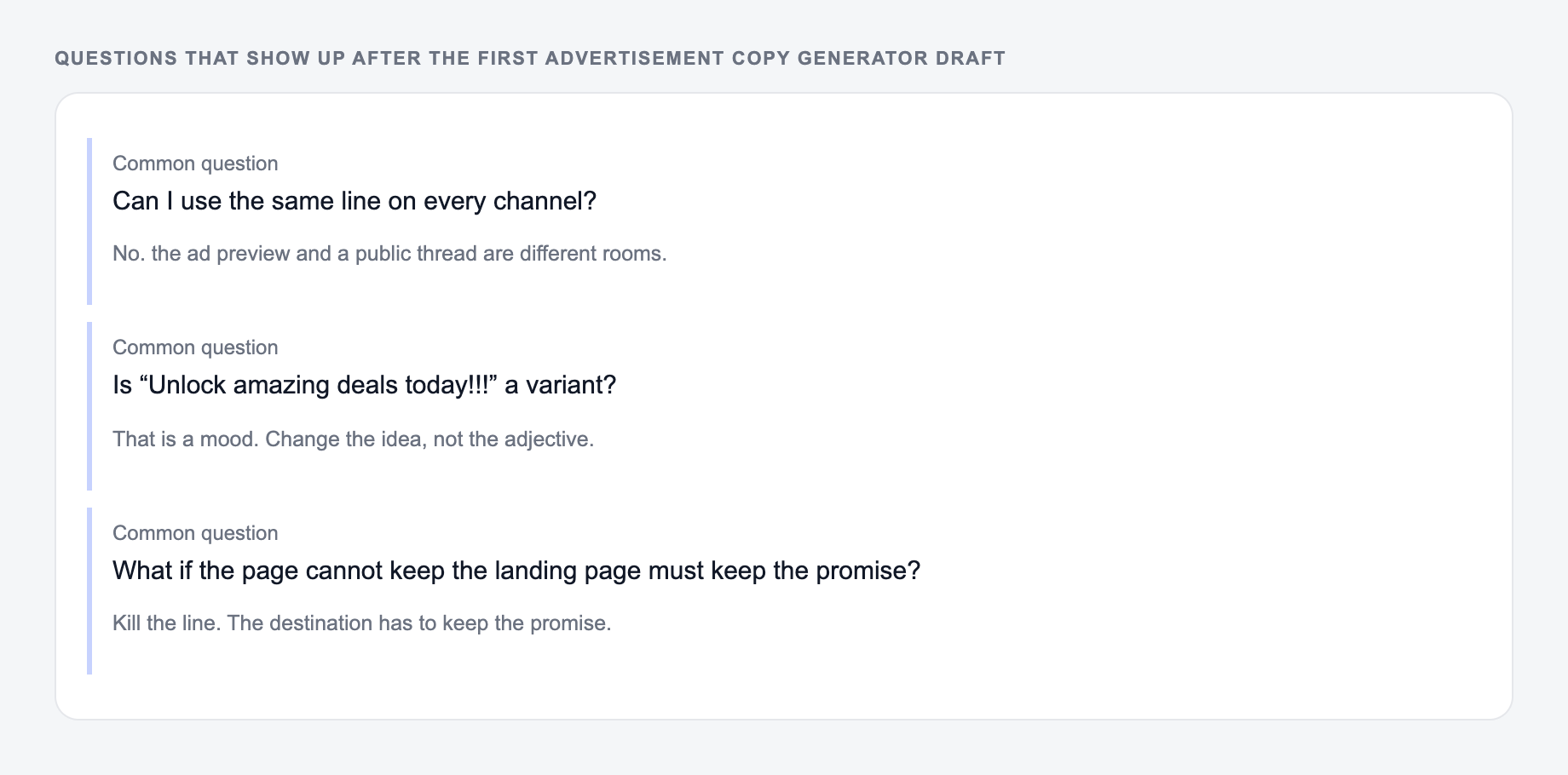
Do not launch AI-generated ad copy without a compliance and accuracy pass.
- Claims are true and supportable.
- Discounts, guarantees, prices, and deadlines are current.
- The CTA matches the landing page.
- The platform tone is appropriate.
- The ad does not imply personal attributes in a way the platform may reject.
- The copy does not promise a result you cannot control.
- The headline and description fit character limits where required.
This review is especially important for health, finance, legal, employment, housing, supplements, and other regulated or sensitive categories.
How to Use Generated Variations for Better Testing
Generate multiple versions, but test them with discipline.
- Compare different hooks only if the offer stays the same.
- Compare different CTAs only if the headline stays mostly stable.
- Keep the landing page consistent while testing ad copy.
- Save winners and generate new variations from the winning angle.
- Label each variation by strategy, not just "Version 1" and "Version 2."
That makes the generator useful beyond the first draft. It becomes a way to build a testable ad copy library.
Final Checklist Before Publishing
Discard pile:
- Fake urgency with no date you will honor
- Personalization tokens that resolve empty
- A line a competitor could paste without lying less than you
Before you use the generated ad copy, confirm:
- The audience is clear within seconds.
- The offer is obvious.
- The benefit is specific.
- The proof is real.
- The CTA fits the funnel stage.
- The copy matches the platform and landing page.
That is the right role for an AI ad copy generator: create strong, varied drafts quickly, then help you choose and refine the versions worth testing.
Angle Card: Hypothesis, Proof, Disqualifier
Label each generated variant with a testable idea, not “Version A.”
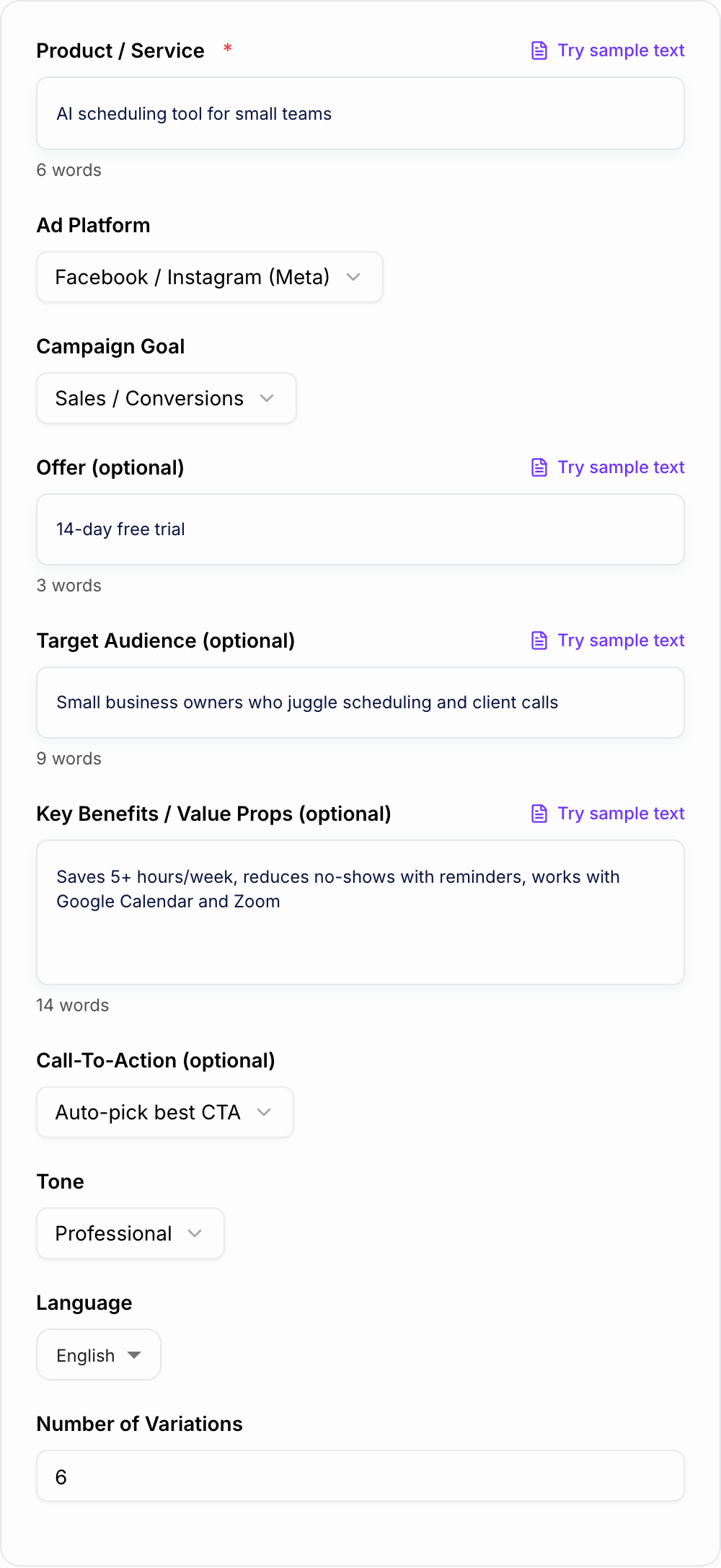
Offer, proof, and who should not click belong on the form before you generate ad lines.
Discard pile for AI Advertisement Copy Generator drafts:
- Fake urgency with no date you will honor
- Personalization tokens that resolve empty
- Claims a competitor could paste without lying less than you
| Label | Hypothesis | Needs on the landing page | Disqualifier |
|---|---|---|---|
| Time | “Setup is the objection” | Minutes-to-first-result, not slogans | Teams who need procurement |
| Proof | “Risk is the objection” | Named example or policy | Anyone you cannot show |
| Offer | “Price is the objection” | Exact trial or plan language | Fake deadlines |
Worked input: scheduling tool for solo therapists. Time variant: “Book returning clients in two clicks.” Proof variant: only if a screenshot or workflow exists. Offer variant: “Start on the free plan” only if that plan exists. Reject “#1 trusted by thousands” unless you can substantiate it under ad policy.
Change one meaningful idea per test. CTR without conversion is not a win.
Frequently Asked Questions
What does the AI Advertisement Copy Generator create?+
It generates advertisement copy variations tailored to your chosen platform—such as Google Search headlines/descriptions, Meta (Facebook/Instagram) primary text + headline, and LinkedIn intro text—focused on benefits, clarity, and conversion.
Is this ad copy generator free to use?+
Yes. You can generate ad copy for free. Some advanced modes (like social proof, urgency, or strict brand-voice matching) may be marked as premium.
Can it write ad copy for Google Ads and Facebook/Instagram?+
Yes. Choose the platform and the tool will format output for common ad placements, including Google Search ads and Meta ads with primary text, headlines, and CTAs.
Will the tool guarantee higher conversions or ROAS?+
No tool can guarantee performance. Results depend on your offer, targeting, creative, landing page, competition, and budget. Use the generated copy as a starting point and A/B test multiple angles.
How do I avoid generic AI ad copy?+
Add specifics: your audience, differentiators, proof points (reviews, numbers), and a concrete offer. The more real details you provide, the more unique and persuasive the ad copy becomes.
Does it include compliant, non-misleading claims?+
It’s designed to avoid inventing statistics or guarantees. If you need strict compliance (health, finance, housing, regulated industries), review the final copy against platform policies and legal requirements.