
Free Book Title Generator
The AI Book Title Generator creates compelling title ideas for fiction and nonfiction books based on genre, tone, audience, theme, and publishing goal. Explore subtitles, hooks, and series-ready naming concepts that feel clear, memorable, and publishable.
Book Title Ideas
Your book title ideas will appear here...
How the AI Book Title Generator Works
Get results in seconds with a simple workflow.
Describe Your Book Premise
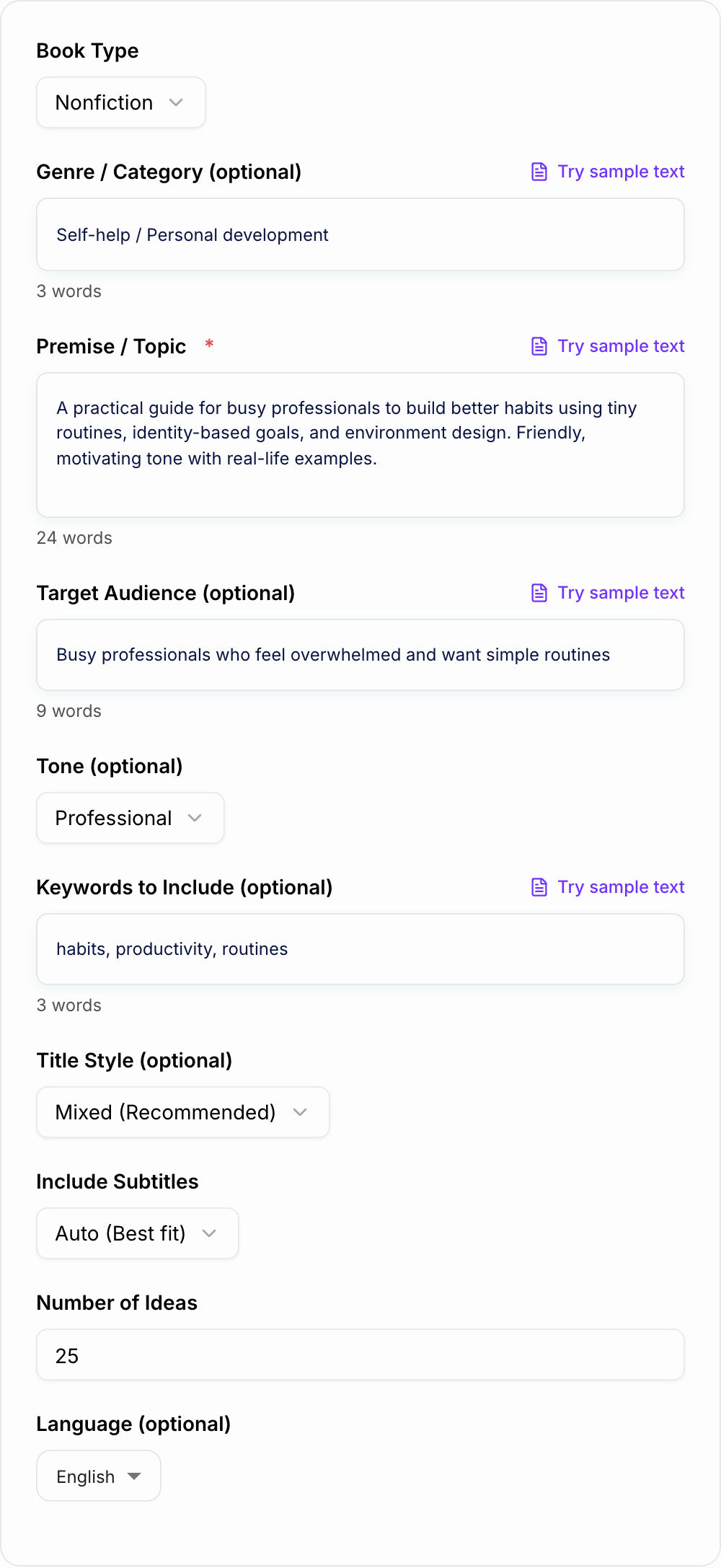
Add a short summary of what the book is about. For best results, include the topic, who it’s for, the transformation/promise, and any key themes.
Choose Book Type, Genre, and Style
Select Fiction or Nonfiction and optionally add genre, tone, and title style (short, descriptive, clever, emotional). This helps the generator match common reader expectations in your category.
Generate, Shortlist, and Refine
Generate a list, shortlist your favorites, then refine by adding keywords or a clearer audience. Finally, research availability and test top candidates with readers before publishing.
See It in Action
Example of turning a rough working title into market-ready book title ideas with stronger positioning and subtitle options.
Working title: Habits Book
Topic: building habits for busy people
Title ideas:
- Tiny Habits, Big Results
- The Busy Person’s Habit Blueprint
- The Routine Reset
- Make It Automatic
- Better Days by Design
Nonfiction title + subtitle options:
- Tiny Habits, Big Results: A Practical System for Busy People to Build Routines That Stick
- The Routine Reset: Simple Daily Habits to Reduce Overwhelm and Get More Done
- Make It Automatic: How to Build Better Habits with Small Changes That Last
Why Use Our AI Book Title Generator?
Powered by the latest AI to deliver fast, accurate results.
Fiction & Nonfiction Book Title Ideas
Generate book titles for novels and nonfiction books with genre-appropriate phrasing, clear positioning, and strong reader appeal—ideal for Amazon KDP, traditional publishing, and content creators.
Subtitle Suggestions for Nonfiction (SEO-Friendly)
Get subtitle options that clarify the promise and audience (e.g., “A Practical Guide to…”), improving discoverability and keyword relevance for online listings without sounding spammy.
Genre-Aware Hooks and Naming Patterns
Produces titles that match common patterns in your category—thriller tension, fantasy wonder, romance emotion, business authority—so your book feels instantly “right” to the target reader.
Keyword & Theme Integration (Natural, Not Stuffed)
Optionally weave in your core themes or keywords to strengthen clarity and search alignment while keeping titles readable, memorable, and brandable.
Series-Ready Options and Variations
Generate consistent variations that work across sequels or installments, helping authors build a recognizable series identity and cohesive bookshelf presence.
Pro Tips for Better Results
Get the most out of the AI Book Title Generator with these expert tips.
For nonfiction, lead with a clear promise
Titles that communicate the benefit (what the reader will achieve) often convert better. Use the subtitle to specify the audience, timeframe, or method without making unrealistic claims.
Signal the genre quickly for fiction
A great fiction title hints at tone and genre (mystery, romance, fantasy). If readers can’t instantly categorize the book, it can hurt click-through on store listings.
Make it easy to say, easy to remember
Avoid tongue-twisters and overly long phrases. Read your title out loud and try to recall it after 10 minutes—memorability is a competitive advantage.
Use a consistent naming pattern for series books
A recognizable pattern (structure, motif, or keyword) increases series cohesion and helps readers instantly identify related books—especially important for Kindle series.
Validate with real search and competitor checks
Search Amazon and Google for your top titles. If results are crowded with a famous book or many near-identical titles, consider a distinct twist while keeping genre signals intact.
Who Is This For?
Trusted by millions of students, writers, and professionals worldwide.
Generate Book Titles That Fit the Reader, Genre, and Shelf
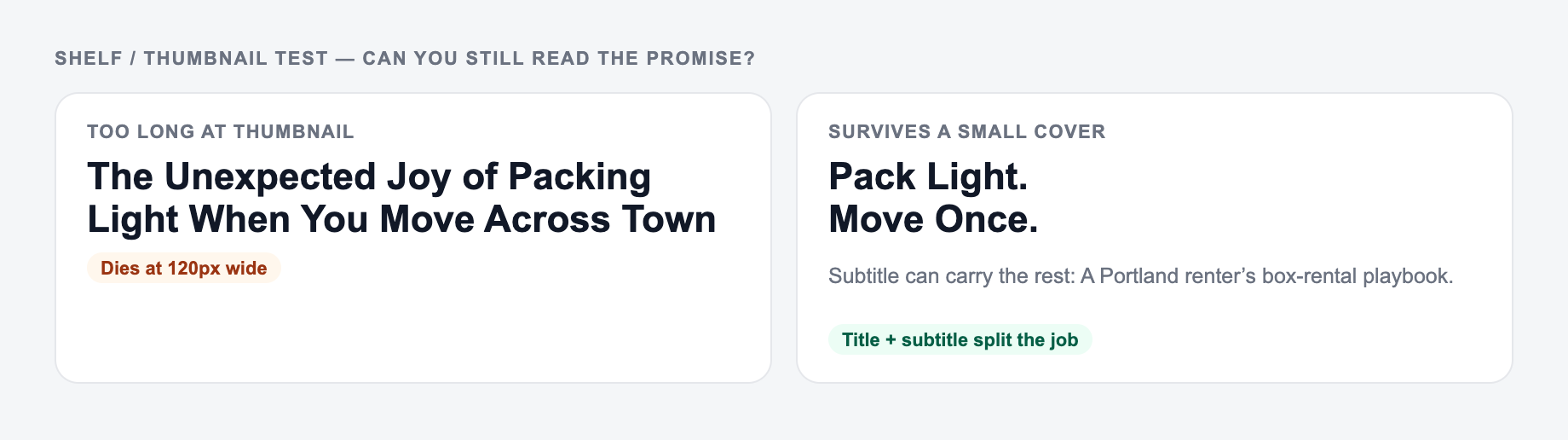
The AI Book Title Generator works best when you give it more than a vague premise. A strong title has to signal the category, create curiosity, and stay easy to remember at thumbnail size.
Use the generator to create a wide set of directions first. Then narrow the list by asking whether each title would make the right reader pause, click, or understand the book faster.
What to Enter Into the Book Title Generator
The more specific your input, the better the title ideas.
Include:
- the book's genre or category
- the central premise or promise
- the target reader
- the emotional tone
- important themes, motifs, or keywords
- title styles you like or want to avoid
For nonfiction, add the reader outcome. For fiction, add the main conflict, atmosphere, setting, or symbolic objects that matter to the story.
Choose the Right Title Mode
Use Fiction Titles when the title needs mood, imagery, and genre signal. This is useful for fantasy, romance, thrillers, literary fiction, horror, and other categories where vibe matters.
Use Nonfiction Title + Subtitle when clarity matters as much as memorability. The main title can be short and hooky, while the subtitle explains the audience, promise, and method.
Use Series Builder when you need a title pattern that can support multiple books. A repeating structure, motif, or rhythm helps readers recognize the series.
Use Marketable Shortlist when you already have options and want a smaller set with positioning notes.
How to Filter Generated Book Title Ideas
Most generated title batches will include a mix of strong, usable, and forgettable options. Keep titles that pass at least three of these checks:
- The genre or category is obvious.
- The title is easy to pronounce.
- It looks good as cover text.
- It creates curiosity without becoming vague.
- It is not too close to a famous existing title.
- It still makes sense without a long explanation.
- It can support a sequel or subtitle if needed.
If a title only works after you explain it, it probably needs another pass.
Use Subtitles to Make Nonfiction Titles Clearer
Nonfiction titles often need two jobs:
- the title creates interest
- the subtitle explains the reader, outcome, and method
A useful subtitle pattern is:
Outcome + Audience + Method
For example:
The Feedback Habit: Simple Conversations That Build Trust, Clarity, and Accountability
The title is memorable. The subtitle tells the reader what the book helps them do.
Validate Before You Commit
Before choosing a final title, do a quick check:
- Search the exact title on Amazon and Goodreads.
- Search it in quotes on Google.
- Check whether a dominant book already owns the phrase.
- Say the title out loud.
- Look at it in a small cover mockup.
The generator gives you options; validation keeps you from building a launch around a confusing or crowded title.
Refine the Best Ideas Inside Your Writing Workflow
Once you have a shortlist, paste the strongest five titles back into the generator and ask for closer variations. That second pass often produces the most publishable options because the tool has clearer taste signals.
You can also bring the final title into Junia AI to build matching subtitles, blurbs, author bios, outlines, and launch copy without losing the positioning you chose.
Thumbnail and Confusion Test
Suppose the nonfiction brief is “a practical guide to giving useful feedback on remote teams.” Three directions reveal different risks:
Think like a bookshop shelf: genre, the reader you want to catch, and whether the cover needs a subtitle.
- Clear Signals: memorable, but broad without a subtitle.
- The Async Feedback Habit: category-specific, but “async” narrows the readership.
- Feedback Without the Meeting: benefit-led and concrete, but may imply meetings are never useful.
Pair each with a subtitle, set it on a 120-pixel-high mock cover, and ask readers two separate questions: “What is this book about?” and “Who is it for?” Do not tell them the category first. Then run a confusion search across booksellers, library catalogs, general web results, domains, podcasts, and relevant trademarks. Similar or identical titles can exist, and title protection varies by jurisdiction; the generator does not provide legal clearance, so seek qualified advice for material brand risk.
For fiction, test genre signal without copying fashionable syntax. A title can be beautiful yet promise the wrong shelf. For a series, write three future titles using the same pattern; if the pattern breaks immediately, it is not truly series-ready.
Frequently Asked Questions
How does the AI book title generator work?+
You provide your book premise (and optionally genre, audience, tone, and keywords). The tool generates multiple title ideas that fit your category and positioning, and can include subtitles—especially helpful for nonfiction books.
Can this generate titles for fiction and nonfiction?+
Yes. Choose Fiction or Nonfiction, then add your genre and premise. Fiction titles focus on mood, intrigue, and genre signals; nonfiction titles often include a clearer promise and may add a subtitle for positioning.
Should I include keywords in my book title for SEO?+
For nonfiction, including a relevant keyword or theme can improve clarity and discoverability on platforms like Amazon and Google. For fiction, keyword stuffing is usually less important than memorability and genre fit—use themes naturally rather than forcing terms.
Will the generator check if a title already exists?+
No. You should research your shortlist on Amazon, Goodreads, and Google to avoid confusion with existing books. Similar titles can be okay, but you’ll want to consider uniqueness and branding.
What makes a good nonfiction title + subtitle?+
A strong nonfiction title is memorable and benefit-led, while the subtitle clarifies the promise, audience, or method (e.g., what the reader will achieve and how). The best combinations are specific, believable, and aligned with your category.
How many title ideas should I generate?+
Start with 20–30 ideas, pick 5–10 favorites, then generate another round using the same premise plus tighter constraints (tone, style, keywords). Iteration is the fastest way to get to a publishable title.