LoginGet Started

Business Plan Generator

Generate comprehensive business plans.

0/700 words

Optional

Results

Cat sitting on a rocket

Your Generated Business Plan Will Appear Here...

Junia AI’s Business Plan Generator helps you take rough ideas and turn them into clear, investor‑ready business plans in way less time than it usually takes. This free business plan generator is made to guide founders, startups, and small business owners from “idea on a napkin” to a polished, professional document you can share with investors, banks, accelerators, or internal stakeholders.

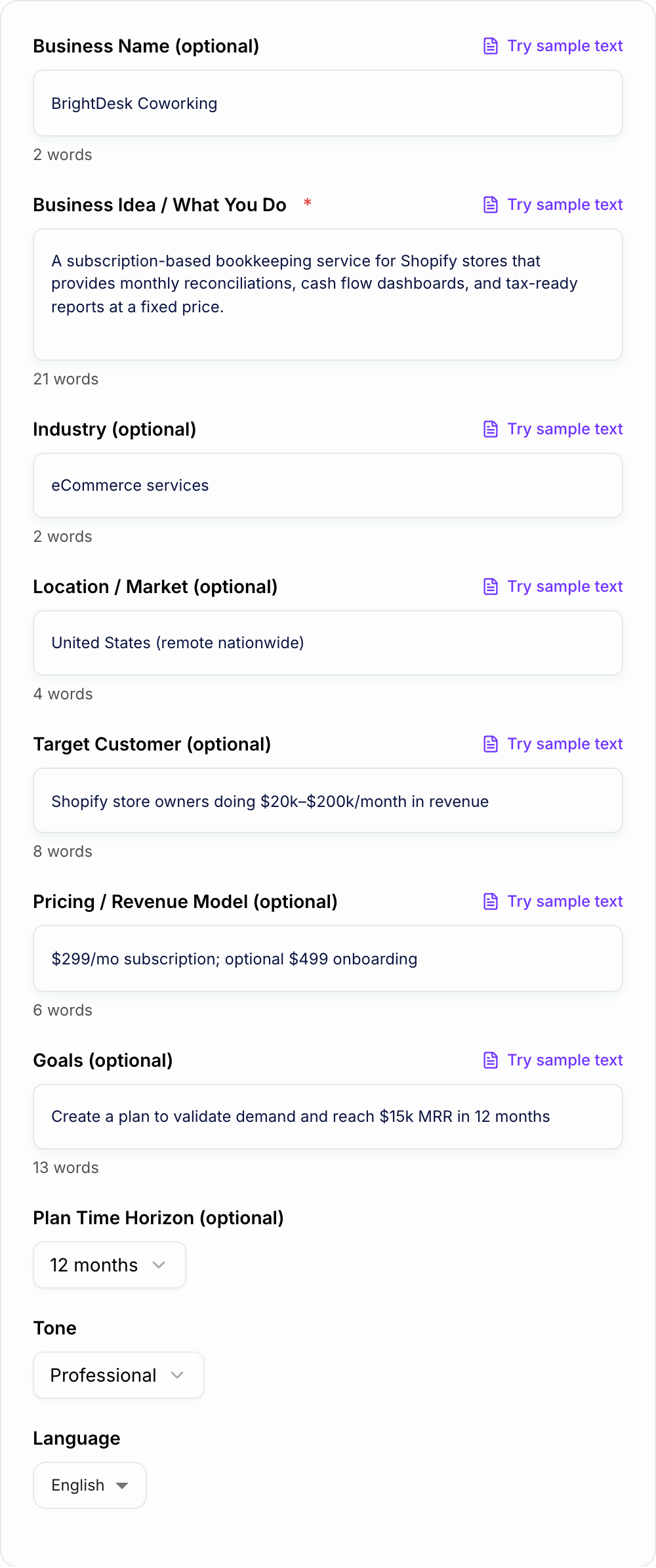
Instead of staring at an empty page or messing around with boring business plan templates, you just answer simple step‑by‑step questions about your:

  • Business model and value proposition
  • Target market and ideal customers
  • Revenue streams and pricing
  • Marketing, sales, and growth strategy
  • Operations and team structure
  • Funding needs and financial projections

Then the AI turns what you wrote into a structured, professional plan with all the standard sections that investors and lenders usually look for, including:

  • Executive summary
  • Company and product overview
  • Market analysis and competitive landscape
  • Target audience and positioning
  • Marketing and sales strategy
  • Operations and management
  • Financial plan and projections
  • Funding requirements and use of funds

Because it is a data‑driven, AI‑powered business plan generator, Junia AI can adapt the plan to your specific industry and stage, whether you’re starting a tech startup, opening a local restaurant, launching an e‑commerce store, or expanding an existing company.

What Is a Business Plan Generator?

A business plan generator is an online tool that helps you create a complete business plan automatically, without having to write everything from scratch. Instead of manually formatting documents and trying to remember what sections to include, you answer guided prompts and the software generates a professional business plan document for you.

Junia AI’s Business Plan Generator is an AI‑driven business plan creator that does more than just fill in a template. It:

  • Interprets your answers in natural language
  • Organizes them into a coherent, investor‑friendly structure
  • Adds context, explanations, and strategic recommendations
  • Refines language so it sounds clear, confident, and credible

Because it’s a free business plan generator tool, you can quickly test multiple ideas, experiment with different business models, and create different versions of your plan for different audiences (for example: investors vs. internal team) without extra cost.

People often search for terms like “AI business plan generator,” “online business plan maker,” “startup business plan generator,” or “free business plan creator.” Junia AI is designed to cover all of these use cases with one powerful, easy‑to‑use platform.

Why Use a Business Plan Generator?

Using a business plan generator like Junia AI saves time, reduces stress, and helps you create a more polished and persuasive document than if you were doing everything manually.

1. Save Time and Avoid Writer’s Block

Most people struggle with the blank page. A guided, AI‑based business plan maker asks targeted questions so you can just describe your ideas in your own words. The tool then does the heavy lifting of:

  • Structuring the content
  • Filling in standard sections
  • Ensuring all key components are included

This can cut the time to create a full, investor‑ready business plan from weeks or months down to hours.

2. Create Professional, Investor‑Ready Plans

Investors and lenders expect a certain level of detail and structure. An AI business plan generator understands those expectations and helps you:

  • Use the right terminology and tone
  • Present your market and financials clearly
  • Avoid obvious gaps or inconsistencies

You end up with a professional business plan that looks like it was prepared by someone with years of experience, even if this is literally your first time starting a business.

3. Improve Clarity and Strategy

Junia AI’s smart business plan generator doesn’t just rephrase your ideas, it actually improves them. Behind the scenes, it uses advanced language models and embedded business logic to:

  • Understand your industry and how you’re trying to position yourself
  • Spot missing details or weak explanations
  • Suggest new strategic ideas and possible opportunities
  • Make your value proposition clearer and more compelling

So your business plan becomes not just a document, but kind of a thinking tool that sharpens your strategy.

4. Keep Everything Consistent

When you write a business plan manually, it’s easy for assumptions and numbers to drift from one section to another. With an AI‑based business plan generator:

  • Tone and style remain consistent
  • Key assumptions are aligned across sections
  • Messaging stays coherent from start to finish

This is super important when potential investors read the plan closely and compare details across different parts of the document.

5. Integrate With Pitch Decks, Marketing, and SEO

Since everything lives inside the Junia AI ecosystem, you can instantly repurpose your business plan into:

  • Investor pitch decks
  • One‑page executive summaries
  • Website copy and landing pages
  • Marketing and sales collateral
  • SEO content and blog posts

Your story, messaging, and numbers stay aligned across every channel, making your startup or business look more credible and professional wherever people find you online.

What Is a Good Business Plan?

A good business plan is more than just a long document, it’s a clear, logical, and practical explanation of how your business will create value and generate profit. Strong business plans usually share a few key things.

1. Clear Problem and Solution

  • Explains the specific problem or need in the market
  • Describes your product or service as a concrete solution
  • Shows why this problem is important enough that customers will pay for a solution

2. Well-Defined Target Market

A well-defined target market is essential for any business looking to succeed. It means understanding who your ideal customers are, estimating the size and growth of your market, and explaining your niche and how you're positioning your brand.

Here are some key points to consider when defining your target market:

  • Identify who your ideal customers are: This includes demographic information such as age, gender, income level, and location, as well as psychographic factors like interests, values, and lifestyle.
  • Estimate the size and growth of your market: Research industry reports, government statistics, and other reliable sources to get an idea of how big your market is and how fast it's growing.
  • Explain your niche: What specific problem does your product or service solve? How is it different from what competitors offer? Understanding your niche will help you communicate your unique value proposition to potential customers.
  • Positioning your brand: Once you have a clear understanding of your target market and niche, think about how you want to position your brand in their minds. What message do you want to convey? What emotions do you want to evoke?

3. Strong Value Proposition and Differentiation

  • Clarifies what makes you different from competitors
  • Highlights unique advantages, features, or business model innovations
  • Communicates why customers should choose you over alternatives

4. Realistic Financials

A solid business plan includes realistic financial projections that show the potential profitability and sustainability of your business. Here are the key elements to include:

  • Revenue Forecasts: Provide detailed projections of your expected revenue over a specific period, like three to five years. Include info on pricing strategies, sales channels, and any expected changes in revenue streams.
  • Cost Estimates: Outline your expected costs, including both fixed and variable expenses. This should cover costs related to production, marketing, operations, and any other relevant areas. Be transparent about how you got these estimates.
  • Cash Flow Projections: Cash flow is crucial for the survival of any business. Include projections of your cash inflows and outflows so you understand your working capital needs and when you might need extra funding.
  • Clear Assumptions: Clearly state the assumptions behind your financial projections. This could include things like pricing strategies, conversion rates, customer acquisition costs, and market growth rates. Being open about your assumptions helps investors judge how realistic your projections are.
  • Path to Profitability or Sustainable Growth: Show a realistic path to profitability or sustainable growth in your financials. Investors want to see you have a well-thought-out plan for how you’ll reach financial success over time.

By including these elements in your business plan, you give potential investors a solid understanding of your financial outlook and increase their confidence in your business's ability to generate profits.

5. Concrete Go-To-Market and Growth Strategy

  • Outlines how you will attract, convert, and retain customers
  • Describes marketing channels and sales tactics
  • Defines milestones and key performance indicators (KPIs)

6. Credible Execution Plan

A strong business plan should include a detailed execution plan that explains how you will turn your ideas into reality. This section should cover the following key points:

  • Introduces the founding team and key roles
  • Describes operational processes, suppliers, and partners
  • Identifies main risks and how you’ll mitigate them

Junia AI’s online business plan generator is specifically optimized to help you create this kind of high‑quality, investor‑grade business plan, even if you’re not used to writing business documents or financial projections.

How to Write a Good Business Plan

Even with a powerful AI business plan generator, understanding how to write a good business plan helps you give the AI better inputs and get stronger outputs. Here’s a simple framework you can follow while using Junia AI’s tool.

1. Start With the Executive Summary (Last)

Although it appears first, the executive summary is usually easier to write last. With Junia AI:

  • Fill in details about your business, market, and financials first
  • Let the AI create a concise, compelling executive summary based on full context
  • Refine it to highlight your strongest points and key metrics

2. Clearly Define Your Business and Product

When answering prompts about your business:

  • Describe what you do in simple, non‑technical language
  • Explain your product or service from the customer’s point of view
  • Mention your current stage (idea, MVP, beta, revenue, growth, etc.)

The AI will then turn this into a well‑structured company overview and product description.

3. Explain Your Market and Customers

A strong market analysis helps investors see the opportunity. In the generator:

  • Outline your target customers (who they are, what they need, how they buy)
  • Indicate the size of the market and any trends you know
  • List your main competitors or alternatives customers use today

Junia AI will turn this into a detailed market analysis and competitive landscape section.

4. Describe Your Business Model and Revenue Streams

When the business plan creator asks how you make money:

  • Be specific about pricing, packages, or revenue sources
  • Mention if you’re subscription‑based, transactional, marketplace, etc.
  • Explain any upsell, cross‑sell, or recurring revenue opportunities

The AI can then build a clear narrative about how you generate revenue and why the model is scalable.

5. Outline Your Marketing and Sales Strategy

Good business plans show how you will reach and convert customers. In the prompts:

  • List the marketing channels you plan to use (SEO, ads, social media, partnerships, events, etc.)
  • Indicate your main acquisition tactics and sales funnels
  • Highlight anything unique about your brand positioning or messaging

Junia AI will transform this into a cohesive go‑to‑market and growth strategy section.

6. Provide Realistic Financial Assumptions

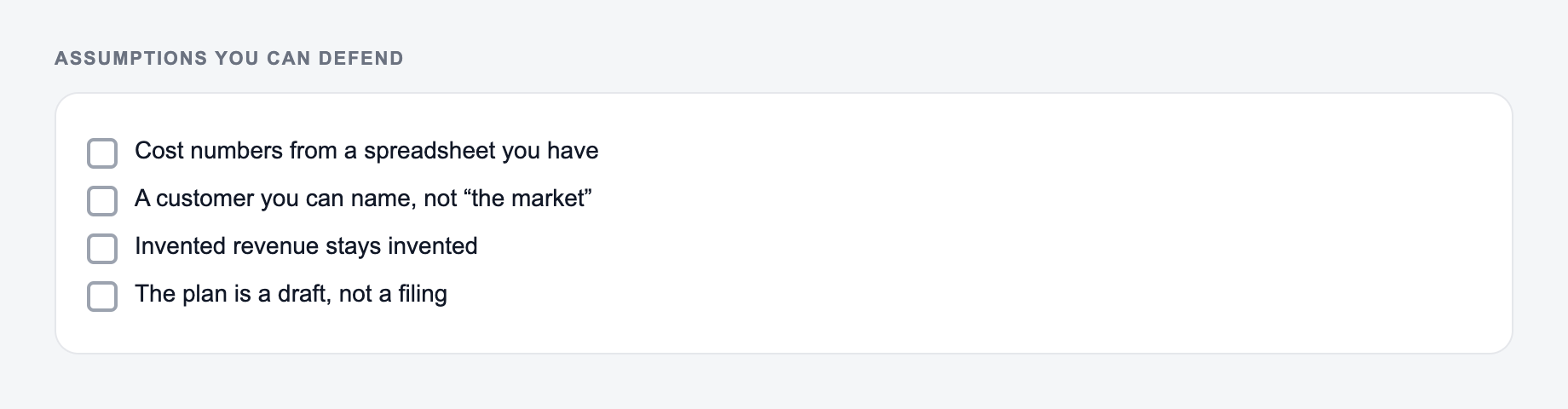
Financial projections don’t have to be perfect, but they should be reasonable. When using the free business plan generator:

  • Share rough numbers for pricing, expected conversion, and initial sales volume
  • Estimate your main costs (product, operations, marketing, staff, etc.)
  • Indicate how much funding you need and how you’ll use it

The AI can then assemble a more complete and investor‑ready financial plan with clear logic and narrative support.

7. Highlight Your Team and Operations

Investors care a lot about execution. In the tool:

  • Briefly describe the founders and key team members
  • Note any important experience, skills, or track record
  • Outline core processes (production, logistics, fulfillment, support, etc.)

The business plan generator will turn this into a polished team and operations section that builds confidence.


Behind the scenes, Junia AI uses advanced language models and business logic to:

  • Understand your industry and how you’re trying to position yourself
  • Suggest new strategic ideas and possible opportunities
  • Fix and improve weak parts with clearer and more convincing wording
  • Keep the tone, structure and basic assumptions steady and consistent through the whole document

Since it’s all inside the Junia AI ecosystem, you can quickly turn your plan into pitch decks, marketing materials, and SEO content, so your story basically stays the same and makes sense everywhere people see it.

You can use this free tool to go from just an idea to an investor‑ready business plan pretty fast, whether you’re testing out a new concept, trying to raise money, or growing a business you already have.

Use Cases

Discover how this tool can be used in various scenarios

  • Validating a New Business Idea

    Use the guided prompts to stress‑test your concept: define your target audience, clarify the problem you solve, map competitors, and outline revenue models. By the end, you’ll know whether the idea has legs or needs refinement.

  • Preparing for Investor Meetings

    Generate an investor‑friendly business plan that clearly explains your market opportunity, traction, and growth strategy. Then, spin off tailored versions for different investor profiles (VCs vs. angels vs. strategic partners).

  • Applying for Bank Loans or Grants

    Create formal, data‑driven plans that match what lenders and grant committees expect: clear cash‑flow projections, risk assessments, and concrete use‑of‑funds sections built into a polished document.

  • Planning for Business Expansion

    When opening new locations, launching new products, or entering new regions, use the tool to model scenarios, estimate required capital, and define go‑to‑market strategies—all within an updated master plan.

  • Repositioning or Pivoting a Startup

    If your current model isn’t working, quickly rebuild your business narrative around a new customer segment, pricing strategy, or product offering, while keeping the rest of your operational plan coherent.

  • Creating Pitch Decks and One-Pagers from Your Plan

    After generating your business plan, use Junia AI’s connected tools to turn its content into pitch decks, executive summaries, and one‑page overviews, ensuring every asset tells the same underlying story.

  • Aligning Teams and Stakeholders

    Share the generated plan with co‑founders, early hires, and advisors to align on goals, roles, and milestones. Update sections as you receive feedback, keeping a single source of truth for the business strategy.

  • Teaching and Training on Business Planning

    Educators and mentors can use the tool in workshops or classes to demonstrate real‑world planning, letting participants experiment with assumptions and instantly see how their choices affect the overall plan.

Benefits

Key Benefits of Junia AI’s Business Plan Generator

1. Save Significant Time

  • Make a full business plan in just a few hours instead of waiting around for weeks.
  • You don’t have to do all the boring manual formatting, structuring, or constant rewriting.
  • Let the AI handle the first drafts so you can actually focus on strategy and, you know, getting things done.

2. Produce Investor-Ready Documents

  • Get plans laid out in the style that VCs, angel investors, and banks are already used to reading.
  • You’ll see clear sections for the problem, the solution, the market, competition, financials, and how you’ll grow.
  • You can show a professional and steady story that makes people feel more confident in what you’re doing.

3. Gain Strategic Clarity

  • Answer focused prompts that make you really think about your market, pricing, and how you’ll make money.
  • Take a bunch of scattered ideas and turn them into a logical, kind of step by step, business model.
  • Spot gaps and risky assumptions yourself before investors point them out.

4. Ensure Consistent Storytelling

  • Keep your goals, numbers, and strategy all lined up from one part of the plan to the next.
  • Avoid weird contradictions between things like market size, pricing, and your financial forecasts.
  • Stick with one clear voice and message from the executive summary all the way to the appendix.

5. Lower the Barrier to Professional Planning

  • You don’t need an MBA, consulting experience, or fancy spreadsheet skills.
  • Complicated jargon gets turned into simple questions and normal, everyday language.
  • Really good for first time founders and business owners who aren’t super technical.

6. Integrate With Content and Pitch Creation

  • Use the same plan content again to make pitch decks, one pagers, and marketing copy.
  • Keep your website text, sales materials, and investor story saying the same thing instead of all over the place.
  • Run everything from one AI powered workspace so you’re not jumping between a bunch of tools.

7. Adapt as Your Business Evolves

  • Quickly update sections of your plan when your assumptions change or you learn something new.
  • Clone new versions for different types of investors or new funding rounds.
  • Treat the tool like a living planning system that grows with your business, not just a one time document.

Who's this tool for?

New Entrepreneurs and First-Time Founders

People with a business idea who need help structuring it into a clear, actionable plan. Junia AI walks them through each core section—market, product, revenue, and growth—so they don’t miss critical components that affect viability.

Startups Seeking Investment

Early‑stage and growth‑stage startups preparing to pitch VCs, angel investors, accelerators, or grant programs. They use the generator to create sharp, investor‑ready plans backed by coherent assumptions and realistic financial projections.

Small Business Owners Planning to Scale

Existing businesses exploring expansion into new markets, products, or locations. They rely on the tool to refine strategies, stress‑test scenarios, and produce plans suitable for bank loans or strategic partnerships.

Freelancers and Solopreneurs

Independent professionals turning their skills into structured businesses. The generator helps them clarify positioning, pricing models, and growth paths in a formal plan they can share with lenders, partners, or support programs.

Consultants, Coaches, and Advisors

Business consultants, startup mentors, and incubator program managers who need to help multiple clients create or refine plans quickly. They use Junia AI to accelerate drafting while still customizing strategy for each client.

Students and Educators in Business Programs

Business school students, MBA candidates, and instructors who need realistic business plans for projects, competitions, or coursework. The generator provides a professional structure while still allowing for experimentation and learning.

Nonprofits and Social Enterprises

Impact‑driven organizations that must present credible plans to grant makers, donors, and partners. Junia AI helps them align mission, impact metrics, and financial sustainability in a single, coherent document.

Why Choose Our Business Plan Generator?

Junia AI’s Business Plan Generator was made to close the gap between how professionals make business plans and how most entrepreneurs have to do it. They usually end up working alone, starting from scratch, and trying to finish everything while the clock is ticking.

Most planning tools kind of stop at giving you basic templates. We created Junia AI to feel more like a smart partner. It doesn’t just show you headings, it actually helps you think things through. The AI takes your rough ideas and turns them into a more organized story. It brings up strategic points you might not have thought about, and it helps keep your numbers and your main message lined up all the way through the document.

Junia AI first started out as a top AI writer for SEO and long form content, so those same strengths like clarity, good structure, and real depth are built into this planning tool too. So in the end you get a business plan that sounds like a consultant helped you write it, instead of something that was just auto filled in a random form.

We also made it as part of a bigger system. Your business plan shouldn’t just sit on its own. It should guide your pitch deck, your website copy, your marketing strategy, and your content roadmap. With Junia AI, you can move pretty smoothly from planning to actually doing stuff, using the same platform to create investor materials, sales content, and search optimized content that all supports your main strategy.

If you want a quick, accurate, and simple way to create serious, investor ready business plans, and you also want that plan to fuel the rest of your business content, then Junia AI’s Business Plan Generator is really made for you.

Frequently asked questions
  • Junia AI's Business Plan Generator is an online tool that uses artificial intelligence to help people make solid and professional business plans pretty fast and without a lot of hassle. It asks you specific questions about your business idea, your place in the market, and what you want to achieve with your finances, and then it turns all that information into a clean, ready to share document for investors. So yeah, it basically makes business planning something almost anyone can do, even if you do not have an MBA or anything like that.
  • Unlike simple templates that just give you the same fixed layout every time, Junia AI actually uses AI to look at what you put in and then shape the business plan around your own industry and business model. It comes up with ideas and strategies, and kind of pulls everything together into layouts that investors can understand more easily. It also works really well with other tools, like the ones for making marketing content, so you end up with this sort of all in one system for your business documents.
  • This tool works really well for lots of different people. Like, new entrepreneurs who are just trying to see if their idea actually makes sense, and startups that want to get investment and need proper plans with market research and financial forecasts and all that stuff. It also helps small business owners who are trying to grow and improve how they run things by tightening up their growth plans. The interface is pretty easy to use and it kind of fits people at any experience level, so you can still put together a detailed and actually useful business plan, even if you’re not very experienced.
  • Some of the main things it offers are a really easy to use interface that turns complicated business ideas into simple questions, AI that takes what you put in and turns it into professional looking documents, formatting that’s pretty friendly for investors, and it also works smoothly with Junia’s other content tools for marketing stuff and pitch decks. It also lets you update your plans on the fly as your business changes and grows over time.
  • Junia AI cuts down a lot of the time you’d usually spend on research, writing and formatting, because it kind of automates most of that stuff for you. Work that might take you weeks to do by hand can often be done in just a few hours with the generator’s guided prompts and its AI content creation. So yeah, it’s way more efficient and that means entrepreneurs can put more of their energy into actually working on and launching their business ideas, instead of getting stuck doing a bunch of paperwork all the time.
  • Yes, it does. The tool puts together clear plans that are based on real data, the kind of stuff investors usually want to see. It includes things like competitive analysis, revenue models, market research insights, and also pretty realistic financial projections. When you show a plan that’s organized and looks professional, and it fits what investors are actually looking for, it kind of boosts how serious and trustworthy you seem. This way you have a better chance of getting venture capital or loans, or at least getting them interested.