
Free Career Path Generator
Use the AI Career Path Generator to turn your background, interests, skills, constraints, and goals into a practical career roadmap. Generate realistic role options, skill gaps, learning priorities, portfolio project ideas, certifications, job-search keywords, and timeline-based next steps for career growth or a career change.
Career Path Plan
Your personalized career path roadmap will appear here...
How the AI Career Path Generator Works
Get results in seconds with a simple workflow.
Describe Your Starting Point (Optional)
Add your current role, skills, interests, and education—or leave fields blank if you’re exploring. Even minimal input works.
Choose Your Timeline and Preferences
Select how fast you want to move and share constraints like time, budget, remote-only preferences, or degree limitations so the plan stays realistic.
Generate a Career Path and Take Action
Get recommended roles, skill gaps, learning priorities, projects, and a step-by-step roadmap. Then validate with job postings and refine your plan.
See It in Action
Turn a vague goal into a structured, keyword-aligned career roadmap with roles, skills, projects, and next steps.
I’m not sure what career to choose. I want something stable and remote-friendly, and I’m open to learning new skills.
Recommended career paths (remote-friendly):
- Data Analyst (Business Intelligence)
- SEO Specialist / Content Strategist
- Customer Success Operations
Best-fit pick: Data Analyst (BI) Why it fits: analytical thinking, clear career ladder, remote roles common, measurable work.
Skill gaps to prioritize:
- SQL (joins, aggregations)
- Spreadsheet modeling (advanced formulas)
- BI tools (Power BI/Tableau)
- Data storytelling (insights + recommendations)
Roadmap (3–6 months):
- Weeks 1–2: SQL fundamentals + daily practice
- Weeks 3–6: Build 2 dashboards from public datasets
- Weeks 7–10: Portfolio case study + GitHub/Notion write-up
- Weeks 11–14: Resume keyword alignment + 30 targeted applications/week
- Weeks 15–24: Mock interviews + networking + iterate portfolio
Portfolio projects:
- SaaS retention analysis (cohort + churn insights)
- Marketing funnel dashboard (CAC, conversion rates)
Next steps (this week):
- Pick 10 target job posts, list recurring skills, and confirm tool stack.
- Start one portfolio project with clear deliverables.
Why Use Our AI Career Path Generator?
Powered by the latest AI to deliver fast, accurate results.
Personalized Career Path Recommendations
Generates multiple career path options based on your background, interests, and goals—helping you identify best-fit roles and realistic next steps.
Skill Gap Analysis + Priority Learning Plan
Highlights the most important skills for your target job and maps your current skills to role requirements, prioritizing what to learn first for faster progress.
Step-by-Step Roadmap With Milestones
Creates a structured career roadmap by timeline (30 days to 12+ months) with measurable milestones, weekly focus areas, and checkpoints you can actually follow.
Portfolio Projects and Practical Experience Ideas
Recommends resume-worthy projects, case studies, and hands-on tasks (with scopes and deliverables) to build credible experience—even without a degree.
Role Keywords and ATS-Friendly Guidance
Suggests relevant job keywords, tools, and responsibilities to align your learning and experience with common job descriptions and applicant tracking systems (ATS).
Pro Tips for Better Results
Get the most out of the AI Career Path Generator with these expert tips.
Copy keywords from real job descriptions
After generating, compare the plan to 10–20 job posts for your target role. Add recurring tools and keywords to your learning plan and resume for better ATS alignment.
Build proof, not just knowledge
Employers hire for evidence. Prioritize portfolio projects, measurable outcomes, and real artifacts (dashboards, writing samples, case studies, prototypes) over passive learning.
Use a “skills stack” approach
Combine a core skill (e.g., data analysis) with a domain (e.g., eCommerce or healthcare) and a communication skill (storytelling). This differentiates you in crowded job markets.
Set weekly milestones you can keep
A sustainable plan beats an ambitious one. Choose weekly goals that fit your schedule (e.g., 3 hours learning + 2 hours project work).
Validate the path with small experiments
Before committing, do a mini project, informational interviews, or a short course. Fast feedback reduces risk and clarifies what you actually enjoy.
Who Is This For?
Trusted by millions of students, writers, and professionals worldwide.
Build a Practical Roadmap with an AI Career Path Generator
A career path generator is most useful when it turns uncertainty into a plan you can test. It should not simply name a dream job. It should connect your background, interests, constraints, skills, and goals to realistic role options and next steps.
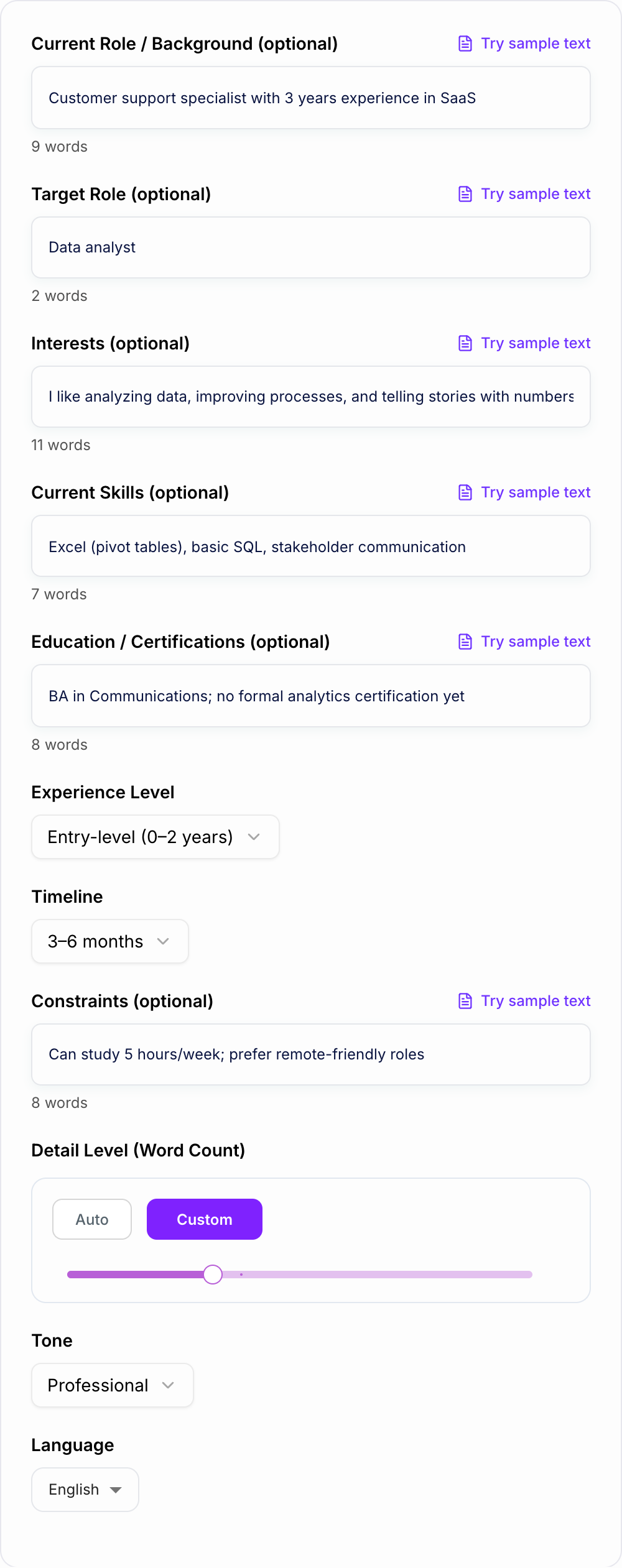
Use the AI Career Path Generator when you are exploring options, planning a career change, trying to level up, or turning early experience into a clearer direction. The output can include role recommendations, skill gaps, projects, certifications, job-search keywords, and a timeline you can actually follow.
What to Enter Into the Career Path Generator
Start with what you actually do, not just your title. Job titles can hide useful experience.
A weak input looks like this:
- "Customer support, want tech job"
A stronger input looks like this:
- "Customer support specialist with 3 years of experience writing help docs, handling bug escalations, tagging product issues, and creating spreadsheet reports. I like analysis, process improvement, and working with product teams. Remote preferred. I can study 5 hours per week."
Useful inputs include:
- current role and responsibilities
- education or training
- tools and skills
- work you enjoy
- work you want to avoid
- target industries or roles
- location, remote, budget, and time constraints
- timeline for changing roles
The more honest the input, the more usable the roadmap.
Choose the Right Career Planning Mode
Different career questions need different output.
Explore options
Use this when you are not sure what role fits. The generator should compare a few realistic paths, explain why each fits, and suggest low-risk ways to test them.
Career change roadmap
Use this when you want to pivot into a new field. The roadmap should focus on transferable skills, missing skills, proof projects, and a realistic timeline.
Level up current career
Use this when you want a promotion, more senior role, or adjacent move. The output should identify high-leverage gaps and projects that create visible proof at work.
Student or early career plan
Use this when you need entry-level role ideas, beginner projects, certifications, and portfolio steps without assuming years of experience.
Validate the Generated Career Path Against the Market
AI can organize your direction, but job posts show what employers currently ask for. After generating a roadmap, validate it with a quick market check.
- Find 10 job posts for the target role.
- Note repeated tools, skills, responsibilities, and keywords.
- Compare them with your generated roadmap.
- Move recurring requirements into your first 4 to 6 weeks of learning.
- Remove anything that sounds interesting but rarely appears in real listings.
This turns a generic career roadmap into a more hireable plan.
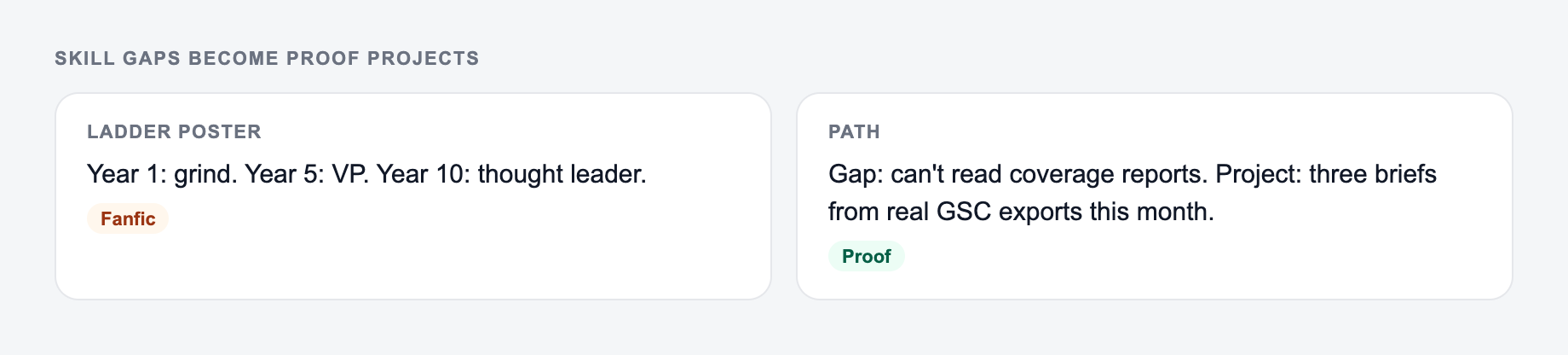
Turn Skill Gaps Into Proof Projects
A career plan is weak if it only lists courses. Hiring managers need proof that you can do the work.
Current skills and the target role belong on the form. Market claims still need a human check.
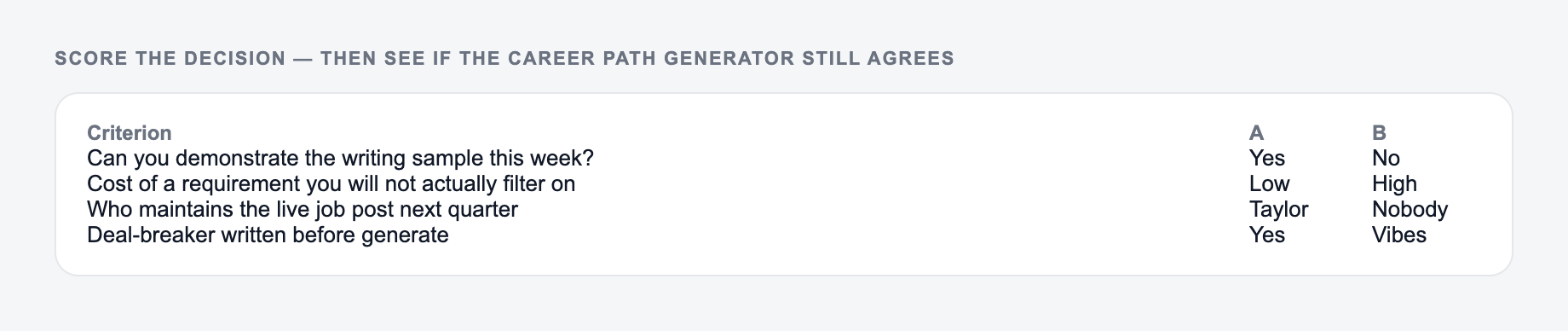
Limitations of a generated comparison:
- It will invent a “pro” you cannot demonstrate.
- It will hide a “con” you already know and did not type.
- Volume, “profit,” and “easy” are not evidence.
If a row cannot be verified this week, delete it before you share the ai career path generator output.
A longer list is not a better decision. Score what you will actually live with.
For each target role, ask the generator for one or two project ideas with deliverables. Good deliverables include:
- dashboards
- audits
- case studies
- writing samples
- prototypes
- campaign reports
- process maps
- research summaries
For example, someone moving from customer support into product operations could analyze 50 support tickets, group root causes, create a dashboard, and write a short recommendations memo. That project proves analysis, customer insight, communication, and operational thinking at the same time.
If you also need to update your resume or profile after choosing a path, the tools on the Junia AI homepage can help turn the same roadmap into job-focused summaries, bullets, and positioning copy.
How to Review the Generated Roadmap
Write the deal-breaker before you run the Career Path Generator. If that line would make you walk away, and the output still recommends the option, the scores are decoration.
Read the generated career path like a plan you will have to follow on a tired Wednesday night. If it assumes more time, money, or energy than you really have, edit it.
Check whether the roadmap includes:
- a clear target role or role family
- reasons the path fits your background
- prioritized skill gaps
- projects that create proof
- certifications only when they matter
- job-search keywords
- realistic weekly actions
- a timeline with milestones
A slower plan you can follow is stronger than an aggressive plan you abandon.
Common Career Path Generator Mistakes
The first mistake is entering only a dream role and leaving out constraints. A plan for full-time study should look different from a plan for 5 hours per week.
The second mistake is accepting too many role options. Use the generator to narrow choices, not expand them forever.
The third mistake is collecting courses without building anything. Learning should lead to proof.
The fourth mistake is ignoring real job descriptions. If the market repeatedly asks for SQL, GA4, Figma, HubSpot, or portfolio writing samples, your roadmap should reflect that.
Final Career Roadmap Checklist
If the recommended winner fails the deal-breaker, ignore the totals.
Before you follow a generated career plan, confirm that the target role is realistic, the first steps are specific, the skill gaps are prioritized, and each month creates visible proof.
The best career path generator output should leave you with a decision and a next action: what role to test, what skill to build first, what project to create, and how to check whether the path is still worth pursuing.
Frequently Asked Questions
Is this career path generator free to use?+
Yes. You can generate a personalized career path and roadmap for free. Some advanced modes (like resume/LinkedIn strategy or interview prep) may be marked as premium.
How does the AI career path generator personalize recommendations?+
It uses the information you provide—current background, target role, interests, skills, education, constraints, and timeline—to suggest roles, prioritize skills, and build a step-by-step plan tailored to your situation.
Can I use this tool even if I don’t know my target career yet?+
Yes. Leave the target role blank and describe your interests and strengths. The tool will suggest several career paths, explain why they fit, and provide next steps to validate each option.
Does the roadmap include certifications, courses, or projects?+
Yes. The plan can include recommended certifications (where relevant), skill-building resources to search for, and portfolio projects with deliverables—so you can show proof of ability to employers.
Will it guarantee I’ll get a job or a salary outcome?+
No. It provides guidance and a structured plan, but hiring depends on market conditions, location, competition, interview performance, and your execution. Use it as a roadmap and validate with real job postings.
What if I have constraints like limited time, no degree, or remote-only needs?+
Add constraints and the generator will adapt recommendations—suggesting more accessible paths, realistic timelines, and practical experience strategies that work within your limits.