
Free Core Values Generator
Create company core values aligned with your mission, culture, and customer expectations. Generate value statements with practical behaviors and examples for About pages, onboarding, hiring, employer branding, and internal team alignment.
Core Values
Your company core values (with descriptions and behaviors) will appear here...
How the AI Core Values Generator Works
Get results in seconds with a simple workflow.
Add Basic Context (Optional)
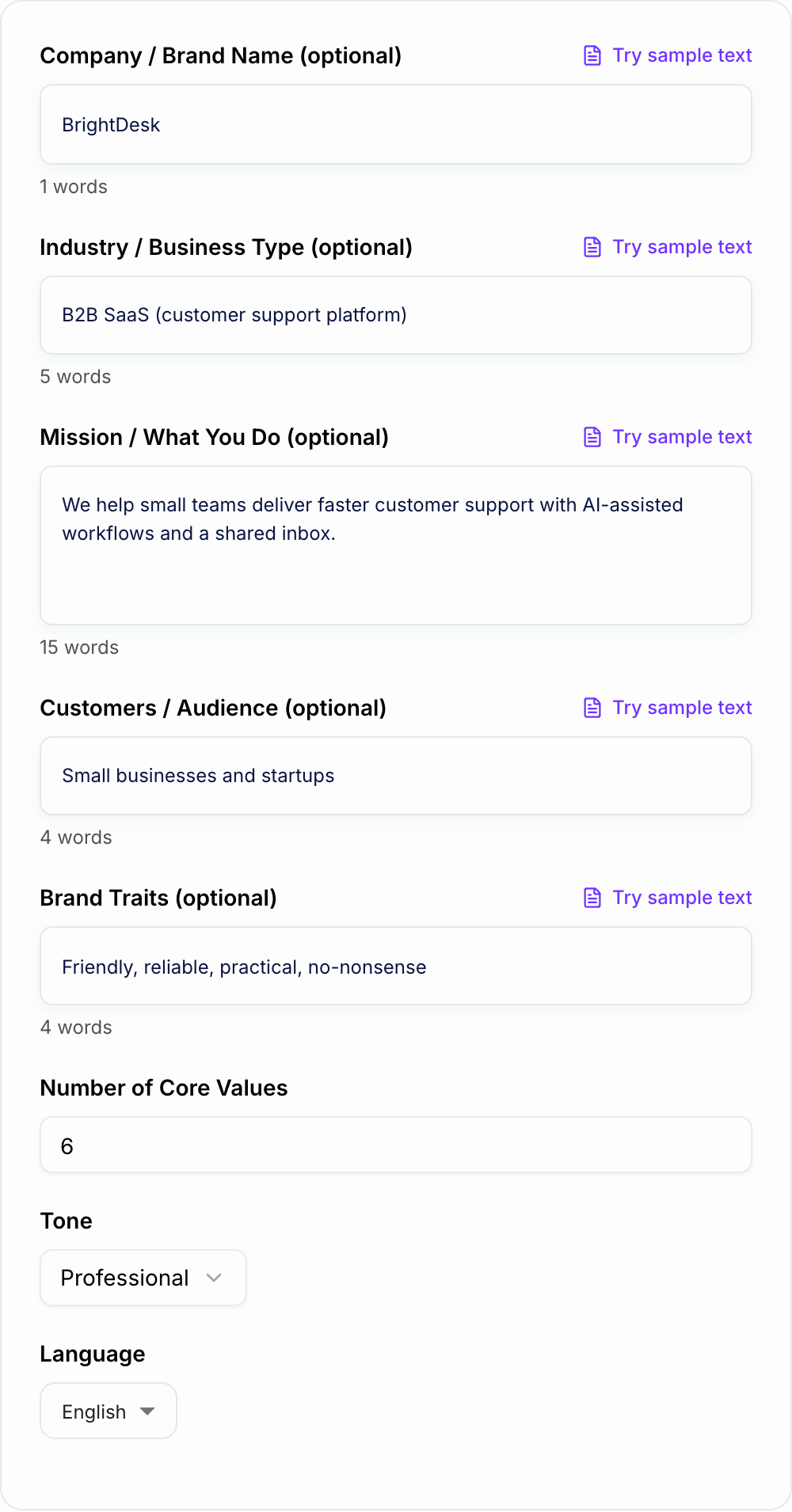
Enter your company name, mission, industry, and audience. You can also leave everything blank and generate a general set of core values to refine later.
Choose Tone and Value Count
Pick the tone (e.g., professional, friendly, bold) and set how many values you want. The tool will match language to your brand voice.
Generate, Then Customize
Get core values with definitions and behaviors. Edit the wording to reflect your real team standards, then publish them on your About page or culture deck.
See It in Action
Turn vague statements into clear, behavior-based company core values you can publish and operationalize.
Our values:
- Integrity
- Innovation
- Customer First
- Excellence
Core Values (example):
-
Earn Trust Through Transparency Description: We communicate clearly, set realistic expectations, and tell the truth—even when it’s uncomfortable. Behaviors: Share progress and blockers early; document decisions; admit mistakes and fix them.
-
Build for Customers, Not for Ego Description: We prioritize customer outcomes over internal preferences and ship improvements that remove real friction. Behaviors: Validate with user feedback; measure impact; simplify workflows; avoid vanity features.
-
Own Outcomes Description: We take responsibility end-to-end and follow through. Behaviors: Define success metrics; close loops; escalate risks early; fix root causes.
-
Raise the Bar With Craft Description: We care about quality and details because they compound into trust. Behaviors: Review work; test thoroughly; write clear docs; improve reliability.
-
Learn Fast, Improve Always Description: We experiment, learn, and iterate without blame. Behaviors: Run retros; share learnings; make small bets; iterate based on data.
-
Be Kind, Direct, and Professional Description: We communicate with respect and clarity. Behaviors: Give actionable feedback; assume good intent; disagree and commit; support teammates.
Why Use Our AI Core Values Generator?
Powered by the latest AI to deliver fast, accurate results.
Company Core Values With Clear Definitions
Generates a complete set of core values with plain-language definitions that are easy to use in culture documents, onboarding, and leadership messaging.
Behavior-Based Examples (So Values Are Actionable)
Includes specific behaviors and decisions that demonstrate each value—ideal for performance reviews, hiring scorecards, and day-to-day team alignment.
Brand Voice + Tone Matching
Adapts the wording to match your brand traits and tone (friendly, formal, bold, minimalist) so your values feel authentic—not generic.
Ready for About Pages, Culture Decks, and Employer Branding
Outputs formatting that works for common placements like About pages, careers pages, LinkedIn company profiles, and internal culture decks.
Mission-Driven and Customer-Centric Options
Supports different frameworks—customer obsession, mission impact, remote-first, enterprise governance—so the values fit your team model and goals.
Pro Tips for Better Results
Get the most out of the AI Core Values Generator with these expert tips.
Write values as decision-making rules
A strong core value helps people decide what to do when trade-offs exist (speed vs. quality, customer trust vs. short-term revenue, autonomy vs. alignment).
Include 2–4 behaviors for each value
Behaviors make values actionable for hiring, onboarding, and performance. If a value can’t be observed, it’s hard to reinforce consistently.
Avoid buzzwords unless you define them
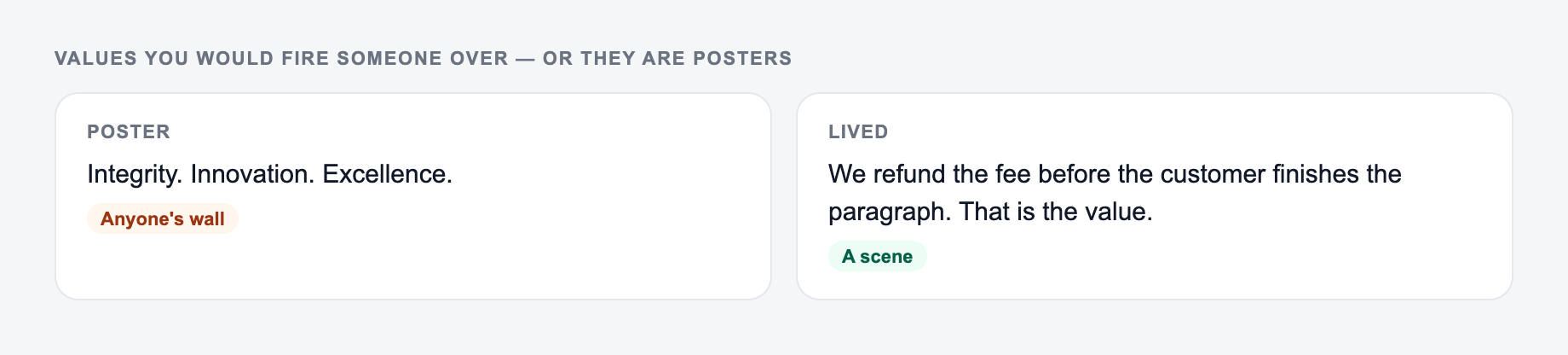
Words like “integrity,” “excellence,” and “innovation” are common. If you use them, add a definition and example so they mean something specific in your company.
Connect values to customers and outcomes
If you want values to support marketing and retention, tie them to how you deliver value: reliability, transparency, support quality, privacy, or craftsmanship.
Pressure-test your values with real scenarios
Ask: Would we fire a high performer for violating this? Would we lose a deal to uphold it? If not, rewrite the value into something your team truly commits to.
Who Is This For?
Trusted by millions of students, writers, and professionals worldwide.
Generate Usable Company Core Values with an AI Core Values Generator
Core values are useful only when people can apply them. This AI Core Values Generator helps you turn a mission, audience, culture traits, and customer promise into value statements with definitions, behaviors, and examples.
The goal is not to create inspirational nouns for a poster. The goal is to create decision rules your team can use in hiring, onboarding, customer work, product decisions, and performance conversations.
What to enter into the Core Values Generator
Start with your mission or purpose. Then add the people the values need to serve: customers, employees, candidates, partners, or a community.
Next, include traits and standards you actually want reflected in behavior. For example:
- practical, direct, high standards, transparent
- fast-moving but careful with customer trust
- kind, accountable, low-ego, async-first
- creative, rigorous, service-oriented
If you already know the tradeoffs your team makes, include them. Values become sharper when they explain what you choose when two good things conflict.
How to choose the right value mode
Use company values mode for About pages, Careers pages, and broad brand messaging. Use behavior-based mode when the values need to work inside a handbook, hiring scorecard, or performance review.
Use startup values mode when you need values that support speed, ownership, learning, and customer focus without becoming vague. Use personal values mode for founders, consultants, coaches, and personal brands.
For most companies, generate 4 to 6 values first. More than that gets hard to remember, and overlapping values usually need consolidation.
Review the generated core values
After generation, test each value against real behavior:
Put behaviors you already reward on the form. Values you will not fund should not appear.
Section order that readers actually scan:
- The ask or the decision.
- The facts that make it true.
- What is out of scope.
- The date they must answer.
This is a draft aid, not legal, HR, or career advice.
- Can a new hire explain it with one example?
- Can a manager use it in feedback?
- Can it guide a hard tradeoff?
- Does it describe what you reward and discourage?
- Would you be willing to lose speed, revenue, or convenience to uphold it?
If a value fails those tests, rewrite it as a behavior. "Integrity" can become "Tell the truth early." "Innovation" can become "Ship, learn, and improve." "Customer first" can become "Build for customer outcomes, not ego."
Where to use generated core values
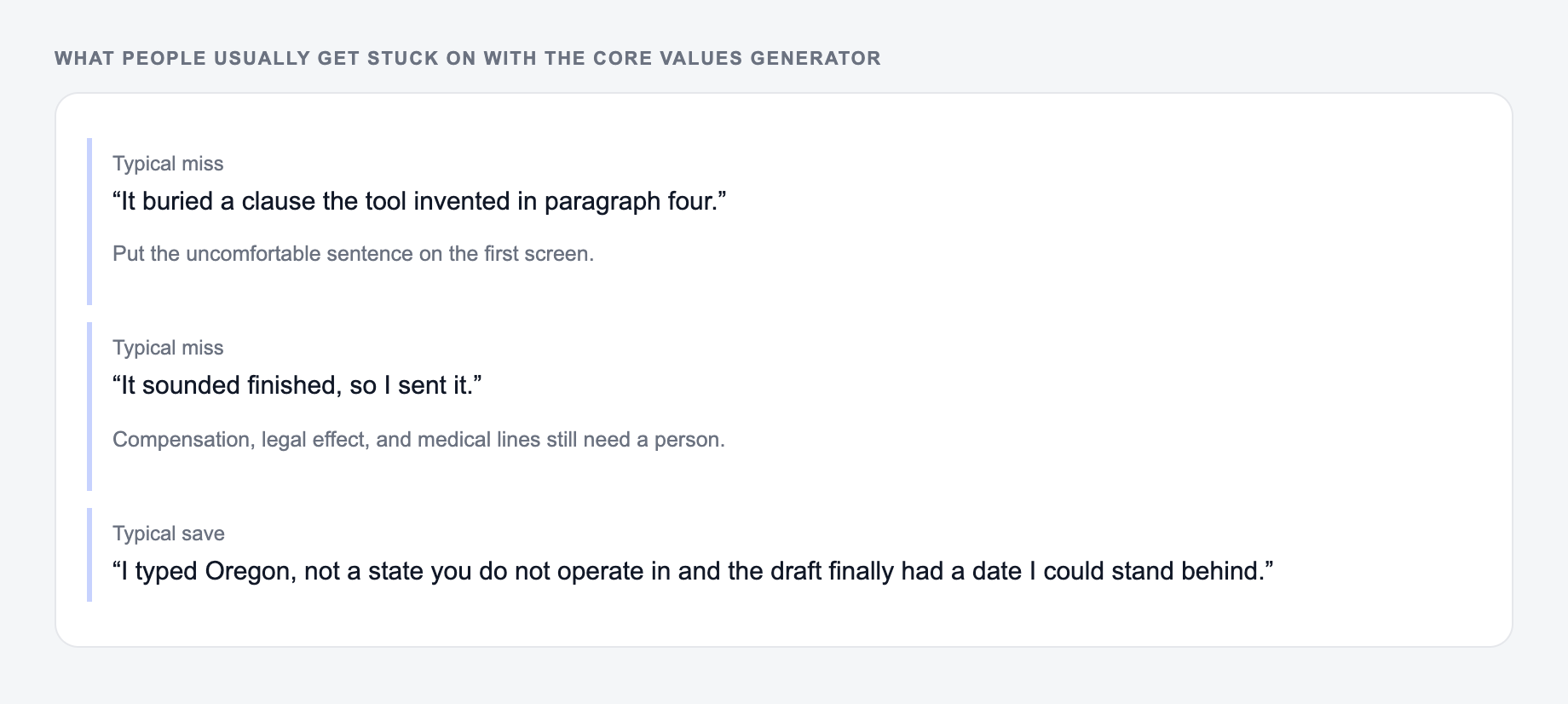
These are the complaints that show up after the first draft — they are almost always about the brief, not the model.
Use the generated values anywhere behavior needs to stay consistent: About pages, Careers pages, onboarding decks, hiring scorecards, interview questions, team rituals, customer promises, and leadership updates.
If you are shaping the rest of your brand language, pair these values with a mission statement, a vision statement, or a clearer value proposition. Each piece should say something different: mission explains purpose, vision explains direction, values explain behavior, and value proposition explains customer benefit.
Filled shape to imitate
The ask, the date, the deliverable, and the thing you will not promise — in that order. If the draft buries the uncomfortable sentence, put it back on the first screen.
Final checklist before publishing values
A generated value set is ready when each value has a short name, a plain definition, observable behaviors, and at least one real example. If the values could fit any company in your category, add more mission context, customer promises, and internal tradeoffs before publishing.
Frequently Asked Questions
What are company core values?+
Company core values are the guiding principles that define how your team makes decisions, works together, and serves customers. Strong values are specific, actionable, and consistently reinforced through behavior—not just slogans.
How many core values should a company have?+
Most teams choose 3–7 core values. Fewer values are easier to remember and operationalize. If you have more than 8–10, consider combining overlaps or rewriting them as clearer behaviors.
How do I make core values feel authentic (not generic)?+
Use your mission, audience, and brand traits as inputs. The best values reflect real trade-offs your team makes, the behaviors you reward, and the standards you won’t compromise—especially under pressure.
Can I use these core values on my website and careers page?+
Yes. The generated values are designed for public-facing use (About page, careers page, LinkedIn) and internal use (onboarding, culture deck). Review and edit to match your real culture and policies.
Should core values include examples or behaviors?+
Yes. Definitions alone can be interpreted differently by different people. Adding behaviors (what it looks like in practice) makes values measurable, teachable, and easier to hire for.
Do core values help with branding and marketing?+
They can. Clear brand values strengthen positioning, differentiate your company, and improve trust—especially when you connect values to customer outcomes, quality standards, and ethical practices.