
Free Demand Letter Generator
Describe the dispute, amount, deadline, and available evidence to generate a professional demand letter for payment, refunds, contract issues, deposits, or small-claims preparation.
Demand Letter
Your demand letter will appear here...
How the AI Demand Letter Generator Works
Get results in seconds with a simple workflow.
Describe the Dispute
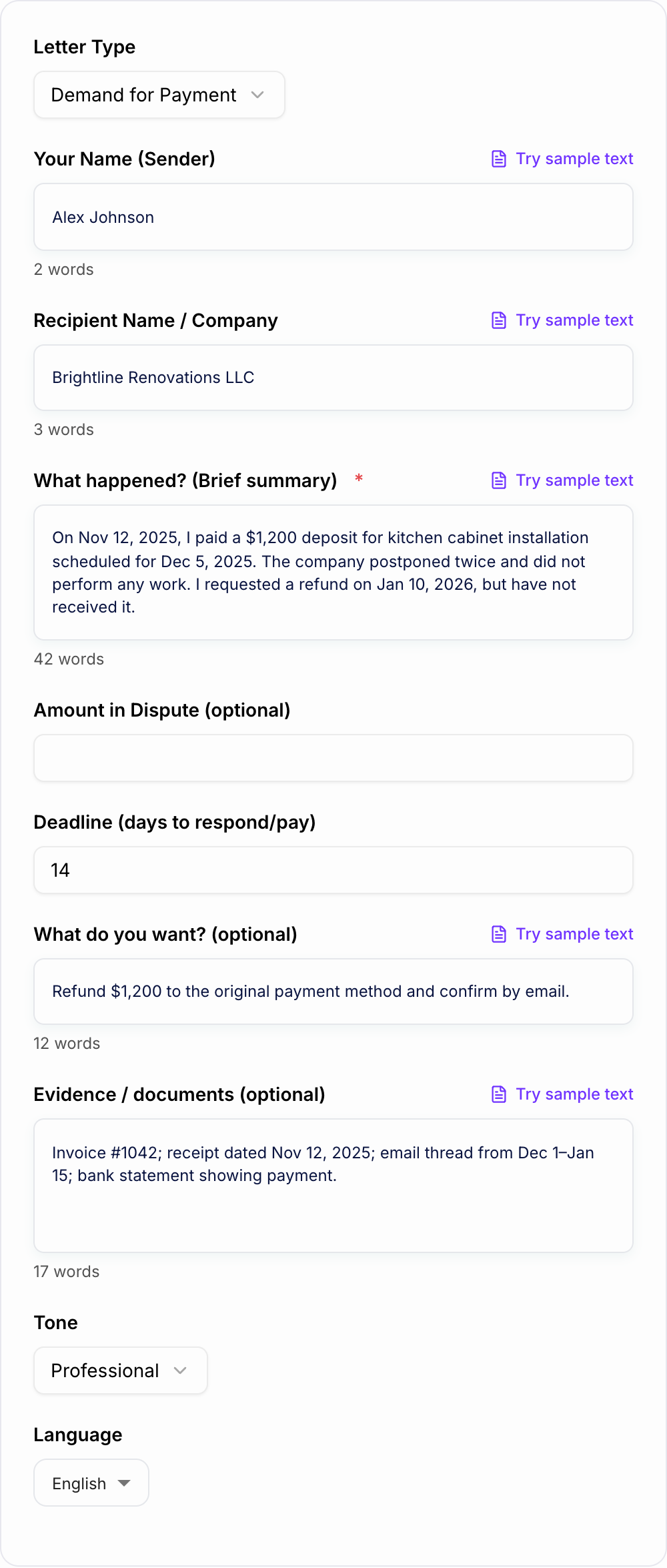
Add a short summary of what happened, including key dates, what was agreed, and what went wrong. Optional: include the amount in dispute and any supporting evidence.
Choose Letter Type, Deadline, and Tone
Select a demand letter type (payment, refund, breach of contract), set a response deadline, and choose the tone (polite, professional, firm).
Generate, Review, and Send
Generate a draft, confirm facts and names, add missing details, and send via email or certified mail depending on your needs. Keep a copy for your records.
See It in Action
Turn a short dispute description into a structured, professional demand letter with a clear remedy and deadline.
They owe me money for work I did and they keep ignoring me. I want them to pay me soon.
Subject: Demand for Payment – Outstanding Balance of $1,200 (Invoice #1042)
Dear Brightline Renovations LLC,
I am writing regarding Invoice #1042 in the amount of $1,200 for services provided on November 12, 2025. Despite prior reminders on January 3 and January 15, 2026, the balance remains unpaid.
Demand Please remit payment of $1,200 within 14 days of receipt of this letter. Payment may be made via bank transfer or the original payment method, and you may confirm payment by replying to this email.
Supporting Information I have retained relevant documentation, including the invoice, payment records, and our email correspondence.
If I do not receive payment by the deadline, I will consider pursuing available remedies to recover the amount owed, which may include filing a claim in small claims court.
Sincerely, Alex Johnson
Why Use Our AI Demand Letter Generator?
Powered by the latest AI to deliver fast, accurate results.
Professional Demand Letter Format
Generates a clear demand letter structure with subject line, factual summary, demand, deadline, and next steps—ideal for payment demands, refund requests, and contract disputes.
Clear Deadline and Cure Period
Adds a response deadline (e.g., 7–30 days) to strengthen your written record and encourage resolution before escalation to small claims or formal action.
Fact-Focused, Evidence-Friendly Writing
Organizes key dates, agreements, communications, and supporting documents to help the recipient understand the claim and to support future dispute resolution.
Tone Control (Firm but Professional)
Adjusts tone from polite to firm while keeping language professional and non-inflammatory—helpful for negotiation, collections, and settlement discussions.
Multilingual Demand Letters
Create demand letters in multiple languages for international clients, cross-border disputes, and multilingual communication—while keeping a formal business style.
Pro Tips for Better Results
Get the most out of the AI Demand Letter Generator with these expert tips.
Be specific about the remedy
State an exact amount, payment method, or action requested. Clear remedies reduce back-and-forth and improve your chance of settlement.
Use a clean timeline
List key dates (agreement, payment, delivery, communications). A concise timeline strengthens credibility and helps if you escalate later.
Attach and reference evidence
Mention invoices, receipts, contracts, photos, and email threads. Refer to them as attachments to support your demand without arguing emotionally.
Keep tone professional and factual
Avoid insults or threats. Professional language improves outcomes and keeps the letter useful as documentation for dispute resolution.
Set a reasonable deadline
A 10–14 day deadline often works for straightforward payment/refund demands. Adjust based on complexity and communication history.
Who Is This For?
Trusted by millions of students, writers, and professionals worldwide.
Generate a Professional Demand Letter from Your Dispute Details
A demand letter works best when it is calm, specific, and easy to verify. It should explain what happened, what you want, when you expect a response, and what evidence supports your position.
This AI Demand Letter Generator turns your notes into a structured draft for payment disputes, refund requests, deposit issues, breach of contract problems, and similar conflicts. It gives you a clear starting point, but it is still a draft you need to review.
What to enter into the Demand Letter Generator
Give the tool facts, not just frustration. The more specific your input is, the stronger the draft will be.
Include:
- names of the parties involved
- the agreement, purchase, invoice, or service at issue
- key dates and deadlines
- the amount owed or remedy requested
- what happened versus what was promised
- evidence such as contracts, receipts, screenshots, photos, emails, or text messages
- the response deadline you want to give
Avoid vague input like “they scammed me.” A clearer input would be: “I paid a $1,200 deposit on Nov 12 for repair work scheduled for Dec 5. The work was postponed twice and never started.”
Choose the right demand letter mode
The mode changes the structure and emphasis of the generated letter.
- Demand for Payment is for unpaid invoices, completed work, reimbursable expenses, or past-due balances.
- Demand for Refund is for undelivered, defective, canceled, or misrepresented purchases.
- Breach of Contract is for situations where an agreement exists and the other party failed to perform.
- Small Claims Ready gives you a more detailed chronology and evidence-focused draft before possible escalation.
Pick the closest mode first. You can always edit the generated letter if the dispute crosses categories.
Review the draft before sending it
The generator can structure the letter, but you need to verify the final details.
Amount and deadline you can prove belong on the form. Have counsel review before you send.
Filled example to imitate
A brief the AI Demand Letter Generator can use: who it is for, where the output will appear, and what must stay true.
Do not send this shape
A one-line request like “run the demand letter” with no audience, channel, or constraint.
The first version names a date, a deliverable, and a boundary. The second hopes the reader will infer them.
This is a draft aid, not legal, medical, or financial advice.
Check that:
- names, dates, amounts, and deadlines are accurate
- the remedy is specific and realistic
- evidence is referenced cleanly
- the tone is firm without sounding threatening
- the letter does not include facts you cannot support
- any local legal notice requirements have been checked
This tool is not a substitute for legal advice. For serious, high-value, regulated, or jurisdiction-specific disputes, have a qualified professional review the final letter.
Make the demand clear without making it longer
Before anything leaves the outbox:
- You can point to the number in a spreadsheet or a contract
- You would sign it if your name were the only one on it
- Compensation, legal effect, and medical content had a human pass
These are the complaints that show up after the first draft — they are almost always about the brief, not the model.
A strong demand letter usually follows a simple order:
- Identify the parties and issue.
- State the facts in chronological order.
- Explain the amount or remedy requested.
- Give a reasonable response deadline.
- Reference evidence.
- State possible next steps calmly.
You do not need to argue every detail. The goal is to create a readable record that the other side can respond to.
Sending and documenting the letter
After editing the generated demand letter, save a copy of what you sent and how you sent it. Email can work for many disputes, but certified mail or another trackable method may be useful when proof of delivery matters.
For broader drafting work, Junia AI can help with related business letters, complaints, contracts, and structured writing tasks while you keep the final review in your hands.
Final checklist
Before sending, ask: would a neutral person understand what happened, what I am asking for, and what evidence supports it? If the answer is yes, the letter is doing its job.
Frequently Asked Questions
What is a demand letter?+
A demand letter is a formal written notice that explains a dispute, states what you want (payment, refund, performance, or other remedy), sets a deadline, and outlines what you may do next if the issue isn’t resolved.
Is this demand letter generator legal advice?+
No. This tool generates general-purpose letter drafts for communication and documentation. For legal advice tailored to your situation or jurisdiction, consult a qualified attorney.
What should I include in a strong demand letter?+
Include key facts and dates, what agreement or obligation exists, what went wrong, the exact remedy you want (amount and method), a reasonable deadline, and a brief list of supporting evidence (invoices, receipts, emails, photos).
How long should the deadline be?+
Common deadlines range from 7 to 30 days depending on the situation. A clear, reasonable deadline helps demonstrate good-faith effort to resolve the dispute before escalation.
Should I mention small claims court or legal action?+
You can state that you may pursue available remedies if the matter isn’t resolved by the deadline. Keep it factual and non-threatening. If you’re unsure what’s appropriate, get legal guidance.
Can I use this for an unpaid invoice or debt collection?+
Yes. The tool can draft a demand for payment letter that includes the amount owed, the basis for the debt, payment instructions, and a deadline—useful for freelancers, agencies, and small businesses.