
Free Essay Title Generator
Create essay title ideas that match your topic, thesis, assignment type, keywords, and academic level. Generate formal academic, persuasive, creative, question-based, or SEO-friendly title options that make the essay's angle clear.
Essay Title Ideas
Your essay title ideas will appear here...
How the AI Essay Title Generator Works
Get results in seconds with a simple workflow.
Enter Your Essay Topic
Type your topic (or prompt). The generator uses it to identify the core subject and likely angle for relevant essay title ideas.
Add Optional Thesis, Keywords, and Essay Type
Include a thesis for stronger alignment, add keywords your rubric requires, and choose an essay type (argumentative, analytical, research, etc.) to match your assignment.
Generate Titles and Pick the Best Fit
Get multiple title options in your chosen tone and language. Choose one, then refine it for length, specificity, and rubric requirements.
See It in Action
Example of turning a broad topic into specific, compelling essay title options aligned with a thesis and essay type.
Topic: social media and mental health
I need a title for my essay.
- Scrolling and Self-Esteem: How Social Comparison on Social Media Affects Teen Anxiety
- The Hidden Cost of Constant Connection: Social Media’s Impact on Teen Mental Health
- Likes, Sleep, and Stress: Why Social Media Can Worsen Anxiety in Adolescents
- Can Digital Literacy Reduce Harm? Rethinking Social Media Use and Teen Well-Being
- Social Media and Teen Anxiety: Causes, Consequences, and Practical Solutions
Why Use Our AI Essay Title Generator?
Powered by the latest AI to deliver fast, accurate results.
Topic-to-Title Generation (Fast and Relevant)
Turn any essay topic into a list of strong title ideas that match your subject, assignment style, and academic level—ideal for brainstorming and outlines.
Thesis-Aware Titles for Stronger Alignment
Add an optional thesis statement to generate titles that reflect your main argument, making your essay title more accurate, specific, and defensible.
Multiple Styles: Academic, Persuasive, Creative, and Question-Based
Generate formal academic titles, argumentative titles that signal your position, creative hooks that boost engagement, or question titles for inquiry-based essays.
Keyword Inclusion Without Keyword Stuffing
Optionally include key terms (themes, authors, concepts, or required vocabulary) naturally—useful for rubric alignment, research papers, and SEO-style web essays.
Readable, Non-Clickbait Titles
Produces clear, human-friendly titles that avoid vague phrasing and misleading hype while still sounding engaging and original.
Pro Tips for Better Results
Get the most out of the AI Essay Title Generator with these expert tips.
Add a thesis to avoid generic title ideas
Even one sentence describing your claim helps generate more specific, higher-quality titles that match your essay’s argument or analysis.
Aim for specificity: who/what/where/when
Titles improve when you add constraints like a population (teens), setting (schools), timeframe (post-2020), or scope (platforms like Instagram/TikTok).
Use a clear keyword only if required
If your teacher or rubric requires vocabulary (e.g., ‘social comparison’), include it—but keep the title readable and natural.
Match the tone to the assignment
Academic essays usually need straightforward titles, while narratives or personal essays can use more creative or reflective hooks.
Keep it short and scannable
If a title feels long, remove filler words and keep the key concept + angle. Clarity beats complexity.
Who Is This For?
Trusted by millions of students, writers, and professionals worldwide.
Generate Better Essay Titles from Your Topic and Thesis
The Essay Title Generator helps you move from a broad topic to title options that actually match the paper you are writing. A good title should not just sound clever. It should signal the topic, angle, and assignment type clearly enough that the reader can predict the essay's focus.
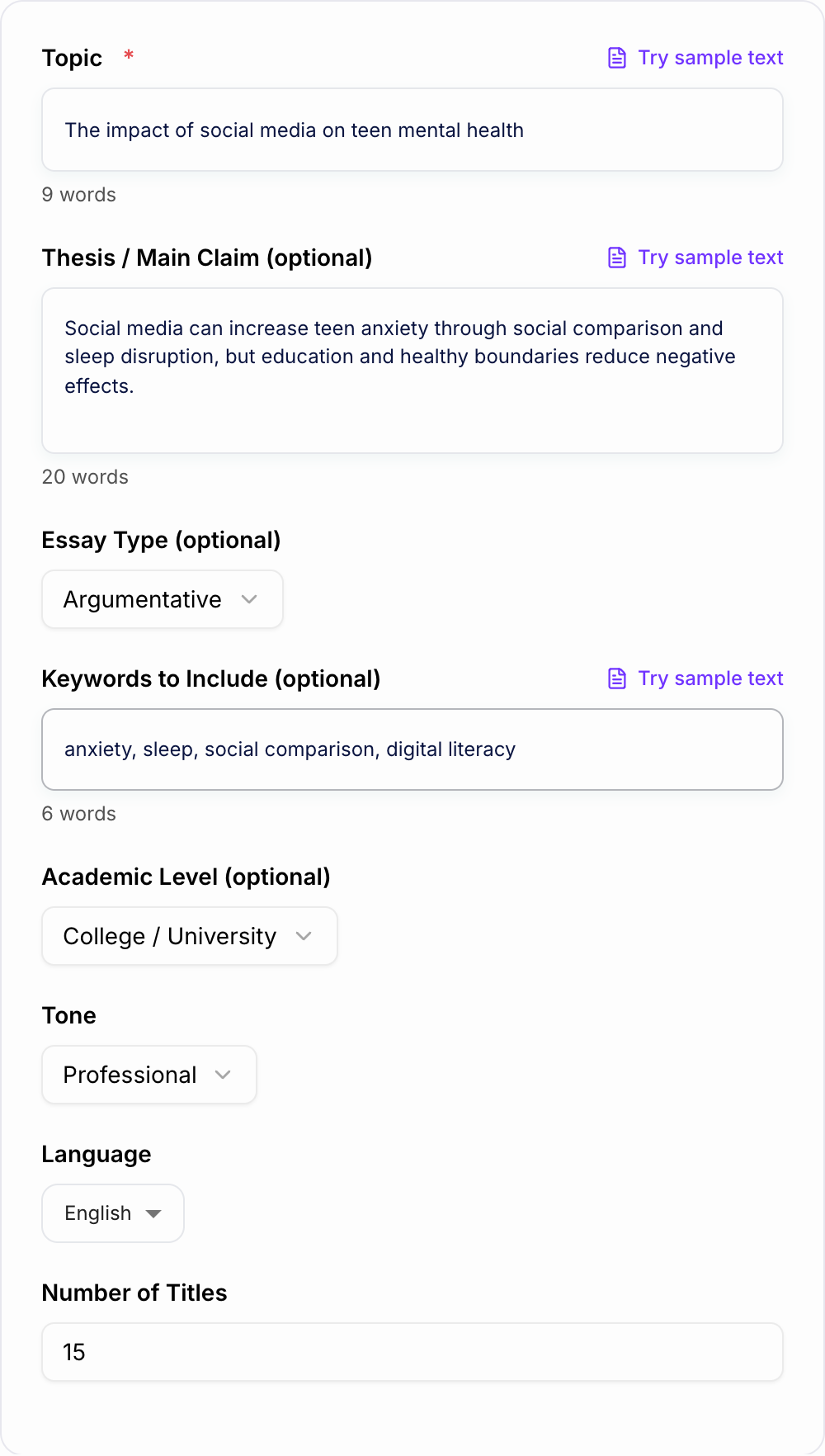
Use the generator when your working title is too vague, too long, too flat, or too disconnected from your thesis.
What to Enter for Stronger Title Ideas
The generator can produce titles from a topic alone, but the best outputs come from a little more context:
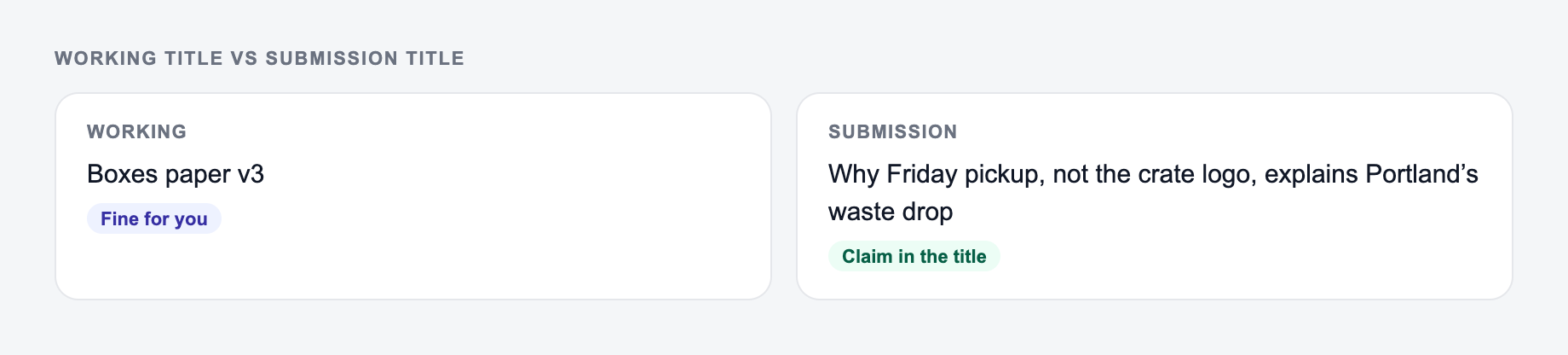
- Topic: the broad subject of the essay.
- Thesis or main claim: the argument, interpretation, or explanation your essay will develop.
- Essay type: argumentative, analytical, narrative, compare and contrast, literary analysis, research, or reflective.
- Keywords: required terms, authors, concepts, variables, texts, or course vocabulary.
- Academic level: middle school, high school, college, or graduate.
- Tone: formal, creative, persuasive, neutral, or another style the assignment allows.
For example, "social media and mental health" is a topic. "Social media can increase teen anxiety through social comparison and sleep disruption, but digital literacy can reduce harm" gives the generator an angle.
Pick the Right Title Mode
Academic
Use this for school essays, research papers, and analysis. The titles should be clear, specific, and non-clickbait.
Persuasive or Argumentative
Use this when the title should hint at a stance. The best options make the position visible without sounding exaggerated.
Creative Hook
Use this for narratives, reflections, personal essays, or assignments where a memorable phrase is welcome. Pair the hook with a clarifying subtitle if the title becomes too clever.
Question Titles
Use this for inquiry-based essays. A strong question title should be specific enough to guide the whole paper, not just ask a broad question.
SEO-Friendly
Use this for web essays or blog-style assignments where a keyword needs to appear naturally near the beginning.
How to Choose the Best Generated Title
Do not pick the flashiest option automatically. Pick the title that matches the actual essay.
A strong title usually passes these checks:
- it names the topic clearly;
- it includes the essay's angle or method;
- it fits the assignment type;
- it is specific enough to rule out unrelated essays;
- it avoids hype, vague words, and empty phrases;
- it is short enough to read quickly.
If a title sounds good but promises more than the essay covers, narrow it. If it sounds accurate but dull, add a sharper noun, time period, comparison, or subtitle.
Example Input and Output Direction
Input: Topic: social media and teen mental health. Thesis: nighttime social media use increases anxiety partly because it disrupts sleep and encourages social comparison. Style: academic but engaging.
A working thesis on the form beats “make it catchy.”
Learning workflow:
- Enter only facts you have.
- Generate a structured draft.
- Check names, dates, citations, and units.
- Rewrite the sentences you would actually say in class or in the paper.
If the task is graded, cited, or used with students, the named writer still owns the claims.
Good generated title direction: Titles should include the population, behavior, and angle. Options like "Late-Night Scrolling and Teen Anxiety: The Role of Sleep Disruption" work better than "Social Media and Mental Health" because they tell the reader exactly what the essay will examine.
Fixing Common Generated Title Problems
- Too broad: Add a population, time period, setting, author, text, or specific variable.
- Too long: Cut filler phrases such as "an examination of" unless your style guide expects them.
- Too clever: Add a subtitle after a colon to clarify the focus.
- Too argumentative for an analytical essay: switch to academic or analytical phrasing.
- Too bland: ask for titles that include contrast, cause and effect, or a stronger noun.
Use Title Ideas with the Rest of Your Draft
Keep the line you could publish. Put facts back. Do not outsource the judgment call.
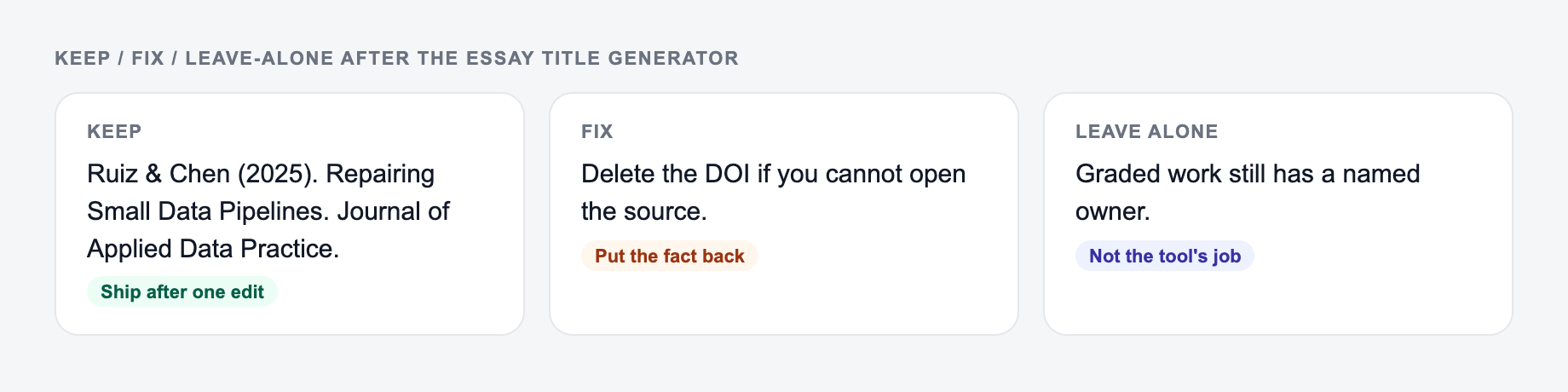
The title should usually be one of the last parts you finalize. Generate options early if you need direction, but revisit the title after the outline and body paragraphs are clear. If the essay changes, the title should change too.
When you are building the rest of the paper, Junia's AI writing tools can help with related drafting steps such as thesis statements, outlines, introductions, and revisions. The title generator works best when those pieces already point in the same direction.
Final Title Checklist
Before submitting, confirm that the title:
- reflects the final thesis, not an earlier idea;
- uses precise words instead of vague labels;
- matches the essay type and academic level;
- includes required keywords or course concepts naturally;
- avoids clickbait unless the assignment explicitly allows a promotional style;
- stays readable at a glance.
The generator gives you options. Your job is to choose the title that makes the essay feel focused before the reader reaches the first paragraph.
Frequently Asked Questions
How do I generate the best essay title?+
Enter a clear topic and, if possible, include your thesis or main claim. The more specific your angle (time period, location, author, concept, or population), the more specific and high-quality your essay title ideas will be.
Should an essay title include my thesis statement?+
Not word-for-word, but the best essay titles reflect the essay’s central idea. Adding your thesis helps generate titles that match your argument and avoids generic results.
What makes a good academic essay title?+
A good academic title is specific, accurate, and informative. It signals the topic and angle, avoids vague wording, and matches the assignment type (analysis, argument, research, compare/contrast, etc.).
Can I generate persuasive or argumentative essay titles?+
Yes. Choose an argumentative or persuasive essay type and (optionally) add a thesis. The generator will produce titles that imply a clear claim while staying balanced and credible.
Can this help with research paper titles?+
Yes. Add your topic and key terms (methods, population, timeframe, variables, or theory). You’ll get research-style title ideas that sound more precise and academic.
Does the tool support different languages?+
Yes. Choose an output language to generate essay titles in many languages—helpful for language classes, multilingual students, and international coursework.