
Free Grant Proposal Generator
Generate a funder-ready grant proposal draft from your project basics. Build executive summaries, needs statements, SMART objectives, methods, evaluation plans, sustainability language, and budget narratives you can tailor to a specific RFP.
Grant Proposal Draft
Your grant proposal draft will appear here...
How the AI Grant Proposal Generator Works
Get results in seconds with a simple workflow.
Enter Your Project Basics
Add your project title and (optionally) the organization, funder, location, beneficiaries, and the problem you’re addressing. Even minimal details can produce a usable grant proposal draft.
Add Goals, Budget, and Timeline (Optional but Helpful)
Include measurable objectives, requested amount, and project duration to generate stronger outcomes, a clearer work plan, and a more realistic budget narrative.
Generate, Then Customize to the RFP
Get a funder-ready proposal draft. Then tailor the language to the grantmaker’s priorities, replace placeholders with real local data, and align sections to the RFP’s exact prompts and limits.
See It in Action
Turn a rough project idea into a structured, funder-ready grant proposal draft with measurable outcomes and clear sections.
We want funding for a tutoring program for kids in our area. We’ll help them do better in school and need money for supplies and staff.
Project Title: Community STEM Tutoring for Middle School Students
Executive Summary: Northside Youth Center seeks $25,000 to deliver a 12-month after-school STEM tutoring program serving approximately 120 middle school students in Detroit, MI. The program will provide twice-weekly small-group tutoring, hands-on STEM labs, and volunteer mentoring to improve math/science proficiency and student confidence.
Needs Statement: Students in our service area face persistent academic gaps and limited access to affordable tutoring and enrichment. Local educators report insufficient capacity for individualized support. [Insert local proficiency data], combined with barriers such as transportation and cost, contributes to lower STEM readiness.
Goals & Objectives:
- Improve participating students’ math proficiency by at least 15% from baseline within 6 months.
- Achieve 80% average attendance across enrolled students.
- Increase STEM self-efficacy by 20% using a pre/post survey.
Program Design / Methods:
- Recruitment through partner schools and community referrals
- Small-group tutoring (max 6:1) twice weekly
- Monthly hands-on STEM lab sessions
- Individual learning plans informed by baseline assessments
Evaluation Plan: Track attendance, pre/post academic assessments, survey-based self-efficacy, and tutor session logs. Review progress monthly and adjust instruction based on results.
Budget Narrative (Summary): Funds will support part-time instructional staff, tutoring materials, assessment tools, volunteer onboarding, and program coordination. Costs directly align with the tutoring schedule, evaluation activities, and participant supports.
Sustainability: After the grant period, we will sustain the program through school partnerships, volunteer mentor pipelines, and diversified funding (local donors, corporate sponsorships, and renewal grant applications).
Why Use Our AI Grant Proposal Generator?
Powered by the latest AI to deliver fast, accurate results.
Grant Proposal Structure That Funders Expect
Generates a complete grant proposal format with standard sections (executive summary, needs statement, goals, methodology, budget narrative, evaluation, and sustainability) to match typical foundation and government grant requirements.
Outcome-Focused Objectives and Measurable Metrics
Helps you write SMART goals, outputs, and outcomes with practical KPIs and an evaluation approach—so your proposal reads credible, accountable, and impact-driven.
Funder Alignment and Priority Matching
Adapts language to common grantmaker priorities (equity, access, workforce development, education, health, community impact) without sounding generic or overly promotional.
Budget Narrative and Cost Assumptions (Clear + Defensible)
Creates a plain-language budget justification that ties costs to activities, staffing, and deliverables—reducing reviewer confusion and improving grant application clarity.
Editable Draft You Can Customize to Any RFP
Produces a high-quality first draft you can quickly tailor to an RFP’s specific questions, character limits, and attachments—saving hours of grant writing time.
Pro Tips for Better Results
Get the most out of the AI Grant Proposal Generator with these expert tips.
Use SMART objectives reviewers can score
Write goals with a measurable change, a target number/percentage, and a timeframe (e.g., “Increase graduation rate by X% within 12 months”). Measurable objectives make evaluation and accountability clear.
Tie every budget line to an activity and outcome
A strong budget narrative explains why each cost is necessary and how it supports deliverables. Mismatched budgets are a common reason proposals get rejected.
Replace placeholders with local, credible sources
Strengthen your needs statement with recent local data from schools, health departments, census sources, or peer-reviewed research. Cite sources in plain text where appropriate.
Show feasibility with staffing, partners, and timeline
Reviewers want to know you can execute. Add who will do the work, partner roles, key milestones, and how you will recruit and retain participants.
Write to the funder’s priorities without forcing buzzwords
Mirror the funder’s language (equity, access, evidence-based, community impact) only where it genuinely fits your project. Specificity beats generic “mission alignment” claims.
Who Is This For?
Trusted by millions of students, writers, and professionals worldwide.
Generate a Funder-Ready Draft with the Grant Proposal Generator
The fastest way to use a grant proposal generator is not to ask it for "a grant proposal" and hope for the best. The stronger workflow is to give it the same details a reviewer will look for: who you serve, what will change, how the work happens, how much it costs, and how you will measure results.
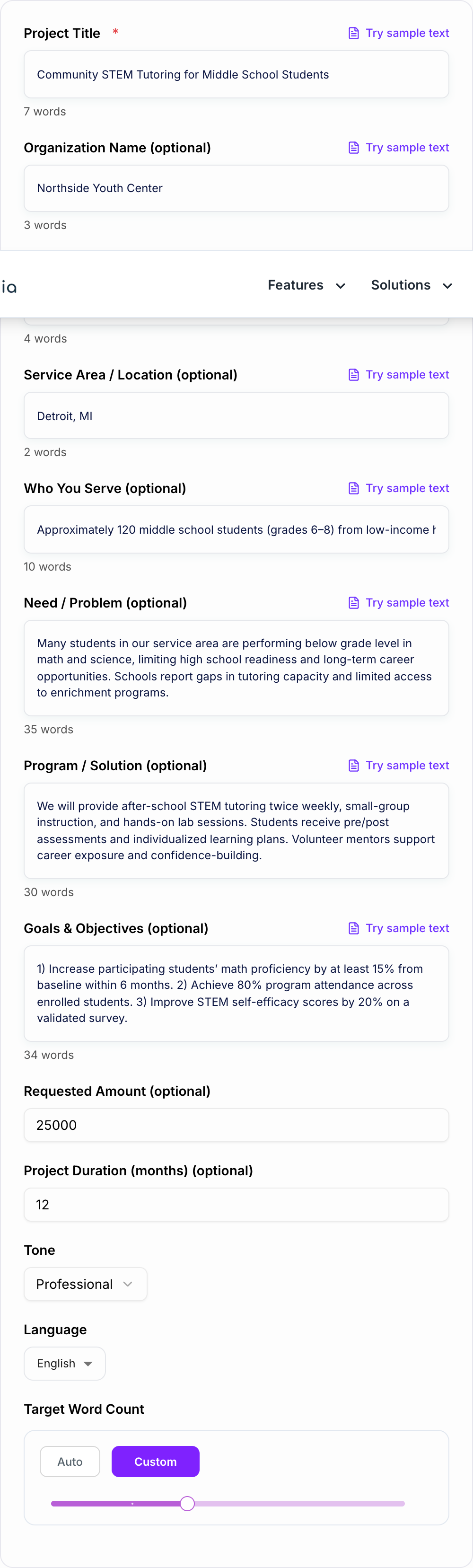
This tool is built to turn those details into a structured first draft. You still need to tailor the proposal to the RFP, verify every number, and add real evidence, but you skip the blank-page stage and start with sections that already resemble a funder-ready application.
What to Enter Before You Generate
The generator can work from a short project idea, but the output improves quickly when you add specific inputs:
- Project title: a plain name that says what the program does
- Organization and funder: useful for tone, alignment, and executive-summary language
- Location and beneficiaries: who is served, where, and roughly how many people
- Need or problem: the local issue, baseline gap, or service barrier
- Program solution: activities, schedule, staffing, partners, and participant experience
- Goals and objectives: 2 to 5 measurable changes with numbers and timelines
- Requested amount and duration: the budget request and grant period
If you do not have local data yet, say that directly. A good AI grant proposal draft should use placeholders such as [Insert local data] instead of inventing statistics.
Choose the Right Proposal Mode
Use Full Proposal Draft when you need a complete starting document with the standard sections: executive summary, needs statement, methods, goals, evaluation, budget narrative, and sustainability.
Use Letter of Inquiry when the funder wants a shorter screening document before inviting a full proposal. Keep this version tighter: problem, solution, amount requested, expected impact, and organizational credibility.
Use Executive Summary Only when the rest of the proposal is already drafted but the opening summary feels flat or unfocused.
Use Needs Statement Only when the problem section needs more structure. After generation, replace placeholders with real local sources from school reports, health departments, census tables, public dashboards, or peer-reviewed studies.
Use Budget Narrative or Evaluation Plan when those sections are the weak spots. These are usually the sections reviewers notice when the proposal sounds promising but not fully planned.
How to Review the Generated Proposal
Do not submit the generated draft without a careful pass. Reviewers are trained to spot vague claims, mismatched numbers, and generic alignment language.
Use this check before moving the draft into the application portal:
- Budget request matches every section. The executive summary, budget narrative, and application fields should use the same amount.
- Objectives are measurable. Replace "improve outcomes" with a target, timeframe, and indicator.
- Methods match capacity. Staffing, schedule, partners, and participant numbers should feel realistic.
- Evaluation measures the promised outcomes. If the proposal promises attendance, proficiency, or confidence gains, the evaluation plan should track those exact things.
- Needs statement has credible proof. Replace placeholders with real data and cite the source in the required format.
- Sustainability is concrete. Name realistic post-grant paths such as renewal funding, school partnerships, earned revenue, donors, or public funding.
Example Input and Output Review
Weak input:
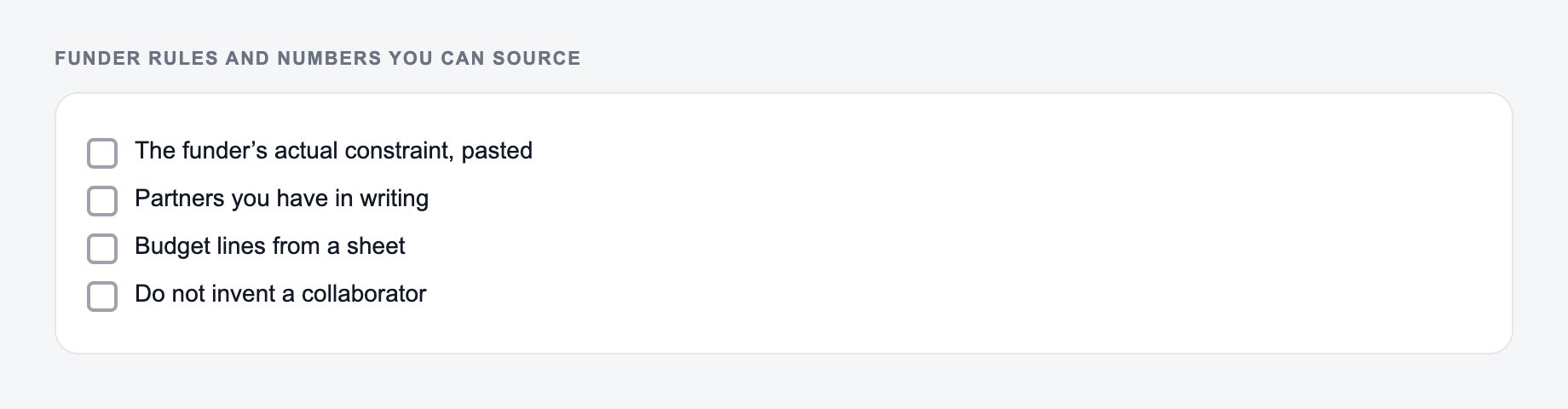
Funder rules and numbers you can source belong on the form. Do not invent partners.
Section order that readers actually scan:
- The ask or the decision.
- The facts that make it true.
- What is out of scope.
- The date they must answer.
This is a draft aid, not legal, medical, or financial advice.
We need money for an after-school tutoring program.
Better input:
Northside Youth Center is seeking $25,000 for a 12-month after-school STEM tutoring program serving 120 middle school students in Detroit. Students attend twice weekly small-group tutoring and monthly STEM labs. Goals: improve math proficiency by 15% in 6 months, maintain 80% attendance, and improve STEM confidence by 20% on pre/post surveys.
The second version gives the grant proposal generator enough material to create measurable objectives, a realistic program design, and a budget narrative that connects costs to activities.
After generation, look for anything that sounds too broad. "Community impact" needs a real beneficiary. "Evidence-based programming" needs the actual practice. "Sustainable funding" needs a path.
Budget Narrative Details to Add Manually
A budget narrative should explain why each cost exists, not just repeat line items. When you review the generated section, add or confirm:
- staff roles, hourly assumptions, and time commitments
- supply costs per participant, session, kit, or classroom
- contractor scope and deliverables
- travel, facility, software, or equipment assumptions
- indirect cost rules if the funder allows them
The draft should make it obvious that the budget supports the work plan. If a cost does not connect to a task, outcome, or participant need, revise it before submission.
When to Use AI in a Grant Workflow
Filled shape to imitate
The ask, the date, the deliverable, and the thing you will not promise — in that order. If the draft buries the uncomfortable sentence, put it back on the first screen.
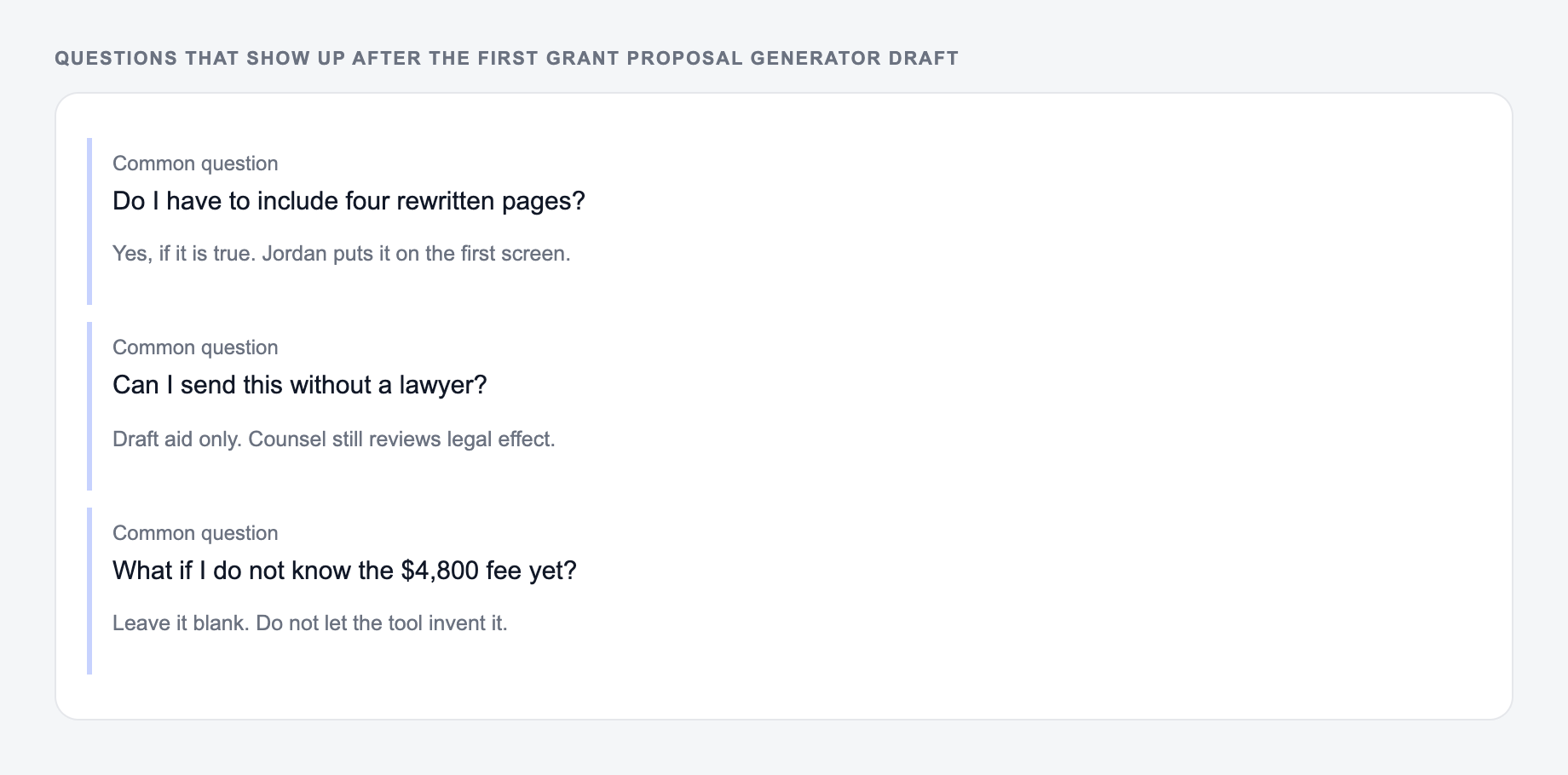
The same three questions show up after people generate once and then stall.
AI is useful for structure, section drafting, clarity, and versioning. It is not a substitute for local context, organizational judgment, funder research, or compliance review.
A practical workflow is:
- generate the first draft
- replace placeholders with verified data
- align each section with the RFP scoring criteria
- cut or expand sections to fit word limits
- review the final version with someone who knows the program
If you are preparing supporting materials at the same time, the broader AI writing tools on Junia AI can help keep summaries, narratives, outreach copy, and related documents consistent across the application package.
Final Checklist Before Submission
Before you submit, confirm:
- the funder name, program name, amount, and dates are correct
- every required RFP question is answered
- all numbers match across the proposal and budget
- claims are supported by real data or removed
- acronyms and partner names are spelled correctly
- attachments, signatures, and formatting rules are complete
The generator should get you to a strong first draft faster. The final advantage comes from the careful details only your team can verify.
Frequently Asked Questions
Is this grant proposal generator free to use?+
Yes. You can generate a full grant proposal draft for free. Some advanced sections (like a deep budget narrative or evaluation plan) may be marked as premium depending on your setup.
Will the proposal match a specific RFP or grant application format?+
It generates a strong standard structure used across many grantmakers. For best results, paste key RFP requirements into your project description or adjust the final draft to match the exact prompts, character limits, and required attachments.
Does it include a needs statement, goals, and evaluation plan?+
Yes. The draft includes a needs statement, measurable goals/objectives, and a practical evaluation approach with indicators and data collection ideas—without inventing statistics.
Can I use it for nonprofit, education, or research grants?+
Yes. The tool works for nonprofit grants, school and education grants, and many research-style proposals. Provide your audience, location, and program details so the narrative and outcomes are relevant.
Will it invent data or statistics?+
No. It’s designed to avoid fabricating statistics. If data would strengthen your case, it will suggest what to include and use clearly labeled placeholders like [Insert local data].
How do I make the proposal more competitive?+
Add specifics: target population size, baseline need, partnerships, timeline, staffing plan, and a clear theory of change. Include credible sources for your local data and ensure your budget matches the narrative and objectives.