
Free Headline Analyzer
Analyze your headline before you publish. Get a practical score for clarity, search intent, emotional pull, readability, and click potential, then use the rewrite suggestions to create stronger titles for SEO, ads, email, YouTube, and landing pages.
Headline Analysis
Your headline score, insights, and optimized variations will appear here...
How the AI Headline Analyzer Works
Get results in seconds with a simple workflow.
Paste Your Headline
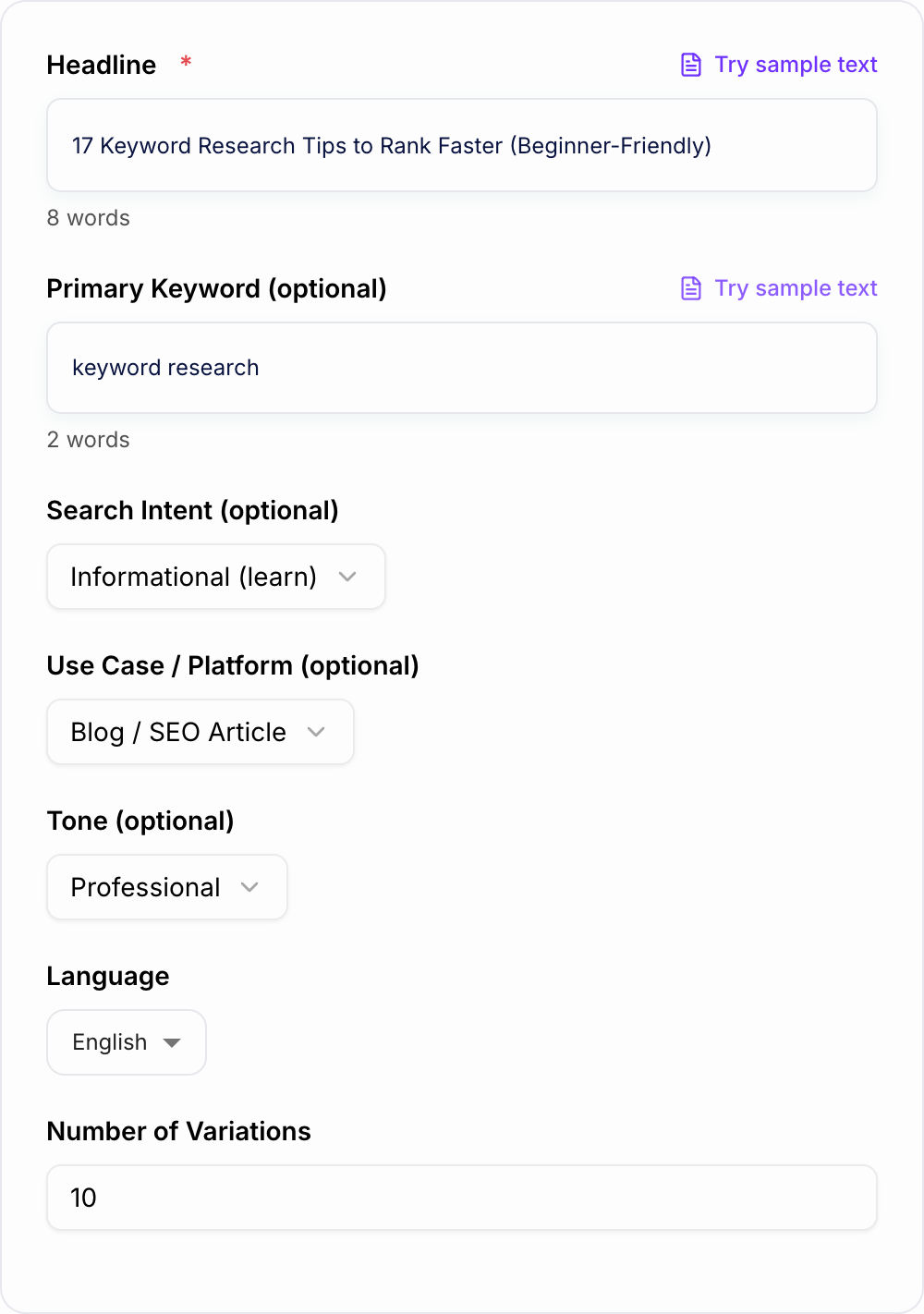
Enter your title or subject line. Optionally add a primary keyword and choose your platform (blog, landing page, email, YouTube, social, ads) for more tailored recommendations.
Get a Score + Clear Fixes
Receive a headline score and a breakdown of what’s helping or hurting performance—like vague phrasing, weak benefits, poor keyword placement, or intent mismatch.
Copy Optimized Variations
Choose from multiple improved versions, then test them in your CMS, SERP snippets, ads, or email campaigns to find the best performer.
See It in Action
See how a generic title becomes more specific, intent-aligned, and SEO/CTR friendly with clearer benefits and stronger structure.
Keyword Research Tips
Keyword Research for Beginners: 17 Tips to Find Low-Competition Keywords and Rank Faster
Why Use Our AI Headline Analyzer?
Powered by the latest AI to deliver fast, accurate results.
SEO Headline Score (Clarity, Intent, Keyword Fit)
Get an easy-to-understand score with SEO-focused checks like keyword placement, search intent alignment, and SERP-friendly structure—so your title matches what people actually search.
CTR & Readability Optimization
Improve click-through rate with clearer benefits, stronger hooks, and tighter wording—while keeping the headline readable, trustworthy, and not clickbait.
Actionable Rewrite Suggestions (Not Generic Tips)
Receive specific, line-level recommendations (what to change and why) to make your headline more compelling, more specific, and more aligned to your audience.
Multiple Optimized Headline Variations
Generate several high-quality headline alternatives for different angles (how-to, list, question, benefit-led, problem/solution) to test for SEO and conversions.
Platform-Aware Titles (Blog, Landing Page, Email, YouTube, Ads)
Adapt your headline to the channel—shorter subject lines for email, stronger hooks for YouTube, or intent-driven SERP titles for SEO pages.
Pro Tips for Better Results
Get the most out of the AI Headline Analyzer with these expert tips.
Put the main keyword early—without forcing it
For SEO titles, front-loading the primary keyword can improve relevance and scanning. Keep it natural and readable; avoid awkward phrasing or stuffing.
Make the benefit obvious in 1 quick glance
Great headlines answer “What do I get?” fast. Use concrete outcomes (save time, rank higher, reduce costs) rather than vague promises (better, amazing, ultimate).
Match the headline to the search intent
Informational titles should promise learning and steps. Commercial titles should frame comparisons and criteria. Transactional titles should highlight action, offer, or next step.
Use specificity to beat generic competitors
Add numbers, timeframes, audiences, or constraints (e.g., “for beginners,” “in 10 minutes,” “for SaaS”) to increase credibility and clicks.
Generate 10+ options, then choose 2–3 to test
Don’t settle on the first ‘good’ option. Pick a few distinct angles (how-to vs list vs question) and A/B test where possible.
Who Is This For?
Trusted by millions of students, writers, and professionals worldwide.
Score and Improve Titles with the Headline Analyzer
A headline analyzer is useful when you already have a title but are not sure whether it is clear, specific, searchable, and clickable enough to publish. The goal is not to chase a perfect score. The goal is to see what is weak and fix the title before it costs you clicks.
Paste a headline, choose the platform or intent, then use the score and rewrite notes to compare better options. If the current title has no strong angle at all, generate a few fresh headline options first and bring the best ones back into the analyzer for scoring.
What the Analyzer Checks
The tool reviews headline quality across several practical signals:
- Clarity: can a reader understand the topic instantly?
- Specificity: does the title include a real outcome, audience, number, timeframe, or constraint?
- Intent match: does it fit the search, email, ad, social, landing page, or YouTube context?
- Keyword fit: does the main phrase appear naturally where SEO matters?
- Emotional pull: does the headline give someone a reason to care?
- Length and readability: will it survive truncation, mobile previews, and fast scanning?
- Promise accuracy: does the headline avoid inflated or misleading claims?
The best feedback is usually about the pattern of issues. If every variation scores low on clarity, the topic is probably buried. If every variation scores low on intent, the angle may not match what the audience is trying to do.
What to Enter for a Better Analysis
Paste the exact headline you are considering, not a rough topic. Then choose the context:
- Blog or SEO title: include the target keyword or search intent if you have one.
- Landing page headline: focus on offer, audience, and outcome.
- Email subject line: keep it short enough to preview clearly.
- Ad headline: check specificity and compliance-friendly wording.
- YouTube title: balance curiosity with a visible payoff.
- Social headline: make the hook clear without hiding the topic.
If you are analyzing SEO titles, compare your draft with a few strong headline examples so you can tell whether the issue is structure, specificity, or simply a weak angle.
How to Use the Score Without Over-Optimizing
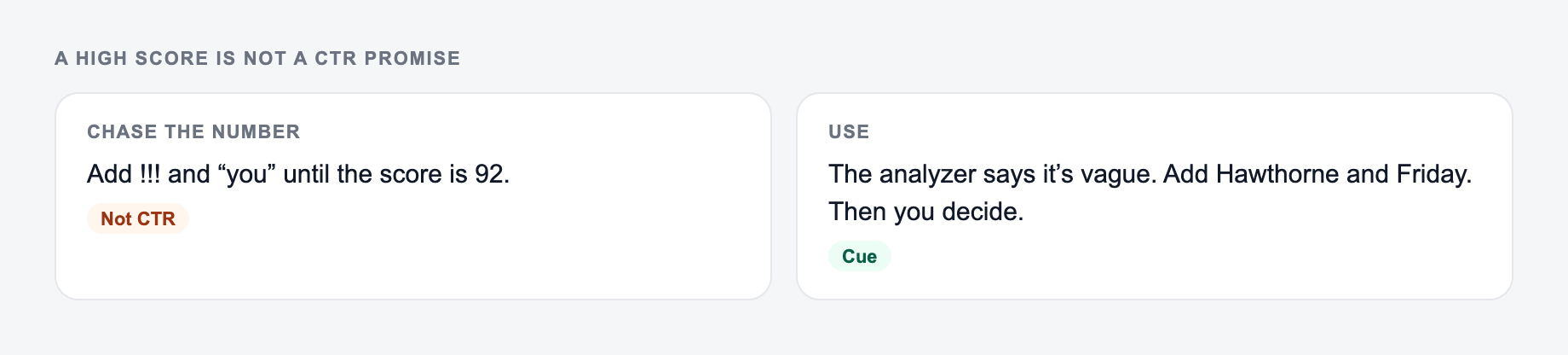
A high score is helpful, but it is not the final decision. A slightly lower-scoring headline can still win if it matches the audience and page better.
Use the score to decide what to revise:
- If clarity is weak, move the main topic closer to the front.
- If the title feels generic, add an audience, benefit, number, or constraint.
- If the keyword feels forced, rewrite the sentence around intent instead of repeating the phrase.
- If the hook sounds clickbait, replace exaggeration with proof or specificity.
- If the title is too long, cut adjectives before cutting the core promise.
For SEO, the first half of the headline matters most because search snippets can truncate. Put the main topic and differentiator early.
Example Analysis Workflow
Rough headline:
Enter the title and where it will appear. A high score is not a CTR promise.
Input / output pair to copy:
IN: A one-line request like “run the headline analyzer” with no audience, channel, or constraint.
OUT: A brief the AI Headline Analyzer can use: who it is for, where the output will appear, and what must stay true.
If your real run diverges from that shape — extra claims, missing names — change the input, not the hope.
Better Marketing Ideas for Small Businesses
Likely problems:
- too broad
- no channel or outcome
- no clear search intent
- no reason to click this result instead of another one
Improved versions to test:
- Small Business Marketing Ideas: 21 Low-Budget Ways to Get More Leads
- Local Marketing Ideas for Small Businesses That Need Customers This Month
- 17 Small Business Marketing Ideas You Can Launch Without an Agency
Run each version through the analyzer and compare the feedback. The best title should be clear even before someone sees the article.
When to Use the Headline Generator First
If your input looks like the miss, do not judge the tool yet — add the noun and the constraint first.
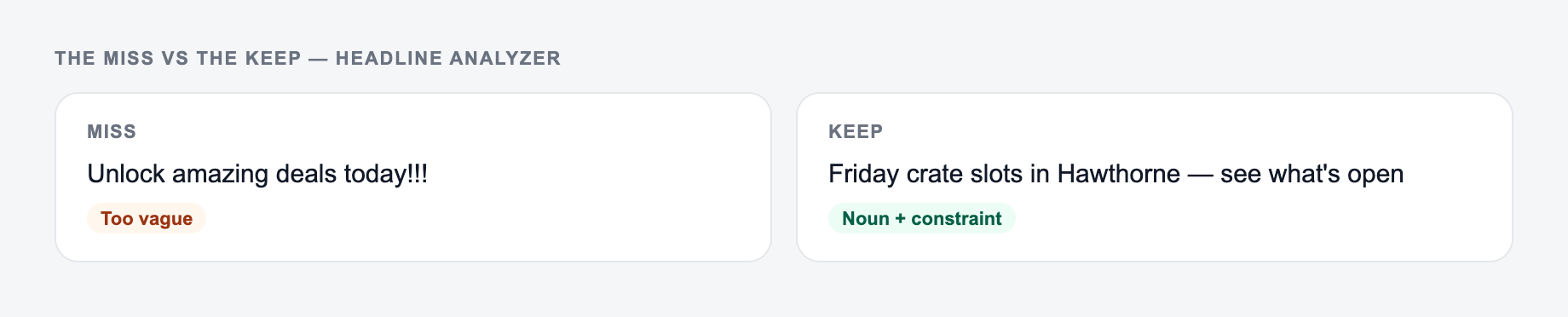
Use the analyzer when you have candidates. Use the generator when you need more angles.
If you are stuck with one flat title, the fastest workflow is to generate better headlines, shortlist three to five different angles, and analyze those finalists here. This gives the analyzer a real comparison set instead of forcing one weak draft through endless tiny edits.
Common Headline Problems the Analyzer Can Catch
- leading with filler such as "ultimate," "complete," or "best ever"
- hiding the topic until the end
- making a promise the page does not support
- using clever wording that slows comprehension
- writing one headline style for every channel
- stuffing two or three ideas into one title
- using a keyword but missing the actual reader intent
When you need inspiration before rewriting, browse practical headline examples and compare how they use numbers, constraints, audience labels, and benefits. Do not copy the surface formula blindly; copy the clarity.
Final Headline Review Checklist
Edge cases worth one run:
- Empty or two-word input — it should ask for a noun, not invent a project.
- Mixed lists — one delimiter per run.
- Protected terms — lock them before you generate.
Before publishing, ask:
- Would the right reader understand this in one glance?
- Does the headline match the page, email, ad, or video exactly?
- Is the strongest keyword or topic visible early?
- Is the promise specific but still honest?
- Would this stand out beside similar results?
- Do you have a backup title ready if performance is weak?
For larger campaigns, it is easier to keep titles, drafts, and supporting copy consistent inside an AI writing workspace like Junia AI, especially when several pages need the same tone and positioning.
Frequently Asked Questions
What does this headline analyzer check?+
It evaluates key headline factors that impact SEO and clicks: clarity, specificity, readability, keyword alignment, search intent fit, and the strength of the hook (benefit, curiosity, or urgency). It then provides targeted improvements and optimized variations.
Does a better headline help SEO rankings?+
A stronger headline can improve organic CTR and user engagement, which can support SEO performance over time. Rankings still depend on content quality, relevance, backlinks, internal links, and technical SEO—but a better title helps your page earn clicks in the first place.
Do I need to enter a keyword?+
No. If you don’t provide a primary keyword, the tool infers the likely keyword topic from your headline and suggests improvements based on relevance and intent.
How long should an SEO title be?+
Most SEO titles perform best when they’re concise and scannable. The tool will recommend tightening overly long titles and putting the most important terms earlier to reduce truncation risk and improve clarity.
Will the tool generate clickbait headlines?+
No. The suggestions prioritize clarity, credibility, and accurate promises. You’ll get click-worthy options that remain aligned with the content and avoid misleading claims.
Can I use this for YouTube titles, ads, or email subject lines?+
Yes. Select your platform/use case and the analyzer will tailor recommendations and variations to that channel’s best practices (length, hook style, and clarity requirements).