
Free Hook Generator
Generate attention-grabbing hooks for videos, ads, emails, blog intros, social posts, and landing pages. Add your topic, audience, platform, goal, and tone to get curiosity, proof, problem-solution, contrarian, and urgency hooks you can test fast.
Hooks
Your hook ideas will appear here...
How the AI Hook Generator Works
Get results in seconds with a simple workflow.
Enter Your Topic or Offer
Describe what you’re promoting or teaching (product, service, video idea, email topic). Add audience context if you have it for more relevant hooks.
Pick Platform, Goal, and Angle
Choose where the hook will be used (TikTok/Reels, ads, email, landing page), what you want (watch time, clicks, leads, sales), and a hook angle (curiosity, proof, mistakes, etc.).
Generate, Test, and Iterate
Get a batch of hook ideas you can plug into scripts, ads, or headlines. Test top candidates, then regenerate with a new angle or tighter audience to improve performance.
See It in Action
Turn a basic idea into multiple high-performing hook variations tailored to platform, audience, and goal.
I need a hook for a video about local SEO for small businesses.
- “Most small businesses do local SEO backwards—here’s the fix.”
- “If you’re not showing up on Google Maps, do this first.”
- “3 local SEO mistakes that silently kill your calls.”
- “The fastest way to rank locally (without more blog posts).”
- “Steal my 10-minute local SEO checklist for more leads.”
Why Use Our AI Hook Generator?
Powered by the latest AI to deliver fast, accurate results.
Platform-Specific Hook Templates
Generate hooks tailored to TikTok, Instagram Reels, YouTube, ads, email subject lines, and landing page headlines—so the length, rhythm, and style fit the channel.
Multiple High-Converting Hook Angles
Create curiosity hooks, problem-solution openers, contrarian takes, proof-based hooks, and urgency hooks—great for testing different creative angles and improving CTR.
Audience + Goal Targeting
Adapt hooks to your audience and objective (watch time, clicks, leads, sales) to improve relevance, retention, and conversion-focused messaging.
Natural, Non-Clickbait Copy
Produces punchy hooks that are compelling without misleading claims—ideal for brand-safe marketing, creator content, and compliant advertising.
Rapid A/B Testing for Creative Performance
Generate many hook variations at once to test different openings, messaging, and positioning—useful for UGC scripts, paid social creatives, and email campaigns.
Pro Tips for Better Results
Get the most out of the AI Hook Generator with these expert tips.
Lead with a specific outcome
Hooks convert better when they promise a clear result (time saved, revenue gained, mistake avoided) rather than generic motivation.
Use proof cues without hard numbers
If you don’t have verifiable stats, use credible signals like “a simple checklist,” “the framework we use,” or “a common mistake I see” to build trust without inventing data.
Match hook style to platform behavior
Short-form hooks should be ultra-tight and curiosity-driven; landing page hooks should be clarity-first; email hooks should be concise and curiosity-led without misleading claims.
Pair each hook with a fast payoff
The next line should immediately deliver context or value (what, who, and why). This reduces drop-off and improves watch time and engagement.
Build a swipe file of winners
Save hooks that perform well and reuse the underlying patterns for new topics—this speeds up ideation and improves consistency across campaigns.
Who Is This For?
Trusted by millions of students, writers, and professionals worldwide.
Generate Stronger Hooks with an AI Hook Generator
A good hook does one job: it makes the right person want the next line, next second, or next click.
The hook generator helps you create those first lines faster by turning a topic, offer, audience, platform, and goal into several usable hook angles. Instead of writing one opener and hoping it works, you can generate a set of curiosity hooks, proof hooks, mistake hooks, how-to hooks, and direct benefit hooks, then test the strongest options.
Use it when you need opening lines for:
- TikTok, Reels, and YouTube Shorts
- YouTube intros
- paid social ads and Google-style ad headlines
- email subjects and newsletter openers
- blog introductions
- landing page hero headlines
- LinkedIn posts, X posts, and social captions
The point is not to make every hook louder. It is to make every hook more specific, easier to understand, and better matched to the channel.
What to Enter Into the Hook Generator
The quality of the output depends heavily on the topic field. A broad topic gives you broad hooks. A specific topic gives you hooks that feel written for a real campaign.
Weak input:
SEO tool
Better input:
AI SEO assistant that helps local dentists improve Google Maps visibility and get more appointment calls
The second version gives the generator an audience, product category, outcome, and channel context. That makes it much easier to produce hooks with a clear promise.
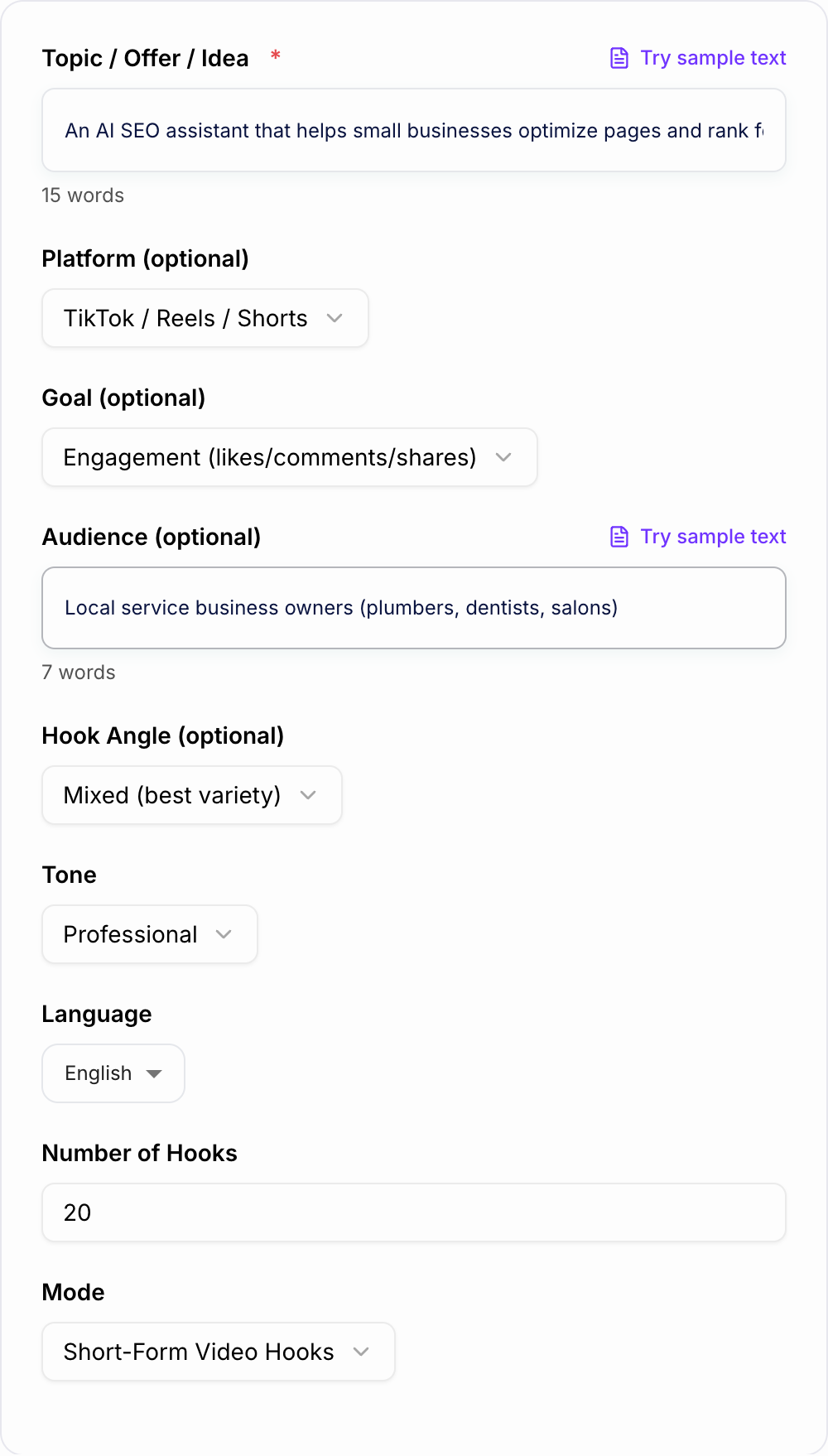
When filling out the form, include:
- the product, topic, offer, or content idea
- the audience you want to stop
- the platform where the hook will appear
- the goal, such as watch time, clicks, leads, or sales
- the angle you want to test
- the tone and language
- the number of variations you need
If you are unsure, start with a detailed topic and choose Mixed for the angle. That gives you a broader set of ideas before you narrow down.
How to Choose the Right Hook Mode
Different hook formats work for different jobs. A great email subject line can be too vague for an ad. A strong TikTok opener can feel too casual for a landing page.
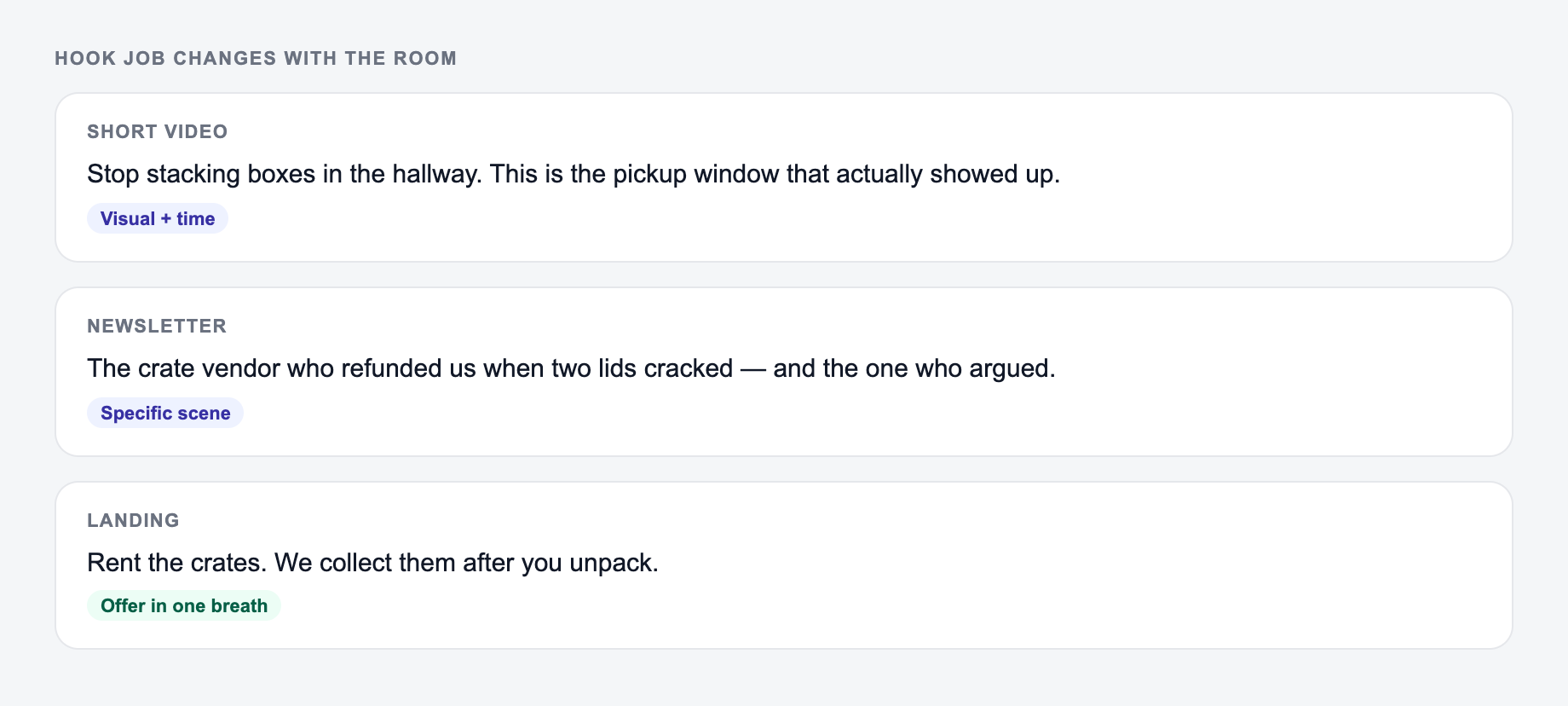
Use Short-Form Video Hooks when the first one or two seconds matter. These hooks should be short enough to say quickly and direct enough to pair with an immediate visual.
Use Ad Hooks when the hook needs to support a conversion. These should lead with a clear benefit, pain point, objection, or differentiator.
Use Email Subject Hooks when you need curiosity and relevance without baiting the reader. The subject line should connect naturally to the first sentence of the email.
Use Landing Page Hero Hooks when clarity matters more than cleverness. The hook should quickly explain who the offer is for and what outcome it creates.
Use Blog Intro Hooks when the reader arrived with search intent. The hook should acknowledge the problem and set up the article's promise.
Use Expert Conversion Hooks when you need sharper positioning. This mode is better for offers where proof, objections, and differentiation matter.
Example Input and Generated Hook Set
Hooks fall flat when all you give is a topic. Add the audience, the platform, and the payoff your content can actually deliver.
- Channel: Short video · Hook job: Stop the scroll in one line · Discard if: The video cannot show the payoff
- Channel: Newsletter · Hook job: Open the email · Discard if: Fake urgency
- Channel: Landing page · Hook job: Connect offer to outcome · Discard if: A joke that hides the product
Input:
AI SEO assistant for local dentists that helps improve Google Maps rankings and generate more appointment calls.
Audience:
Dental clinic owners and practice managers.
Goal:
Leads.
Angle:
Mixed.
Possible output:
- Most dentists are invisible on Google Maps for one simple reason.
- If your dental clinic is not getting local calls, check this first.
- Your website might not be the problem. Your local SEO signals might be.
- Before you pay for more ads, fix these Google Maps basics.
- The 10-minute local SEO check every dental clinic should run.
Do not treat every generated hook as ready to publish. Treat the output as a strong testing set.
How to Review Generated Hooks
Before you use a hook, check five things.
First, does the audience recognize itself immediately? A hook for "business owners" is weaker than a hook for "solo dentists," "SaaS founders," or "new real estate agents."
Second, does it create a clear reason to keep reading or watching? That reason can be a benefit, curiosity gap, mistake, warning, proof cue, or useful shortcut.
Third, is it believable? Hooks that sound too extreme often earn attention but lose trust.
Fourth, can the next line pay it off? If the content does not deliver quickly, the hook becomes clickbait.
Fifth, does the length fit the platform? Video hooks need to be short. Landing page hooks need to be clear. Email hooks need to fit the inbox.
How to Turn Generated Hooks Into a Testing Workflow
Generate more hooks than you need, then group them by angle:
- curiosity
- problem-solution
- proof
- contrarian
- how-to
- mistake
- urgency
Pick two or three angles that best fit the offer. Then regenerate using those specific angle settings. This usually produces stronger second-round options than trying to perfect one hook manually.
For short-form video, test hooks against retention. For ads, test hooks against click-through rate and conversion quality. For emails, test open rate alongside replies, clicks, or downstream conversions. A high-open subject line is not useful if the email disappoints readers.
If you are building a larger content workflow, you can pair generated hooks with scripts, landing page copy, and campaign drafts inside Junia AI, then keep the hooks that actually perform.
Common Hook Generator Mistakes
The first mistake is entering only a topic. Add audience and outcome details so the generator has something concrete to work with.
The second mistake is choosing a clever hook for a clarity-first channel. Landing page heroes and direct-response ads usually need a clear benefit before wordplay.
The third mistake is generating only five hooks. If you are testing creative, generate enough variation to compare angles.
The fourth mistake is using a hook that the content cannot support. A strong hook should raise interest, not write a check the rest of the piece cannot cash.
The fifth mistake is ignoring the platform. A 12-word video hook may work beautifully on Reels, but an email subject line may need a different rhythm.
Final Checklist Before You Publish
Use this checklist before posting, sending, or launching:
- The hook names the audience or problem clearly.
- The promise is specific enough to matter.
- The hook fits the platform's pace and format.
- The next sentence or scene pays off the hook.
- The hook does not rely on fake urgency or exaggerated proof.
- You have at least a few alternate angles to test.
The fastest way to improve hooks is not to stare at one sentence for an hour. Generate a focused set, choose the most believable angles, and test the versions that give the audience a real reason to keep going.
Payoff Pairing: Never Review the Hook Alone
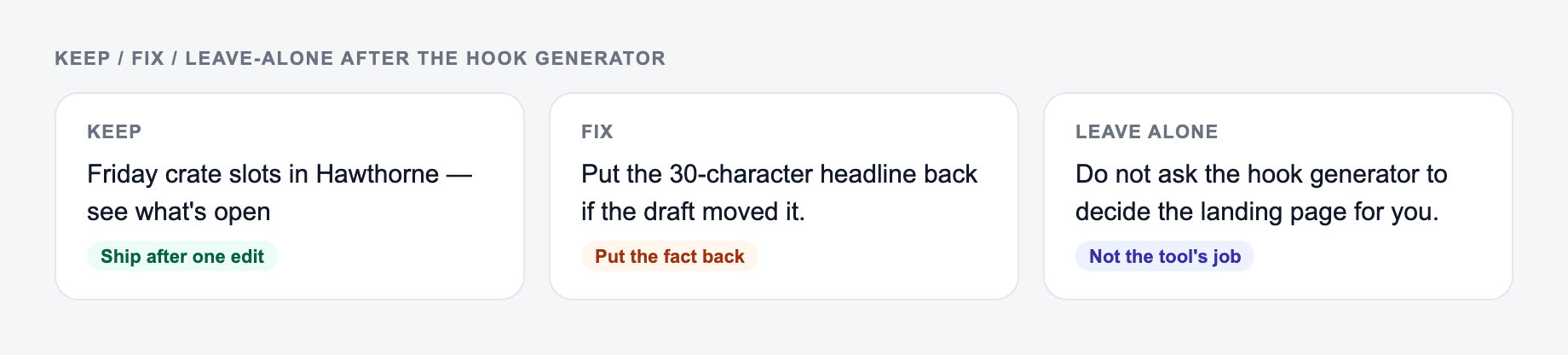
Pair every candidate with the next line or first visual. Example: hook “Your trial users may not be stuck where you think” needs an immediate payoff such as “Open the activation report and separate account creation from the first completed task.” If the content cannot deliver that step, reject the hook even if it sounds intriguing.
Frequently Asked Questions
What is a hook in marketing or content creation?+
A hook is the opening line (or first few seconds) designed to grab attention and keep someone reading or watching. Strong hooks increase retention, clicks, and conversions by quickly communicating curiosity, a benefit, or a compelling problem.
What platforms is this hook generator best for?+
It works for TikTok, Instagram Reels, YouTube Shorts, long-form YouTube intros, paid ads (Facebook/Instagram/Google-style headlines), email subject lines, landing page hero headlines, and social posts.
How many hooks should I test?+
For short-form video and ads, testing 10–30 hooks per concept is common. Use a few different angles (curiosity, proof, mistakes, how-to) and track retention, CTR, and conversions to find winners.
How do I make hooks convert without sounding clickbaity?+
Anchor hooks in a real promise: a clear outcome, credible proof cues, and a specific audience. Avoid exaggerated claims, then deliver quickly on the hook in the next line or first steps of the video.
Can it generate hooks in different tones and languages?+
Yes. Select a tone and language to generate localized hooks that match your brand voice—helpful for multilingual marketing and international audiences.
What should I enter as the topic for best results?+
Include your offer or message, who it’s for, and the outcome (e.g., “meal plan for busy parents to lose weight” or “local SEO checklist for plumbers”). The more specific the outcome, the sharper the hooks.