
Free IEP Goals Generator
Create SMART, measurable IEP goals from a student skill area, baseline, needs, measurement method, and grade level. Generate annual goals, short-term objectives, progress monitoring language, and support ideas you can review before adding to an IEP draft.
IEP Goals
Your IEP goals (SMART + measurable) will appear here...
How the AI IEP Goals Generator Works
Get results in seconds with a simple workflow.
Choose a Skill Area (and Optional Focus)
Select the IEP goal domain (reading, writing, math, behavior, speech, OT, executive functioning, etc.). Optionally add a specific focus like fluency, inferencing, self-regulation, or organization.
Add Baseline + Measurement Method
Optionally paste present levels/baseline performance (PLAAFP). Choose how progress will be measured (CBM, rubric, frequency, duration, work samples).
Generate Goals and Customize
Get measurable annual goals (and optional objectives). Review wording, adjust criteria to match the student’s data, and align with your district’s IEP format and reporting requirements.
See It in Action
Example of turning a vague goal into a measurable SMART IEP goal with clear criteria and progress monitoring language.
Reading Goal: Student will improve reading comprehension.
H2: Annual Goal (Reading Comprehension) By the annual review date, given a grade-level passage and 5 comprehension questions, the student will answer inferential and literal questions with at least 80% accuracy across 3 consecutive probes, as measured by curriculum-based measurement (CBM).
H3: Objectives/Benchmarks
- Given a passage and visual supports (e.g., key details highlighted), the student will answer 5 literal questions with 70% accuracy across 3 probes.
- Given a passage and a graphic organizer, the student will identify 2 supporting details and answer 5 mixed questions with 75% accuracy across 3 probes.
- Given a passage without supports, the student will answer 5 mixed questions with 80% accuracy across 3 consecutive probes.
Progress Monitoring Method: CBM comprehension probes Frequency: Biweekly Data: % accuracy per probe; trend line reviewed monthly
Why Use Our AI IEP Goals Generator?
Powered by the latest AI to deliver fast, accurate results.
SMART, Measurable IEP Goals (Annual Goals + Objectives)
Generate clear IEP annual goals written in SMART format with measurable criteria, conditions, and mastery targets. Optionally includes short-term objectives/benchmarks that build toward the annual goal.
Baseline-Aware Goal Writing (PLAAFP-Aligned)
Incorporates the student's present levels and baseline performance to create realistic growth targets—helpful for writing defensible, data-informed IEP goals.
Progress Monitoring Built In
Adds practical progress monitoring details like measurement method, data collection frequency, and performance criteria—making it easier to track IEP progress and report results.
Skill-Area Templates Across Special Education Needs
Supports common IEP goal domains including reading, writing, math, speech/language, behavior, executive functioning, OT, and life skills—each with domain-appropriate metrics and language.
Clear, Compliance-Friendly Wording
Produces goal language that is specific, observable, and measurable (while staying general and non-legal). Ideal for drafting and then adapting to district requirements and student context.
Pro Tips for Better Results
Get the most out of the AI IEP Goals Generator with these expert tips.
Anchor goals to baseline data for measurable growth
Include a starting point (e.g., % accuracy, frequency per day, WCPM, rubric score). Baseline-informed goals are easier to monitor, justify, and explain during IEP meetings.
Define conditions clearly to reduce ambiguity
Add the conditions under which the skill will be demonstrated (e.g., given a graphic organizer, with visual cues, during independent work, in a small group). This improves consistency across staff and settings.
Choose one main metric per goal when possible
Avoid mixing multiple measures in one goal (e.g., accuracy + speed + independence). Use one primary metric and keep additional metrics as objectives or notes to simplify progress monitoring.
Use observable behaviors for behavior/social-emotional goals
Replace vague terms (e.g., “will behave appropriately”) with observable actions (e.g., “will request a break,” “will follow directions within 1 prompt,” “will use a coping strategy”).
Write objectives as a progression toward mastery
Short-term objectives should increase in difficulty or independence over time (e.g., with prompts → minimal prompts → independent; structured setting → generalization).
Who Is This For?
Trusted by millions of students, writers, and professionals worldwide.
Generate measurable IEP goals with the AI IEP Goals Generator
The IEP Goals Generator is most useful when you treat it as a drafting workspace, not a final decision maker. It can turn a skill area, baseline, and measurement method into a clear annual goal, but the final wording still needs to match the student record, team decisions, and local IEP format.
Use it when you need a faster starting point for SMART goals, short-term objectives, progress monitoring language, or accommodations aligned to a specific skill need.
What to enter before you generate goals
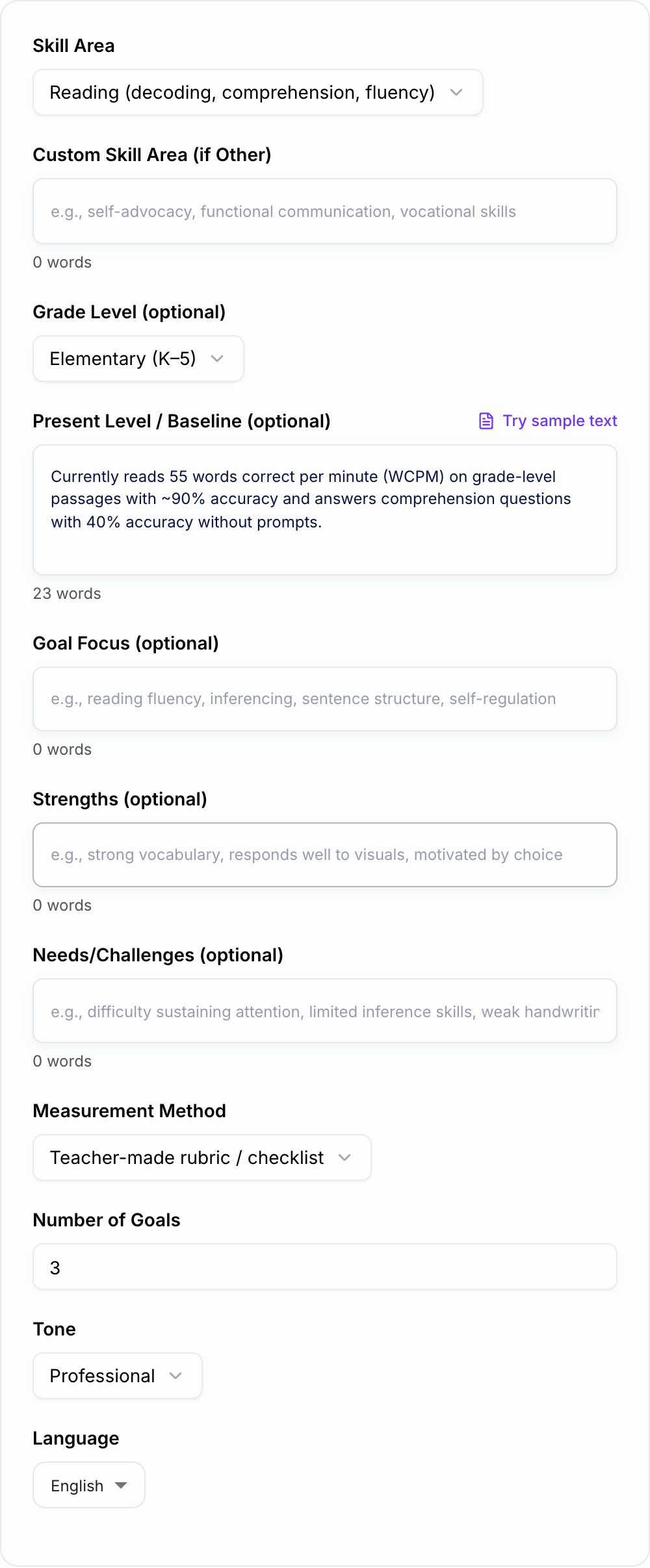
The strongest output comes from specific inputs. Start with the required skill area, then add as much student context as you can safely use.
Useful details include:
- Present level or baseline data
- Grade level or transition age range
- Goal focus, such as reading fluency, inferencing, task initiation, articulation, or self-regulation
- Strengths that can support instruction
- Needs or barriers that affect performance
- Preferred measurement method
- Number of goals you want
A weak input is: "reading comprehension."
A stronger input is: "Currently answers 2/5 inferencing questions correctly on grade-level passages with a graphic organizer; needs support citing evidence from the text."
That second version gives the generator enough information to draft a goal with conditions, criteria, and progress monitoring language.
Choose the right IEP goal mode
Use Annual Goals when you only need measurable annual goal drafts. This is a good choice for early brainstorming or when your district form already has separate fields for objectives.
Use Goals + Objectives when the student needs benchmark steps. This mode works well for skills that should move from supported practice to independence, such as reading comprehension, behavior routines, executive functioning, life skills, or AAC use.
Use Progress Monitoring Plan when the goal needs clearer data collection language. This is especially helpful when a draft sounds measurable but does not say how evidence will be collected.
Use Accommodations & Supports when you want aligned support ideas. Treat these as general suggestions, then check them against the student's services, placement, evaluation data, and team recommendations.
How to review the generated IEP goal
Before you copy any goal into an IEP draft, check the wording against five practical questions:
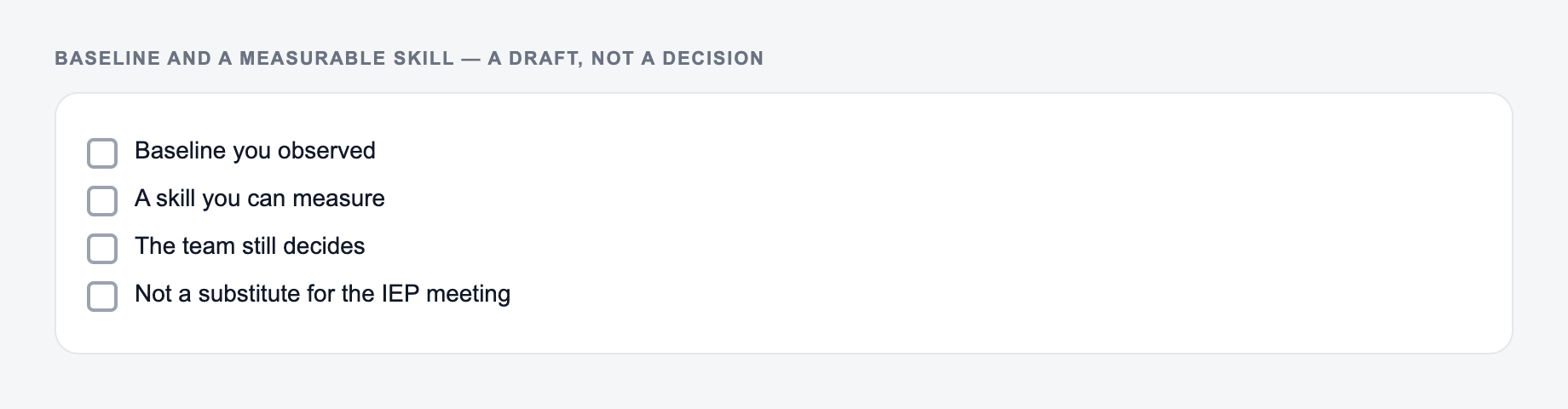
Baseline and a measurable skill belong on the form. This is a draft aid, not an IEP decision.
How to verify IEP-goal output:
- Condition, behavior, and criterion are all present
- No diagnosis or service you did not type
- A named team member still owns the goal
If the task is graded, cited, or used with students, the named writer still owns the claims.
- Can the skill be observed or scored?
- Does the goal include the condition or support level?
- Is the mastery criterion clear enough for another staff member to measure?
- Does the measurement method fit the skill?
- Does the goal show reasonable growth from the baseline?
For example, "will improve attention" is not ready. "Given a visual checklist and one verbal prompt, the student will begin an assigned independent task within 2 minutes in 4/5 observed opportunities across 3 consecutive weeks" is much easier to monitor.
Turn baselines into stronger generated goals
Baseline data is the fastest way to improve the output. Even one number can keep a goal from becoming vague.
Strong baseline examples include:
- Reads 55 words correct per minute on a grade-level passage
- Answers 2/5 inferencing questions correctly
- Scores 2/4 on a paragraph organization rubric
- Completes 3/8 task-analysis steps independently
- Uses a coping strategy in 1/5 observed opportunities
- Remains on task for 4 minutes before redirection
When you enter a baseline, the generator can propose a target that has a visible growth path. Without it, the tool has to rely on more general wording.
Edit objectives so they show progression
The IEP Goals Generator drafts structure. You still own the claim. If you cannot explain a sentence without looking it up, do not leave it in.
Short-term objectives should not be three copies of the same sentence. After generating them, look for a real ladder.
Good progression patterns include:
- More support to less support
- Easier task to harder task
- Small group setting to general classroom setting
- Lower accuracy to higher accuracy
- Fewer independent steps to more independent steps
- Shorter duration to longer duration
If the generated objectives feel too similar, revise the criteria or conditions so each one marks a different stage of learning.
Use progress monitoring language carefully
The generator can draft progress monitoring language, but you should make the data plan realistic for the people collecting it.
A clean progress monitoring note usually names:
- Method: CBM probe, rubric, checklist, work sample, frequency count, duration recording, or observation
- Frequency: weekly, biweekly, monthly, or by reporting period
- Collector: case manager, teacher, SLP, OT, related service provider, or team member
- Review rule: when the team will look at the trend and adjust instruction
Avoid monitoring plans that sound impressive but cannot be collected consistently in a school week.
Final checklist before using the generated draft
Keep the line you could publish. Put facts back. Do not outsource the judgment call.
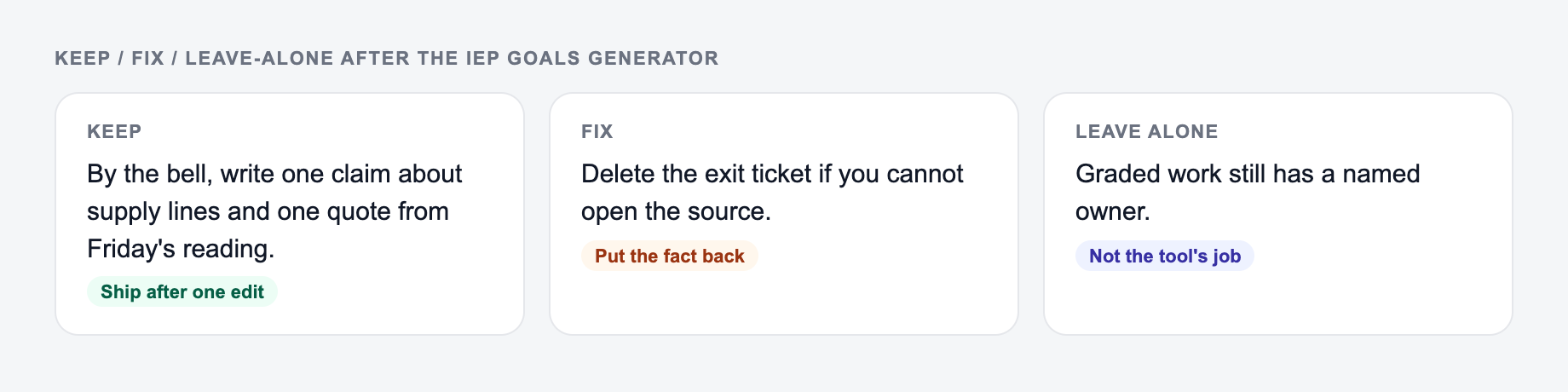
Use the generated output as a starting point, then make the professional pass yourself.
Check that:
- The goal aligns with PLAAFP and evaluation data
- The skill area matches the service or instructional need
- The criteria are realistic and measurable
- Objectives build toward the annual goal
- Accommodations are appropriate and not overpromised
- The wording fits your district form
- The team has reviewed anything that affects services or placement
For broader AI-assisted drafting workflows, Junia AI can help create structured educational, planning, and writing outputs, but IEP goals still need human review because they affect a real student's support plan.
Frequently Asked Questions
Does this IEP goals generator create SMART goals?+
Yes. It generates SMART-style IEP annual goals with specific conditions, measurable criteria, and clear mastery targets. You can also include short-term objectives/benchmarks for step-by-step progress.
Can I use this for different IEP goal areas (reading, writing, behavior, speech, OT)?+
Yes. Choose a skill area (e.g., reading comprehension, written expression, social-emotional/behavior, speech/language, OT/fine motor, executive functioning, life skills). The tool adapts the goal wording and measurement to the selected domain.
Do I need to enter a baseline or present level?+
No. You can generate goals with only a skill area and measurement method. However, adding a brief baseline (PLAAFP) typically produces more realistic and defensible targets.
What progress monitoring methods does it support?+
It supports common progress monitoring approaches such as CBM probes, rubrics/checklists, work samples, frequency or duration recording, rating scales, task analysis, and structured observations. You can pick the method that fits your setting.
Is this a substitute for district policies or legal guidance?+
No. This tool provides drafting help and general best-practice wording. Always review, adapt to district templates, confirm alignment with evaluations and present levels, and follow your school/district procedures.
How can I make the goals more individualized and less generic?+
Add the student’s baseline data, specific skill breakdown (e.g., inferencing vs main idea), common supports that work (visuals, prompts), and the setting/conditions (small group, given a graphic organizer, using AAC). Then review and tailor the final language.