
Free Job Responsibilities Generator
Generate clear, role-specific job responsibility bullets for job descriptions, hiring plans, HR templates, and internal role docs. Add the job title, seniority, department, skills, and work model to create scannable responsibilities that match the actual scope of the role.
Job Responsibilities
Your job responsibilities will appear here (clear, role-specific bullet points)...
How the AI Job Responsibilities Generator Works
Get results in seconds with a simple workflow.
Enter a Job Title
Type the role name (e.g., Sales Development Representative, Product Designer, Data Analyst). This is the only required field.
Add Optional Context (Level, Team, Skills)
Select seniority level, department, industry, and key tools to generate responsibilities that better match real-world expectations and workflows.
Generate and Customize
Get a clean list of responsibilities. Copy into your job description, then tweak a few bullets to reflect your KPIs, deliverables, and internal processes.
See It in Action
Example showing how a vague role note becomes clear, ATS-friendly job responsibility bullets.
Job: Marketing Manager
Need someone to handle marketing, grow the brand, and manage campaigns.
H2: Key Responsibilities
- Own the marketing calendar and campaign planning across acquisition and retention channels
- Plan, launch, and optimize multi-channel campaigns (paid search, email, SEO, social) to hit growth targets
- Partner with Sales and Product to align messaging, positioning, and go-to-market timelines
- Analyze performance using GA4 and dashboards; report insights and recommend optimizations
- Manage agency and contractor relationships; ensure on-brand creative and on-time delivery
- Improve conversion rates through landing page testing, audience segmentation, and funnel optimization
- Maintain clear documentation, briefs, and post-campaign retrospectives to scale repeatable wins
- Monitor competitors and market trends to identify new opportunities and messaging angles
Why Use Our AI Job Responsibilities Generator?
Powered by the latest AI to deliver fast, accurate results.
Role-Specific Job Responsibility Bullet Points
Generates clear, realistic job responsibilities tailored to your job title, seniority level, and department—ideal for job descriptions, internal role docs, and hiring posts.
ATS-Friendly Formatting for Job Descriptions
Outputs scannable, action-verb bullet points that are easy to read and compatible with ATS parsing—helping you create structured responsibilities fast.
Seniority-Aware Scope (Entry to VP)
Adjusts ownership, autonomy, and leadership expectations based on level—so junior roles don’t read like director roles (and vice versa).
Industry + Skills Context (Optional)
Add an industry and key tools (e.g., Jira, SQL, GA4, Salesforce) to generate responsibilities that match how the role is actually performed in your org.
Consistent Tone and Multilingual Output
Match your company voice with tone controls and generate responsibilities in multiple languages for global teams, localized job posts, and international hiring.
Pro Tips for Better Results
Get the most out of the AI Job Responsibilities Generator with these expert tips.
Make each bullet outcome-focused
The strongest job responsibilities describe outcomes (what success looks like), not just tasks. Add measurable language like “improve,” “reduce,” “deliver,” “own,” and “ensure.”
Avoid unrealistic “wish list” responsibilities
If you list too many advanced responsibilities for a junior role, you’ll reduce qualified applicants. Align expectations with seniority and provide growth paths in the JD.
Mirror your internal collaboration model
If your team is cross-functional, include stakeholder and communication responsibilities (Product, Engineering, Sales, Customer Success) to set expectations early.
Use tools/skills to improve specificity
Adding 3–8 tools/skills (e.g., SQL, Jira, HubSpot, GA4) helps generate responsibilities that feel real and reduces generic job description language.
Keep responsibilities distinct from requirements
Responsibilities should describe work. Put qualifications (years of experience, certifications) in a separate requirements section to avoid confusion and improve readability.
Who Is This For?
Trusted by millions of students, writers, and professionals worldwide.
Generate Clear Job Responsibility Bullets with an AI Job Responsibilities Generator
The Job Responsibilities Generator is built for the part of a job description candidates read most closely: the bullets that explain what the role actually does. Instead of starting from a blank page or copying a stale JD, you can enter the role context and generate responsibility statements that are specific, scannable, and easier to edit.
Use it when you need responsibilities for a job post, hiring plan, internal role doc, onboarding checklist, or performance planning draft. The best results come from treating the generator like a hiring brief, not just a title field.
What to Enter Before You Generate Responsibilities
Start with the job title, but do not stop there. A title like "Marketing Manager" can mean growth, brand, lifecycle, product marketing, or demand generation depending on the company.
Add any details you already know:
- Seniority: entry, junior, mid-level, senior, lead, manager, director, or VP
- Department or team: Growth Marketing, Finance, Product, Customer Success, Operations
- Industry: SaaS, healthcare, ecommerce, education, agency, manufacturing
- Key tools or skills: GA4, SQL, Jira, HubSpot, Salesforce, Figma, Tableau, compliance workflows
- Work model: remote, hybrid, or on-site
- Bullet count: usually 8 to 12 for a job description
A thin input produces broad bullets. A detailed input gives the AI job responsibilities generator enough context to describe real work instead of generic tasks.
How to Choose the Right Generator Mode
Use Job Description Ready when you are writing a public hiring post. This mode keeps the output clean, ATS-friendly, and candidate-facing.
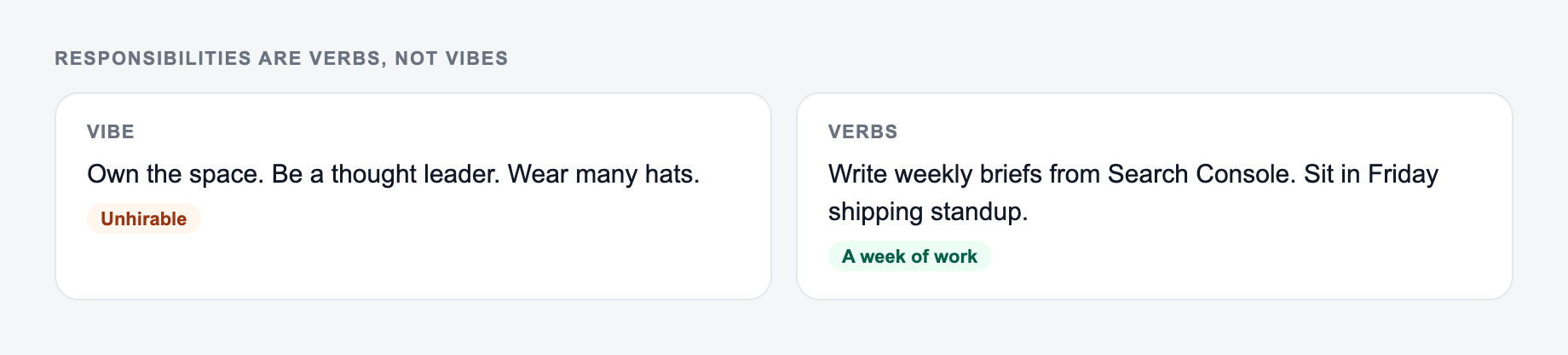
Use Resume/LinkedIn Style when you need responsibility language for a profile, resume, bio, or internal talent document. The wording leans more toward impact and ownership.
Use Manager/Senior Focus for roles that involve strategy, mentoring, stakeholder management, prioritization, and cross-functional ownership. This is useful when a role needs leadership scope without turning every bullet into vague executive language.
Use Entry-Level Friendly when the role should be realistic for new hires. It keeps responsibility bullets clear, learnable, and supported rather than inflated.
Use Compliance & Process for roles where documentation, controls, audits, quality standards, or data handling matter. Review this output carefully so the wording fits your actual policies.
Example Input and Generated Output
Input:
Role, team size, and what “done” means belong on the form before you generate bullets.
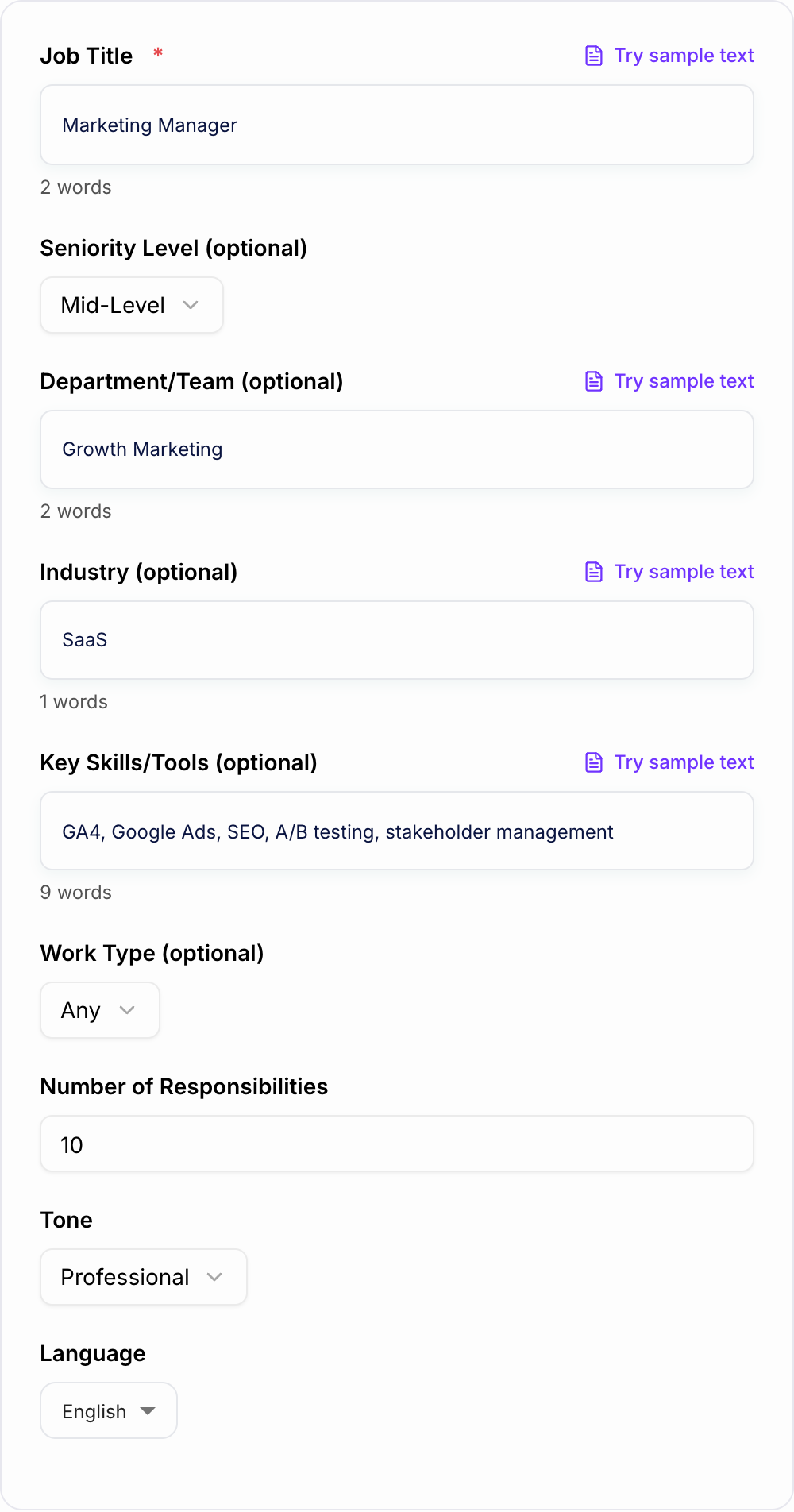
Treat the AI Job Responsibilities Generator as a first draft. Compensation, legal effect, medical content, and anything you would not say in the room still need a person — and often counsel — before they leave your outbox.
This is a draft aid, not legal, HR, or career advice.
- Job title: Customer Success Manager
- Seniority: Mid-level
- Department: Customer Success
- Industry: B2B SaaS
- Skills: onboarding, renewals, QBRs, Salesforce, health scores
- Work type: Remote
- Bullet count: 8
Generated responsibility style:
- Own onboarding for new customers and guide accounts toward clear activation milestones
- Monitor customer health signals in Salesforce and flag expansion, renewal, or churn risks early
- Run QBRs that connect product adoption, business goals, and next-step recommendations
- Partner with Sales, Support, and Product to resolve account issues and improve retention
- Maintain account documentation so distributed teams can understand status, risks, and commitments
Before publishing, add the exact customer segment, renewal process, product names, and internal KPIs your team uses.
How to Review the Generated Responsibilities
Do not publish the first output unchanged. Use it as a strong first draft, then check every bullet against the real role.
Ask these questions:
- Does this describe work the person will actually do?
- Does the responsibility match the seniority level?
- Is the bullet clear without internal jargon?
- Does it describe an outcome, owner, workflow, stakeholder, or tool?
- Is it a responsibility, not a requirement?
- Would a candidate understand what a normal week looks like?
If a bullet says "support projects," make it concrete. Support which projects? With which team? Toward what result?
Keep Responsibilities Separate from Requirements
If your input looks like the miss, do not judge the tool yet — add the noun and the constraint first.
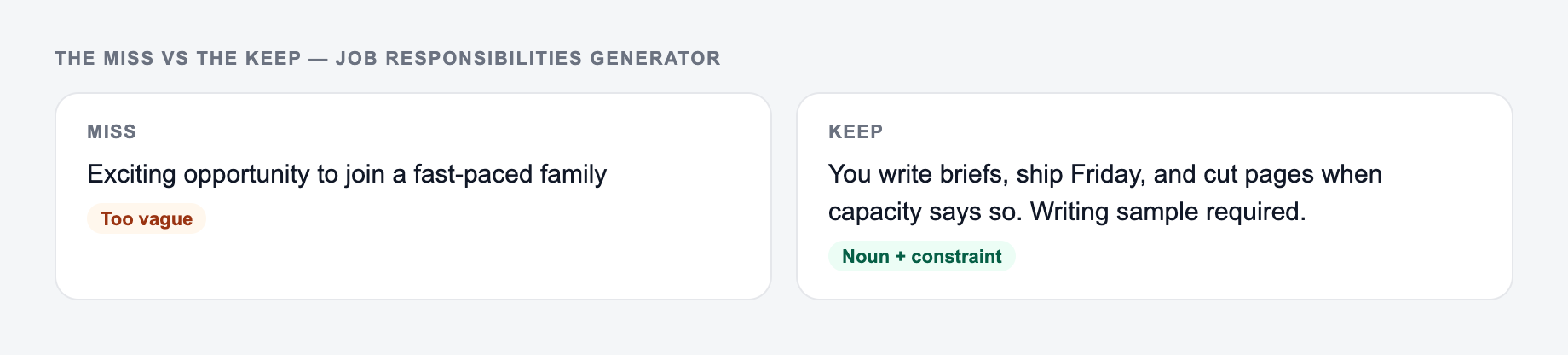
The generator is for responsibility bullets, not candidate requirements. Keep these sections separate in the final JD.
Responsibilities should say:
- Own the monthly reporting dashboard and translate performance trends into recommended actions
- Partner with Product and Sales to align launch messaging and campaign priorities
- Maintain documentation for recurring workflows, handoffs, and post-campaign retrospectives
Requirements should say:
- 3+ years of marketing operations experience
- Experience with HubSpot, Salesforce, and GA4
- Strong written communication and project management skills
This separation makes the job post easier to scan and keeps the responsibilities from turning into a wish list.
How to Make the Output Less Generic
If the generated bullets feel too broad, improve the input instead of manually fighting every line.
Add:
- one KPI the role owns
- two or three tools the person will use
- the main stakeholder groups
- the business stage or team size
- a workflow the role must manage
- a constraint such as remote work, compliance, budget limits, or high volume
For larger hiring workflows, keeping prompts and outputs consistent across tools in Junia AI can help teams create job content faster without losing the human review step.
Final Checklist Before You Use the Responsibilities
Before anything leaves the outbox:
- You can point to the number in a spreadsheet or a contract
- You would sign it if your name were the only one on it
- Compensation, legal effect, and medical content had a human pass
Before you paste the generated bullets into a job description, confirm that:
- the title, level, and scope all agree with each other
- no junior role is accidentally written like a director role
- no senior role is reduced to basic task support
- the final list has 8 to 12 strong bullets, not 20 overlapping ones
- tools and skills appear only where they shape the work
- responsibilities and requirements are separated
- the language sounds clear to someone outside your company
A good responsibility section helps candidates self-select. The generator gets you most of the way there; your final pass makes it honest, specific, and ready to publish.
Frequently Asked Questions
Is this job responsibilities generator free to use?+
Yes. You can generate job responsibility bullet points for free. Some advanced modes may be marked as premium depending on your site’s settings.
What’s the difference between job responsibilities and job requirements?+
Job responsibilities describe what someone will do in the role (day-to-day duties and outcomes). Job requirements describe what the candidate should have (skills, experience, education). This tool focuses on responsibilities.
Are the responsibilities ATS-friendly?+
Yes. The output is designed to be scannable and ATS-friendly with clear bullet points, strong action verbs, and straightforward language that fits typical job description formats.
How do I make responsibilities more accurate for my company?+
Add optional context like department, industry, and key tools/skills. After generating, customize a few bullets to reflect your exact workflows, KPIs, and cross-functional partners.
How many job responsibility bullets should a job description include?+
Most job descriptions perform well with 8–12 responsibility bullets. Senior roles may need fewer, higher-level bullets focused on ownership and outcomes, while entry roles can include clearer task-based responsibilities.
Can I generate responsibilities for remote roles?+
Yes. Choose Remote (or Hybrid) to encourage responsibilities that reflect async collaboration, documentation, and distributed teamwork where appropriate.