
Free Learning Objectives Generator
Generate measurable learning objectives for lesson plans, courses, workshops, syllabi, microlearning, and corporate training. Add the topic, audience, difficulty, subject area, count, and format to create Bloom-aligned or SMART outcomes that are easier to assess.
Learning Objectives
Your learning objectives will appear here...
How the AI Learning Objectives Generator Works
Get results in seconds with a simple workflow.
Enter Your Topic
Add your lesson, course, or training topic. The generator will infer suitable skills and outcomes based on the subject area.
Choose Audience, Level, and Format
Optionally set the audience and difficulty level. Select the output format (bullets, numbered list, or an assessment-ready table).
Generate and Refine
Get measurable learning objectives with action verbs and clear outcomes. Edit wording to match your exact assessment, duration, and instructional context.
See It in Action
Turn a vague topic into measurable, assessment-ready learning objectives aligned to Bloom’s taxonomy.
Topic: Keyword research
I want objectives for a lesson on keyword research.
By the end of this lesson, learners will be able to:
- Define seed keywords and explain how they relate to search intent.
- Use at least two keyword research methods (e.g., Autocomplete, People Also Ask) to generate a list of keyword ideas.
- Categorize keywords by intent (informational, commercial, transactional, navigational).
- Evaluate keyword opportunities using basic criteria (relevance, competition signals, and feasibility).
- Select one primary keyword and 3–8 secondary keywords for a single blog post and justify the choice.
- Outline a simple topic cluster using one pillar topic and supporting articles with internal linking targets.
- Draft an assessment plan (quiz + mini-project) that measures performance against the objectives.
Why Use Our AI Learning Objectives Generator?
Powered by the latest AI to deliver fast, accurate results.
Measurable Learning Objectives (No Vague Outcomes)
Generates clear, measurable learning objectives using action verbs (e.g., define, analyze, evaluate, create) so outcomes are assessable and instruction-ready.
Bloom’s Taxonomy Alignment
Creates Bloom’s taxonomy learning objectives across appropriate cognitive levels—helpful for lesson plans, unit plans, training programs, and curriculum design.
Assessment-Ready Outcomes
Produces objectives that map naturally to quizzes, projects, rubrics, demonstrations, and practical tasks—improving alignment between instruction and assessment.
Audience + Difficulty Adaptation
Adjusts depth and language based on target audience and level (beginner, intermediate, advanced) for clearer expectations and better learner outcomes.
Flexible Formats for Syllabi and Lesson Plans
Export objectives as bullets, numbered lists, or a table including suggested Bloom verbs and assessment ideas—ready to paste into documents and LMS platforms.
Pro Tips for Better Results
Get the most out of the AI Learning Objectives Generator with these expert tips.
Avoid “understand” and “learn” in objectives
Use measurable verbs like define, explain, apply, compare, analyze, evaluate, or create. This makes your objectives easier to assess and improves instructional alignment.
Align each objective to an assessment
If you can’t imagine how you’d measure it (quiz item, rubric, practical task), rewrite the objective to describe an observable performance.
Match Bloom’s level to learner level and time
Short lessons often fit remembering/understanding/applying, while projects and capstones support analyzing/evaluating/creating.
Write objectives from the learner’s perspective
Use “By the end, learners will be able to…” outcomes focused on learner performance—not instructor activities.
Keep the list tight for clarity
More objectives isn’t always better. Prioritize the outcomes that matter most and combine overlapping objectives to reduce cognitive overload.
Who Is This For?
Trusted by millions of students, writers, and professionals worldwide.
Generate Measurable Learning Objectives with an AI Learning Objectives Generator
The Learning Objectives Generator turns a lesson, course, workshop, or training topic into measurable objectives. Use it when you need Bloom-aligned outcomes, SMART objectives, assessment-ready wording, syllabus outcomes, microlearning objectives, or corporate training goals.
The tool is most useful when you already know the topic but need clearer wording for what learners should be able to do after instruction.
What to Enter Into the Learning Objectives Generator
Start with the topic. Then add the learning context so the generator can choose better verbs, difficulty, and assessment language.
Useful inputs include:
- Topic: Introduction to keyword research, workplace safety basics, customer onboarding, Python loops
- Audience: high school students, new hires, beginners, managers, nurses, customer support agents
- Difficulty: beginner, intermediate, advanced
- Subject area: education, corporate training, higher education, software, healthcare, compliance, marketing, engineering
- Number of objectives: usually 3 to 7 for a lesson, more for a course or unit
- Format: bullets, numbered list, or table with objective, Bloom verb, and assessment idea
- Assessment context: quiz, rubric, project, scenario, demo, practical task, LMS module
If you know how learners will be assessed, include it. Objectives become much stronger when the generator can align outcomes to evidence.
Choosing the Right Objective Mode
Use Bloom's Taxonomy when you need objectives tied to cognitive levels such as remember, understand, apply, analyze, evaluate, or create.
Use SMART Objectives when the outcome needs clearer criteria, conditions, time limits, or performance expectations.
Use Assessment-Ready when each objective should connect directly to a quiz, project, rubric, demonstration, or practical task.
Use Microlearning for short modules where each objective needs to be narrow and achievable in a few minutes.
Use Corporate Training for onboarding, SOPs, compliance, sales enablement, support training, or job-performance outcomes.
Use Higher Education for syllabus-ready course outcomes with a more academic tone.
Example Input and Generated Objectives
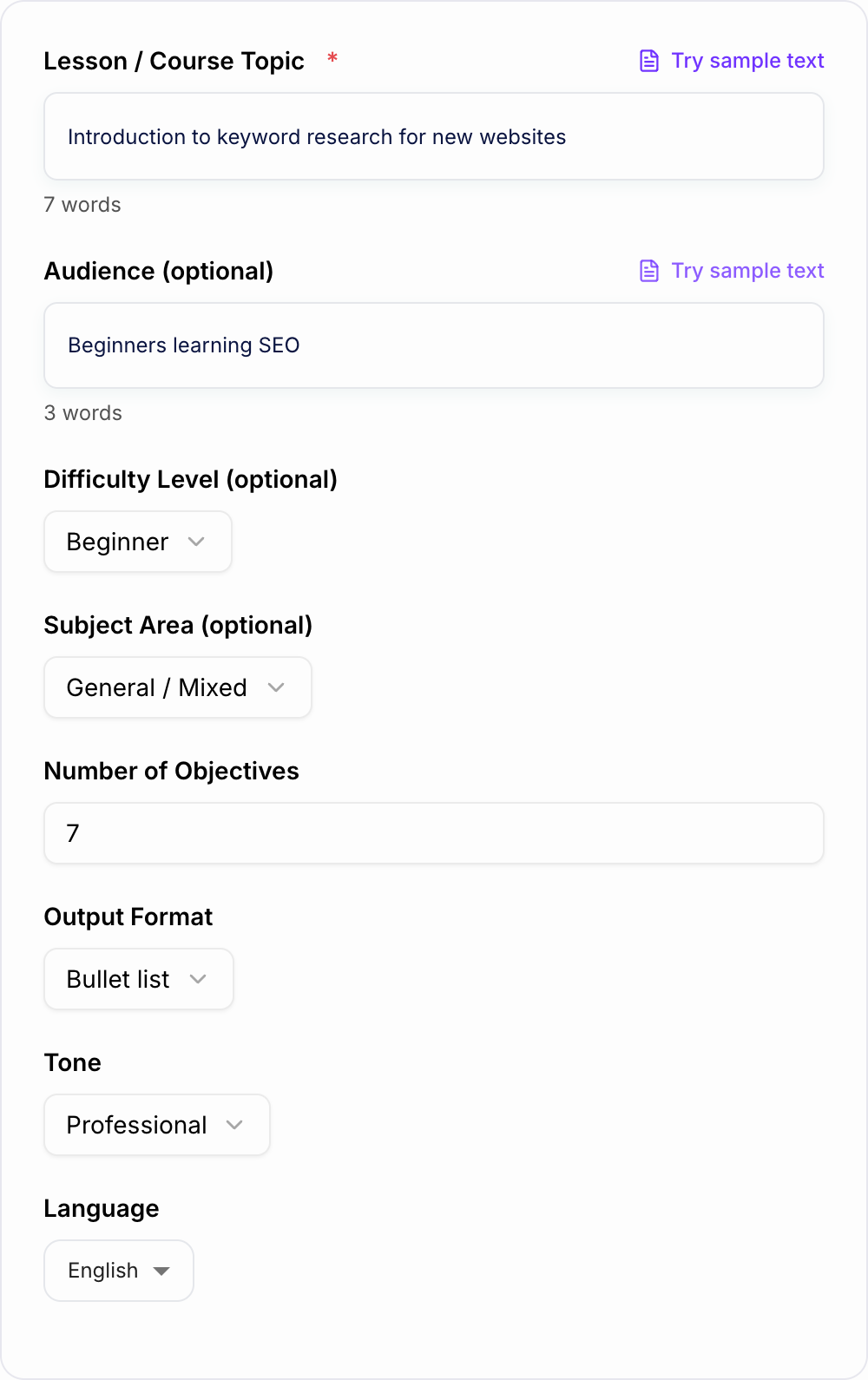
Input:
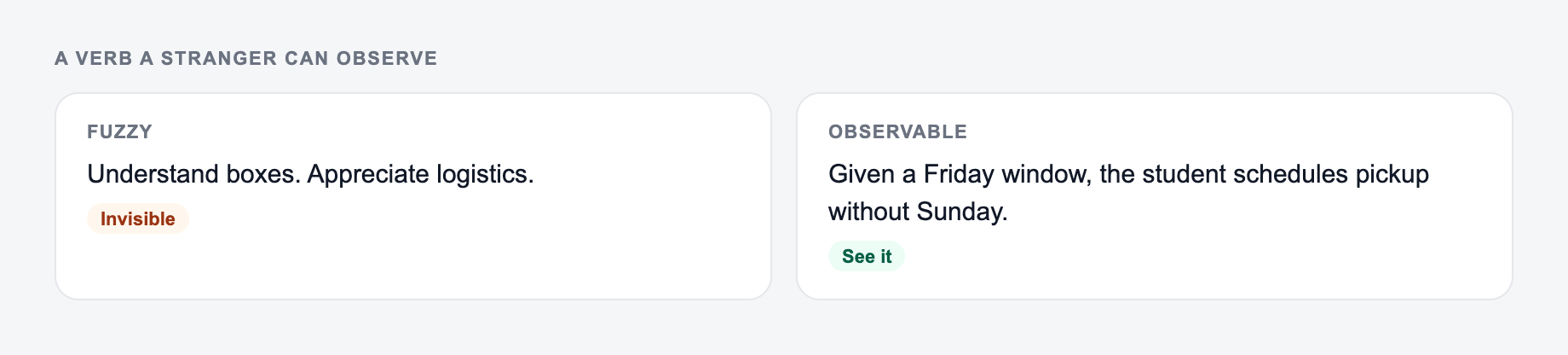
Topic and the verb you will assess belong on the form. “Understand” is not a measurable objective.
Accuracy caveats for the AI Learning Objectives Generator:
- It will complete a citation you only half-remember — wrongly.
If the task is graded, cited, or used with students, the named writer still owns the claims.
- Topic: Introduction to keyword research for new websites
- Audience: beginners learning SEO
- Difficulty: beginner
- Subject area: marketing / SEO
- Count: 5
- Format: table
- Mode: Assessment-ready
Generated objective direction:
| Objective | Assessment idea |
|---|---|
| Identify seed keywords related to a website's products, services, or audience needs. | Short worksheet |
| Categorize keyword ideas by informational, commercial, transactional, or navigational intent. | Sorting activity |
| Compare keyword opportunities using relevance, competition, and search intent signals. | Mini-analysis |
| Select one primary keyword and supporting secondary keywords for a sample page. | Practical task |
| Explain why the selected keywords match the page goal and intended audience. | Written justification |
Before using the output, check whether each objective can be measured in your actual lesson or training environment.
How to Review Generated Learning Objectives
Check learning objectives generator output against the room you actually have:
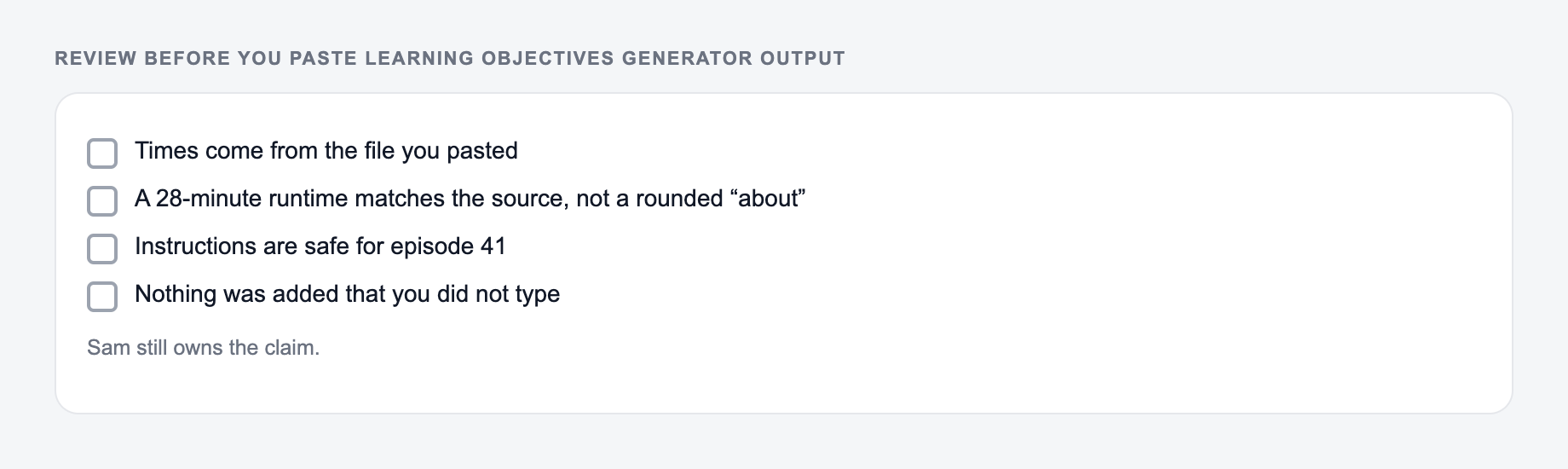
- Times, loads, and criteria match what you typed
- Nothing medical, legal, or graded was invented
- You would still own this if a parent or clinician asked
A generated objective should pass three tests.
First, it should use an observable verb. Avoid understand, know, learn, and be familiar with unless you rewrite them into actions like explain, compare, solve, perform, create, or evaluate.
Second, it should match the learner level. Beginners may identify and explain. Advanced learners may diagnose, justify, design, or evaluate.
Third, it should connect to an assessment. If you cannot imagine the quiz item, rubric row, scenario, project, or practical task, the objective is probably still too vague.
Bloom vs SMART: How to Use the Output
Bloom's taxonomy helps you choose the thinking level. It answers: what kind of cognitive work should learners do?
SMART criteria help you define success. They answer: how specific, measurable, realistic, relevant, and time-bound is the outcome?
You can combine both. For example:
- Analyze three customer support tickets to identify the root cause of each issue with at least 80% accuracy.
"Analyze" gives the Bloom level. "Three tickets" and "80% accuracy" give measurable criteria.
When to Use Table Format
Choose table output when you are building a syllabus, course map, training plan, or curriculum review document.
A table makes it easier to check:
- objective wording
- Bloom verb
- assessment method
- alignment with lesson activities
- gaps or duplicate outcomes
For quick lesson planning, bullets are usually enough. For stakeholder review, tables are easier to defend.
Make AI-Generated Objectives Feel Human and Useful
Tick these before the output leaves your machine. A fluent miss is still a miss.
The generator can draft clean objectives quickly, but your review matters. Adjust the output for the real class time, learner background, tools available, and assessment method.
For example, a corporate training objective should often mention the system, SOP, quality standard, or performance condition. A higher-ed objective may need discipline language, course-level scope, or program alignment.
If you are building many learning assets, Junia AI can help keep lesson plans, rubrics, summaries, and training copy consistent. Still, every final objective should map to what learners will actually practice and prove.
Common Mistakes to Fix Before Publishing
The first mistake is accepting vague verbs. Replace understand with explain, apply, compare, evaluate, design, or perform.
The second mistake is writing activities instead of outcomes. "Attend a workshop" is not a learning objective. "Demonstrate the workflow using the checklist" is closer.
The third mistake is generating too many objectives. A 20-minute lesson does not need 12 outcomes.
The fourth mistake is using high-level verbs with low-level assessments. If the objective says evaluate, the assessment should ask learners to make a judgment, not recall a definition.
The fifth mistake is skipping audience context. A beginner, manager, new hire, and advanced practitioner need different verbs and criteria.
Final Checklist for Generated Learning Objectives
Before you paste the objectives into a lesson plan, syllabus, LMS, or training doc, confirm that:
- each objective starts with a measurable action verb
- the objective describes learner performance, not instructor activity
- the difficulty matches the audience and available time
- every objective can be assessed
- conditions and criteria are included where they add clarity
- overlapping objectives are combined or removed
- the final format fits the document you are publishing
The generator gives you a structured first draft. The final step is alignment: objectives, activities, and assessments should all point to the same learner outcome.
Frequently Asked Questions
What is a learning objective?+
A learning objective is a clear, measurable statement that describes what learners will be able to do after instruction. Strong objectives use action verbs and specify an observable outcome that can be assessed.
How do I make learning objectives measurable?+
Use observable action verbs (e.g., identify, compare, solve, design) and avoid vague verbs like “understand” or “learn.” A measurable objective includes a clear performance (what learners do) and often a condition or criteria for success.
Does this generator use Bloom’s taxonomy?+
Yes. You can generate Bloom’s taxonomy learning objectives that match the appropriate cognitive level—from remembering and understanding to analyzing, evaluating, and creating.
How many learning objectives should a lesson have?+
Many lessons work well with 3–7 objectives, depending on complexity and time. For short sessions or microlearning, 1–3 focused objectives are often more effective than a long list.
Can I use these objectives in a syllabus or lesson plan?+
Yes. The objectives are designed to be copy-paste ready for syllabi, lesson plans, unit plans, training documentation, and learning management systems (LMS).
What’s the difference between goals and objectives?+
Goals are broad, high-level intentions (e.g., “Improve SEO skills”). Objectives are specific, measurable outcomes learners can demonstrate (e.g., “Perform keyword research and prioritize keywords by intent and difficulty”).