
Free Legalese Translator
Translate legalese into plain English so contracts, leases, NDAs, policies, and terms are easier to understand. Paste a clause or section to get a clearer rewrite, key obligations, risks, deadlines, and practical questions to review before you sign or escalate.
Plain-Language Translation
Your plain-language translation will appear here...
How the AI Legalese Translator Works
Get results in seconds with a simple workflow.
Paste a Clause or Section
Copy the legal text you want to understand—contract clauses, policy sections, or terms & conditions. Short excerpts usually translate most accurately.
Choose Context (Optional)
Select the document type and add jurisdiction if relevant. This helps the translation focus on the kind of agreement you’re reviewing and the terms that matter.
Get a Plain-Language Translation
Receive a clearer rewrite and explanation that highlights obligations, restrictions, deadlines, and practical meaning—so you can review faster and ask better questions.
See It in Action
Example of translating a dense limitation of liability clause into plain language while preserving meaning.
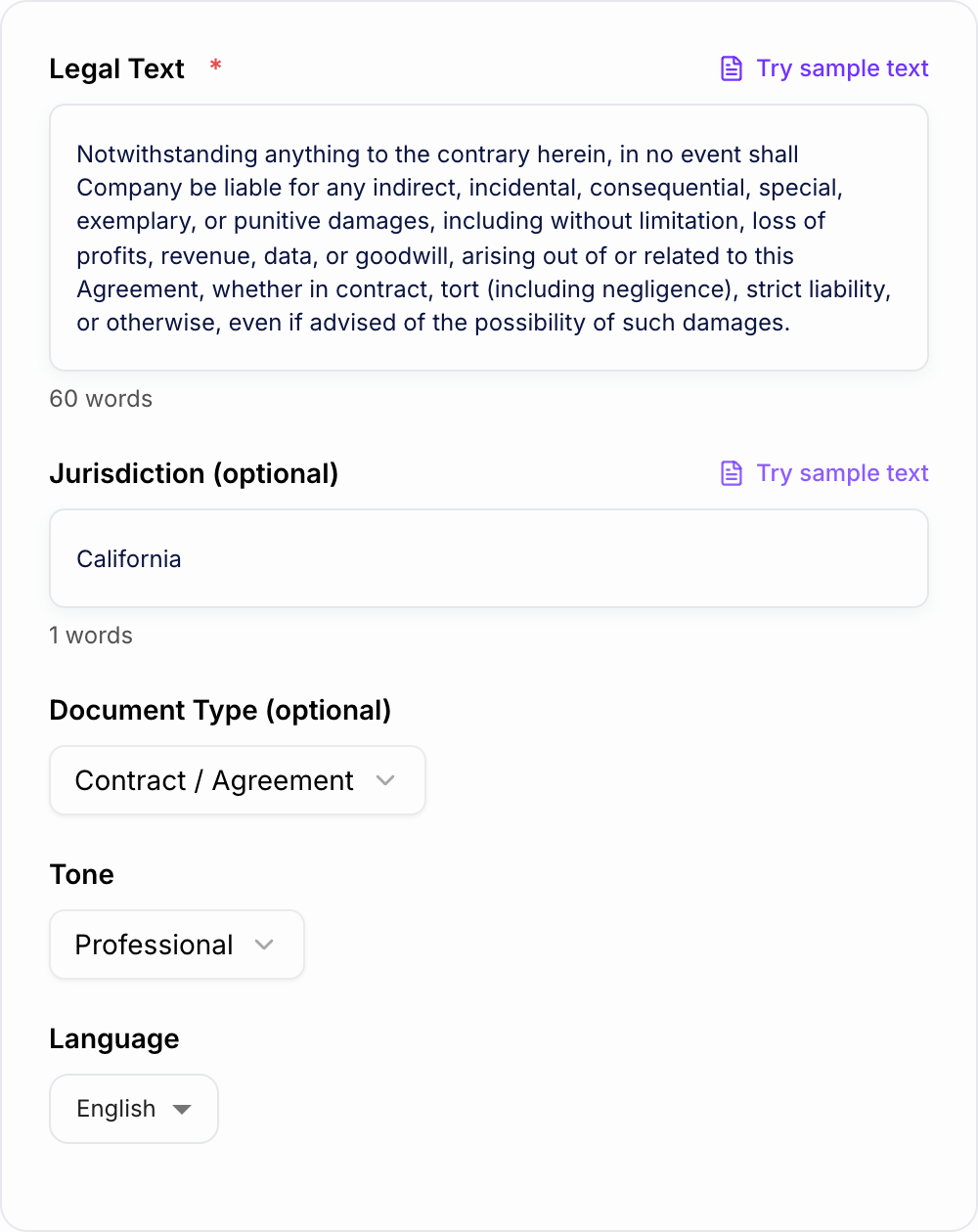
Notwithstanding anything to the contrary herein, in no event shall Company be liable for any indirect, incidental, consequential, special, exemplary, or punitive damages, including without limitation, loss of profits, revenue, data, or goodwill, arising out of or related to this Agreement, whether in contract, tort (including negligence), strict liability, or otherwise, even if advised of the possibility of such damages.
Even if something else in this agreement suggests otherwise, the company will not be responsible for indirect or “extra” damages. That includes things like lost profits, lost revenue, lost data, or damage to reputation. This applies no matter what legal theory is used (for example, breach of contract or negligence), and even if the company was warned that these damages could happen.
Why Use Our AI Legalese Translator?
Powered by the latest AI to deliver fast, accurate results.
Plain-English Legal Translation (Meaning Preserved)
Converts legal jargon into clear, readable language while keeping the original intent—so you understand obligations, rights, and restrictions without losing key details.
Clause-by-Clause Clarity for Contracts and Policies
Works well for common legal sections like limitation of liability, indemnity, termination, governing law, confidentiality, warranties, and dispute resolution.
Key Takeaways: Obligations, Deadlines, and Risks
Highlights what each party must do, important timeframes, payment terms, termination triggers, and potential consequences—helpful for quick contract review.
User-Friendly Explanations for Non-Lawyers
Explains legal concepts in everyday terms, defining confusing phrases (e.g., 'notwithstanding', 'herein', 'indemnify') and translating dense sentences into simpler ones.
Multilingual Output for International Teams
Translate legal text into many languages for better understanding across global teams—useful for procurement, HR, and founders reviewing vendor agreements.
Pro Tips for Better Results
Get the most out of the AI Legalese Translator with these expert tips.
Include the definitions the clause relies on
If the clause references defined terms (e.g., “Confidential Information”, “Services”, “Effective Date”), paste the definition too. It reduces ambiguity and improves accuracy.
Translate one clause at a time for maximum clarity
Legal documents are dense. Clause-by-clause translation keeps the output precise and helps you spot obligations, carve-outs, and exceptions more easily.
Pay special attention to liability, indemnity, and termination
These sections often have the biggest real-world impact. Translate them first to understand what you’re responsible for, what’s excluded, and how the agreement can end.
Turn unclear language into questions for your lawyer
Use the output to create a checklist: What triggers termination? What damages are excluded? Who owns IP? What are the notice periods? This saves time and legal fees.
Don’t rely on the translation for compliance-sensitive wording
For regulated industries, privacy, healthcare, finance, or employment matters, treat the translation as a comprehension aid and get professional review before acting.
Who Is This For?
Trusted by millions of students, writers, and professionals worldwide.
Translate Legalese Into Plain English Before You Sign or Escalate
A legalese translator helps you understand what a clause is actually doing. It can turn dense contract language into plain English, extract obligations, flag deadlines, and give you better questions to ask before you sign, negotiate, or send the document to counsel.
Use this Legalese Translator for comprehension, not legal advice. The output should make the text easier to read and review. It should not replace a lawyer when the decision is important, the risk is high, or the jurisdiction matters.
What to Paste Into the Legalese Translator
You can paste a single clause, a short section, or a paragraph from a contract, NDA, lease, Terms of Service, employment agreement, privacy policy, or vendor agreement.
For better output, include:
- the clause you want explained
- nearby definitions if the clause uses defined terms
- document type, such as NDA, lease, employment agreement, or SaaS contract
- jurisdiction if you know it
- the specific question you care about, such as "Can they cancel anytime?" or "What damages are excluded?"
Avoid pasting unnecessary personal data, pricing, account numbers, confidential customer details, or regulated information. Use placeholders when the exact identity is not needed.
Choosing the Right Translation Mode
Use Plain English Rewrite when you want the clause rewritten in simpler language while staying close to the original meaning.
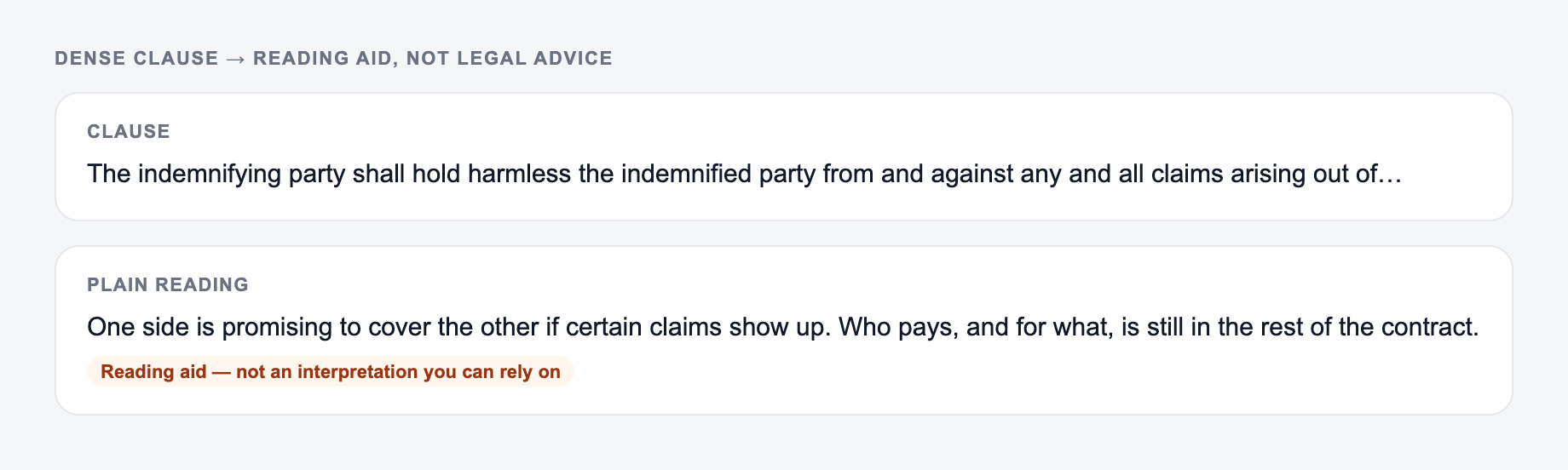
Use Explain Like I'm Not a Lawyer when you want the practical meaning: who must do what, what is allowed, what is restricted, and what could happen if someone breaches the clause.
Use Key Points Summary when you need a quick list of obligations, deadlines, fees, renewal terms, termination triggers, and risks.
Use Red Flags and Negotiation Ideas when you want the tool to point out language that may be one-sided, vague, unusually broad, or worth asking counsel about.
If the original text is long, translate it clause by clause. Long legal sections often stack exceptions, cross-references, and defined terms in ways that are easier to review in smaller pieces.
Clauses Worth Translating First
Start with the parts that change risk, money, rights, or exit options.
High-priority clauses include:
- limitation of liability
- indemnification
- termination and notice
- automatic renewal
- payment terms, late fees, and price increases
- confidentiality
- intellectual property ownership
- warranties and disclaimers
- data use, privacy, and security obligations
- governing law, venue, arbitration, and attorney fees
These sections often look like boilerplate, but they control what happens when the relationship breaks down.
How to Use the Output as a Review Checklist
Preservation checklist for the Legalese Translator:
- Proper nouns are unchanged
- Numbers and dates survived
- A warning is still a warning
A good translation should not just sound simpler. It should help you decide what to check next.
After generating the plain-English version, ask:
- Who has to do something under this clause?
- What deadline or notice window applies?
- What happens if one side breaches?
- Are damages capped or excluded?
- Is the obligation mutual or one-sided?
- Does the clause survive termination?
- Are defined terms making the clause broader than it first appears?
- What should be clarified before signing?
This is where the tool saves time. Instead of sending counsel a vague "please review this," you can ask targeted questions about the exact clause and risk.
Example: From Dense Clause to Practical Meaning
Original clause:
Paste the clause. The output is a reading aid, not a legal interpretation.
Annotation pass after you generate:
- Highlight anything the rewrite added. If you cannot source it, cut it.
- Highlight anything it deleted. If it was a condition, put it back.
- Read the before and after aloud. If the after sounds friendlier but vaguer, it failed.
The Provider shall indemnify, defend, and hold harmless Customer from and against all third-party claims arising out of Provider's gross negligence, willful misconduct, or breach of confidentiality obligations.
A useful translation should explain:
- Provider may have to cover the customer's losses and legal costs for certain third-party claims.
- The duty is not unlimited; it is tied to gross negligence, intentional misconduct, or confidentiality breaches.
- The phrase "third-party claims" may exclude direct disputes between Provider and Customer.
- The contract should be checked for notice requirements, control of defense, liability caps, and carve-outs.
That practical explanation is more useful than simply replacing "indemnify" with "pay for."
Privacy and Accuracy Checks Before You Rely on the Translation
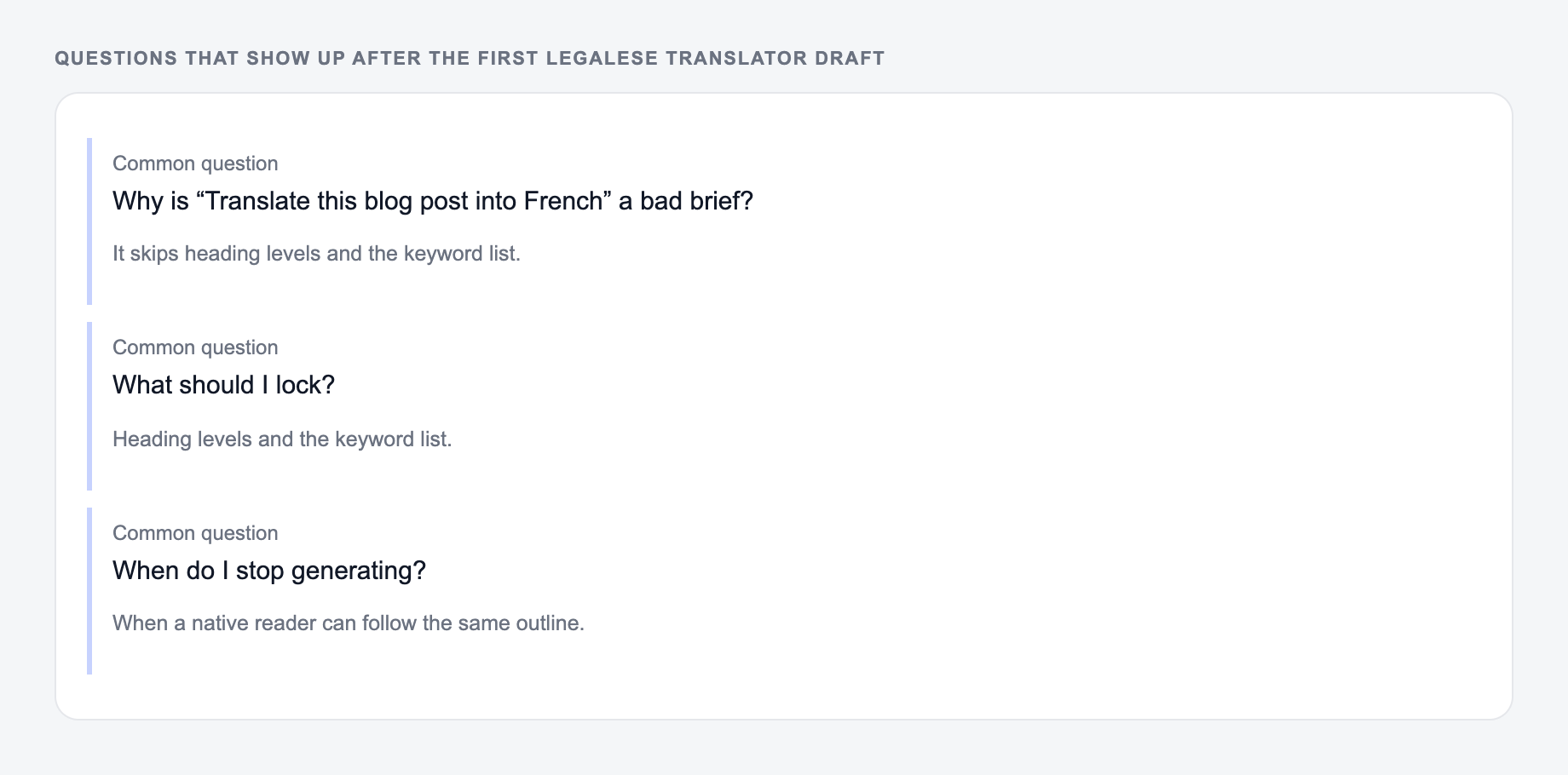
The same three questions show up after people generate once and then stall.
Before pasting legal text, remove details that are not needed for comprehension. Replace names with Company A and Company B, remove account numbers, and avoid confidential customer or employee data unless your policy allows it.
Before relying on the output, compare it against the original wording. Watch especially for:
- missing exceptions
- defined terms that expand the scope
- time periods and notice requirements
- money amounts, caps, and exclusions
- cross-references to other sections
- jurisdiction-specific terms
Plain English should make the clause clearer. It should not make it seem less serious.
When to Bring in a Lawyer
Use the Legalese Translator to understand what you are reading, prepare negotiation questions, and decide what deserves deeper review. Bring in a lawyer when the document involves major money, employment restrictions, IP ownership, data obligations, litigation risk, regulated activity, or anything you cannot afford to misunderstand.
The same practical review habit applies across Junia AI writing workflows: generate a clearer version first, then use expert judgment for the parts where consequences matter.
Final Checklist for Translated Legal Text
Before you act on the translation, confirm that you understand:
- the plain-English meaning
- who is obligated
- what triggers the obligation
- deadlines and notice windows
- payment, damages, and liability limits
- termination effects
- unanswered questions for counsel
- whether the original clause still supports the simplified explanation
Frequently Asked Questions
Is this legalese translator a substitute for a lawyer?+
No. It helps you understand legal language by rewriting and explaining it in plain terms, but it does not provide legal advice. For important decisions or high-stakes contracts, consult a qualified attorney in your jurisdiction.
Will the tool preserve the original meaning of the clause?+
It is designed to preserve meaning and intent while improving clarity. Always verify the translation against the original text, especially for definitions, deadlines, payment terms, and liability sections.
What types of documents does it work best for?+
It works well for common business and consumer documents such as contracts, NDAs, leases, employment agreements, Terms of Service, and privacy policies—especially clause-level excerpts.
Can it identify risky terms like indemnity or limitation of liability?+
It can explain what those clauses generally do and (in certain modes) surface potential red flags or negotiation questions. However, risk depends on context and local law—use it as a starting point, not a final assessment.
Can I translate legal text into another language?+
Yes. Select an output language to translate the plain-language version. Note that legal nuance can be sensitive—use a professional translator and attorney review when accuracy is critical.
What should I paste for best results?+
Paste a single clause or a short section (1–3 paragraphs) for the clearest output. Include surrounding context if the clause references defined terms (e.g., “Services”, “Confidential Information”).