
Free Marketing Strategy Generator
Generate a focused marketing strategy for go-to-market, growth, content and SEO, paid media, B2B demand generation, or eCommerce. Add your business, audience, goal, budget, and timeline to create ICPs, positioning, messaging pillars, channel strategy, KPIs, and a 30/60/90-day roadmap.
Marketing Strategy
Your marketing strategy will appear here...
How the AI Marketing Strategy Generator Works
Get results in seconds with a simple workflow.
Describe Your Business and Goal
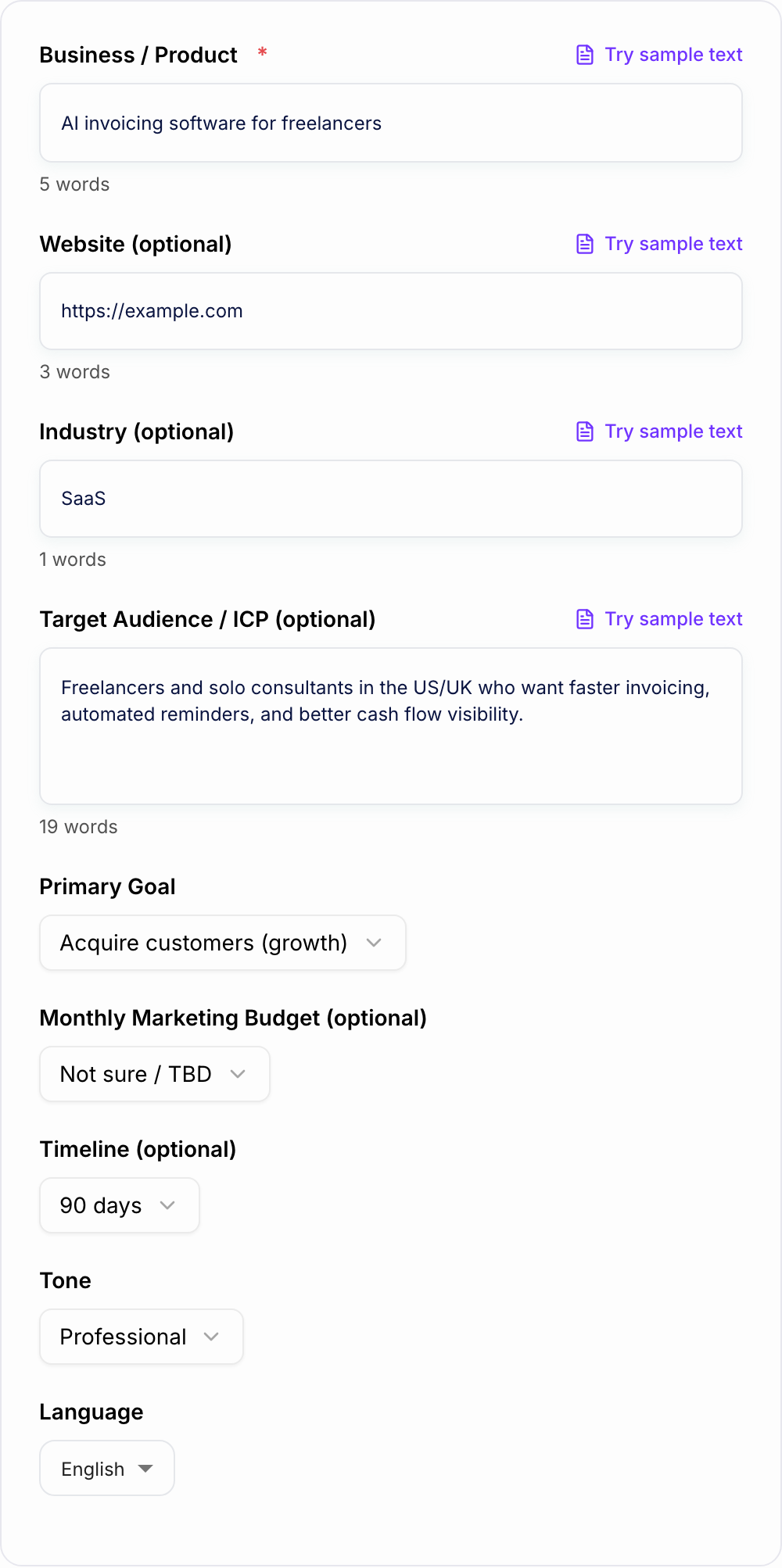
Enter what you sell and your primary marketing goal (growth, leads, launch, retention, or awareness). Add optional context like industry, audience, and budget.
Choose a Mode, Tone, and Language
Pick a strategy type (GTM, Growth, Content+SEO, Paid, B2B, eCommerce), then select tone and output language to match your brand and team.
Generate and Execute the 30/60/90-Day Plan
Get a structured marketing strategy with KPIs and weekly priorities. Implement the quick wins first, then run experiments and iterate based on results.
See It in Action
Turn a vague marketing idea into a structured, channel-by-channel strategy with KPIs and an execution roadmap.
We need a marketing plan to get more customers. We’re not sure which channels to use or what to do first.
Goal: Acquire 150 qualified leads/month in 90 days
Positioning: AI invoicing that saves freelancers time and gets invoices paid faster ICP: Freelancers/solo consultants (US/UK), 1–5 clients/month, pain: late payments + admin overhead
Channel plan:
- SEO: Pillar page “Freelance invoicing software” + 12 supporting articles (late payment reminders, invoice templates, best invoicing apps)
- Content upgrades: Free invoice template pack + “late payment email scripts” lead magnet
- Email: 5-email nurture sequence + onboarding + winback
- Partnerships: creator affiliates + coworking spaces + freelancer communities
- Paid (optional): Google Search for high-intent keywords + retargeting
KPIs:
- Organic sessions, signups, MQLs, CAC, trial-to-paid conversion, payback period
30/60/90 plan:
- 30: tracking setup, landing page, 4 SEO posts, lead magnet, email nurture
- 60: publish pillar + 6 more posts, partner outreach, CRO test #1
- 90: scale winners, expand topics, add retargeting, publish 2 case studies
Why Use Our AI Marketing Strategy Generator?
Powered by the latest AI to deliver fast, accurate results.
Complete Marketing Strategy Framework (ICP → Positioning → Channels)
Generates a structured marketing plan including ideal customer profile, positioning, messaging pillars, channel strategy, and a practical execution roadmap.
Full-Funnel Channel Mix (Awareness, Consideration, Conversion, Retention)
Maps recommended channels to funnel stages with clear tactics for content marketing, SEO, email, partnerships, social, and paid acquisition—tailored to your goal and budget.
Content + SEO Plan With Topic Clusters
Creates an SEO-friendly content strategy with pillar pages, supporting articles, keyword angles, internal linking ideas, and a lightweight editorial calendar.
KPIs, Targets, and Measurement Plan
Defines north-star metric, channel KPIs, conversion benchmarks, tracking setup, and attribution guidance so you can measure marketing ROI and improve performance.
30/60/90-Day Action Plan (Execution-Ready)
Outputs a step-by-step plan with priorities, quick wins, experiments, and weekly actions—so you can start executing immediately.
Pro Tips for Better Results
Get the most out of the AI Marketing Strategy Generator with these expert tips.
Anchor everything to a single north-star metric
Choose one primary metric (e.g., qualified leads, trials, purchases, revenue) and align channels, content, offers, and KPIs to it to avoid scattered marketing.
Match channels to your ICP’s buying behavior
If your audience searches for solutions, prioritize SEO and high-intent content. If they discover products socially, focus on short-form content and creators. If deals are high-ACV, add outbound and partner channels.
Create one strong offer per funnel stage
Top of funnel: guides/tools. Middle: webinars, comparison pages, case studies. Bottom: demos, trials, consultations. Clear offers improve conversion rates and lead quality.
Use content clusters to build topical authority
Publish a pillar page for the core topic and supporting articles targeting long-tail keywords. Interlink them to improve crawlability, rankings, and user journey.
Instrument tracking before scaling spend
Set up analytics, conversion events, UTMs, and a basic dashboard. Measure CAC, LTV, conversion rate, and payback period to scale channels with confidence.
Who Is This For?
Trusted by millions of students, writers, and professionals worldwide.
Create a Focused Strategy with the AI Marketing Strategy Generator
A marketing strategy generator is not just a way to list tactics. Its real job is to help you make choices: who to target, what to say, which channels deserve attention, what to measure, and what to ignore for now.
This tool takes your business, audience, goal, budget, and timeline, then generates a strategy with ICP, positioning, messaging pillars, channel mix, content or SEO direction, KPIs, and a 30/60/90-day roadmap.
Use it inside Junia AI when you need a sharper strategic direction before building campaigns, plans, emails, content, or paid media assets.
What to Enter Into the Strategy Generator
The business field should explain what you sell and why buyers care. Add your website if it gives useful context about your offer, pricing, or positioning.
The target audience field is where strategy quality usually improves. Include job titles, industry, company size, pain points, buying trigger, objections, and alternatives.
Useful inputs include:
- Product or service category
- Audience or ICP
- Business stage: launch, early growth, scaling, retention, or repositioning
- Primary goal: leads, customers, revenue, launch, retention, or awareness
- Budget range and team capacity
- Current channels and performance
- Differentiators and proof points
- Timeline for execution
Weak input produces a generic strategy. Specific input gives the generator room to make tradeoffs.
Choose the Strategy Mode by the Decision You Need
Use Go-To-Market when you are launching something new. The output should clarify audience, category, positioning, launch channels, early offers, and first 90 days.
Use Growth Strategy when you already have traction and need scalable acquisition, activation, retention, or expansion loops.
Use Content + SEO Strategy when buyers search for solutions and you want compounding organic demand. Expect topic clusters, pillar pages, supporting content, internal linking direction, and publishing cadence.
Use Paid Media Strategy when spend, targeting, landing pages, creative tests, funnel stages, and measurement need structure.
Use B2B Demand Gen when pipeline matters. The strategy should include ICP, account segments, lead magnets, nurture, sales enablement, and attribution.
Use eCommerce Strategy when product pages, merchandising, paid creative, lifecycle flows, CRO, retention, and LTV are the main growth levers.
Review the Generated Strategy for Real Choices
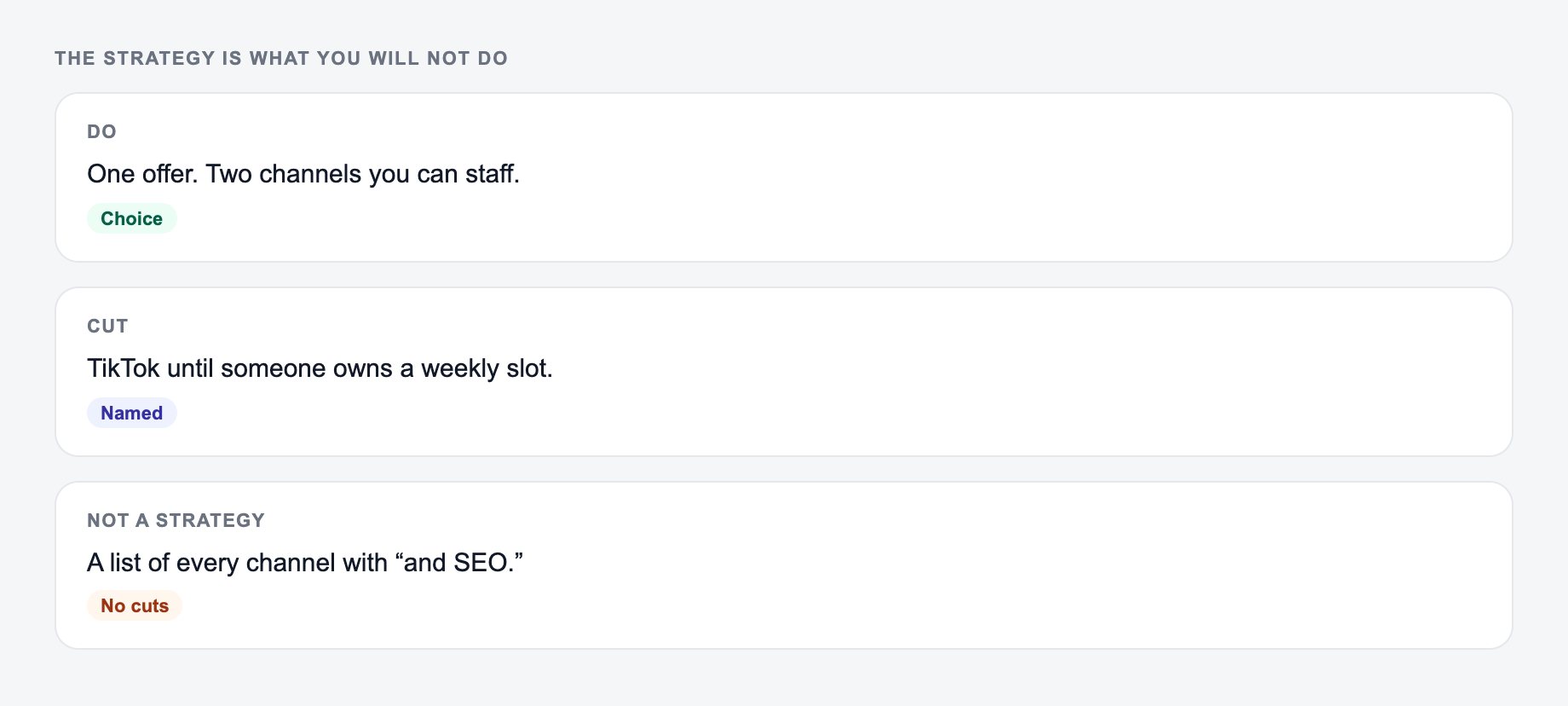
A useful strategy should make tradeoffs. If the output says to do SEO, paid ads, TikTok, webinars, partnerships, podcasts, community, affiliates, and events all at once, it is too broad.
Look for these pieces:
- Primary ICP and secondary segments
- Positioning that explains why this offer wins
- Messaging pillars that can repeat across channels
- Primary and secondary channels
- Channels to avoid or delay
- Offers and conversion paths by funnel stage
- KPIs that match the main goal
- A roadmap with early decisions, not just activities
The best generated strategy should make some options feel obviously lower priority.
Turn Strategy Into a Marketing Plan
Before anything leaves the outbox:
- You can point to the number in a spreadsheet or a contract
- You would sign it if your name were the only one on it
- Compensation, legal effect, and medical content had a human pass
After generation, do not jump straight into asset creation. First, convert the strategy into a plan.
Choose the primary channel. Define the first offer. Pick the first KPI. Decide what ships in the next 30 days. Then assign owners and deadlines.
For example, if the strategy says organic-led growth is the main path, the plan might include keyword research, three high-intent landing pages, two comparison pages, internal links, and a lead capture offer. If the strategy says paid search is the main path, the plan should include budget, landing page tests, conversion tracking, creative angles, and a weekly optimization cadence.
Strategy sets direction. Planning turns direction into work.
Check Positioning, Messaging, and KPIs
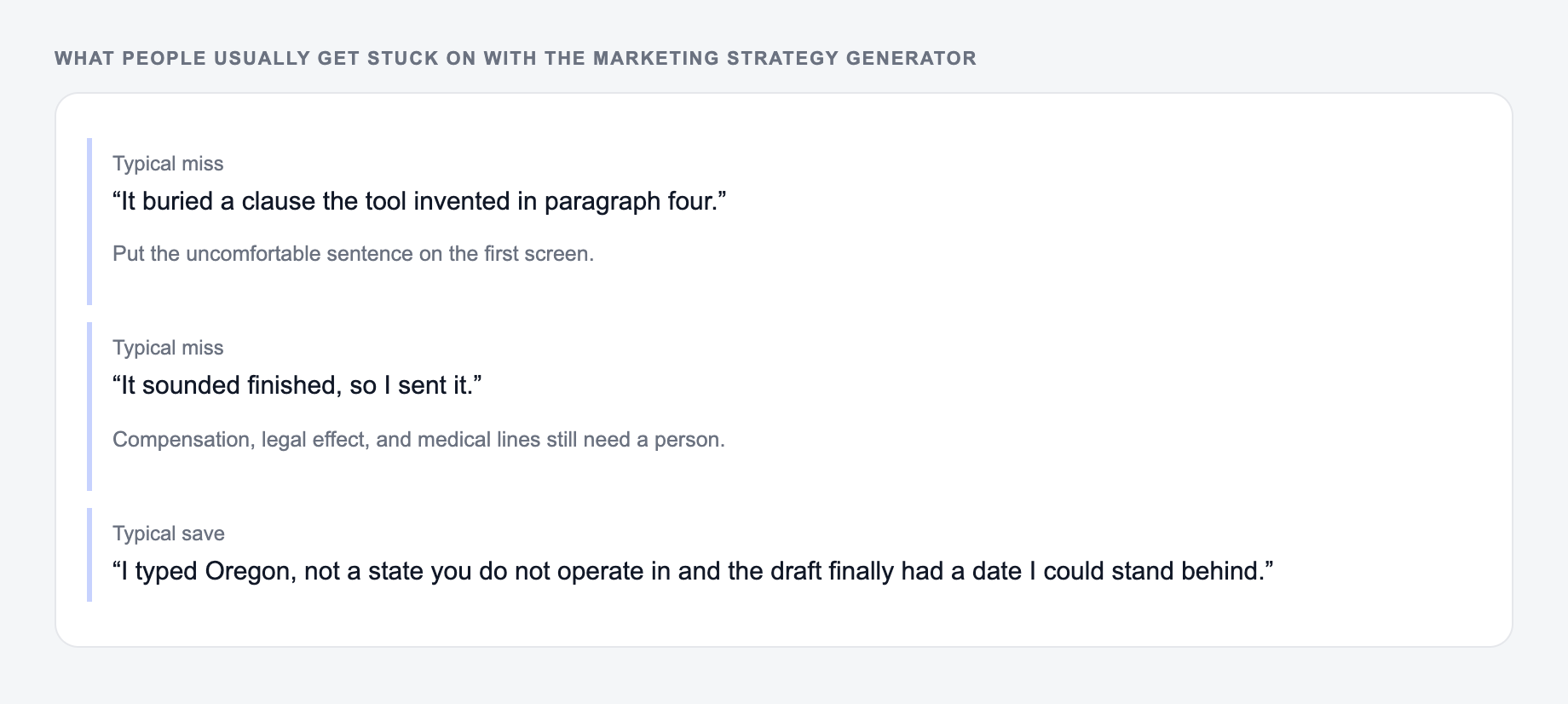
These are the complaints that show up after the first draft — they are almost always about the brief, not the model.
Positioning should make the buyer say, "This is for me." If it could apply to any competitor, make it sharper. Add the audience, pain, category, outcome, or mechanism.
Messaging pillars should support the position from different angles: pain, outcome, proof, objection, and differentiation. Use them later in campaigns, emails, landing pages, and content briefs.
KPIs should protect focus. A launch strategy might track waitlist signups, activation, and early conversion. A B2B strategy might track qualified pipeline and sales cycle. An eCommerce strategy might track conversion rate, AOV, repeat purchase, CAC, and LTV.
Common Marketing Strategy Generator Mistakes
The first mistake is asking for tactics before defining the audience. Channels do not matter much if the buyer is unclear.
The second mistake is treating the output as a finished executive strategy. Use it as a draft for decisions, then refine with market knowledge and real data.
The third mistake is keeping too many channels. Strategy improves when you cut.
The fourth mistake is ignoring what you can actually execute. A strategy that requires a team you do not have is not strategy. It is fiction.
Final Strategy Checklist
Before you use the generated strategy, confirm that:
- The ICP is specific and believable
- The positioning is different from obvious competitors
- Messaging pillars can become real campaign copy
- Primary and secondary channels are clear
- At least one channel is intentionally deprioritized
- KPIs match the goal and funnel stage
- The 30/60/90 roadmap starts with the most important constraint
A good AI marketing strategy should narrow your choices. If the next best move is clearer than it was before, the generator has done the right work.
Cut List: The Strategy Is What You Will Not Do
A generated strategy that lists six channels, four ICPs, and a 90-day roadmap is a menu. Make it a strategy by writing a cut list.
Budget, team size, and one offer on the form beat a request for “a full marketing strategy.”
Filled example to imitate
A brief the AI Marketing Strategy Generator can use: who it is for, where the output will appear, and what must stay true.
Do not send this shape
A one-line request like “run the marketing strategy” with no audience, channel, or constraint.
The first version names a date, a deliverable, and a boundary. The second hopes the reader will infer them.
Worked constraint set: B2B tool, two-person team, $2k/month paid cap, sales cycle ~21 days.
- Do: one ICP (ops managers at 20–80 person agencies), one primary channel (LinkedIn + founder posts), one offer (15-minute workflow teardown).
- Do not: TikTok, a weekly webinar series, hiring an agency, competing on enterprise RFPs.
- KPI: qualified teardown bookings, not impressions.
- 30-day constraint to remove first: no live teardown landing page, so week 1 is the page and the booking link, not ads.
If the generator keeps recommending channels you cannot staff, that is a prompt problem and a judgment problem. Positioning should name a rival alternative (“spreadsheet plus Slack”), not “bad marketing.”
Frequently Asked Questions
Is this marketing strategy generator free?+
Yes. You can generate a complete marketing strategy for free. Some specialized modes (like paid media, B2B demand gen, or eCommerce) may be marked as premium.
What does the generated marketing strategy include?+
It typically includes: goals, ICP/personas, positioning and value proposition, messaging pillars, channel plan by funnel stage, content and SEO plan, offers and conversion strategy, budget split, KPIs, and a 30/60/90-day execution roadmap.
Can it create a strategy for B2B, SaaS, eCommerce, or local businesses?+
Yes. Add your business type, audience, and goals, and the strategy will adapt. For best results, include your industry, website, and who you sell to (ICP).
How accurate are the budget and KPI recommendations?+
They’re directional starting points based on common marketing benchmarks. You should validate assumptions with your historical data, analytics, and channel performance once you start running campaigns.
Will this help with SEO and organic traffic growth?+
Yes. The strategy includes an SEO and content plan with topic clusters, keyword angles, and internal linking ideas designed to match search intent and improve organic visibility over time.
How do I get a more specific strategy?+
Include specifics like your niche, target audience details, pricing, location, differentiators, and current channels. The more context you provide, the more tailored and actionable the output will be.