
Free Mission Statement Generator
Generate clear mission statement options for startups, nonprofits, local businesses, agencies, teams, and personal brands. Add what you do, who you serve, the outcome you create, your values, and preferred tone to get specific statements you can refine for websites, pitch decks, onboarding, and brand guidelines.
Mission Statement
Your mission statement options will appear here...
How the AI Mission Statement Generator Works
Get results in seconds with a simple workflow.
Describe What You Do
Write 1–3 sentences about your product or service and the outcome it creates. Specific inputs lead to mission statements that feel authentic and non-generic.
Add Audience, Differentiation, and Values (Optional)
Optionally include your target audience, what makes you different, and your core values to shape a mission statement that supports positioning and brand voice.
Generate and Choose the Best Option
Get multiple mission statement options. Pick one, then refine wording for clarity and memorability for your website, pitch deck, or internal docs.
See It in Action
Example of turning a vague mission statement into a specific, outcome-focused mission statement.
Our mission is to empower businesses with innovative solutions.
Our mission is to help small construction contractors finish projects on time and on budget with simple planning, cost tracking, and team coordination tools.
Why Use Our AI Mission Statement Generator?
Powered by the latest AI to deliver fast, accurate results.
Specific, Non-Generic Mission Statements
Generates mission statements that clearly define what you do, who you serve, and the outcome you create—avoiding vague buzzwords and empty claims.
Startup, Nonprofit, and Brand-Friendly Options
Creates mission statements tailored for startups, nonprofits, small businesses, and personal brands, with wording that fits each context and audience.
Tone and Voice Control
Choose a tone (professional, friendly, bold, minimalist, etc.) to match your brand voice for your website, pitch deck, About page, or onboarding docs.
Positioning-Ready Messaging
Helps clarify your positioning by emphasizing customer outcomes, differentiation, and values—useful for brand strategy, marketing copy, and internal alignment.
Multiple Mission Statement Variations
Generates several strong options so you can compare styles, refine wording, and pick the best mission statement for your brand identity.
Pro Tips for Better Results
Get the most out of the AI Mission Statement Generator with these expert tips.
Use a simple formula to stay specific
Try: “We help [audience] [achieve outcome] by [how/approach].” This structure produces mission statements that are clear, concrete, and easy to defend.
Avoid empty buzzwords unless you can prove them
Words like “innovative,” “best-in-class,” and “cutting-edge” sound generic without context. Replace them with a differentiator (niche, method, speed, support, quality standard).
Optimize for clarity over cleverness
A great mission statement is easy to understand in one read. If someone outside your industry can’t explain it back to you, simplify the wording.
Make it usable across marketing and culture
The best mission statements work on your About page, in recruiting, and in onboarding. If it only fits marketing, add a values/quality standard phrase to make it operational.
Test it with a quick “So what?” check
After your mission statement, ask: “So what?” If the answer isn’t obvious (who, what outcome, why it matters), add specificity to the statement.
Who Is This For?
Trusted by millions of students, writers, and professionals worldwide.
Generate a mission statement people can actually understand
The Mission Statement Generator helps you turn rough brand notes into clear mission statement options. Instead of starting from a blank page or defaulting to vague lines like “empowering people with innovative solutions,” you can give the tool your audience, outcome, values, and tone, then choose the strongest version.
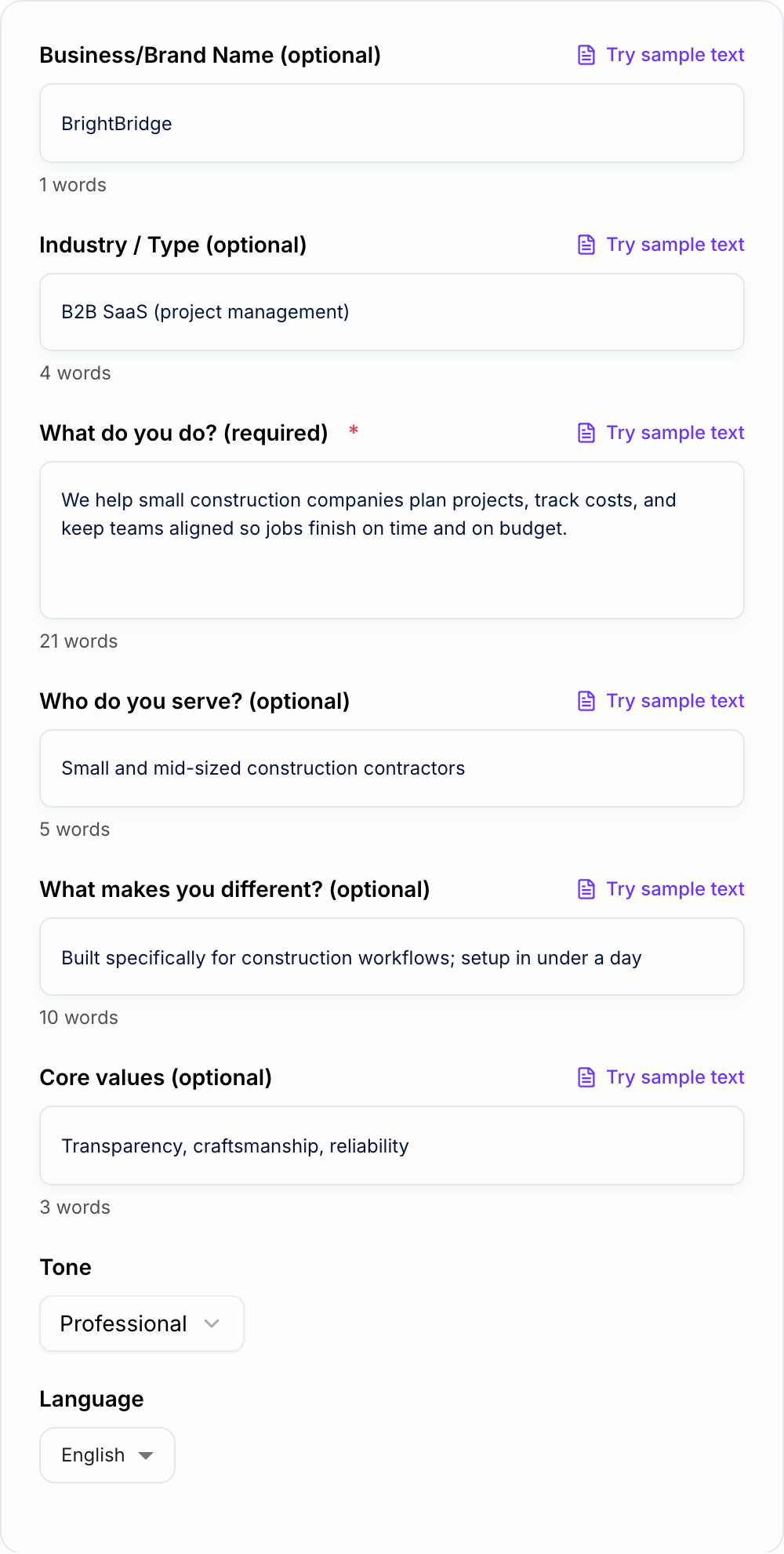
A useful mission statement answers three questions: what do you do, who do you serve, and why does it matter now?
What to enter into the Mission Statement Generator
The tool can work from a short description, but specific inputs lead to mission statements that sound less generic. Add:
- Business or organization type: startup, nonprofit, agency, local business, creator brand, SaaS company, school, community group, or product.
- Audience: the people you primarily serve.
- Outcome: what changes for that audience because you exist.
- Approach: how you create that outcome, such as education, software, service, funding, coaching, research, or community support.
- Values: the standards or principles that should shape the wording.
- Tone: warm, bold, professional, minimalist, inspiring, practical, founder-led, or community-focused.
Weak input sounds like “we help businesses grow.” Better input sounds like “we help independent dental clinics fill appointment gaps with simple patient retention campaigns; tone should be professional and warm; values are clarity, trust, and measurable growth.”
How to choose the best generated mission statement
Generate several options, then compare them against a simple formula:
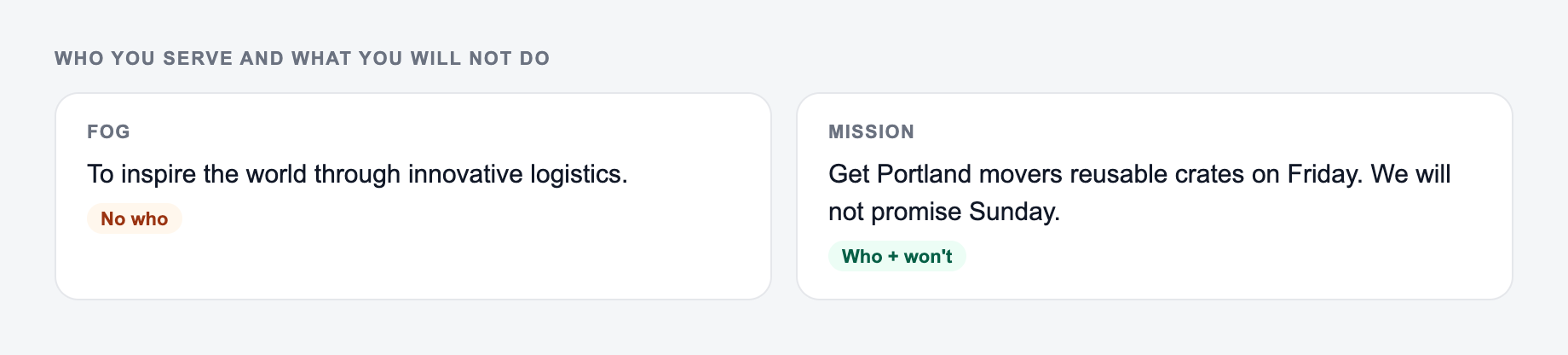
We help [audience] [achieve outcome] by [approach].
The final statement does not have to follow that exact structure, but it should contain those parts somewhere. If the generated output sounds polished but could fit any competitor, regenerate with a narrower audience, clearer outcome, or more specific approach.
The best option is usually not the cleverest one. It is the one a new customer, employee, donor, or partner can understand after one read.
Mission statement vs vision statement vs values
The generator works best when you know which statement you are asking for.
- Mission statement: what you do now, who you serve, and what value you create.
- Vision statement: the future you want to help create over time.
- Values: how you behave while doing the work.
If the output sounds too broad or future-facing, ask for a mission statement instead of a vision statement. If it turns into words like integrity, excellence, and innovation without a concrete outcome, ask for “more specific customer impact.”
Example input and generated output
Input:
Who you serve and what you will not do belong on the form.
Section order that readers actually scan:
- The ask or the decision.
- The facts that make it true.
- What is out of scope.
- The date they must answer.
This is a draft aid, not legal, medical, or financial advice.
Organization: project management software for small construction contractors
Audience: contractors managing multiple jobs
Outcome: finish projects on time and on budget
Approach: simple planning, cost tracking, and team coordination tools
Tone: practical, confident, plain English
Generated mission statement:
We help small construction contractors finish jobs on time and on budget with simple planning, cost tracking, and team coordination tools.
That output works because it is specific. It names the audience, the outcome, and the approach without trying to sound grander than the business actually is.
How to refine the generated options
After generating mission statement ideas, edit in this order:
- Clarify the audience. Replace broad words like “people,” “teams,” or “businesses” with the real group you serve.
- Sharpen the outcome. Swap vague benefits like “success” for concrete results such as save time, reduce errors, get hired, learn faster, or grow revenue.
- Simplify the method. Explain how you help in plain language.
- Remove buzzwords. Words like innovative, world-class, cutting-edge, and empowering only work when supported by specifics.
- Read it out loud. If it sounds like a corporate policy, make it simpler.
Regenerate when the structure is wrong. Manually edit when the structure is good but one or two words feel off.
Where to use the final mission statement
Filled shape to imitate
The ask, the date, the deliverable, and the thing you will not promise — in that order. If the draft buries the uncomfortable sentence, put it back on the first screen.
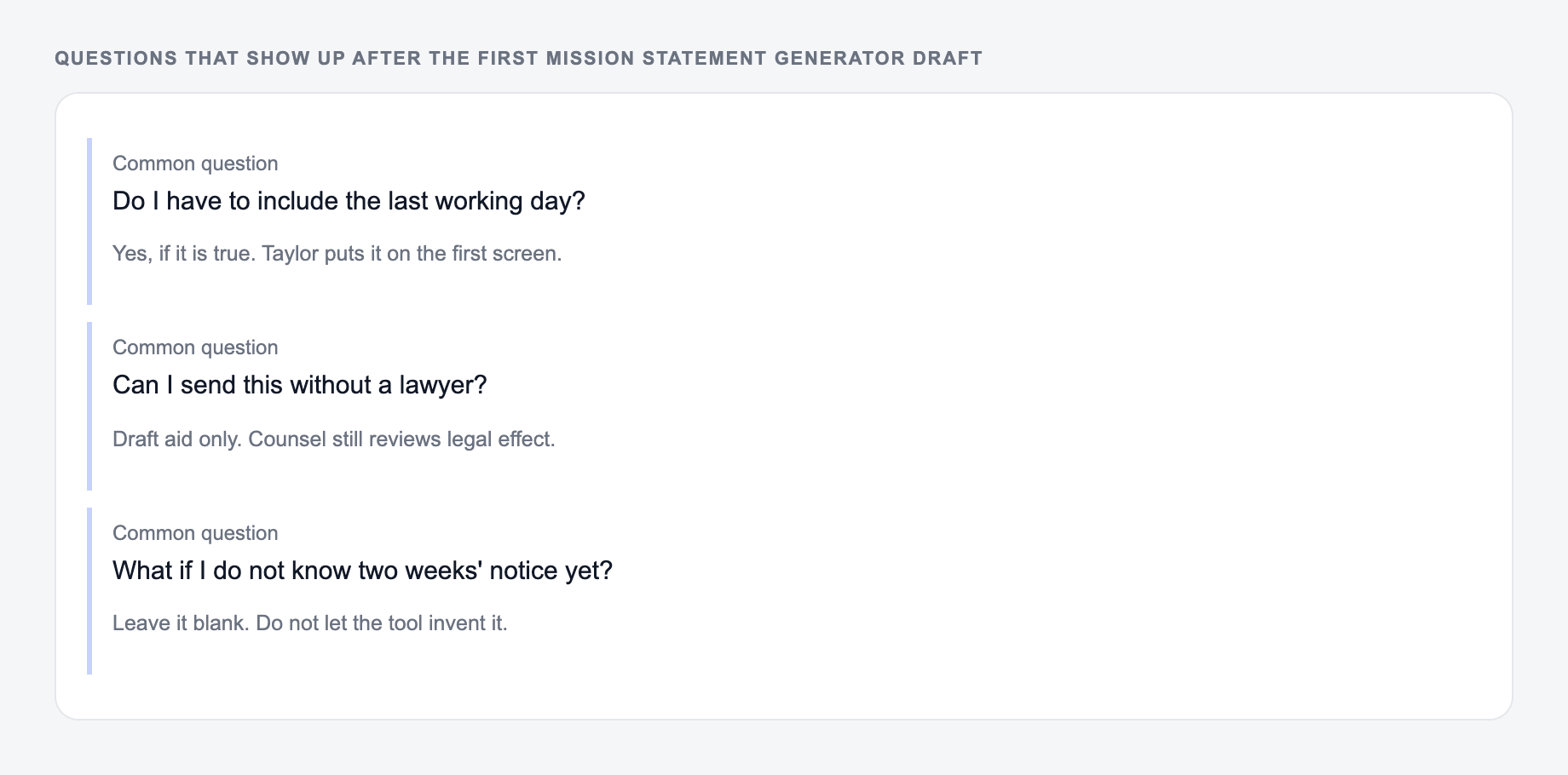
The same three questions show up after people generate once and then stall.
Once refined, your mission statement can support:
- Homepage hero copy
- About page positioning
- Pitch decks and business plans
- Nonprofit grant or donor materials
- Internal onboarding docs
- Brand guidelines
- Hiring pages and culture notes
If you are expanding the mission into About page copy, taglines, positioning, or campaign messaging, an AI writing workspace like Junia AI can help turn the statement into related brand copy without losing the core idea.
Final checklist before publishing
- The audience is clear.
- The outcome is concrete.
- The approach is believable.
- The sentence is easy to remember.
- The tone fits the brand.
- A competitor could not copy it unchanged.
- It works outside the homepage, not just inside a design mockup.
If the generated statement is close but still generic, add a narrower audience or a more concrete result and run the generator again. Specific inputs are the fastest way to get a mission statement that sounds like yours.
Frequently Asked Questions
What is a mission statement?+
A mission statement explains what you do, who you serve, and the value you deliver. It’s a clear, practical statement used on websites, pitch decks, onboarding materials, and brand guidelines.
How long should a mission statement be?+
Most mission statements work best at 10–25 words (often one sentence). Shorter is easier to remember, but it still needs to be specific and credible.
What’s the difference between a mission statement and a vision statement?+
A mission statement describes what your organization does today and for whom. A vision statement describes the future you want to create (the long-term impact).
How do I make my mission statement less generic?+
Include concrete details: your audience, the outcome you create, and what makes your approach different. Avoid vague phrases like “empower,” “innovative solutions,” or “world-class” unless you add specifics.
Can I use this for a nonprofit or community organization?+
Yes. Provide who you help, the problem you address, and the impact you aim to create. The generator can produce nonprofit-friendly mission statements that focus on beneficiaries and measurable change.
Can I generate a mission statement in another language?+
Yes. Choose your output language, and the tool will generate mission statements in that language while keeping the meaning and tone consistent.