
Free Musician Bio Generator
Generate professional musician bios for Spotify, Apple Music, EPKs, artist websites, press pitches, booking submissions, and social profiles. Add your genre, location, influences, highlights, unique angle, tone, and target length to create platform-ready artist copy.
Musician Bio
Your musician bio will appear here...
How the AI Musician Bio Generator Works
Get results in seconds with a simple workflow.
Add Your Artist Name and Basic Details
Enter your artist/band name and (optionally) your genre, location, and influences so the bio includes the right context for fans, venues, and media.
Paste Highlights and Your Unique Angle (Optional)
Include releases, press, playlists, radio, tours, collaborations, or a one-line story about what makes your sound distinct. More specifics = more authentic results.
Choose Length, Tone, and Generate
Pick a short, standard, or EPK-length bio, set your tone, and generate a platform-ready musician bio you can edit and reuse across Spotify, EPKs, and websites.
See It in Action
Example transformation from a basic description into a professional, platform-ready musician bio.
We’re an indie band and we make good music. We love playing live and we have some songs out.
Neon Harbor is an Austin-based indie pop project blending warm analog synths, driving guitars, and late-night lyricism into cinematic, hook-forward songs. Drawing influence from Phoebe Bridgers, M83, and The 1975, the band pairs nostalgic textures with a modern pop edge.
Following their debut EP “Afterglow” (2024), Neon Harbor has built momentum with 200k+ streams and placements on indie-pop playlists, turning intimate storytelling into live sets that feel both cathartic and electric. With a new single on the way, the project is entering its next chapter—bigger choruses, sharper production, and the same honest core.
Why Use Our AI Musician Bio Generator?
Powered by the latest AI to deliver fast, accurate results.
Platform-Ready Bios (Spotify, EPK, Website, Press)
Generate an artist bio tailored for common use cases—Spotify and Apple Music profiles, electronic press kits (EPKs), music websites, press releases, and booking submissions—with the right length and structure.
Genre-Aware Sound Descriptions
Creates accurate, specific genre and sound descriptors (without cringe clichés) so your band bio or solo artist bio feels authentic and easy for fans, blogs, and venues to understand.
Highlights That Build Credibility
Weaves your achievements—releases, streams, press mentions, playlists, radio spins, awards, tours, collaborations, and sync placements—into a clean narrative that reads like a professional press bio.
First-Person or Third-Person Options
Choose a personal first-person voice for creator pages or a third-person press style for media kits and PR. Both are written to be scannable, confident, and booking-friendly.
Keyword-Rich for Music Search (Without Stuffing)
Naturally includes terms fans and industry search for (artist bio, band bio, genre, city, latest release, live shows) to help your bio perform better across profiles, websites, and press pages.
Pro Tips for Better Results
Get the most out of the AI Musician Bio Generator with these expert tips.
Lead with a clear positioning line
Start with a one-sentence summary of your sound and vibe (genre + distinguishing trait). It helps playlist curators, blogs, and venues understand you instantly.
Use 2–3 credible highlights, not 10 claims
A few real milestones (release, playlist, press mention, tour support) read stronger than a long list. Keep it skimmable and specific.
Add a “now” line to keep it current
End with what you’re promoting: latest single/EP/album, upcoming dates, or a new era. This improves relevance for press and booking outreach.
Avoid generic adjectives; use concrete details
Instead of ‘unique’ or ‘incredible,’ describe the sound (instrumentation, tempo, mood) and what listeners feel. Specifics make the bio memorable.
Make variants for different platforms
Generate a short social bio, a standard Spotify bio, and a longer EPK bio. Consistent messaging across profiles improves professionalism and discoverability.
Who Is This For?
Trusted by millions of students, writers, and professionals worldwide.
Generate Platform-Ready Artist Bios with an AI Musician Bio Generator
A musician bio has to do more than sound impressive. It needs to tell listeners, bookers, curators, journalists, and venue teams what the artist sounds like, why the project matters, and what is happening now.
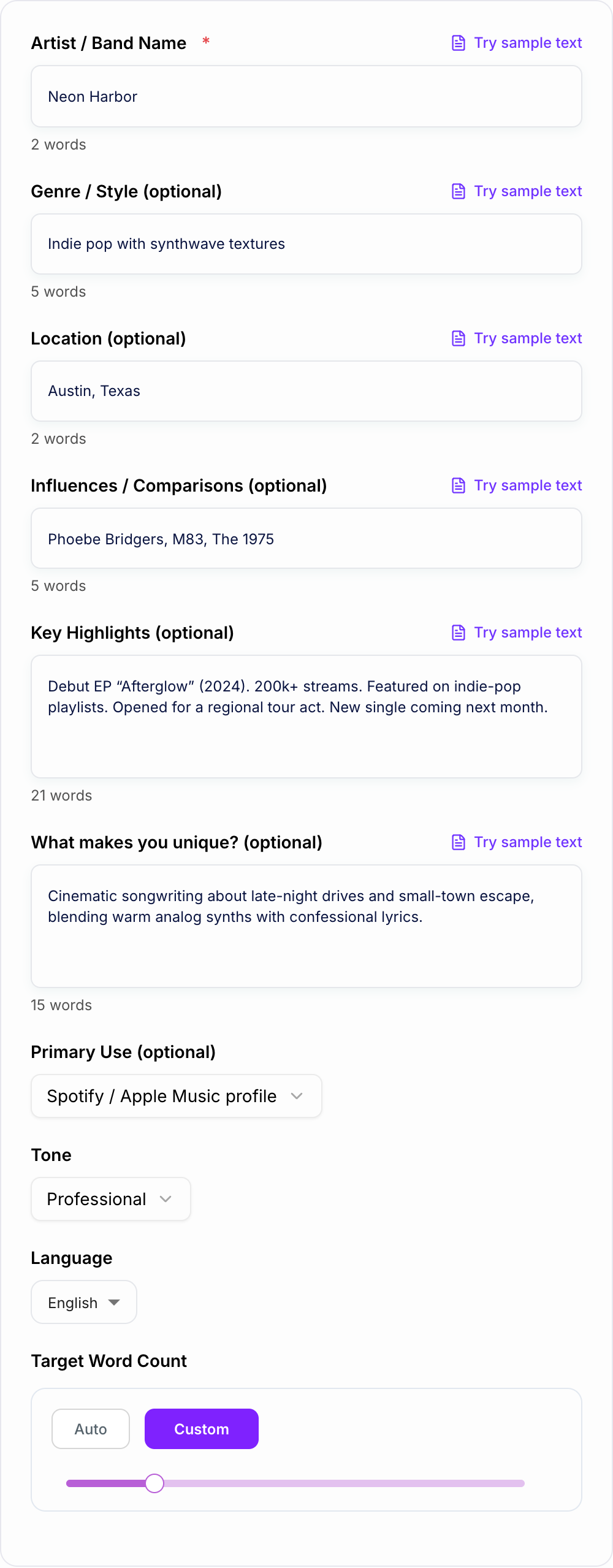
Credits and the platform length belong on the form. Do not invent press quotes.
Framework: write the uncomfortable sentence first (fee, last day, exclusion, jurisdiction). Then generate. If the AI Musician Bio Generator output buries that sentence, put it back in the first screen.
This is a draft aid, not legal, medical, or HR advice.
The AI Musician Bio Generator helps you turn scattered artist details into a usable bio for Spotify, Apple Music, EPKs, press pitches, booking submissions, websites, and social profiles. Choose the right mode, then review and edit the generated bio for facts, platform fit, and voice.
What to enter into the musician bio generator
The generator works best when you provide concrete details rather than broad praise.
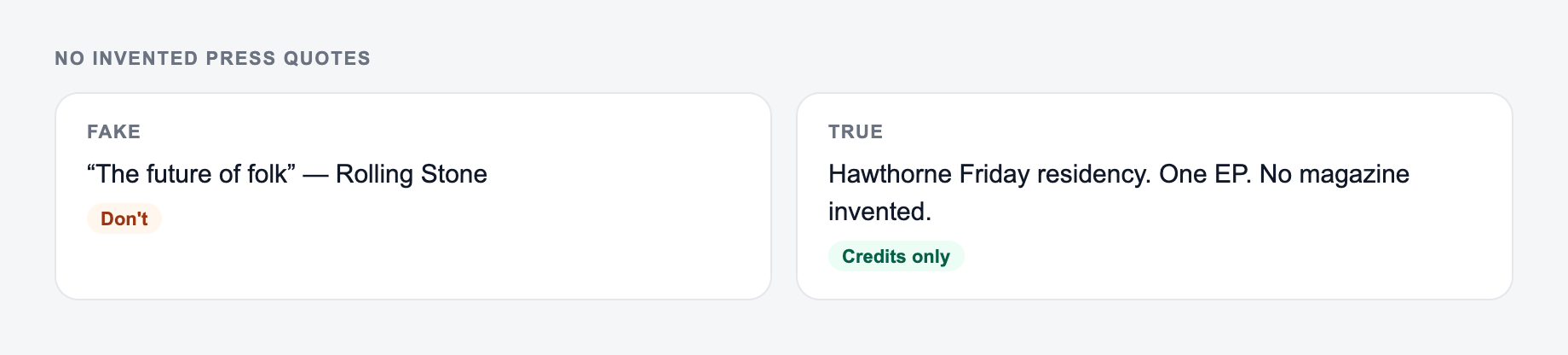
If your input looks like the miss, do not judge the tool yet — add the noun and the constraint first.
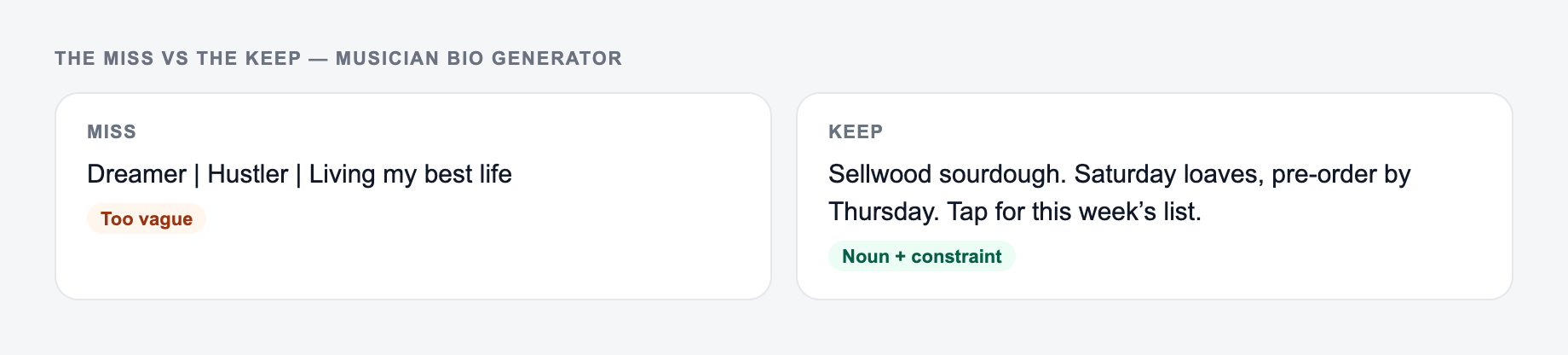
Walk the Musician Bio Generator like a template, not a finished filing. Names, dates, and amounts have to be ones you can prove.
Add:
- Artist or band name: exactly as it should appear.
- Genre and sound: not just "indie," but "indie pop with synthwave textures" or "folk songwriting with ambient electronic production."
- Location: useful for local press, venues, and search.
- Influences: only comparisons that genuinely help someone understand the sound.
- Highlights: releases, streams, playlists, press, radio, syncs, awards, tour support, venues, festivals, collaborations.
- Unique angle: themes, origin story, creative process, stage presence, community, or what listeners feel.
- Current focus: new single, upcoming EP, tour dates, booking push, or a fresh era.
Weak input: We are a band and make good music.
Stronger input: Neon Harbor is an Austin indie-pop project blending analog synths, driving guitars, and late-night lyrics. Debut EP Afterglow came out in 2024, passed 200k streams, and landed on indie-pop playlists. New single coming next month.
The second version gives the generator a sound, a story, and credible proof.
Choose the right bio format
Different platforms need different versions.
- Short Bio: best for Instagram, Spotify snippets, social profiles, and quick intros.
- Standard Bio: best for Spotify, Apple Music, websites, and general media blurbs.
- EPK / Press Bio: best for booking agents, festivals, publicists, journalists, and venue submissions.
- Third-Person Press Style: best when someone else needs to quote or copy the bio.
- First-Person Artist Voice: best for creator pages, fan communities, newsletters, and personal websites.
Generate at least two versions. A strong artist usually needs a short profile bio, a standard streaming bio, and a longer EPK bio with proof.
How to keep the bio credible
Music bios often fail because they overclaim. The generator can produce polished language, but the facts still need to be true.
Before using the output, check:
- Are the achievements real and current?
- Are stream counts, press names, venues, and release dates accurate?
- Do the genre comparisons actually match the music?
- Does the first sentence explain the sound clearly?
- Is there a "now" line that makes the bio feel alive?
If you do not have big milestones yet, do not invent them. Use sound, themes, location, creative process, and current releases instead. An honest emerging-artist bio is stronger than fake prestige.
Example input and generated structure
Input:
Artist: Mara Vale. Genre: cinematic folk-pop with cello, soft percussion, and confessional lyrics. Location: Portland. Influences: Laura Marling, Daughter, early Bon Iver. Highlights: debut single reached 75k streams, opened for two regional touring artists, new EP in September. Tone: intimate, professional. Use: EPK.
A strong generated EPK bio should include:
- a positioning line with artist name, location, and sound
- a paragraph that describes instrumentation, mood, and themes
- a short proof section with real highlights
- a live or performance angle if booking matters
- a current project or release line
That structure helps media and bookers scan the bio quickly.
Editing the generated musician bio
Do a simple revision pass before publishing:
- Cut adjectives that do not prove anything, such as "unique," "powerful," or "unforgettable."
- Replace vague sound descriptions with concrete ones: tempo, instrumentation, production style, vocal tone, lyrical themes.
- Keep only the strongest two or three highlights.
- Remove comparisons that make the artist sound derivative.
- Add a current release, tour, or project if the draft feels timeless in a bad way.
For streaming profiles, shorten aggressively. For an EPK, keep enough context for someone who has never heard the music.
Spotify bio vs EPK bio
A Spotify or Apple Music bio should be quick and scannable. It needs sound, identity, one proof point, and a current line.
An EPK bio can go deeper. It should explain the project, show momentum, describe the live show, and give press or booking teams a clean story they can reuse. If you are sending the bio with photos, links, and one-sheets, use third person unless the recipient asks otherwise.
Using Junia for artist promotion copy
Once the bio is ready, you can reuse the same details for release announcements, pitch emails, social captions, and website copy. The wider writing tools on Junia AI are useful for keeping that language consistent without rewriting the artist story from scratch every time.
Final checklist before publishing
- Does the first sentence clearly explain the sound?
- Are the highlights specific and true?
- Is the bio the right length for the platform?
- Does it include what is happening now?
- Would a booker, curator, or journalist understand the artist in 10 seconds?
- Does the final version sound like the artist, not a generic press template?
If the generated bio passes those checks, it is ready to adapt across music platforms, EPKs, and promotional channels.
Frequently Asked Questions
What should a good musician bio include?+
A strong musician bio usually includes your artist/band name, genre or sound description, origin or story, notable releases, key achievements (press, playlists, radio, tours), and what you’re doing now (new single/EP/album, upcoming shows). This tool formats those details into a clear, press-ready narrative.
Should my artist bio be in first person or third person?+
Third person is common for press bios and EPKs because it reads more objective for media and booking. First person can feel more personal for artist websites and social profiles. The generator supports both styles via modes.
How long should a Spotify artist bio be?+
Many artists use a short bio (1–2 sentences) or a standard bio (around 80–150 words) for music profiles. If you’re building an EPK for PR and booking, a longer 200–350 word version often works better.
Can I use this as an EPK bio for booking gigs?+
Yes. Choose the EPK/Press mode and add highlights such as recent releases, notable venues, festivals, tour support, and any press or playlist features. The output is designed to be easy for promoters and venues to scan.
Will the bio include my achievements without sounding braggy?+
Yes. The prompts emphasize credible, specific milestones and avoid overhyped language. If you provide numbers (streams, cities, dates), they’ll be integrated naturally and professionally.
What if I don’t have big milestones yet?+
You can still generate a strong emerging-artist bio by focusing on your sound, influences, themes, live energy, and what listeners can expect next. The tool won’t invent awards or press—add only what’s true.