
Free Niche Idea Generator
Use the AI Niche Idea Generator to discover profitable niche and micro-niche ideas with audience pain points, long-tail keyword angles, content clusters, and realistic monetization paths. Start broad, narrow by audience or business model, and validate ideas before you build.
Niche Ideas
Your niche ideas will appear here...
How the AI Niche Idea Generator Works
Get results in seconds with a simple workflow.
Enter a Seed Topic (Optional)
Add interests, skills, or a market you’re curious about. If you leave it blank, the tool will generate a diverse set of niche ideas across multiple categories.
Set Constraints (Audience, Monetization, Competition)
Optionally specify a target audience, monetization goal, and competition preference. This helps generate niche ideas that fit your business model and SEO strategy.
Get Niche Ideas + Keywords + Monetization
Receive niche and sub-niche ideas with audience pain points, content angles, keyword opportunities, and monetization routes you can use for validation and planning.
See It in Action
Turn vague ideas into specific, SEO-friendly niche options with audiences, keyword angles, and monetization strategies.
I want to start a blog but I don’t know what niche to choose. Maybe something like fitness or money.
Niche idea: Budget Meal Prep for Busy Professionals Audience: Young professionals (25–40) who want to eat healthier and save money Positioning angle: “High-protein, low-cost meal prep in under 90 minutes/week” SEO keyword angles: meal prep on a budget, high protein meal prep for beginners, cheap healthy lunches for work, meal prep grocery list Monetization: affiliate kitchen tools + grocery delivery apps, digital meal plan templates, newsletter sponsorships Content cluster: pillar guide + weekly meal plans, grocery lists, recipes, and time-saving meal prep tips
Why Use Our AI Niche Idea Generator?
Powered by the latest AI to deliver fast, accurate results.
Profitable Niche Ideas With Clear Angles
Generates niche and sub-niche ideas with a strong positioning angle, helping you avoid overly broad markets and find topics you can realistically grow.
SEO Keyword Opportunities (Topics + Long-Tail Queries)
For each niche, includes keyword-rich content angles and long-tail search queries (e.g., “best”, “how to”, “for beginners”, “near me”) to support SEO content planning and topical authority.
Audience + Pain Points + Problem-to-Solution Fit
Maps each niche to a specific audience and their pain points, making it easier to build content that matches search intent and converts.
Monetization Paths (Affiliate, Ads, Services, Products, SaaS)
Suggests realistic monetization strategies per niche—affiliate programs, product categories, service packages, or digital products—so you can validate revenue potential early.
Content Cluster Ideas for Faster Growth
Provides pillar + cluster topic ideas to help you build topical coverage, internal links, and a scalable editorial plan for organic traffic.
Pro Tips for Better Results
Get the most out of the AI Niche Idea Generator with these expert tips.
Start with a micro-niche, then expand to adjacent topics
Ranking is often easier when you begin with a narrow focus. Build topical authority with a tight content cluster, then expand to related sub-niches as you gain traffic and links.
Prioritize buyer intent if you need revenue quickly
If monetization is the goal, pick niches with natural “best”, “review”, “vs”, “alternatives”, “pricing”, and “for [audience]” keywords—these often convert better than purely informational topics.
Look for “problem-rich” audiences
A good niche has recurring problems that create content demand: check Reddit, Quora, Facebook groups, and industry forums for repeated questions and frustrations.
Map a simple content cluster before committing
Before choosing a niche, outline 1 pillar page and 15–30 supporting articles. If you can’t easily create that map, the niche may be too small or unclear.
Differentiate with a clear positioning statement
Add a unique angle: who it’s for, the core promise, and what you do differently (budget, premium, beginner-friendly, data-driven, templates, case studies). This improves clicks and brand recall.
Who Is This For?
Trusted by millions of students, writers, and professionals worldwide.
Generate Better Niche Ideas with an AI Niche Idea Generator
A strong niche idea is not just a topic you like. It is a specific audience, a problem they keep trying to solve, a set of searchable content angles, and a monetization path that does not feel forced.
The AI Niche Idea Generator is built for that early decision point. Instead of giving you a loose list like "fitness" or "finance," it can generate niche and micro-niche ideas with audience details, keyword angles, content clusters, and revenue options you can validate before you commit months of work.
What to Enter Into the Niche Idea Generator
The best results come from giving the generator a few useful constraints. You do not need a full business plan, but you should enter enough context for the tool to avoid generic ideas.
Useful inputs include:
- Seed topics: interests, skills, industries, hobbies, or markets you already understand
- Audience: who you want to serve, such as freelancers, new parents, ecommerce owners, students, or local businesses
- Monetization goal: affiliate, ads, services, digital products, SaaS, ecommerce, or newsletter sponsorships
- Competition preference: low competition if you are starting from scratch, balanced if you already have some authority
- Region or market: US, UK, local, global, or another market that changes search behavior
A weak input is "money." A stronger input is "personal finance for young professionals in the US who want budgeting help and affiliate-friendly product comparisons." That gives the generator a real direction.
How to Choose the Right Niche Mode
Use Broad Niches when you are still exploring a large market and need a map of possible directions. This is useful before you pick a content site, newsletter theme, YouTube channel, or SaaS category.
Use Micro Niches when you want a focused entry point. A micro-niche like "budgeting for freelancers with irregular income" is usually easier to position than "personal finance" because the audience and problem are clearer.
Use Low-Competition SEO when organic traffic is the main goal. This mode should push the generator toward long-tail keyword opportunities, content clusters, and subtopics you can realistically cover before bigger competitors notice.
Use Affiliate Niches when revenue needs to come from reviews, comparisons, alternatives, best-of lists, and buyer guides. In this mode, look for niches with products people already compare before buying.
Use Local / Service Niches when you want lead generation ideas, such as service plus location pages, trust-driven content, and local SEO angles.
Use SaaS / B2B Niches when the niche should support a product, workflow, or vertical solution. These ideas should include roles, pain points, compliance needs, or repeated business tasks.
How to Review the Generated Niche Ideas
Do not pick the idea that sounds most exciting first. Pick the idea that gives you the clearest path to content, traffic, and revenue.
Review each generated niche with this quick filter:
- Can you name the audience in one sentence?
- Can you list 10 to 20 long-tail keywords without forcing them?
- Are there repeated problems in forums, comments, search suggestions, or social communities?
- Is there a natural monetization path, such as products, services, templates, software, or sponsorships?
- Can you build one pillar page and at least 10 supporting pages around it?
- Can you explain how your angle is different from generic competitors?
If the answer is mostly yes, the niche is worth deeper validation. If the answer is no, regenerate with a narrower audience or a clearer monetization goal.
Example Input and Output Review
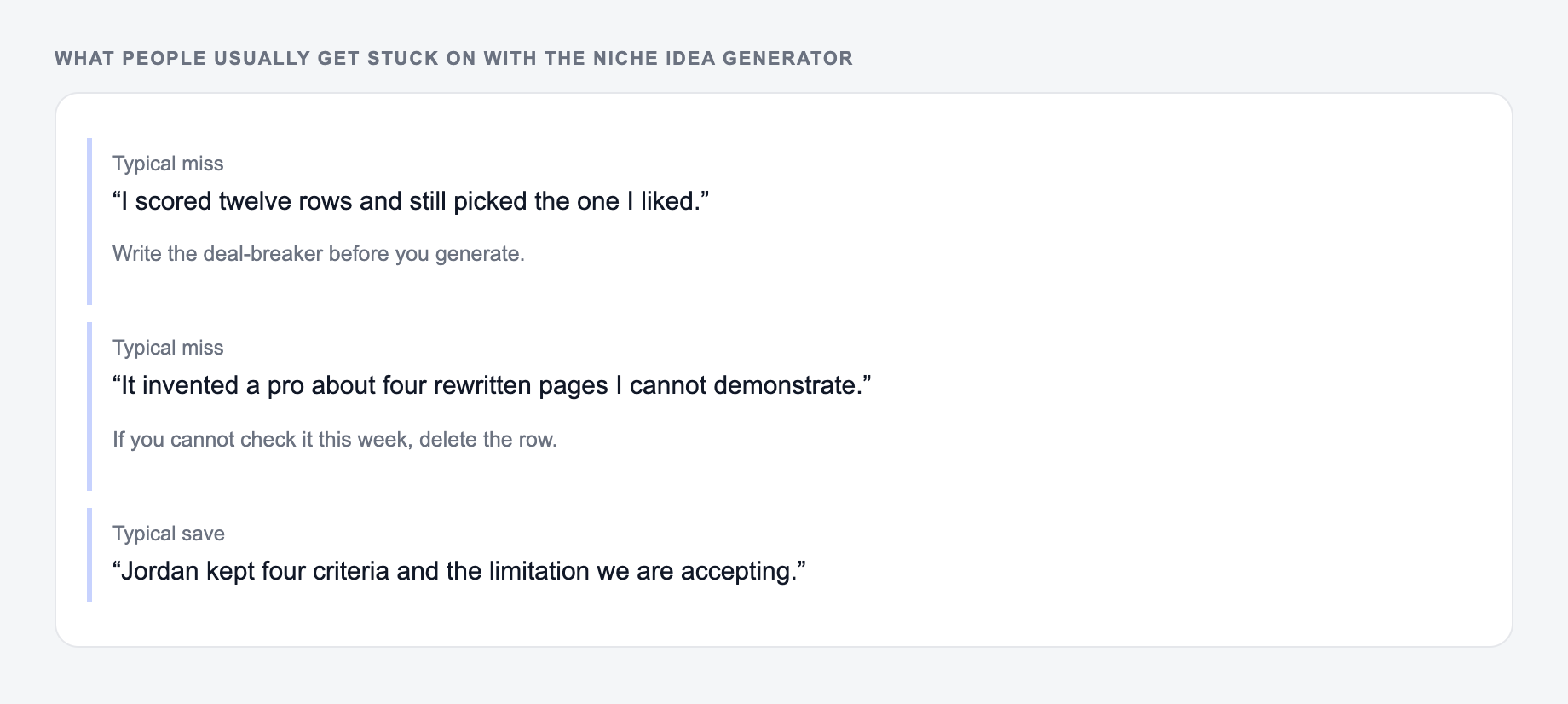
Give the Niche Idea Generator a real brief: who it is for, where it will appear, and one thing it is not allowed to invent. These are the complaints that show up after the first draft — they are almost always about the brief, not the model.
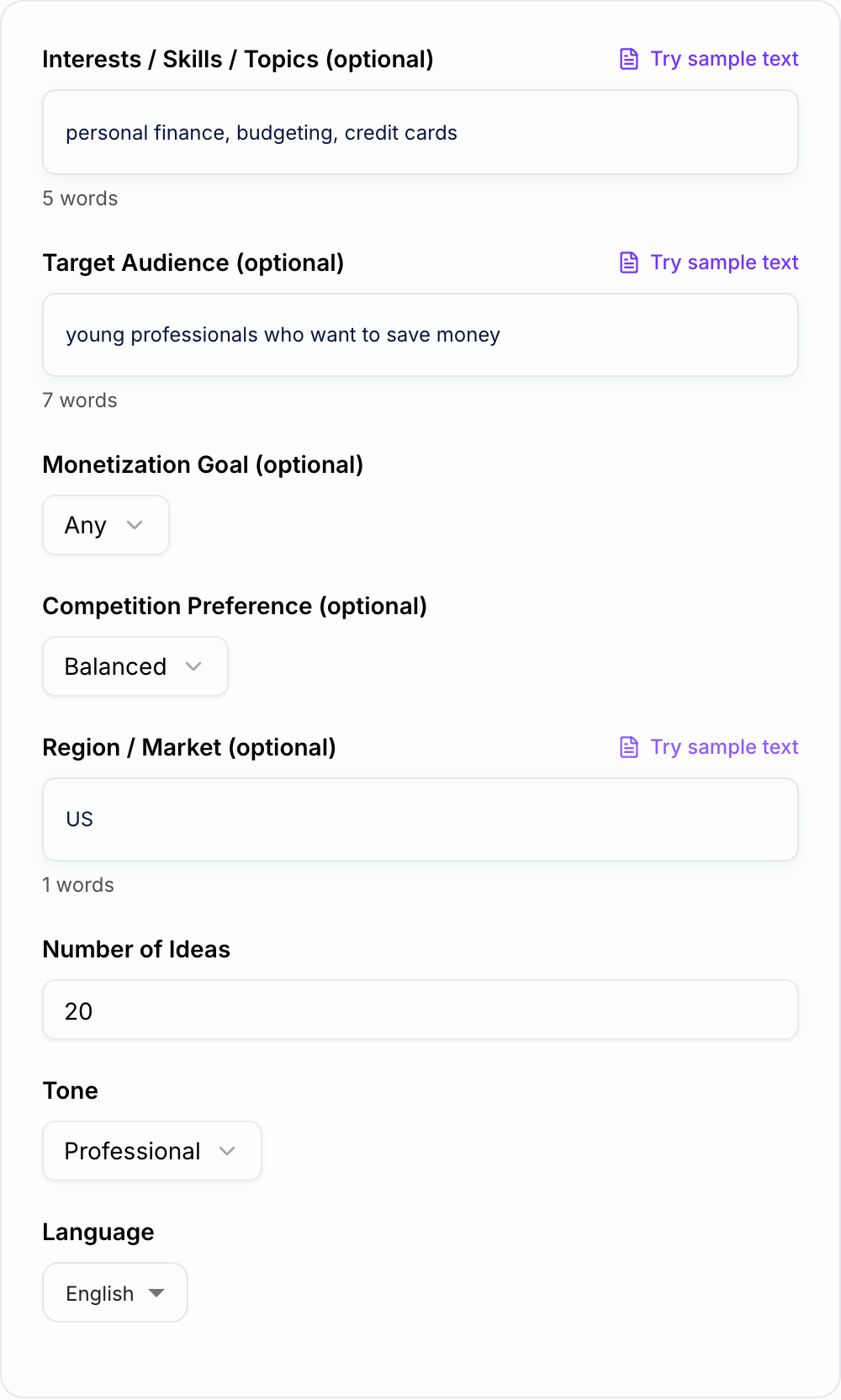
Example input:
- Seed topic: personal finance, budgeting, credit cards
- Audience: young professionals with irregular income
- Monetization: affiliate marketing and digital products
- Competition preference: low competition
- Region: US
A useful generated idea might look like this:
- Niche: budgeting for freelancers with irregular income
- Audience: self-employed workers who have uneven monthly cash flow
- Pain points: tax planning, inconsistent pay, debt payoff, emergency savings, business and personal expense separation
- SEO angles: budget template for freelancers, irregular income budgeting, freelancer tax savings, best budgeting apps for self-employed workers
- Monetization: budgeting app affiliates, spreadsheet templates, courses, newsletter sponsorships, tax software affiliates
- Content cluster: pillar guide, monthly budget templates, app comparisons, tax-season checklist, debt payoff plan, emergency fund guide
That output is usable because it gives you more than a category. It gives you audience, problems, content, and revenue logic.
Common Mistakes When Using a Niche Generator
The first mistake is treating every generated idea as equally viable. A niche can sound clever and still have weak search demand or no clear buyer path.
The second mistake is staying too broad. If the output says "fitness for beginners," regenerate with audience, constraint, or outcome details until the idea becomes more specific.
The third mistake is ignoring content depth. A niche that supports only five article ideas may be too small. A niche that supports hundreds of unrelated ideas may be too broad.
The fourth mistake is choosing only by revenue potential. If you do not understand the audience or cannot create credible content for them, the niche will be hard to sustain.
Final Checklist Before Choosing a Niche
Before you commit, take your top three generated ideas and write:
- One positioning sentence for each niche
- Ten long-tail keywords for each
- One pillar page and ten supporting article ideas
- One realistic monetization path
- Three audience problems you can explain clearly
- One reason your angle is different
If one idea passes that test faster than the others, start there. You can use the niche output with Junia AI to move from idea selection into keyword research, content briefs, and publishable pages without losing the original positioning.
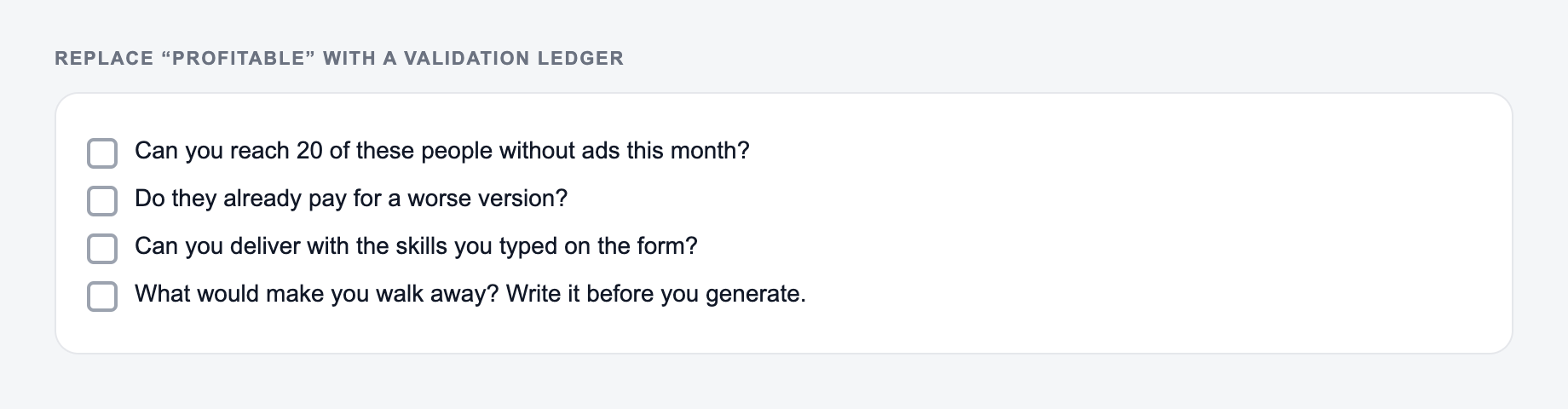
Replace “Profitable” With a Validation Ledger
A generator cannot know that a niche is profitable or low competition from a prompt alone. Treat those labels as hypotheses. For “budgeting for freelancers with irregular income,” create a ledger with: audience evidence, recurring problem, query examples, existing solutions, willingness-to-pay signal, your credibility advantage, acquisition route, and risks.
The form should list constraints you can actually work, not a request for “profitable niches.”
Use a one-pass framework:
- Name the decision in a sentence a colleague could repeat.
- List only the criteria that would change the choice.
- Score what you can observe, not what you prefer.
- Write the risk you are accepting next to the winner.
Compare candidate niches on evidence rather than enthusiasm:
- Problem frequency: Does it recur weekly, seasonally, or once?
- Reachability: Can you name communities, partnerships, or search journeys where the audience already gathers?
- Commercial fit: Are buyers paying for software, advice, templates, or services now?
- Content depth: Can you cover the subject without stretching beyond your expertise?
- Trust burden: Finance, health, legal, and other consequential topics require stronger sourcing and qualified review.
- Concentration risk: Would traffic or revenue depend on one platform or affiliate program?
Current keyword volume, SERP composition, commissions, regulations, and competition must be checked using dated sources. A list of plausible keywords is not keyword research, and affiliate availability is not proof of demand.
Frequently Asked Questions
What is a niche (and why does it matter for SEO)?+
A niche is a focused topic area with a specific audience and problems. For SEO, niches help you create consistent, relevant content, build topical authority, target long-tail keywords, and compete more effectively than broad, generic sites.
How do I choose a profitable niche?+
Look for overlap between (1) demand (people search for it), (2) a clear audience with problems to solve, (3) monetization options (affiliate products, services, digital products, ads), and (4) a realistic competition level. This tool helps you generate ideas with all four in mind.
What are micro-niches and are they better for beginners?+
Micro-niches are narrower segments (e.g., “budgeting for freelancers” instead of “personal finance”). They’re often easier to rank for, faster to position, and better for building an audience—especially when you plan a content cluster around them.
How can I validate a niche idea quickly?+
Validate by checking Google suggestions/People Also Ask, reviewing competitor sites, scanning forums and social communities for repeated questions, and confirming monetization (affiliate programs, product marketplaces, service demand). Start with 10–30 content ideas and see if they map cleanly to search intent.
Can this tool generate niche ideas for affiliate marketing?+
Yes. Choose an affiliate monetization goal to prioritize niches that naturally support buyer-intent content like reviews, best-of lists, comparisons, and alternatives.
Will these niche ideas be unique?+
Niche categories may be common, but the tool emphasizes specific angles, audiences, and problem-to-solution positioning. Your differentiation comes from your focus, content quality, and unique experience or expertise.