
Free OKR Generator
Use the AI OKR Generator to turn broad goals into focused Objectives, measurable Key Results, and practical initiatives for teams, companies, or personal planning. Add baseline metrics, timeframe, constraints, and focus areas to create OKRs that are easier to track and review.
OKRs
Your OKRs (Objectives + Key Results + Initiatives) will appear here...
How the AI OKR Generator Works
Get results in seconds with a simple workflow.
Enter a Goal and Context
Add your desired outcome and optionally include team, industry, focus areas, and baseline metrics to guide targets and OKR alignment.
Choose Timeframe and Output Preferences
Select monthly/quarterly/yearly OKRs and how many Objectives and Key Results you want. Add constraints like budget or headcount for more realistic OKRs.
Generate OKRs and Iterate
Get Objectives, measurable Key Results, and recommended initiatives. Then refine metric definitions, owners, and targets to fit your strategy and reporting cadence.
See It in Action
Transform a vague goal into clear, measurable OKRs with targets and initiatives for execution and weekly tracking.
Goal: Improve marketing performance this quarter. We want more leads and better results.
Objective 1: Increase qualified pipeline from inbound marketing KR1: Increase organic sessions from 18,000/mo to 26,000/mo KR2: Improve website signup rate from 1.6% to 2.4% KR3: Increase MQLs from 220/mo to 360/mo KR4: Reduce MQL-to-SQL time from 10 days to 6 days Initiatives: refresh top 10 SEO pages, build 6 comparison pages, improve onboarding emails, add intent-based CTAs
Objective 2: Improve activation from self-serve signups KR1: Increase activation (Aha%) from 28% to 40% KR2: Increase onboarding completion from 45% to 65% KR3: Reduce time-to-first-value from 3.2 days to 1.8 days Initiatives: onboarding checklist, in-app nudges, lifecycle emails, product tours
Why Use Our AI OKR Generator?
Powered by the latest AI to deliver fast, accurate results.
Measurable Objectives and Key Results
Generates OKRs with outcome-based, metric-driven Key Results (not tasks) so your goals are trackable, measurable, and aligned to a clear definition of success.
Initiatives, Owners, and Leading Indicators
Adds recommended initiatives and practical leading indicators to help teams execute, monitor progress weekly, and connect daily work to quarterly OKR targets.
Baseline-Aware Target Setting
Uses your baseline metrics (if provided) to set realistic OKR targets and improve OKR quality—ideal for growth OKRs, product OKRs, marketing OKRs, and sales OKRs.
Built-In Quality Checks (Anti-Pattern Guardrails)
Avoids common OKR mistakes like vague objectives, binary key results, or initiative-only KRs. Produces crisp wording, clear metrics, and time-bound targets.
Team, Company, or Personal OKR Templates
Create OKRs for departments (Marketing, Product, HR, Customer Success), company-level strategy, or individual development—optimized for OKR planning and quarterly goal setting.
Pro Tips for Better Results
Get the most out of the AI OKR Generator with these expert tips.
Write Objectives as outcomes, not projects
A strong Objective describes the impact you want (e.g., “Improve activation and early value”) rather than a deliverable (e.g., “Redesign onboarding”).
Use clear metric definitions and data sources
For each KR, define what counts (numerator/denominator), the reporting tool (GA4, CRM, data warehouse), and the update cadence to prevent tracking confusion.
Balance leading and lagging indicators
Include a mix: leading indicators (e.g., onboarding completion rate) help you steer early, while lagging indicators (e.g., retention) confirm the outcome later.
Make KRs controllable by the owner
Assign ownership to teams that can influence the metric. If a KR depends on other teams, note dependencies and add cross-functional initiatives.
Limit initiatives and prioritize weekly actions
Too many initiatives dilute focus. Pick 3–6 high-leverage initiatives per Objective and define the first week’s actions to start execution immediately.
Who Is This For?
Trusted by millions of students, writers, and professionals worldwide.
Generate Measurable OKRs with an AI OKR Generator
Good OKRs turn a broad goal into a small set of measurable outcomes. Weak OKRs usually fail because they sound strategic but do not tell the team what progress means.
The AI OKR Generator helps you draft Objectives, Key Results, and initiatives from a goal, team, timeframe, baseline metrics, and constraints. Use it to create a strong first version, then review the metrics, owners, and feasibility before you take the OKRs into planning.
What to Enter Into the OKR Generator
Start with the outcome you want, not the project you want to ship. The generator performs better when the input explains the business result and the current context.
Helpful inputs include:
- Goal or desired outcome: increase activation, improve retention, grow qualified pipeline, reduce churn, improve onboarding
- Team or function: marketing, product, sales, customer success, HR, operations, or personal development
- Timeframe: monthly, quarterly, half-year, or yearly
- Industry: SaaS, ecommerce, agency, healthcare, education, finance, or another context that affects metrics
- Focus areas: acquisition, conversion, revenue, NPS, efficiency, quality, retention, hiring, or learning
- Baseline metrics: current traffic, conversion rate, activation rate, churn, pipeline, revenue, cycle time, or satisfaction score
- Constraints: budget, team size, dependencies, must-ship work, or known risks
A weak input is "improve marketing." A stronger input is "increase self-serve SaaS signups this quarter; marketing team; current traffic 18,000 visits/month, signup rate 1.6%, no paid ads budget." That gives the generator enough information to create measurable Key Results.
How to Choose the Right OKR Mode
Use Team OKRs when a function needs goals it can directly influence. This is the safest mode for quarterly planning because it keeps OKRs close to team ownership.
Use Company OKRs when leadership needs strategic outcomes across departments. These should be fewer, broader, and tied to the company's north star metrics.
Use Personal OKRs for career development, learning, productivity, or health goals. In this mode, the Key Results should be realistic and based on habits or milestones you can track.
Use Stretch Goals when you intentionally want ambitious targets. Stretch OKRs should still be measurable and credible, but they may be designed for 60 to 70 percent attainment instead of guaranteed completion.
How to Review the Generated OKRs
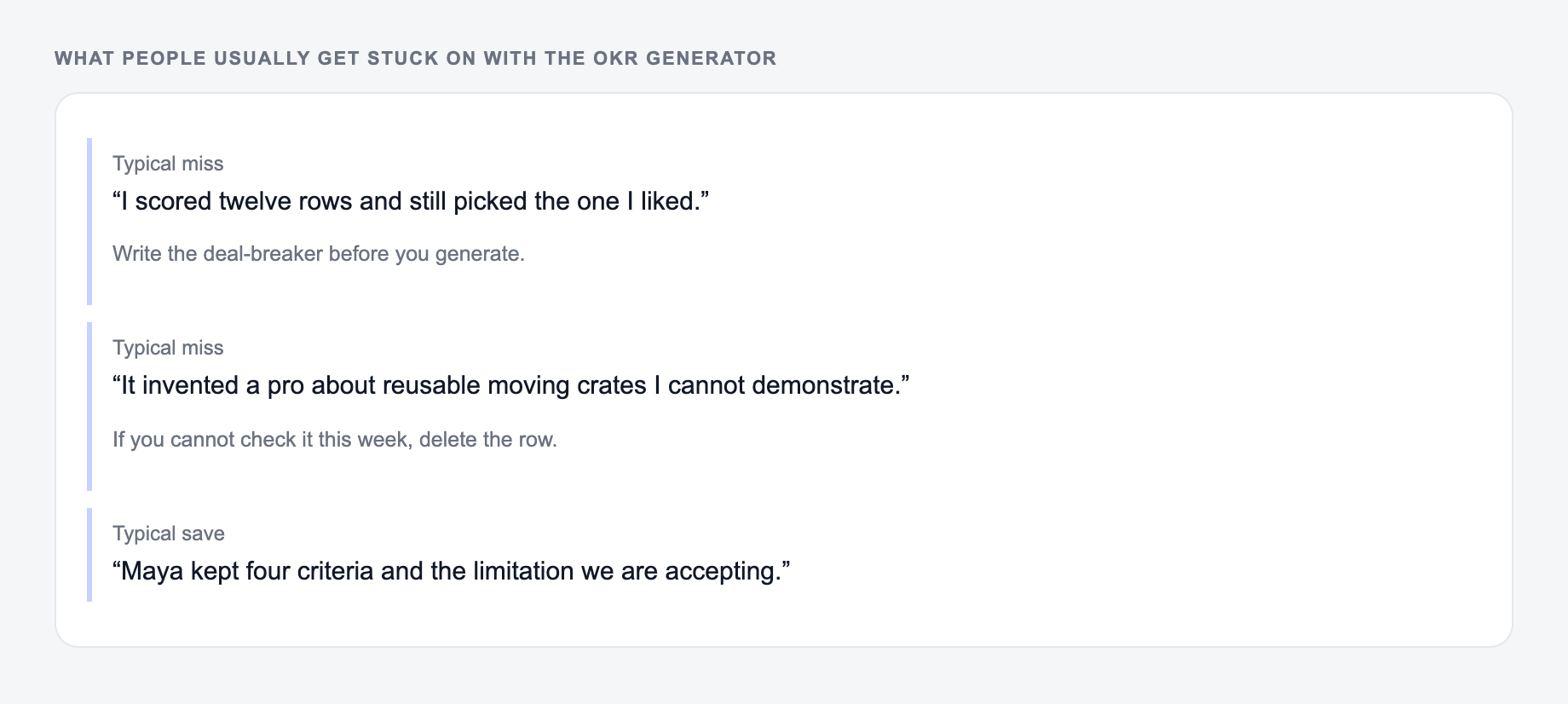
If the output felt generic, it is usually one of these three misses.
Treat generated OKRs as a draft, not a final plan. Before using them, check each Key Result with five questions:
- Is it measurable by a real data source?
- Does it describe an outcome, not an activity?
- Is the baseline clear or at least estimated?
- Can the owner influence the result?
- Is the timeframe explicit?
For example, "launch onboarding emails" is an initiative. "Increase onboarding completion from 45% to 65% by the end of Q3" is a Key Result. The second version tells the team what must change and how progress will be judged.
Example Input and Generated OKR
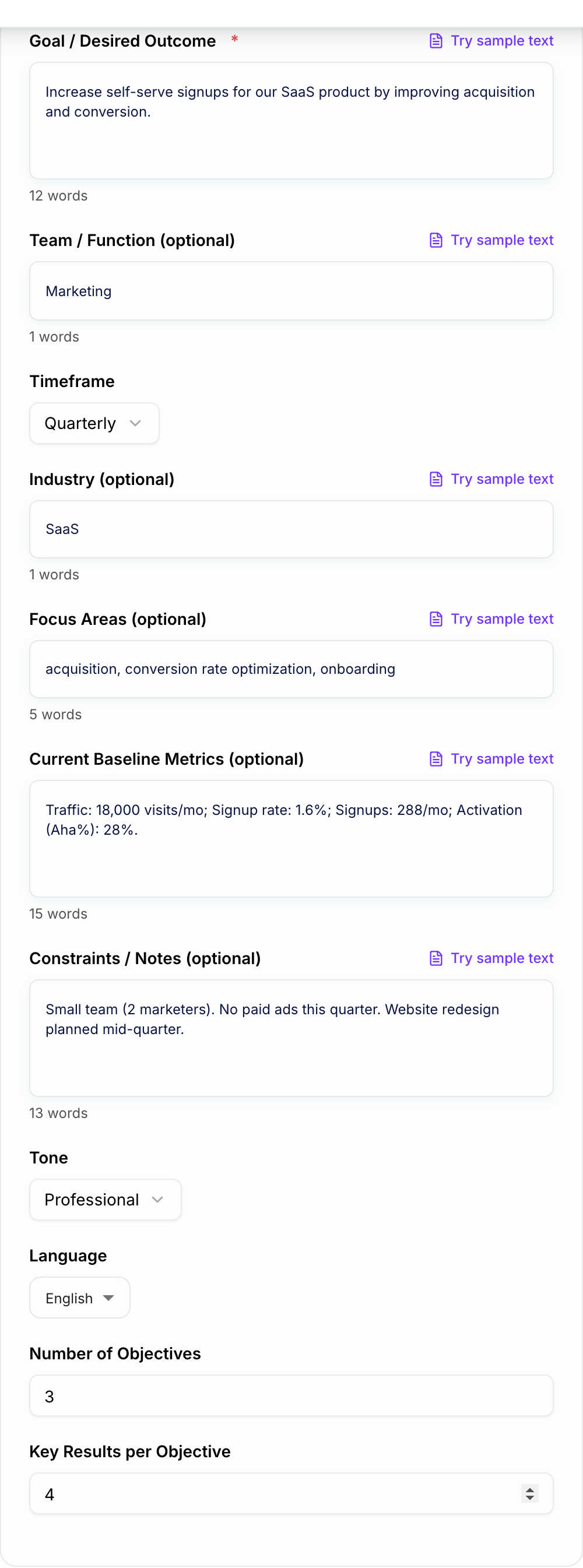
Example input:
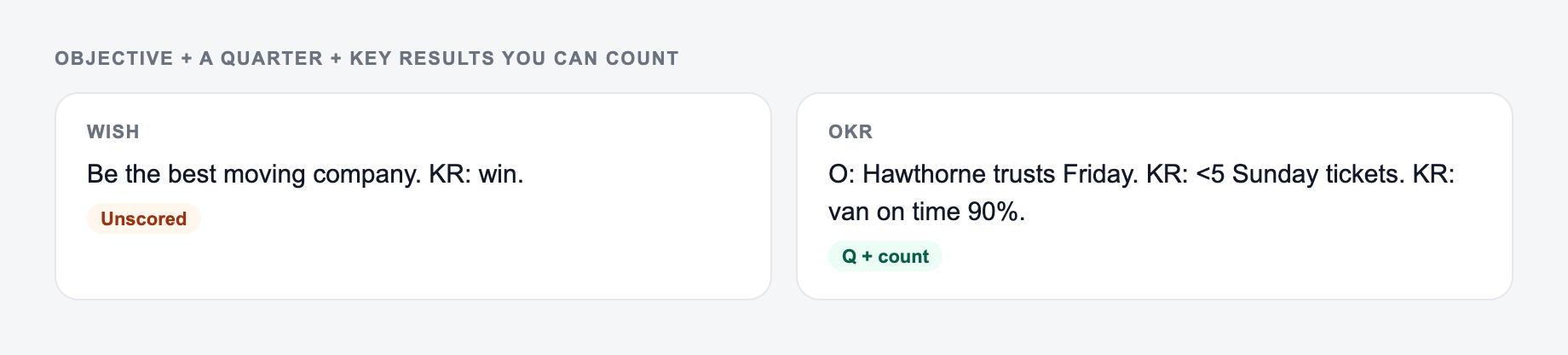
Objective and a quarter on the form beat “make us more successful.”
After you generate, do not average the scores. Circle the one criterion that would make you walk away, then see whether the AI OKR Generator output still recommends that option.
A longer list is not a better decision. Score what you will actually live with.
- Goal: increase self-serve signups for a SaaS product
- Team: marketing
- Timeframe: quarterly
- Baseline: 18,000 visits/month, 1.6% signup rate, 288 signups/month
- Constraints: two-person team, no paid ads this quarter
A useful generated OKR might be:
Objective: Increase qualified self-serve acquisition without paid ads
Key Results:
- Increase organic sessions from 18,000/month to 26,000/month
- Improve website signup rate from 1.6% to 2.4%
- Increase monthly self-serve signups from 288 to 620
- Reduce MQL-to-SQL handoff time from 10 days to 6 days
Initiatives: refresh top organic pages, publish comparison pages, improve intent-based CTAs, tighten lifecycle email handoff.
The Key Results are useful because they have numbers, direction, and a timeframe. The initiatives explain the work without pretending the work itself is the outcome.
Common OKR Generator Mistakes
The first mistake is entering a project instead of an outcome. If you enter "redesign onboarding," the generator may give you task-shaped KRs. Enter the reason instead: "help new users reach first value faster."
The second mistake is asking for too many Objectives. Most teams are better served by two to four Objectives per quarter with three to five Key Results each.
The third mistake is skipping baseline metrics. You can generate OKRs without baselines, but targets become more credible when the generator knows the current numbers.
The fourth mistake is accepting vague metric names. Define what activation, qualified lead, churn, or adoption means before tracking starts.
Before you adopt the okr generator draft:
- The metric is something you can collect this quarter
- An owner and a review date are named
- Volume, “profit,” and “easy” were not treated as evidence
Final Checklist Before Sharing OKRs
Before you publish generated OKRs, confirm:
- Every Objective is short and outcome-led
- Every Key Result has a metric, direction, and deadline
- Initiatives are listed separately from Key Results
- Owners and data sources are clear
- Targets are ambitious but not fantasy
- Weekly check-ins can update progress without debate
Once the draft passes those checks, the AI OKR Generator has done its job: it gave you a structured planning version that your team can refine, own, and track.
If the OKRs need to become planning notes, campaign briefs, or team updates, Junia AI can help turn the approved structure into clearer supporting content without changing the targets.
Frequently Asked Questions
What is an OKR generator?+
An OKR generator helps you create Objectives and Key Results from a goal. It turns a desired outcome into measurable OKRs, often including targets, metrics, and suggested initiatives to execute.
How many OKRs should a team set per quarter?+
Most teams do best with 2–4 Objectives per quarter and 3–5 Key Results per Objective. Fewer, higher-quality OKRs improve focus and make tracking simpler.
What makes a good Key Result?+
A good Key Result is measurable, time-bound, and outcome-focused (e.g., “Increase activation rate from 28% to 40%”) rather than an activity (e.g., “Launch onboarding emails”).
Can I generate company OKRs and team OKRs?+
Yes. You can generate OKRs for a company, department, or individual. Company OKRs focus on strategic outcomes, while team OKRs emphasize what the team can directly influence.
Do I need baseline metrics to use this OKR generator?+
No. Baselines are optional. If you include them, the generator can propose more realistic targets and clearer success criteria based on your current performance.
How do I track OKRs after generating them?+
Use weekly check-ins: update each Key Result’s current value, confidence (low/medium/high), and next actions. If progress stalls, adjust initiatives—not the Key Result—unless assumptions changed significantly.
Are these OKRs guaranteed to be correct for my business?+
They’re a strong starting point. Review for feasibility, ownership, and metric definitions. Align with strategy, confirm data sources, and ensure each KR is within your team’s influence.