
Free Peer Review Generator
Paste a manuscript, abstract, thesis chapter, or key paper sections to generate a structured peer review with strengths, weaknesses, major and minor revisions, methodology feedback, clarity notes, recommendation options, and an actionable revision checklist.
Peer Review
Your peer review will appear here...
How the AI Peer Review Generator Works
Get results in seconds with a simple workflow.
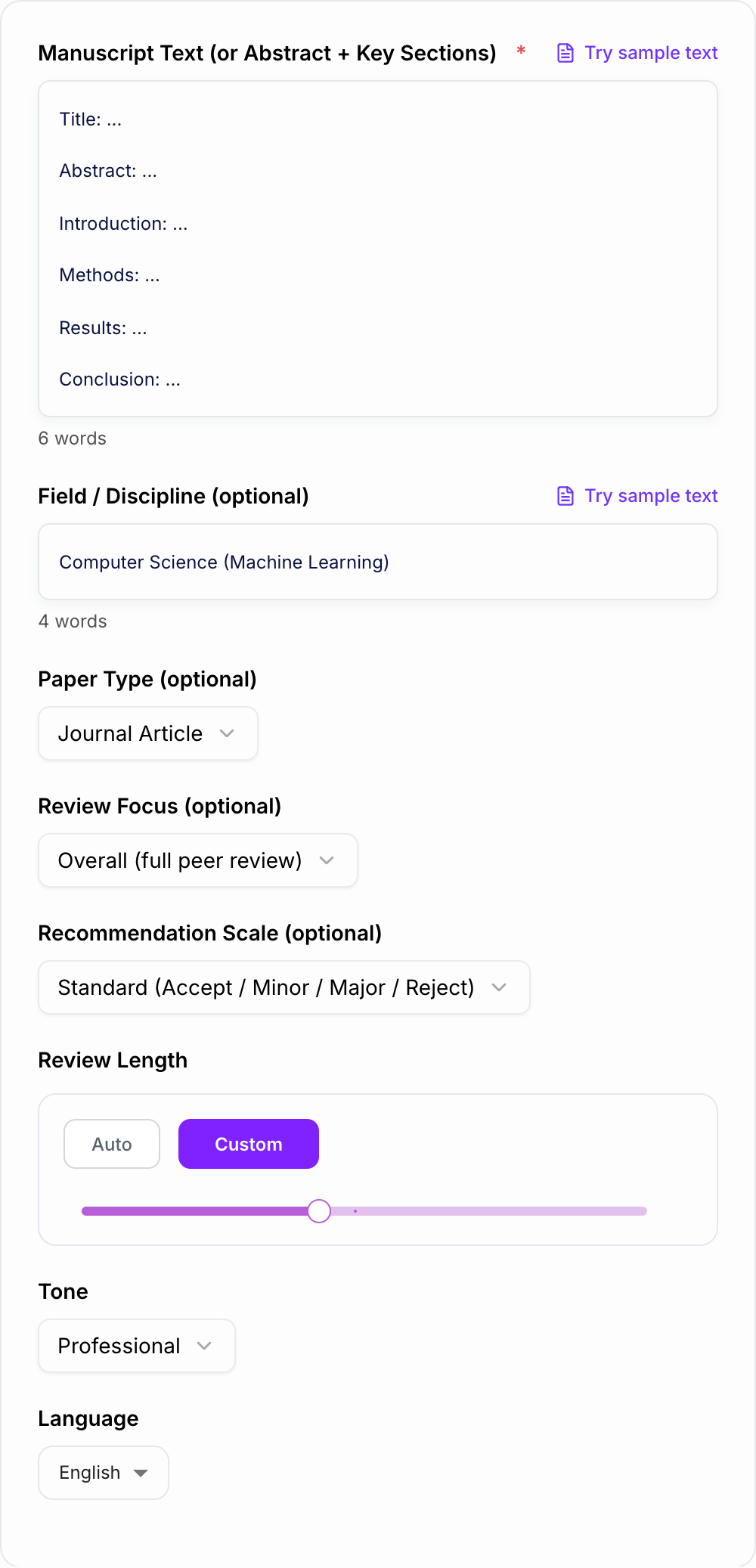
Paste the Manuscript (or Abstract + Key Sections)
Provide the paper text so the review can assess the research question, contribution, methods, results, and conclusions.
Choose Paper Type and Review Focus
Select whether you want an overall peer review or feedback focused on methodology, writing clarity, novelty, statistics, or references.
Generate a Structured Review and Revision Plan
Get an editor-ready peer review with strengths, concerns, major/minor revisions, and (optionally) a recommendation and confidence score.
See It in Action
Turn a draft manuscript into a structured, constructive peer review with prioritized revisions and an editor-style recommendation.
I need feedback on my paper. Can you peer review it?
Abstract: We propose a new method for... Methods: We evaluate on... Results: We show improvements...
Summary: The manuscript proposes a method for X and evaluates it on Y. The main claimed contribution is Z.
Strengths:
- Clear motivation and problem framing.
- Empirical improvement over baseline A on dataset B.
- Reproducible high-level pipeline description.
Major Concerns (Required Revisions):
- Experimental design: clarify train/validation/test splits and prevent leakage.
- Baselines: add strong baselines (C, D) and justify hyperparameter tuning fairness.
- Claims vs evidence: weaken or support the claim about generalization; add an ablation study.
Minor Concerns (Optional Improvements):
- Improve figure captions to be self-contained.
- Define key term T at first use.
- Fix inconsistent notation in Section 3.
Recommendation: Major Revision Confidence: Medium
Revision Checklist:
- Add split details + leakage mitigation.
- Add baselines + tuning protocol.
- Add ablations + revise generalization claim.
- Improve definitions, notation, and figures.
Why Use Our AI Peer Review Generator?
Powered by the latest AI to deliver fast, accurate results.
Structured Peer Review (Strengths, Weaknesses, Major/Minor Revisions)
Generates a journal-style peer review with clear sections: summary, strengths, concerns, and prioritized major and minor revisions—ideal for academic peer review, conference reviews, and classroom feedback.
Methodology and Rigor Checks
Flags common research design issues such as missing controls, unclear sampling, weak evaluation protocols, threats to validity, and reproducibility gaps—helpful for improving methods sections and study credibility.
Clarity, Organization, and Academic Writing Feedback
Improves readability by identifying confusing claims, weak transitions, missing definitions, and structural issues across abstract, introduction, methods, results, and discussion.
Recommendation + Confidence (Editor-Ready)
Provides an accept/minor/major/reject recommendation (or conference scale) with a brief justification and confidence level, mirroring real peer review workflows.
Actionable Revision Checklist
Turns critique into a practical revision plan with concrete changes authors can implement—useful for resubmissions, rebuttals, and iterative drafts.
Pro Tips for Better Results
Get the most out of the AI Peer Review Generator with these expert tips.
Include methods and evaluation details for better rigor feedback
Peer reviews are strongest when the tool can assess sampling, experimental setup, baselines, metrics, and limitations. If you only paste an abstract, methodology critique will be more conditional.
Ask for actionable revisions, not just criticism
A useful review explains what to change and why. After generating, ensure each major concern has a concrete fix (add analysis, clarify definitions, expand related work, adjust claims).
Use the review to build a resubmission checklist
Convert major concerns into a numbered checklist, then track changes in the manuscript. This mirrors journal revision workflows and makes rebuttals easier.
Verify claims, numbers, and missing information flags
If the review says something is missing, confirm whether it’s actually absent or simply hard to find. Improve signposting with clearer sectioning, captions, and explicit statements.
Generate two modes: Balanced + Strict
A balanced review helps with clarity and tone; a strict review helps uncover rigor gaps. Comparing both often yields a stronger final manuscript.
Who Is This For?
Trusted by millions of students, writers, and professionals worldwide.
Generate a Structured Peer Review from a Manuscript Draft
The Peer Review Generator helps turn a manuscript, abstract, thesis chapter, student paper, or conference submission into a clear review with strengths, concerns, major revisions, minor revisions, and an optional recommendation.
The tool is most useful when you need structured academic feedback but do not want the review to sound vague, harsh, or unbalanced. It can help reviewers draft comments faster, help authors self-review before submission, and help instructors produce more consistent feedback.
The output should still be checked by a human reviewer. The generator can organize critique and surface common issues, but you remain responsible for accuracy, fairness, and discipline-specific judgment.
What to Paste for a Better Peer Review
You can generate a review from an abstract, but the result will be limited. A peer review is only as strong as the manuscript details the tool can inspect.
For the best output, paste:
- the title and abstract
- introduction or problem statement
- methods, data, experimental setup, or analytical approach
- key results, tables, figures, or findings
- conclusion and limitations
- any reviewer instructions, rubric, venue requirements, or recommendation scale
If you cannot paste the full paper, say that clearly in the input. The generator can then phrase concerns as "the manuscript should clarify..." instead of pretending it saw sections you did not provide.
How to Choose Review Mode and Focus
Use Balanced when you want a complete review with strengths, weaknesses, and practical revisions. This is the best default for most journal articles and academic assignments.
Use Strict / Critical when you need a harder check on methodology, claims, baselines, limitations, or reproducibility. This mode is useful before submission because it exposes weak points while you still have time to fix them.
Use Supportive / Mentorship for classroom feedback, thesis drafts, early-stage papers, or author self-review. It explains why issues matter and how to improve them.
Use Short Review when you need a concise review with only the highest-priority comments.
Use Double-Blind Safe when the review must avoid identity guessing. This mode keeps the feedback focused on manuscript content, not authors, institutions, or assumptions.
The review focus matters too. Choose methodology, novelty, statistics, writing, or references when you want the tool to inspect one area more closely instead of producing a general review.
Example Input and Generated Review Structure
Useful input:
Paste the section you read and the review focus. The form cannot supply evidence from a paper you did not attach.
Learning workflow:
- Enter only facts you have.
- Generate a structured draft.
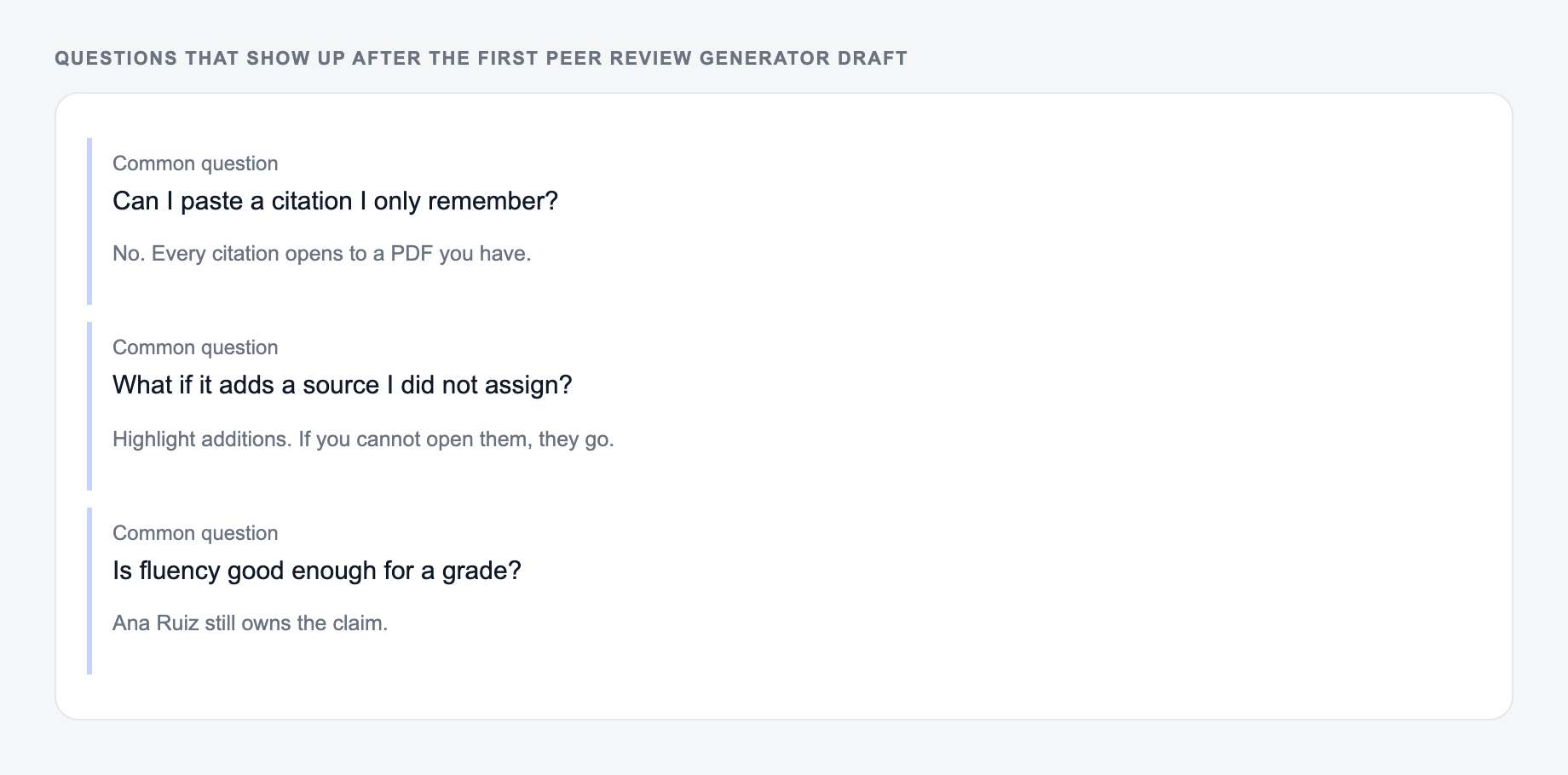
- Check names, dates, citations, and units.
- Rewrite the sentences you would actually say in class or in the paper.
If the task is graded, cited, or used with students, the named writer still owns the claims.
Discipline: Computer science / machine learning Paper type: Conference paper Review focus: Methodology and evaluation Recommendation scale: Conference Include strengths, major concerns, minor concerns, recommendation, confidence, and a revision checklist. Manuscript sections: [paste abstract, methods, results, and conclusion]
The generated review should give you:
- a short summary of the manuscript in the reviewer's own words
- specific strengths tied to contribution, clarity, evidence, or relevance
- major concerns that affect validity, novelty, reproducibility, or claims
- minor concerns around definitions, wording, citations, figures, and formatting
- a recommendation and confidence level if you requested one
- a revision checklist the author can act on
That structure is important because authors need priorities, not just criticism.
How to Review the Generated Peer Review
Do not submit the output untouched. Read it like an editor.
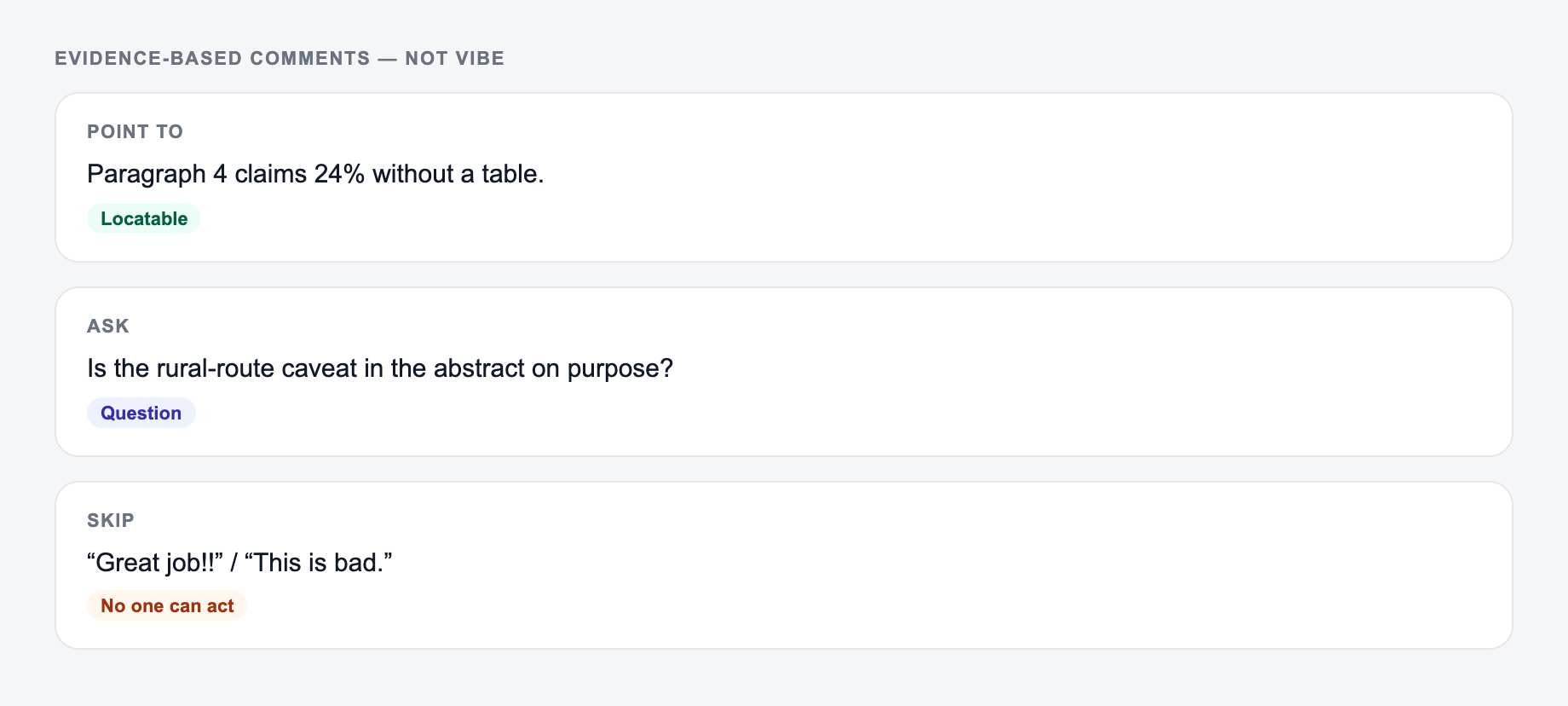
Check whether each major concern is supported by the manuscript text. If the generator flags a missing baseline, missing limitation, unclear sample, or weak claim, confirm that the issue is real.
Remove comments that overreach. A peer review should not claim the paper is wrong unless the evidence supports that conclusion.
Add two or three manuscript-specific observations. Mention a method detail, a result nuance, a figure, a definition, or a related-work gap. These details make the review more credible and useful.
Keep the tone professional. Good peer review critiques the work, not the author. It should be direct enough to help and careful enough to be fair.
Common Mistakes to Avoid
Answer these before you generate a second batch. A reroll will not fix a vague brief.
Do not paste only the abstract and expect a full methodology review. The tool cannot assess controls, sampling, statistical choices, ablations, or limitations without seeing the relevant sections.
Do not treat the recommendation as final. The accept/minor/major/reject label should match your venue's criteria and your own reading.
Do not let the output invent citations, missing sections, or author intent. If something is unclear, phrase it as a clarification request.
Do not make every issue major. Reserve major concerns for problems that affect contribution, validity, interpretation, or reproducibility.
If you also need to polish your own review wording after fact-checking, the broader Junia AI writing workflow can help tighten tone and structure while keeping the substance intact.
Final Peer Review Checklist
Before using the generated review, confirm:
- the manuscript summary is accurate
- strengths are specific, not generic praise
- major concerns are genuinely major
- minor revisions are grouped clearly
- the recommendation matches the evidence
- no confidential, identifying, or unsupported claims were added
- each requested change gives the author a clear next step
Frequently Asked Questions
Is this peer review generator free to use?+
Yes. You can generate a complete peer review for free. Some advanced modes (like strict/critical review styles) may be marked as premium.
What should I paste for the best peer review?+
For the most accurate feedback, paste the full manuscript. If that’s not possible, include at least the abstract, introduction, methods, key results, and conclusion so the review can assess claims, evidence, and study design.
Will the tool invent problems or citations?+
The review is based on the text you provide. It should not fabricate citations or claim the paper includes details that are not present. If information is missing, the review will note it as a limitation or request clarification.
Can it generate an accept/minor/major/reject recommendation?+
Yes. You can choose a standard journal-style recommendation scale or a conference-style scale. You can also disable recommendations and generate comments only.
Can I use it to improve my paper before submission?+
Yes. Many authors use peer review templates to self-review drafts. Use the output as a revision plan: address major concerns first, then minor edits, and verify that your claims are supported by results.
Does it work for different disciplines and paper types?+
Yes. Add your discipline and paper type (journal article, conference paper, thesis, systematic review, case study, or student assignment) to tailor the review criteria, terminology, and expectations.