
Free Podcast Episode Title Generator
Use the AI Podcast Episode Title Generator to turn an episode topic, guest name, keyword, or rough angle into a batch of clear, clickable title ideas. Create titles for Spotify, Apple Podcasts, YouTube, interview episodes, solo episodes, and back-catalog refreshes without forcing awkward keywords.
Podcast Episode Titles
Your podcast episode title ideas will appear here...
How the AI Podcast Episode Title Generator Works
Get results in seconds with a simple workflow.
Enter Your Episode Topic (and Optional Guest)
Type the episode topic and, if relevant, the guest name. Add a couple of keywords to align titles with podcast SEO and search intent.
Pick Platform + Style
Choose where you publish (Spotify/Apple Podcasts, YouTube, or both) and a title style (how-to, question, benefit-driven, contrarian) to match your audience.
Generate, Then Choose the Best Hook
Get a list of title options. Pick 1–2 finalists, ensure accuracy, and use the strongest title across your podcast host, YouTube upload, and promo posts.
See It in Action
Example of turning a generic podcast episode name into a clearer, keyword-friendly, clickworthy title.
Episode 12: Newsletter Growth
How to Grow a Newsletter Fast (Without Spam) — 7 Tactics That Work
Why Use Our AI Podcast Episode Title Generator?
Powered by the latest AI to deliver fast, accurate results.
SEO-Friendly Podcast Episode Titles
Generates keyword-aware podcast titles that are easy to understand and optimized for discovery in Spotify, Apple Podcasts, and YouTube search.
Multiple Title Variations for Higher CTR
Creates a diverse list of title ideas (how-to, questions, benefits, contrarian hooks) so you can pick the best option for clicks and plays.
Guest + Topic Formatting for Interview Episodes
Automatically formats interview titles to highlight the guest name and the most compelling takeaway—ideal for shareability and credibility.
Mobile-First Length and Clarity
Avoids overly long titles and front-loads the key phrase so your episode reads clearly in podcast apps and on small screens.
Platform-Aware Suggestions (Podcast Apps vs YouTube)
Adapts titles based on where you publish—clean and scannable for podcast directories, or hook-forward for YouTube podcast thumbnails and titles.
Pro Tips for Better Results
Get the most out of the AI Podcast Episode Title Generator with these expert tips.
Front-load the keyword or outcome
Place the main topic early (first ~3–6 words) so it’s visible in podcast apps and improves relevance for podcast search and YouTube discovery.
Make the benefit obvious, not vague
Swap generic titles (e.g., “Marketing Tips”) for specific outcomes (e.g., “Marketing Tips That Increase Trial Signups”). Specificity improves CTR and listener trust.
Use a consistent naming formula for series
For multi-part episodes, keep a stable prefix (show/series name) and vary the payoff. Consistency improves brand recognition and helps listeners follow along.
Avoid hype words without proof
Words like “secret,” “insane,” or “guaranteed” can reduce trust. Use curiosity, but keep the title aligned with what the episode actually delivers.
Test 2 title variants over time
If your host supports it, try updating titles on older episodes after a few weeks. Small title improvements can increase back-catalog plays and SEO visibility.
Who Is This For?
Trusted by millions of students, writers, and professionals worldwide.
Generate Better Podcast Episode Titles From a Rough Topic
The podcast episode title generator works best when you treat it like an angle finder, not a magic title button. Give it the episode topic, the listener promise, the guest if there is one, and the platform you care about most. It can then turn a rough idea into title options that are easier to search, scan, and click.
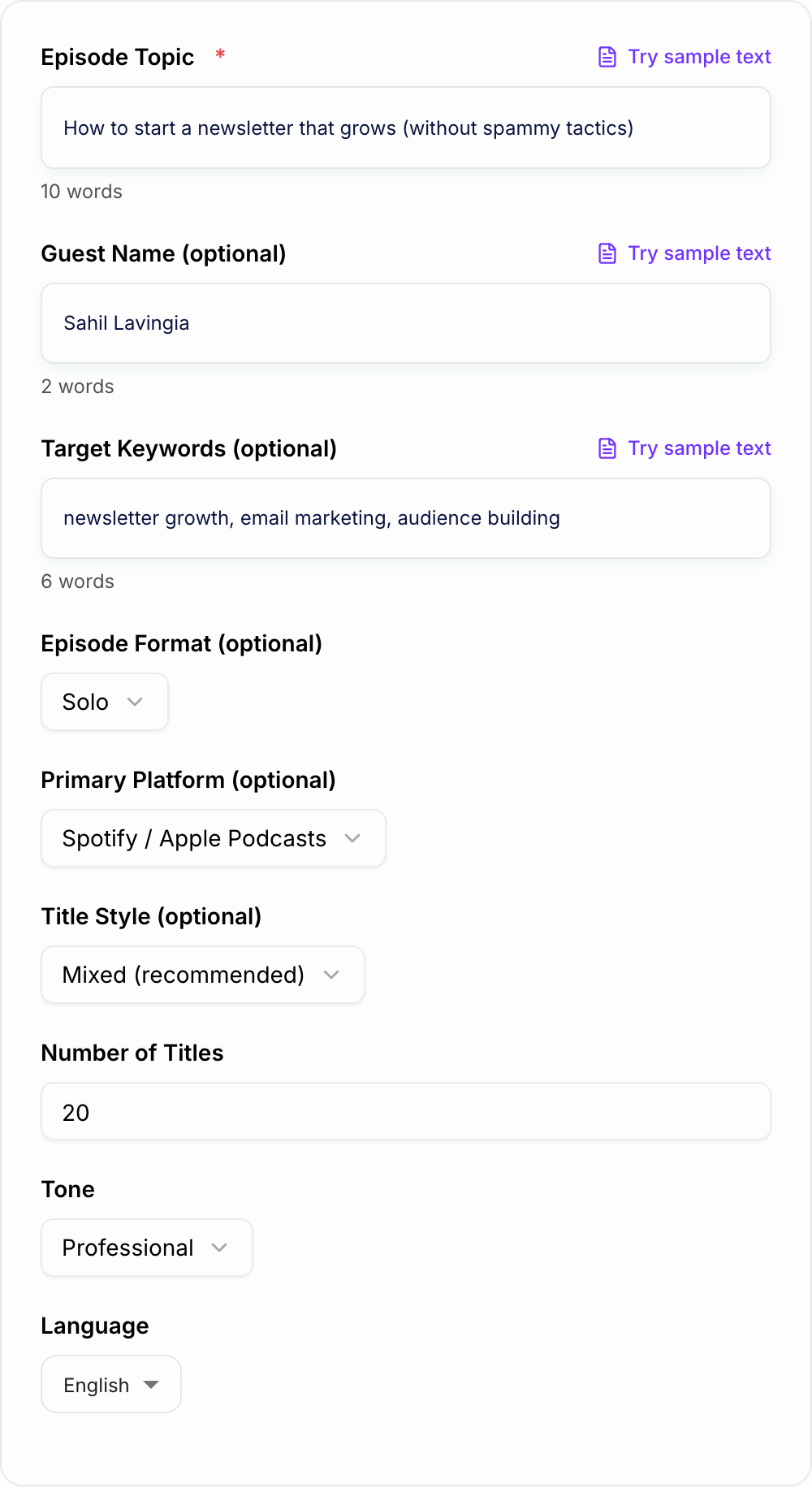
That matters because a podcast title has to do two jobs at once:
- Explain what the episode is about.
- Give a real listener a reason to press play.
If either side is missing, the title usually becomes vague, over-clever, or too long for podcast apps.
What to Enter Into the Podcast Episode Title Generator
Do not enter only a broad topic like "newsletter growth" or "fitness habits." The generator can work with that, but the output will sound generic.
Use a tighter input like this:
- Episode topic: newsletter growth
- Audience: solo founders with small lists
- Main promise: grow without spammy tactics or daily posting
- Guest: optional
- Keyword: newsletter growth
- Platform: Apple Podcasts and YouTube
- Style: practical, specific, not hypey
The listener promise is the most important part. A title like "Newsletter Growth Tips" has no edge. A title like "How to Grow a Newsletter Without Spammy Tactics" gives the generator a sharper direction.
How to Choose the Right Title Style
Different episodes need different title angles. Generate a few styles before choosing.
How-to titles
Use these for educational episodes with a clear outcome.
Example: "How to Grow a Newsletter Without Posting Every Day"
Question titles
Use these when the episode answers a problem listeners already have.
Example: "Why Is Your Newsletter Not Growing?"
Benefit-led titles
Use these when the outcome is stronger than the process.
Example: "7 Newsletter Growth Moves for Busy Founders"
Guest-led titles
Use these when the guest name adds credibility or search value.
Example: "Sahil Lavingia on Building an Audience That Actually Buys"
Contrarian titles
Use these carefully. They can work well, but only when the episode truly challenges common advice.
Example: "Stop Chasing Subscribers. Fix This First."
Podcast Apps vs YouTube Titles
If the episode will appear on Spotify or Apple Podcasts, prioritize clarity. Put the topic early, keep the title readable on mobile, and avoid clickbait that does not match the audio.
If the episode will also go on YouTube, generate a separate title set. YouTube can handle a stronger hook, but the first few words still need to carry the point. A title that is too clever for podcast search might work better as a YouTube thumbnail/title pair.
A simple workflow:
- Generate clean podcast-app titles.
- Generate YouTube-friendly hooks.
- Keep the strongest accurate title for each platform.
- Reuse the core angle in descriptions, show notes, and promo posts.
A consistent publishing workflow matters here. Once the title angle is set, the same promise should show up in the episode description, show notes, and social copy. The broader tools on Junia AI can help keep those pieces aligned without rewriting everything from scratch.
Example Input and Generated Output
The left side is what most people type. The right side is the brief that actually steers the draft.
Input:
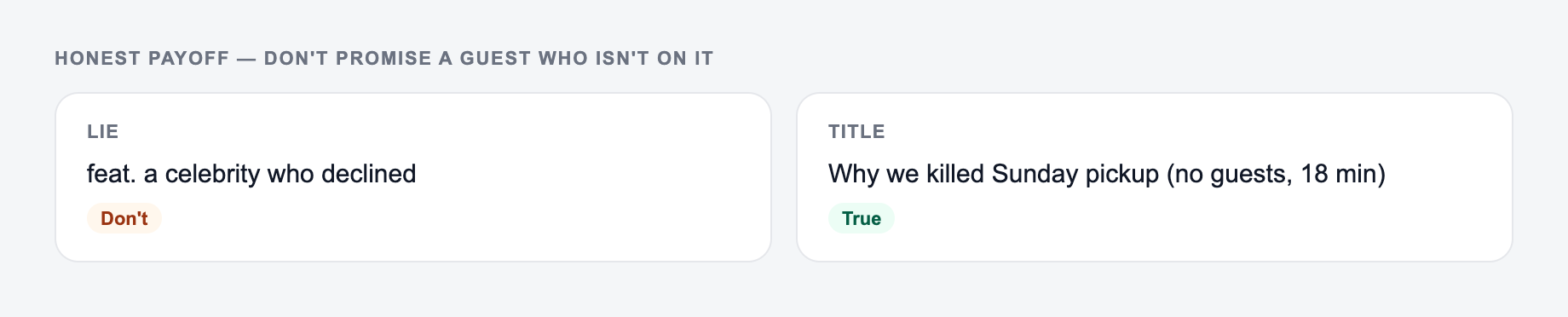
Topic and the honest payoff belong on the form. Do not promise a guest who is not on the episode.
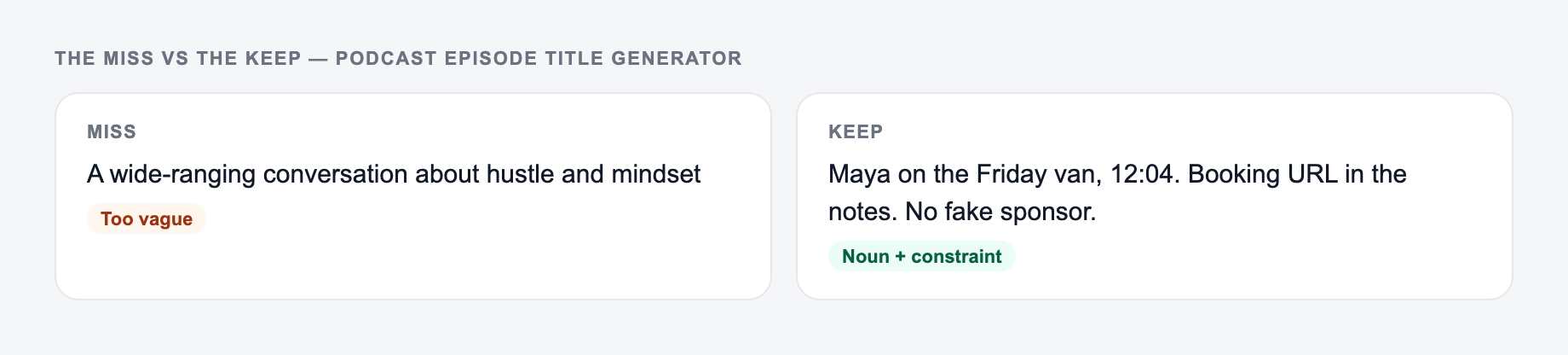
A/B is one changed idea. Swapping “unlock” for “discover” is not a variant. Test object-vs-urgency, or proof-vs-promise — not two moods of the same fog.
Episode about newsletter growth for solo founders.
The episode explains how to grow without giveaways, spammy tactics, or posting every day.
Tone: practical and direct.
Keyword: newsletter growth.
Platform: podcast apps and YouTube.
Generated title directions:
- How to Grow a Newsletter Without Spammy Tactics
- Newsletter Growth for Solo Founders: 7 Moves That Still Work
- Why Your Newsletter Is Not Growing, Even With Good Content
- Stop Chasing Subscribers. Build This First.
- The Simple Newsletter Growth System I Would Start With Today
The best choice depends on the episode. If it is a tactical guide, use the how-to title. If it diagnoses common mistakes, use the question title. If the episode is opinionated, the contrarian option may fit.
Give the Podcast Episode Title Generator a real brief: who it is for, where it will appear, and one thing it is not allowed to invent.
Review Checklist Before Publishing
Before you copy a generated title into your podcast host, check it against the actual recording.
- Does the title promise something the episode actually delivers?
- Is the main topic visible in the first few words?
- Would a new listener understand it without knowing your show?
- Is it short enough to scan on a phone?
- Does it avoid stuffing multiple keywords into one title?
- Does the guest name belong in the title, or is the takeaway stronger?
The strongest podcast title usually feels obvious after you compare a batch. It is specific, accurate, and easy to repeat. The generator gets you to that batch faster; your final job is to pick the option that best matches the episode and the listener's reason to care.
Frequently Asked Questions
How do I write a good podcast episode title?+
A strong podcast episode title is specific, benefit-driven, and easy to scan. Lead with the main keyword or outcome, keep it concise for mobile, and avoid vague titles. If it’s an interview, include the guest name when it adds credibility.
Are these podcast titles optimized for Spotify and Apple Podcasts search?+
Yes. The generator can produce SEO-friendly titles that naturally include your primary topic or keyword early, while staying readable and aligned with listener intent—helpful for podcast discovery and browse surfaces.
Should I include keywords in my podcast episode title?+
Often, yes. Including a primary keyword can improve discoverability in podcast search and on Google/YouTube. The key is to keep it natural—use one main keyword and avoid stuffing multiple phrases into the title.
How long should a podcast episode title be?+
Aim for clarity first and keep it scannable. Many creators target roughly 40–70 characters for podcast apps, while YouTube can sometimes support slightly longer titles if the hook stays strong and readable.
What’s better: a question title or a how-to title?+
It depends on the content and search intent. How-to titles signal a clear outcome and often perform well for educational episodes. Question titles can drive curiosity and work well when the episode answers a specific listener problem.
Can I use this tool to rename old podcast episodes for better SEO?+
Yes. Updating older episode titles can improve back-catalog performance by clarifying the topic, adding relevant keywords, and making the benefit more obvious—just keep the title accurate to the audio content.