
Free Proposal Generator
Generate a polished client proposal from a rough project brief. Add the service type, client goals, deliverables, timeline, budget, pricing style, tone, and language to create a proposal with an executive summary, scope of work, milestones, pricing, assumptions, exclusions, and next steps.
Proposal
Your client-ready proposal will appear here...
How the AI Proposal Generator Works
Get results in seconds with a simple workflow.
Describe the Project Brief
Add a short description of what the client needs, their goals, and any context. If you don’t know deliverables yet, just explain the outcome you’re aiming for.
Choose Service Type, Pricing Style, and Tone
Select the service type (SEO, web design, consulting, etc.) and how you want pricing presented (single price, hourly, retainer, or tiered options). Choose a tone that matches your brand.
Generate and Customize
Generate the proposal, then quickly edit names, pricing, timelines, and legal terms. Send as a PDF or paste into your proposal software.
See It in Action
Turn a rough message into a structured, client-ready proposal with scope, deliverables, timeline, and pricing.
Need a proposal for SEO work. They want more traffic and leads. Not sure what to include.
Project: SEO Growth Plan (8 Weeks)
Executive Summary: We’ll improve organic visibility and lead quality by fixing technical issues, optimizing key service pages, and building a content plan aligned to search intent.
Goals:
- Increase qualified organic traffic
- Improve conversions on priority service pages
- Establish a repeatable content workflow
Scope of Work:
- Technical SEO audit + fixes (crawl/indexing, speed, core web vitals)
- Keyword research + topic map
- On-page optimization for 8 pages
- Content briefs for 6 blog posts
- Reporting + recommendations
Timeline: Week 1: Audit + research Weeks 2–4: On-page + technical fixes Weeks 5–8: Content + iteration + reporting
Investment (Options): Option A (Good): On-page + audit Option B (Better): + content briefs + reporting Option C (Best): + implementation support + extra pages
Assumptions & Exclusions: Client provides access and timely feedback; new development features not included.
Next Steps: Choose an option, confirm start date, and approve to begin.
Why Use Our AI Proposal Generator?
Powered by the latest AI to deliver fast, accurate results.
Client-Ready Proposal Structure
Generates a professional business proposal format with an executive summary, scope of work, deliverables, timeline, pricing, assumptions, and next steps—so you can send proposals faster and close deals sooner.
Clear Scope, Deliverables, and Boundaries
Defines what’s included (and excluded) to prevent scope creep. Adds assumptions and client responsibilities to reduce misunderstandings and protect your time.
Smart Pricing Presentation (Options or Single Quote)
Supports single-price proposals and tiered packages (Good/Better/Best). Helps you position value, clarify what changes across tiers, and improve proposal conversion rates.
Timeline + Milestones That Set Expectations
Creates a realistic project timeline with phases and milestones—useful for SEO retainers, website projects, consulting engagements, and content marketing deliverables.
Service-Specific Copy for SEO, Web, Content, and Consulting
Adapts proposal language to common service types (SEO services, web design, content strategy, paid ads, consulting) so your proposal matches the client’s needs and buying criteria.
Pro Tips for Better Results
Get the most out of the AI Proposal Generator with these expert tips.
Lead with outcomes, not tasks
In the executive summary, connect deliverables to business results (e.g., qualified leads, conversion rate, organic traffic, faster publishing). Buyers say yes to outcomes.
Use tiered pricing to anchor value
Good/Better/Best packages help clients self-select while increasing average deal size. Make the middle option the most attractive and clarify what extra value comes with higher tiers.
Add assumptions and exclusions to avoid scope creep
Document what you’re assuming (client provides access, timely feedback, brand assets) and what’s excluded (extra pages, extra rounds, paid tools, custom integrations) to reduce rework.
Make next steps frictionless
Include a simple call-to-action: approve option, confirm start date, sign agreement, pay deposit. The easier the next step, the faster the close.
Include success metrics when possible
Define how you’ll measure progress (rankings, traffic, conversions, lead volume, ROAS, page speed). Clear metrics improve trust and align expectations.
Who Is This For?
Trusted by millions of students, writers, and professionals worldwide.
Generate Client Proposals With Scope, Pricing, Timeline, and Next Steps
A proposal should turn a sales conversation into a clear decision. It needs to show that you understood the client, define the work, explain the value, and make approval easy.
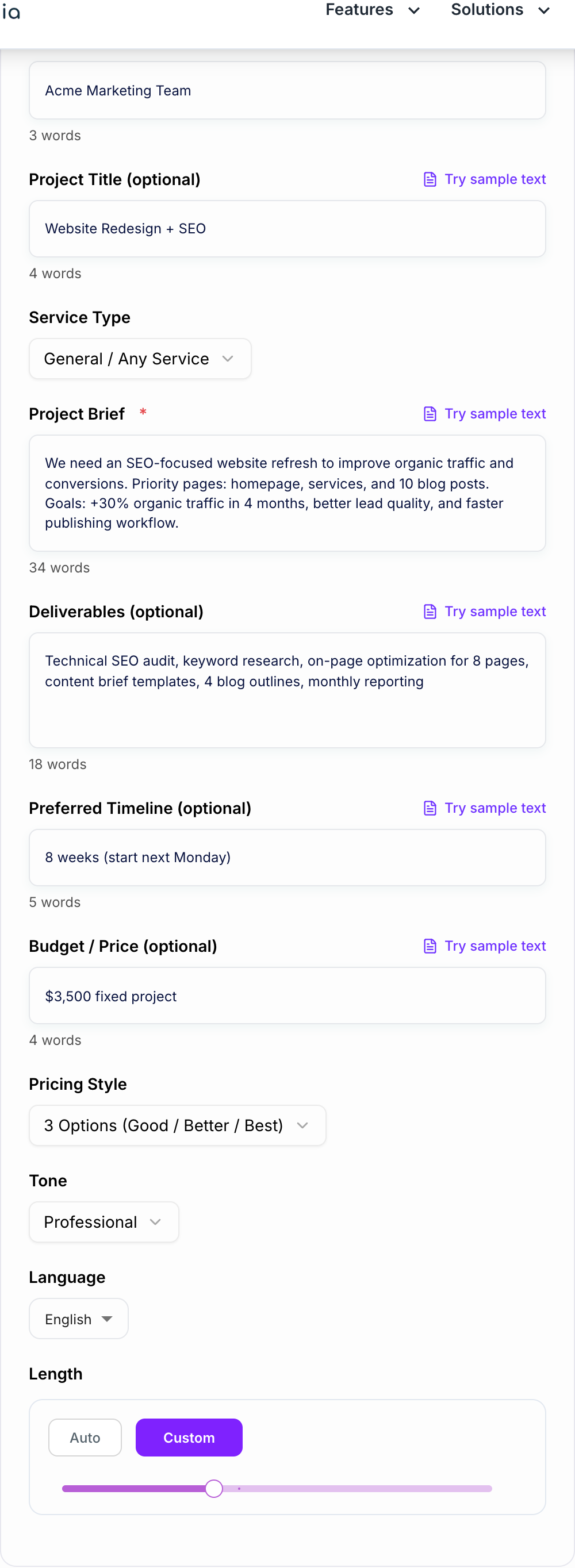
The AI Proposal Generator is built for that moment. Paste in a rough project brief, choose a service type and pricing style, and generate a client-ready draft with the sections buyers expect: executive summary, goals, scope, deliverables, timeline, pricing, assumptions, exclusions, and next steps.
The output should save drafting time, but you still need to review the details before sending.
What to Enter Into the Proposal Generator
The project brief is the most important field. A better brief creates a proposal that feels specific instead of recycled.
Include:
- Client situation: what prompted the project or inquiry
- Goals: traffic, leads, conversions, revenue, launch date, efficiency, brand clarity, or risk reduction
- Service type: SEO, web design, content marketing, paid ads, branding, consulting, advisory, or another service
- Known deliverables: audits, pages, briefs, campaigns, workshops, reports, designs, implementation support
- Constraints: timeline, budget, internal capacity, access, approvals, legal review, technical limits
- Success criteria: what a good result would look like
- Budget or pricing preference: fixed fee, hourly, retainer, or tiered options
- Tone: concise, formal, consultative, confident, friendly, or direct
If your notes came from a call, use the client’s own words where possible. A proposal sounds much stronger when the buyer recognizes their priorities in the executive summary.
Choose the Right Pricing Style
Pricing format changes how the client reads the proposal. Pick the option that matches the deal.
Single price
Use this when the scope is clear, the client already agreed on the direction, and adding options would create unnecessary complexity.
Hourly rate
Use this for advisory work, ongoing support, uncertain scope, or projects where time is the fairest unit. Add an estimated range when possible so the client is not surprised. If the client only wants numbers before committing to a full proposal, send a short project estimate first and expand it once the scope is agreed.
Monthly retainer
Use this for ongoing SEO, paid ads, content, social, consulting, or maintenance work. Make the monthly deliverables and reporting cadence very clear.
Good, Better, Best packages
Use this when the client has flexibility. The lowest tier should solve the core problem, the middle tier should be the best fit for most clients, and the top tier should add speed, depth, or implementation help.
Review the Generated Proposal Before Sending
The generated draft should give you a clean structure, but proposals affect money, expectations, and delivery. Check the output carefully.
Review:
- Scope: does it clearly say what is included?
- Exclusions: does it say what is not included?
- Client responsibilities: does the client know what they must provide?
- Timeline: does it account for feedback, access, approvals, and dependencies?
- Pricing: do the numbers match the scope and level of support?
- Assumptions: are key conditions written plainly?
- Legal terms: are payment, IP, confidentiality, cancellation, and liability handled elsewhere if needed?
- Next steps: is there one obvious action to approve and start?
Do not let the generator invent commitments you cannot meet. Edit timelines, deliverables, and terms before the proposal leaves your inbox.
Example Brief and Proposal Direction
Here is a brief that gives the generator useful detail:
Client needs an SEO-focused website refresh. Goals are more qualified organic traffic, better lead quality, and faster publishing. Priority pages are homepage, services, and 10 blog posts. Budget is $3,500. Timeline is 8 weeks.
A weak proposal might say:
We will improve your SEO and help your website perform better.
A stronger generated section would say:
We will improve qualified organic traffic by fixing technical issues, optimizing priority service pages, and building a focused content plan around search intent. The project includes a technical SEO audit, keyword research, on-page optimization for 8 pages, content briefs for 6 supporting articles, and a reporting dashboard with recommendations.
That version is more useful because it connects outcomes to deliverables and gives the client a clearer buying decision.
How to Prevent Scope Creep in the Generated Draft
Scope creep usually starts with vague language. Replace loose phrases with concrete limits.
Instead of:
Includes SEO improvements.
Use:
Includes technical audit, keyword research, on-page recommendations for 8 priority pages, and 6 content briefs. Development implementation, new page design, paid tools, and additional revision rounds are not included unless added through a change request.
The generator can create assumptions and exclusions, but you should tailor them to your actual delivery process.
Common Proposal Generator Mistakes
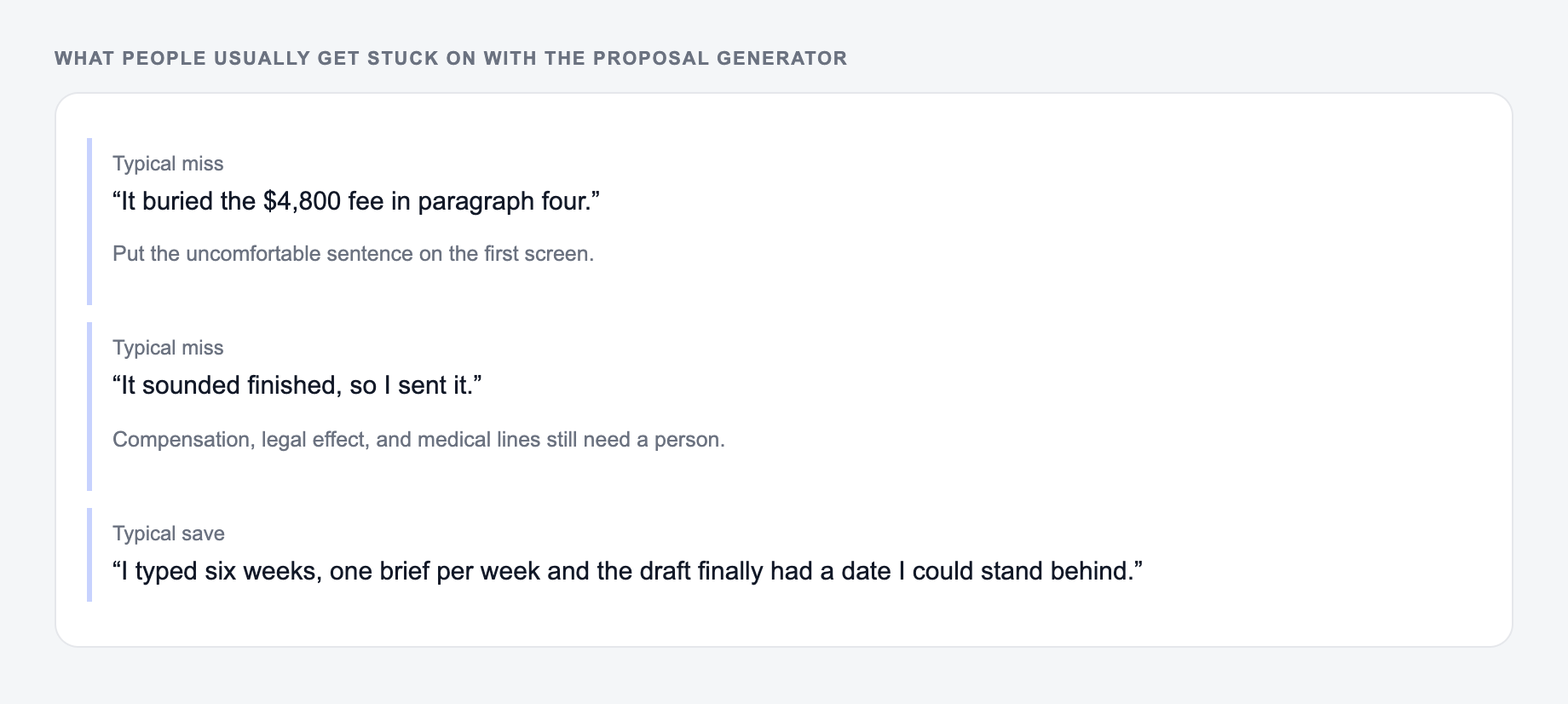
The first mistake is pasting only "need proposal for SEO." Add the client’s goals, site context, timeline, and decision criteria.
The second mistake is sending the generated pricing without checking the scope. Price and deliverables need to match.
The third mistake is hiding exclusions because they feel awkward. Clear exclusions protect the relationship by setting expectations early.
The fourth mistake is making next steps vague. End with one action: choose an option, approve the proposal, sign the agreement, pay the deposit, or schedule kickoff.
Final Checklist Before You Send
Before sending the proposal, confirm:
- The executive summary reflects the client’s actual situation
- Goals and success criteria are clear
- Scope and deliverables are specific
- Exclusions and assumptions are written plainly
- Timeline includes client dependencies
- Pricing format matches the sales context
- Legal or contract language has been reviewed separately
- The approval step is obvious
If you also create SEO briefs, content plans, landing page copy, or follow-up emails for clients, keeping those workflows inside Junia AI can help you move from proposal to delivery without rebuilding the same context every time.
Filled Scope Boundary Example
For the $3,500 SEO refresh in the example above, turn nouns into countable outputs:
List the same countable deliverables you will later hold yourself to in the statement of work.
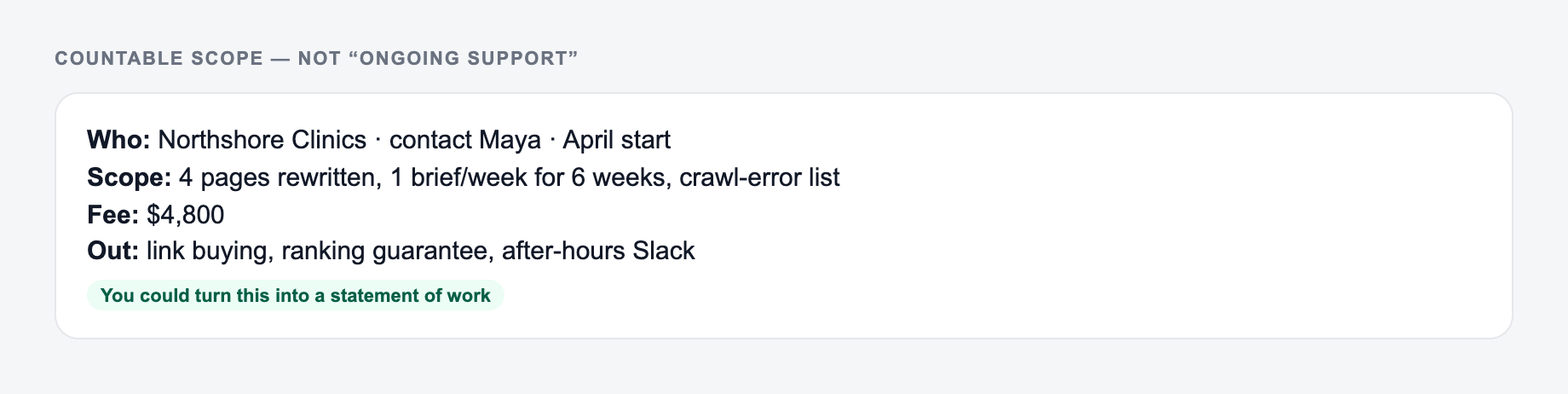
Included: one technical audit; keyword mapping for 8 existing pages; on-page recommendations for those 8 pages; 6 content briefs; one 60-minute handoff; two consolidated revision rounds. Client provides: analytics and CMS access by day 3, one decision-maker, and feedback within three business days. Excluded: development, page design, content drafting, paid software, backlink outreach, and work on additional URLs. New requests use a written change order covering fee and schedule.
Then connect milestones to dependencies. “Week 2: audit delivered” is incomplete if access arrives late. State that dates move when agreed client inputs are delayed, and confirm who can approve changes. Pricing, taxes, payment schedules, intellectual property, confidentiality, liability, cancellation, and governing law may need a separate agreement reviewed for the relevant jurisdiction; generated wording is not legal advice.
Before sending, run a traceability check: every promised outcome should point to a deliverable, and every deliverable should have an acceptance condition. “Improve rankings” is not a controllable deliverable. “Deliver keyword mapping in the agreed spreadsheet format” is.
Frequently Asked Questions
Is this proposal generator free to use?+
Yes. You can generate a professional proposal draft for free. Some advanced modes may be marked as premium depending on your site’s plan.
What should I include in a winning client proposal?+
Strong proposals include a clear executive summary, client goals, scope of work, deliverables, timeline, pricing, assumptions, exclusions, and next steps. Adding success metrics and client responsibilities also improves clarity and reduces scope creep.
Can I generate proposals for SEO services or marketing retainers?+
Yes. Choose SEO Services or a relevant service type and include the project brief (goals, pages, current issues, and success criteria). The tool can produce a scope and deliverables suitable for SEO audits, on-page optimization, content plans, and monthly reporting.
Will the proposal include pricing options (Good/Better/Best)?+
Yes. If you select “3 Options (Good / Better / Best)”, the proposal will present tiered packages with what’s included in each option to help clients choose a fit and to support value-based pricing.
How do I prevent scope creep in a proposal?+
Include clear inclusions/exclusions, assumptions, client responsibilities, revision limits, and change-request language. The generated proposal includes these sections by default so expectations are documented from the start.
Can I use this proposal as a contract?+
A proposal is a great starting point, but it’s not legal advice. For enforceable terms (payment schedules, IP ownership, confidentiality, liability), use a proper contract or have a professional review your agreement language.