
Free Reading Passage Generator
Create original reading passages for any topic, grade level, reading difficulty, genre, and lesson goal. Add comprehension questions, vocabulary support, answer keys, discussion prompts, ESL-friendly wording, and differentiated versions for classwork, homework, homeschooling, and test prep.
Reading Passage
Your reading passage (and questions, if selected) will appear here...
How the AI Reading Passage Generator Works
Get results in seconds with a simple workflow.
Pick Topic, Grade, and Genre
Enter an optional topic (or leave it blank), then choose grade level and genre to match your lesson plan, unit theme, or reading comprehension objective.
Set Length and Question Options
Choose passage length and how many questions to generate. Select mixed questions or focus on specific skills like inference, main idea, or vocabulary in context.
Generate, Review, and Use
Copy the passage into a worksheet, Google Doc, or LMS. Review for your classroom needs, then print or assign digitally with the included answer key.
See It in Action
Example of turning a simple request into a complete, classroom-ready reading passage with comprehension questions and an answer key.
I need a reading passage for 4th grade about wind energy with questions.
Title: How Wind Turbines Make Electricity
Passage: Wind is moving air, and people can use that movement to make electricity. A wind turbine is a tall tower with long blades at the top. When the wind blows, it pushes the blades so they spin. The spinning blades turn a part inside the turbine called a shaft. The shaft connects to a generator, which changes motion into electrical energy.
Wind farms are groups of turbines placed in windy areas, such as open plains or near the ocean. Wind energy is renewable because the wind naturally returns. It also produces electricity without burning fuel, which can help reduce air pollution. However, turbines need steady wind, and they must be placed carefully to avoid harming wildlife.
Questions:
- What is the main idea of the passage? A. Wind is dangerous. B. Turbines are made of metal. C. Wind turbines use moving air to generate electricity. D. Wind farms are only near oceans.
- What does the generator do?
- Why is wind energy called renewable?
- Name one challenge of using wind turbines.
Answer Key:
- C
- It changes motion into electrical energy.
- Because wind naturally returns and doesn’t run out.
- Example: turbines need steady wind / careful placement to protect wildlife.
Why Use Our AI Reading Passage Generator?
Powered by the latest AI to deliver fast, accurate results.
Grade-Level Reading Passages (K–12 + Adult)
Generate original reading passages tailored to your chosen grade level, with age-appropriate vocabulary, sentence length, and text complexity for classroom reading practice and homework.
Reading Level Control (CEFR + Difficulty Options)
Adjust reading difficulty using CEFR options (A1–C1) or below/on/above grade settings—ideal for differentiated instruction, ESL/ELL learners, and intervention groups.
Comprehension Questions + Answer Key
Create comprehension questions aligned to the passage (main idea, details, inference, vocabulary in context) with a clean answer key for quick lesson planning and assessment.
Multiple Genres for Any Curriculum Topic
Choose informational, narrative, persuasive, biography, science, or social studies to match your unit plans, standards-based instruction, and reading comprehension goals.
Original, Classroom-Safe Content
Generates fresh, plagiarism-free reading text designed for student use. Avoids copyrighted passages and keeps topics appropriate for school settings.
Pro Tips for Better Results
Get the most out of the AI Reading Passage Generator with these expert tips.
Differentiate by generating two reading levels from the same topic
Create an on-grade and below-grade version of the same passage to support mixed-ability classrooms while keeping everyone on the same content standard.
Use ‘Mixed’ question types for stronger comprehension coverage
A combination of main idea, details, inference, and vocabulary questions better reflects real reading assessments and builds balanced comprehension skills.
Add text-evidence prompts for deeper learning
For close reading, ask students to quote a sentence that supports their answer. This strengthens citing evidence and reduces guesswork on inference items.
Keep lengths short for daily practice
Short passages (150–250 words) work well for daily fluency and comprehension routines, especially in intervention and ESL settings.
Align vocabulary with your unit
Include a topic tied to your current unit so the passage reinforces domain vocabulary (science terms, historical concepts) without feeling disconnected.
Who Is This For?
Trusted by millions of students, writers, and professionals worldwide.
Generate Classroom-Ready Reading Passages with AI
A reading passage generator is most useful when it saves the teacher from three separate jobs: writing a level-appropriate text, creating questions that actually test comprehension, and building an answer key that is easy to check.
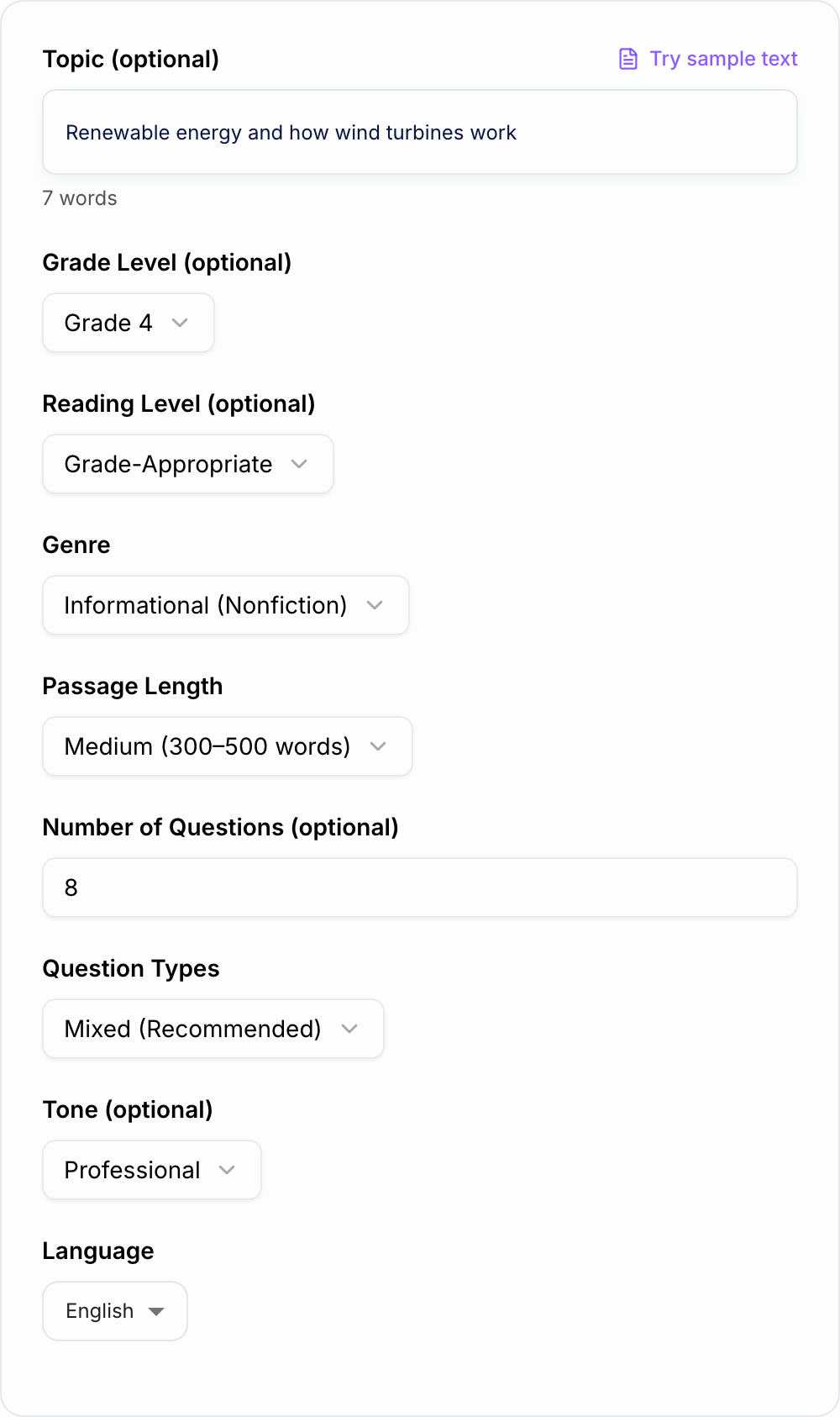
This AI Reading Passage Generator creates original passages by topic, grade level, reading difficulty, genre, length, and question type. Use it for worksheets, warm-ups, ESL support, homeschooling, test prep, or differentiated versions of the same lesson.
What to Enter into the Reading Passage Generator
Start with the lesson goal. The topic matters, but the skill matters just as much.
A strong input might include:
- Topic: wind energy, animal adaptations, the Silk Road, friendship, food chains
- Grade level: 3rd grade, 6th grade, high school, adult ESL
- Reading level: below grade, on grade, above grade, or CEFR A1 to C1
- Genre: informational, narrative, persuasive, science, social studies, or biography
- Skill focus: main idea, inference, cause and effect, vocabulary, text evidence
- Output need: multiple choice, short answer, vocabulary list, answer key, discussion prompt
If you leave the topic blank, the tool can suggest one. For classroom planning, though, a unit-aligned topic usually gives you a more useful passage.
Choose Grade, Reading Level, and Length Carefully
Grade level and reading level are related, but they are not the same thing. Grade level keeps the topic and context age-appropriate. Reading level controls vocabulary, sentence complexity, and support.
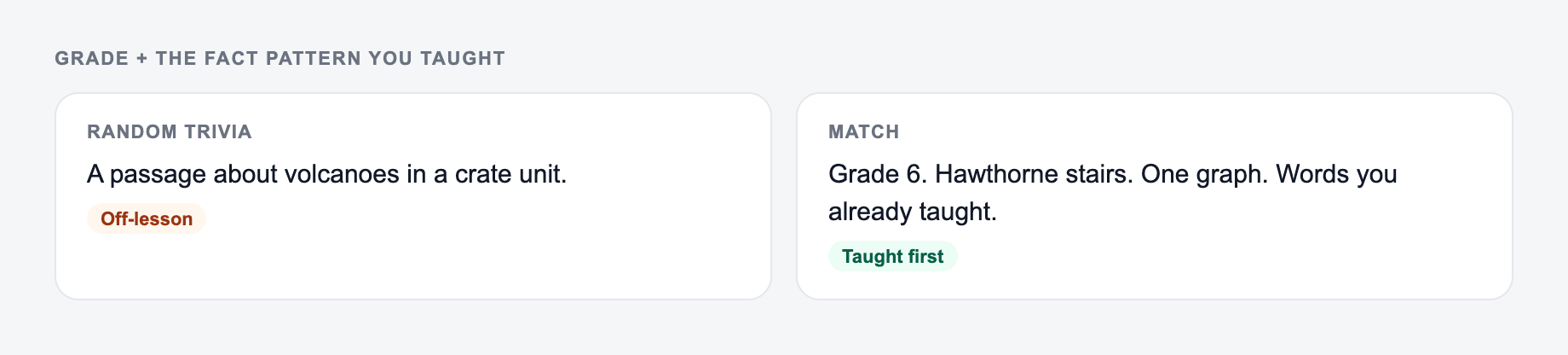
That means you can ask for a 6th grade science topic written at a below-grade level for intervention, or a CEFR A2 version for English learners. Students can discuss the same concept without reading identical text.
Length should match the activity:
- Short passages work well for warm-ups, fluency, intervention, and ESL practice
- Medium passages fit standard comprehension worksheets and homework
- Long passages are better for test prep, stamina, close reading, or multi-question assignments
Shorter is often better when the goal is targeted skill practice rather than endurance.
Generate Better Comprehension Questions
Check reading passage generator output against the room you actually have:
- Times, loads, and criteria match what you typed
- Nothing medical, legal, or graded was invented
- You would still own this if a parent or clinician asked
Question type determines what students actually practice. If you only generate multiple choice questions, grading is faster, but you may miss how students are thinking.
Use mixed questions when you want balanced comprehension coverage. A strong set might include one main idea question, two detail questions, one inference question, one vocabulary-in-context item, and one short answer that asks for text evidence.
For test prep, ask for plausible distractors. For close reading, ask for questions that require students to quote or point to a line in the passage. For ESL learners, include a short vocabulary list with simple definitions.
Example Prompt for a Classroom Passage
Try a prompt like this:
Grade, length, and the standard you are teaching belong on the form before you generate.
Learning workflow:
- Enter only facts you have.
- Generate a structured draft.
- Check names, dates, citations, and units.
- Rewrite the sentences you would actually say in class or in the paper.
If the task is graded, cited, or used with students, the named writer still owns the claims.
Create a 5th grade informational reading passage about how rivers shape landforms. Keep it medium length, on grade level, and include 6 mixed comprehension questions, one vocabulary-in-context question, one short answer requiring text evidence, and an answer key.
That prompt tells the generator what to write, who it is for, how complex it should be, and how the questions will be used. The output should be much closer to a classroom-ready worksheet than a generic article about rivers.
Differentiate Without Rebuilding the Lesson
One of the fastest uses for the tool is creating multiple versions of the same passage.
For example, you can generate:
- A below-grade version for intervention
- An on-grade version for the main group
- An above-grade version for enrichment
- A CEFR A2 or B1 version for language learners
Keep the same topic and question skill so students can participate in the same discussion. Change the vocabulary load, sentence length, and support level instead of changing the entire lesson.
If you build passages, prompts, worksheets, and classroom copy often, a broader Junia AI writing workspace can help keep related materials organized around the same unit or lesson sequence.
Teacher Review Still Matters
If the output felt generic, it is usually one of these three misses.
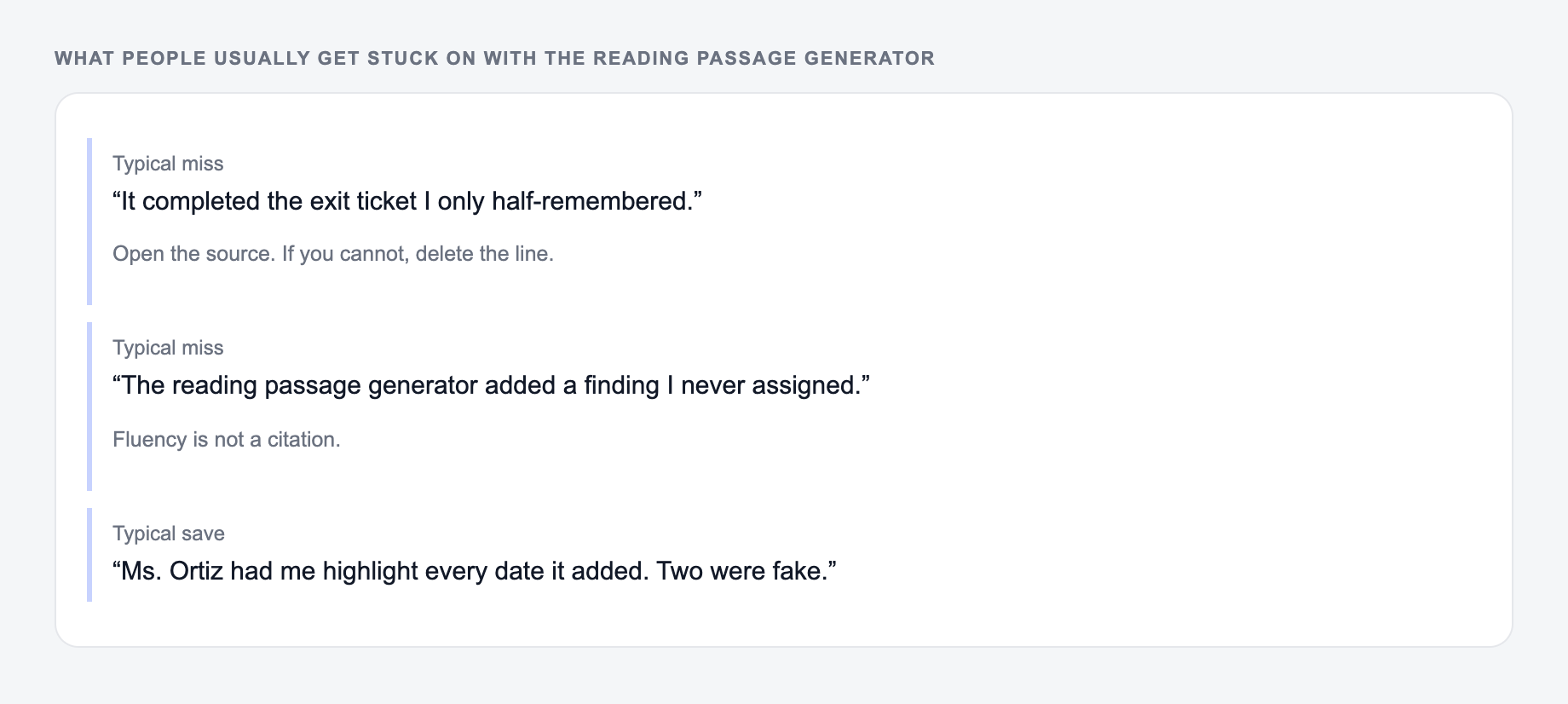
AI can speed up passage creation, but it should not replace the final teacher check. Review the passage for factual accuracy, sensitive wording, age fit, and whether the questions match the skill you are teaching.
Look closely at answer choices. Weak distractors make multiple choice questions too easy, and vague short-answer questions can frustrate students even when they understood the text.
For science, history, health, culture, and current events, verify facts before assigning the passage. For younger students, check that examples and wording are developmentally appropriate.
Final Checklist Before Assigning the Passage
Before using the generated passage, confirm:
- The topic supports the lesson objective
- The reading level matches the students, not just the grade label
- Questions require reading the passage, not guessing from background knowledge
- The answer key is accurate and specific
- Vocabulary support is useful without giving away every answer
- The passage is free of factual or sensitive wording issues
Use the generator to get the draft, questions, and answer key quickly. Use your review to make sure the material fits your actual students.
Frequently Asked Questions
Can I generate reading passages by grade level and reading level?+
Yes. Choose a grade level and a reading level setting (grade-appropriate, below/on/above grade, or CEFR A1–C1). The generator adapts vocabulary, sentence complexity, and overall readability.
Does the tool include comprehension questions and an answer key?+
Yes. Select a mode that includes questions and choose the question count and type (mixed, multiple choice, short answer, inference, main idea, or vocabulary). The output includes an answer key.
Is the reading passage content original?+
The passages are generated as original text and are designed to avoid copying copyrighted materials. Always review for accuracy and appropriateness for your students and curriculum.
Can I use this for ESL / ELL learners?+
Yes. Use CEFR levels (A1–B2) or choose below-grade difficulty. The ESL mode can also add a vocabulary list with simple definitions to support language learners.
What topics work best?+
Any curriculum-friendly topic works well: science concepts, historical events, biographies, geography, life skills, and high-interest themes. If you leave the topic blank, the tool can generate an age-appropriate topic automatically.
Can I generate passages in other languages?+
Yes. Select an output language to generate reading passages and questions for multilingual classrooms, world language practice, or bilingual materials.