
Free SMART Goal Generator
Turn a vague objective into a specific, measurable SMART goal with realistic targets, milestones, and next steps. Add your baseline, deadline, constraints, and goal type to generate a goal statement you can use in reviews, plans, OKRs, or personal tracking.
SMART Goal
Your SMART goal (with metrics and milestones) will appear here...
How the AI SMART Goal Generator Works
Get results in seconds with a simple workflow.
Enter Your Objective
Type what you want to achieve—career, business, study, fitness, or personal growth. Keep it simple; you can add details later.
Add Timeframe and Context (Optional)
Choose a timeframe and add constraints like your baseline, resources, and schedule. This helps generate more realistic metrics and milestones.
Generate a SMART Goal + Milestones
Get a SMART goal statement, measurable success criteria, milestone plan, and next steps you can copy into a planner, OKR doc, or performance review.
See It in Action
Example of turning a vague objective into a SMART goal with clear metrics, deadline, and milestones.
I want to get better at SEO and grow my website traffic.
SMART Goal: Increase monthly organic traffic from ~8,000 to 10,000 sessions (+25%) within 12 weeks by publishing 2 SEO-optimized posts per week, refreshing 10 existing pages, and improving internal linking across the top 20 pages.
Measurable success criteria:
- Organic sessions: 10,000/month
- Publish: 24 new posts (2/week)
- Refresh: 10 pages updated
- Internal links: +3–5 contextual links per updated page
Milestones:
- Week 4: +8% organic sessions; 8 posts published; 4 pages refreshed
- Week 8: +16% organic sessions; 16 posts published; 7 pages refreshed
- Week 12: +25% organic sessions; 24 posts published; 10 pages refreshed
Next steps (this week): Choose 4 target keywords, create outlines, update internal link map, and publish the first 2 posts.
Why Use Our AI SMART Goal Generator?
Powered by the latest AI to deliver fast, accurate results.
Instant SMART Goal Statements (Specific + Time-Bound)
Transforms a vague objective into a clear SMART goal statement with a defined deadline, scope, and success definition—ideal for performance reviews, planning, and accountability.
Measurable Metrics and Success Criteria
Adds measurable targets (numbers, percentages, milestones, or frequency) so you can track progress and prove results with concrete key performance indicators (KPIs).
Achievability Check + Constraints-Aware Suggestions
Includes realistic assumptions, effort level, and constraints (time, resources, team size) to keep goals achievable and reduce goal drift.
Milestones and Next-Step Action Plan
Generates a step-by-step plan with weekly milestones, progress checks, and immediate next actions—useful for project management and habit-building.
Multiple Formats: SMART, OKRs, 30/60/90 Plans
Choose a standard SMART goal, convert it into OKRs, or create a 30/60/90-day plan for structured execution across work, business, and education goals.
Pro Tips for Better Results
Get the most out of the AI SMART Goal Generator with these expert tips.
Start with a baseline before setting the target
Measurable goals work best when you know your current state (e.g., current revenue, traffic, grades, or weekly workout count). Add a baseline in the context field for clearer, more credible metrics.
Use one primary metric and 2–3 supporting metrics
Choose a main KPI (the outcome) and supporting metrics (leading indicators). Example: primary = organic traffic; supporting = publish cadence, CTR, and ranking improvements.
Define what ‘done’ looks like in one sentence
A strong SMART goal has a crisp completion definition. If someone else can’t evaluate success quickly, make it more specific and measurable.
Break the goal into weekly milestones
Weekly milestones reduce overwhelm, improve consistency, and make progress visible—especially for long goals like business growth, exam prep, and SEO projects.
Schedule a recurring progress check
Set a weekly or biweekly review to compare actuals vs target. Adjust actions, not the goal, unless assumptions or constraints change significantly.
Who Is This For?
Trusted by millions of students, writers, and professionals worldwide.
Generate SMART Goals That Are Specific Enough to Use
A SMART goal generator is useful when your objective is real, but the wording is still too fuzzy to execute. "Improve sales," "study more," or "get healthier" may be true, but they do not tell you what success looks like, how to measure it, or what to do this week.
Use this tool to turn that loose objective into a practical goal statement with:
- a specific outcome
- measurable success criteria
- a realistic target
- a deadline
- milestones and next steps
The stronger your inputs are, the more useful the generated SMART goal will be.
What to Enter Before You Generate
Start with the objective in plain language. You do not need perfect wording yet.
Good objective inputs look like this:
- Improve organic traffic for my SaaS blog
- Get promoted to senior analyst this year
- Finish a certification exam by September
- Build a consistent strength training routine
- Reduce customer support response time
Then use the context field to add details the generator cannot guess:
- current baseline: traffic, revenue, grade, weight, completion rate, response time
- target or desired improvement
- deadline or planning window
- available time, budget, team size, or tools
- constraints that make the goal harder
- where the goal will be used, such as a review, OKR doc, or personal planner
Even one baseline number can improve the output. "Increase traffic" is broad. "Increase organic sessions from 8,000/month" gives the generator something measurable to build around.
How to Choose the Right Output Format
Use SMART Goal when you need one clear statement with measurable criteria. This is the best default for personal goals, performance reviews, study plans, and simple business objectives.
Use OKR Style when one objective needs several measurable outcomes. For example, a marketing team objective may need key results for leads, conversion rate, content output, and ranking growth.
Use 90-Day Plan when the goal is too large to act on immediately. The generated 30/60/90 structure gives you checkpoints instead of one faraway deadline.
Use Habit-Based Goal when success depends on repeated behavior. Fitness, study, writing, and productivity goals often work better when the tool turns the goal into triggers, routines, and tracking habits.
If you are not sure, generate the standard SMART goal first. Then regenerate in OKR or 90-day mode if you need a more detailed execution plan.
Example Input and Generated Direction
Weak input:
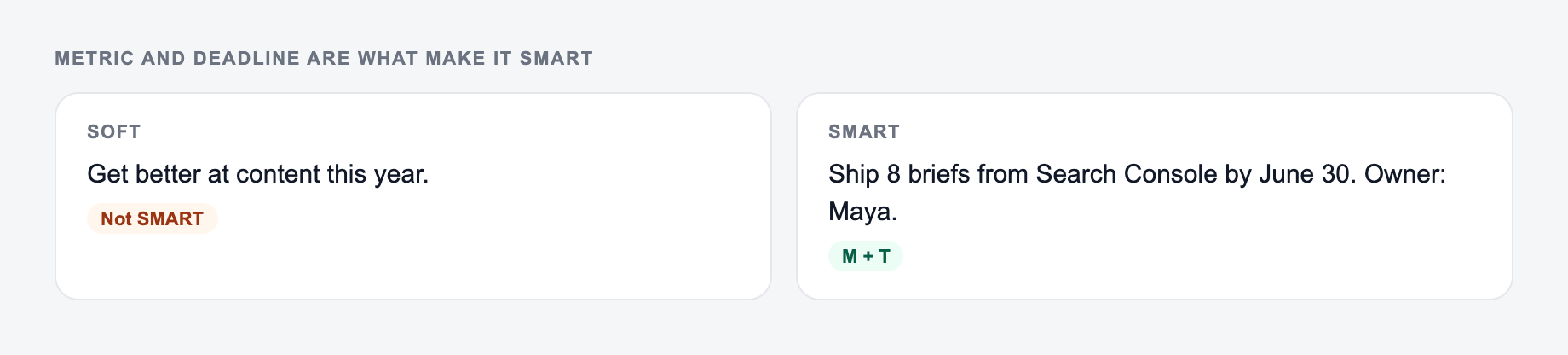
Metric and deadline on the form are what make the goal SMART.
After you generate, do not average the scores. Circle the one criterion that would make you walk away, then see whether the AI SMART Goal Generator output still recommends that option.
A longer list is not a better decision. Score what you will actually live with.
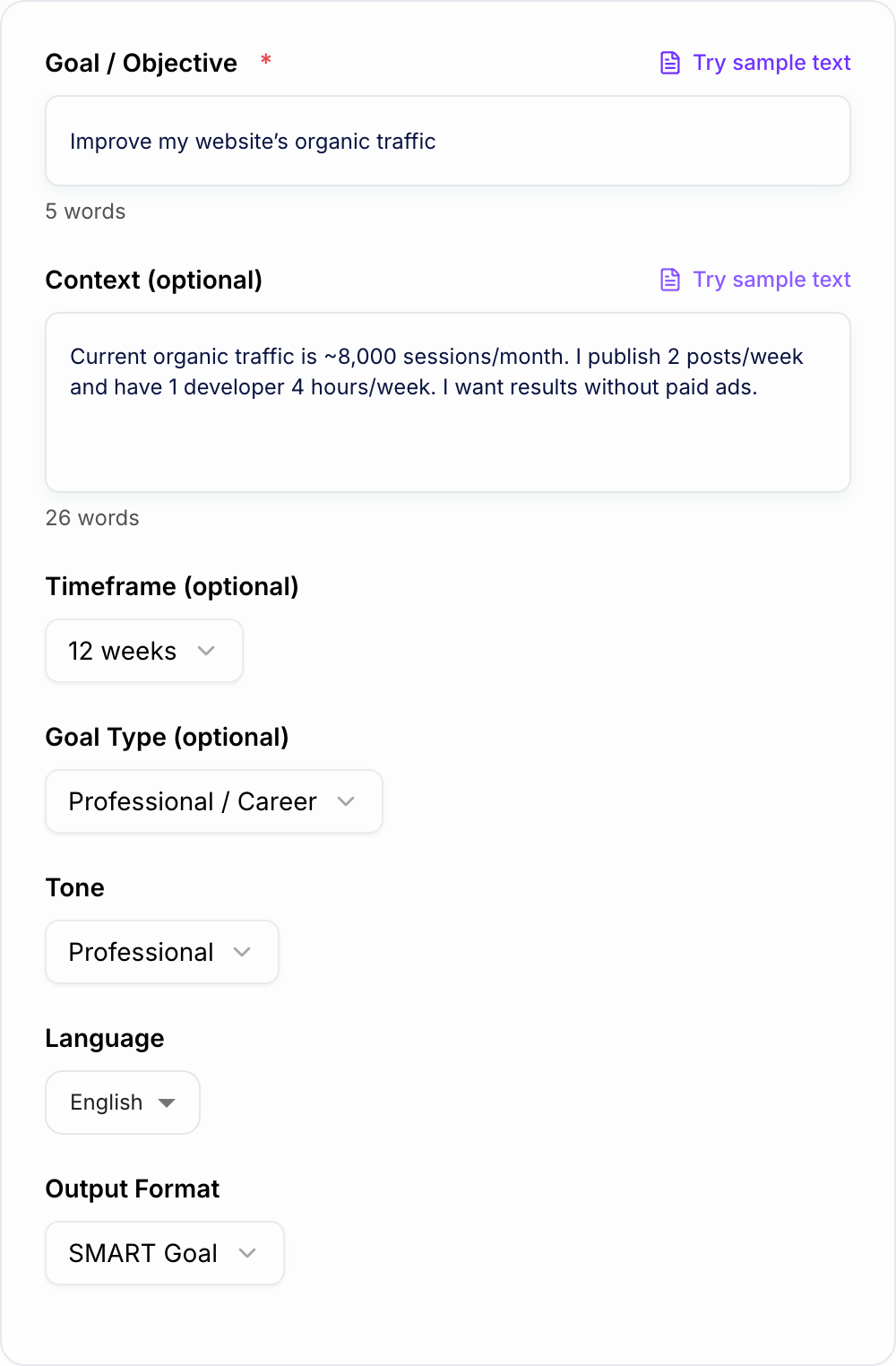
I want to grow my website traffic.
Better input:
Current organic traffic is about 8,000 sessions/month. I publish two posts per week and can refresh two old posts per month. I want a realistic 12-week SEO goal without paid ads.
A useful generated goal should come back with a target, such as increasing organic sessions to a specific number by a specific date, plus supporting actions like publishing cadence, page refreshes, internal linking, and weekly progress checks.
Do not accept a goal just because it sounds polished. Check whether the metric, deadline, and action plan fit your actual resources.
How to Review the Generated SMART Goal
Before you paste the goal into a review document or planning system, check five things:
- Specific: Could someone else understand exactly what will change?
- Measurable: Is there a number, frequency, milestone, or clear completion test?
- Achievable: Does the target match your baseline and constraints?
- Relevant: Does the goal support the larger priority, or is it just busywork?
- Time-bound: Is the deadline clear enough to create urgency?
If one part is weak, regenerate with more context. For example, if the target is too ambitious, add "I only have 3 hours per week" or "the team has no paid budget" to the context field.
Milestones, Metrics, and Next Steps Are Different
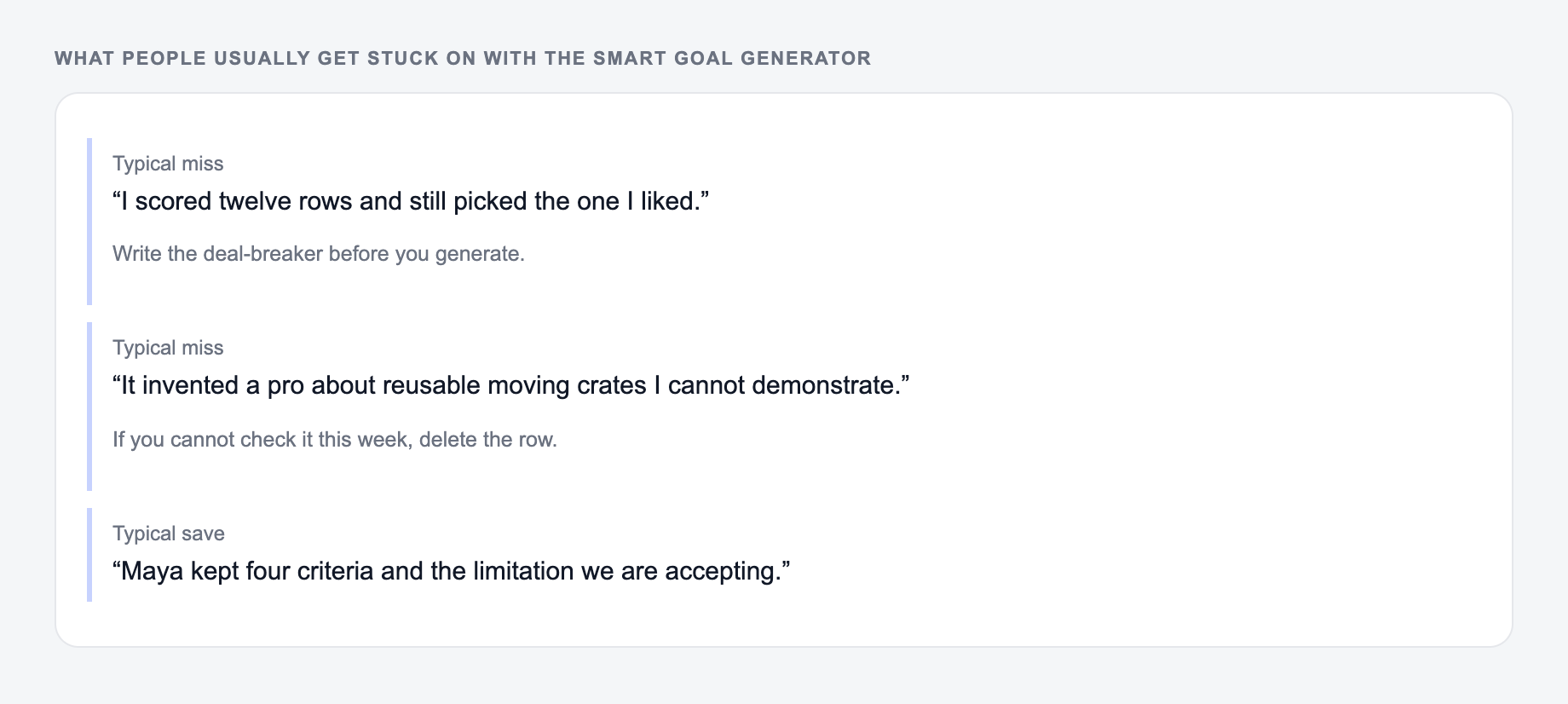
If the output felt generic, it is usually one of these three misses.
A good generated plan should not mix these together.
- Metrics tell you how success will be measured.
- Milestones show progress checkpoints along the way.
- Next steps are actions you can take immediately.
For an SEO goal, "10,000 monthly organic sessions" is a metric. "Refresh 10 existing pages by week 6" is a milestone. "Choose the first five pages to update" is a next step.
Keep all three. A goal with only a metric feels intimidating. A goal with only tasks may never prove success.
When to Use This Generator Instead of Writing From Scratch
Use the generator when you already know the direction but need cleaner structure. It is especially helpful for performance reviews, quarterly planning, classroom goals, coaching plans, habit tracking, and team accountability.
If the generated goal becomes part of a larger planning or content workflow, keep the final wording alongside your notes in a broader writing workspace like Junia AI, especially when you need to turn the goal into briefs, reports, or execution documents later.
Final Checklist Before You Use the Goal
Before you adopt the smart goal generator draft:
- The metric is something you can collect this quarter
- An owner and a review date are named
- Volume, “profit,” and “easy” were not treated as evidence
Review the generated SMART goal one last time:
- The goal has one main outcome.
- The baseline and target are clear.
- The deadline is realistic.
- The milestones prove progress.
- The first next step can be done this week.
- The wording fits where you will share it.
If the answer is yes, the goal is no longer just an intention. It is something you can track, review, and actually do.
Frequently Asked Questions
What is a SMART goal?+
A SMART goal is Specific, Measurable, Achievable, Relevant, and Time-bound. It defines exactly what you’ll do, how you’ll measure success, and when you’ll complete it—making it easier to execute and track progress.
How do I make a goal measurable?+
Add a metric or clear completion criteria—such as a number, percentage, frequency, or milestone. For example: “Publish 12 SEO articles” or “Increase organic traffic by 20% by June 30.”
Can I use this SMART goal generator for work and business goals?+
Yes. It works for professional goals (performance reviews, leadership development), business goals (revenue, leads, customer retention), and team goals (project delivery, OKRs, process improvements).
How do I know if my SMART goal is achievable?+
A goal is achievable when the scope matches your time, resources, and constraints. If you share context (baseline, tools, schedule), the generator can propose realistic targets, milestones, and pacing.
Does the tool create an action plan too?+
Yes. Along with the SMART goal statement, it provides milestones and next steps so you can move from planning to execution immediately.
Can I generate SMART goals in different languages?+
Yes. Select a language and the SMART goal, metrics, and plan will be generated in that language for international teams, students, and multilingual planning.