
Free Thesis Statement Generator
Turn a topic, prompt, or rough stance into a clear thesis statement. The free Thesis Statement Generator creates arguable claims with focused scope and supporting points for argumentative essays, research papers, literary analysis, compare-and-contrast writing, and academic assignments.
Thesis Statements
Your thesis statement options will appear here...
How the AI Thesis Statement Generator Works
Get results in seconds with a simple workflow.
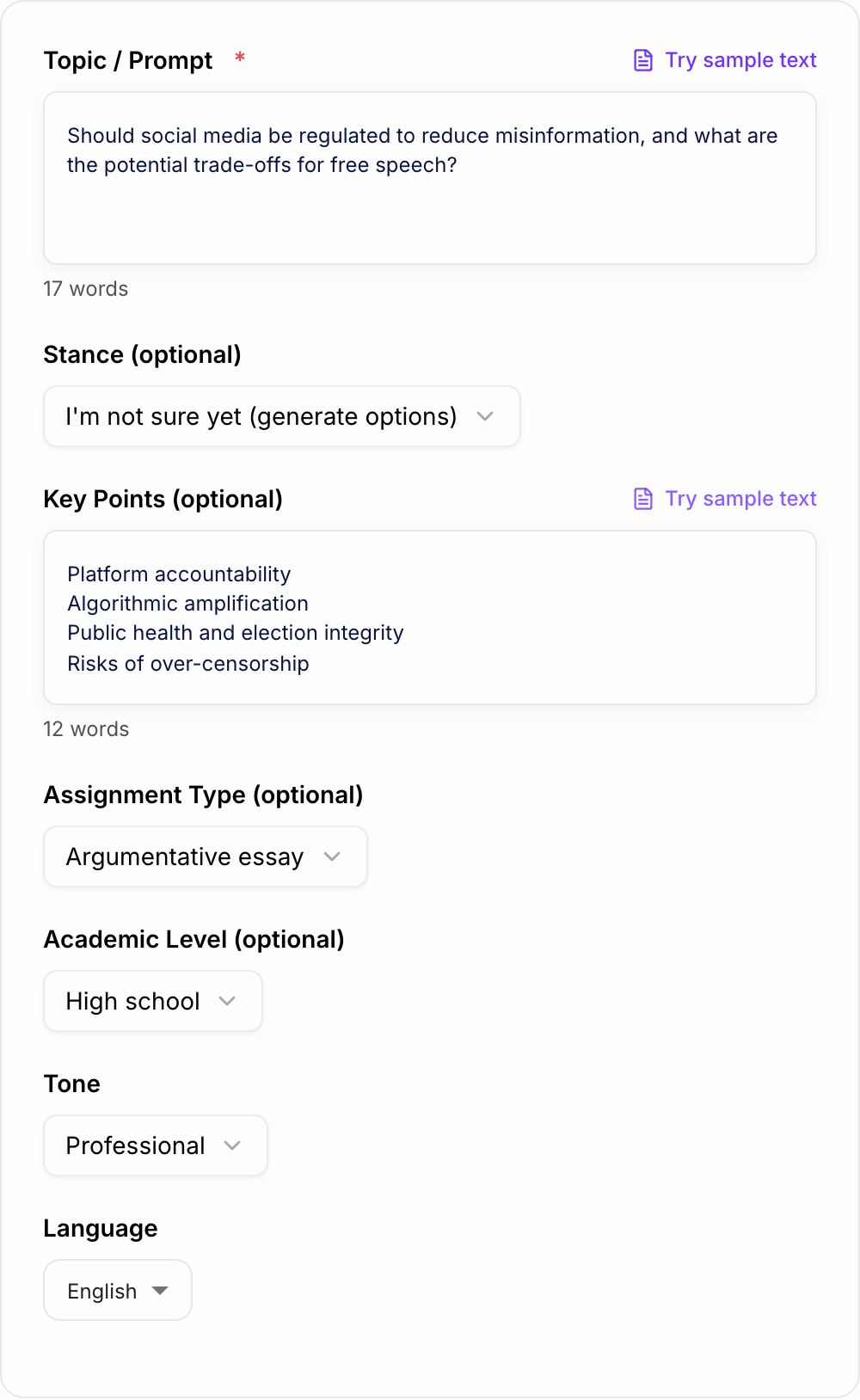
Enter Your Topic or Essay Prompt
Paste the prompt or describe your topic. The more specific your question or issue, the easier it is to generate a focused, arguable thesis.
Add Stance and Key Points (Optional)
Choose a stance (or generate options) and optionally list a few key reasons or themes. This helps create a thesis that previews your argument and guides your outline.
Generate, Choose, and Refine
Get multiple thesis statement options. Pick the strongest one and refine scope, specificity, and wording to match your evidence and assignment requirements.
See It in Action
Example of improving a weak thesis into a stronger, more specific, arguable thesis statement.
Social media has a lot of effects on society and should be controlled.
Because social media algorithms can amplify misinformation at scale, governments should require transparent content-moderation and recommendation standards—while limiting regulation to narrowly defined harms to protect legitimate political speech.
Why Use Our AI Thesis Statement Generator?
Powered by the latest AI to deliver fast, accurate results.
Strong, Arguable Thesis Statements (Not Generic)
Generates clear, defensible thesis statements that take a position (or offer multiple stances) and avoid vague phrasing—ideal for argumentative essays and research papers.
Assignment-Aware Thesis Types
Create the right kind of thesis for analytical, expository, compare-and-contrast, or research writing—so your claim matches the prompt and the paper’s structure.
Specificity + Scope Control
Produces thesis statements with the right level of scope for your academic level, keeping the claim focused, measurable, and realistic for the length of the paper.
Key-Point Integration
Optionally weave your main reasons, themes, or evidence into the thesis to create a strong roadmap sentence that supports better outlines and body paragraphs.
Clarity and Academic Style
Improves academic phrasing, precision, and readability while avoiding wordiness—useful for polishing thesis statements in essays, term papers, and proposals.
Pro Tips for Better Results
Get the most out of the AI Thesis Statement Generator with these expert tips.
Make the claim testable and specific
Replace vague language (“is important,” “has many effects”) with a concrete claim and a clear dimension (economic impact, policy outcomes, ethical trade-offs, or measurable effects).
Avoid writing a thesis that’s just a fact
A thesis should be arguable. If everyone would agree, it’s likely a topic statement—turn it into a claim that requires evidence and reasoning.
Use a roadmap when your essay needs structure
For argumentative and expository essays, include 2–3 main reasons/categories in the thesis to create a clear outline for body paragraphs.
Control scope to match length
If your topic is broad, narrow by time period, location, population, or a specific mechanism. A focused thesis is easier to prove and usually earns higher grades.
Check alignment with the prompt verbs
If the prompt says analyze, compare, evaluate, or argue, your thesis should do that. Match your claim to the assignment type to avoid off-topic drafts.
Who Is This For?
Trusted by millions of students, writers, and professionals worldwide.
Generate a Strong Thesis Statement From Your Topic or Prompt
A thesis statement generator is useful when you know the assignment topic but cannot yet turn it into a claim. The tool helps you move from "I am writing about this" to "this is what my paper will argue, explain, or prove."
The best generated thesis is not always the most academic-sounding sentence. It is the sentence that answers the prompt, makes a supportable claim, and gives your essay a clear path.
What to Enter Into the Thesis Generator
Paste the assignment prompt if you have it. A full prompt is better than a broad topic because it includes the verb your instructor cares about.
For example, the tool can respond differently to:
- analyze the role of social media in political misinformation
- argue whether social media platforms should be regulated
- compare government regulation and platform self-governance
- explain how recommendation algorithms affect public trust
If you only enter "social media," the generator has to guess. If you enter the full assignment, it can create a thesis that fits the task.
Add a Rough Stance Before You Generate
You do not need a perfect opinion. A rough stance is enough.
Weak input:
Social media misinformation.
Better input:
Should governments regulate social media platforms to reduce misinformation? I think some regulation is needed, but it should not limit legitimate political speech. Key points: algorithms amplify false claims, transparency is weak, free speech concerns matter.
That input gives the generator a position, tension, and possible body sections. The output will be much stronger than a generic thesis about social media being important.
Choose the Right Thesis Type
Use an argumentative thesis when your paper needs to take a position. It should be debatable and supported by reasons.
Use an analytical thesis when your paper explains how or why something works. It should name the insight you will develop, not just the topic.
Use an expository thesis when your assignment asks you to explain a topic clearly. It can be less debatable, but it still needs a focused scope.
Use a compare-and-contrast thesis when the point is not just that two things are similar or different, but why that comparison matters.
Use a research paper thesis when you need a claim that can be supported with sources, data, examples, or scholarly evidence.
How to Review Generated Thesis Options
Generate several versions and test each one with these questions:
- Does it answer the prompt directly?
- Can someone reasonably disagree with it?
- Is it narrow enough for the paper length?
- Does it imply body sections or evidence categories?
- Can you actually prove it with your sources?
If a thesis sounds impressive but you cannot prove it, choose a simpler one. A clear, provable claim usually scores better than a broad sentence full of abstract words.
Example: From Weak Topic to Usable Thesis
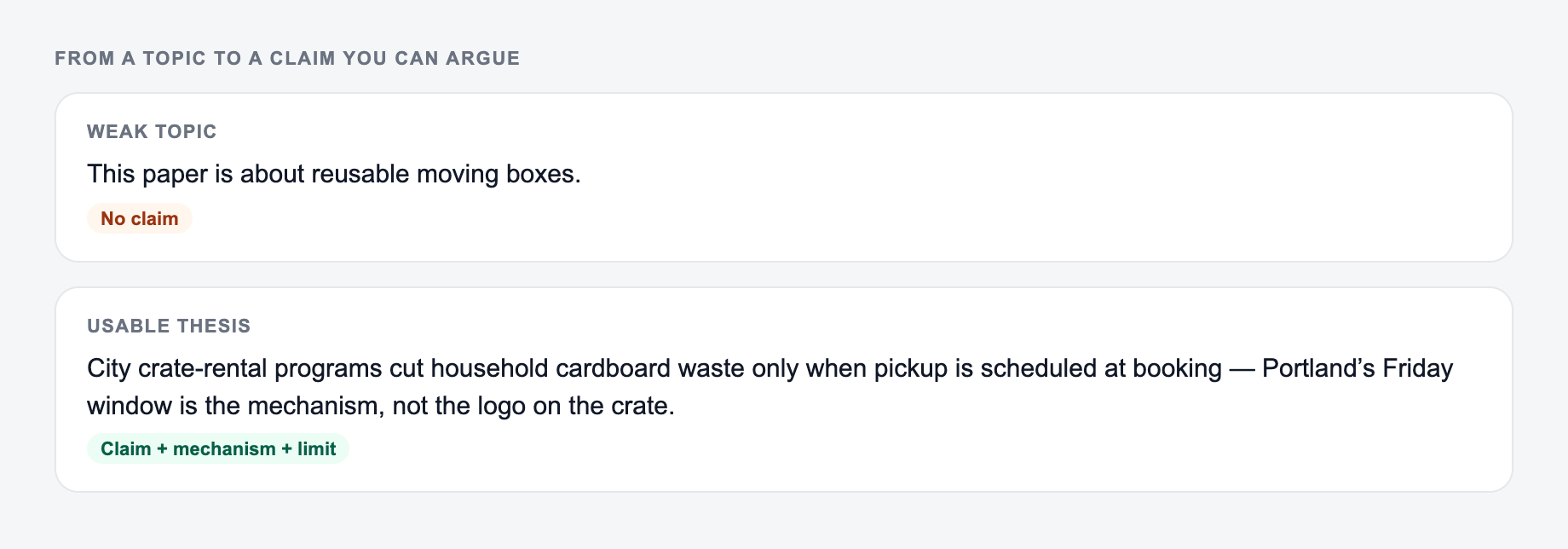
Weak topic sentence:
A rough stance on the form is what turns a topic into a thesis you can actually argue.
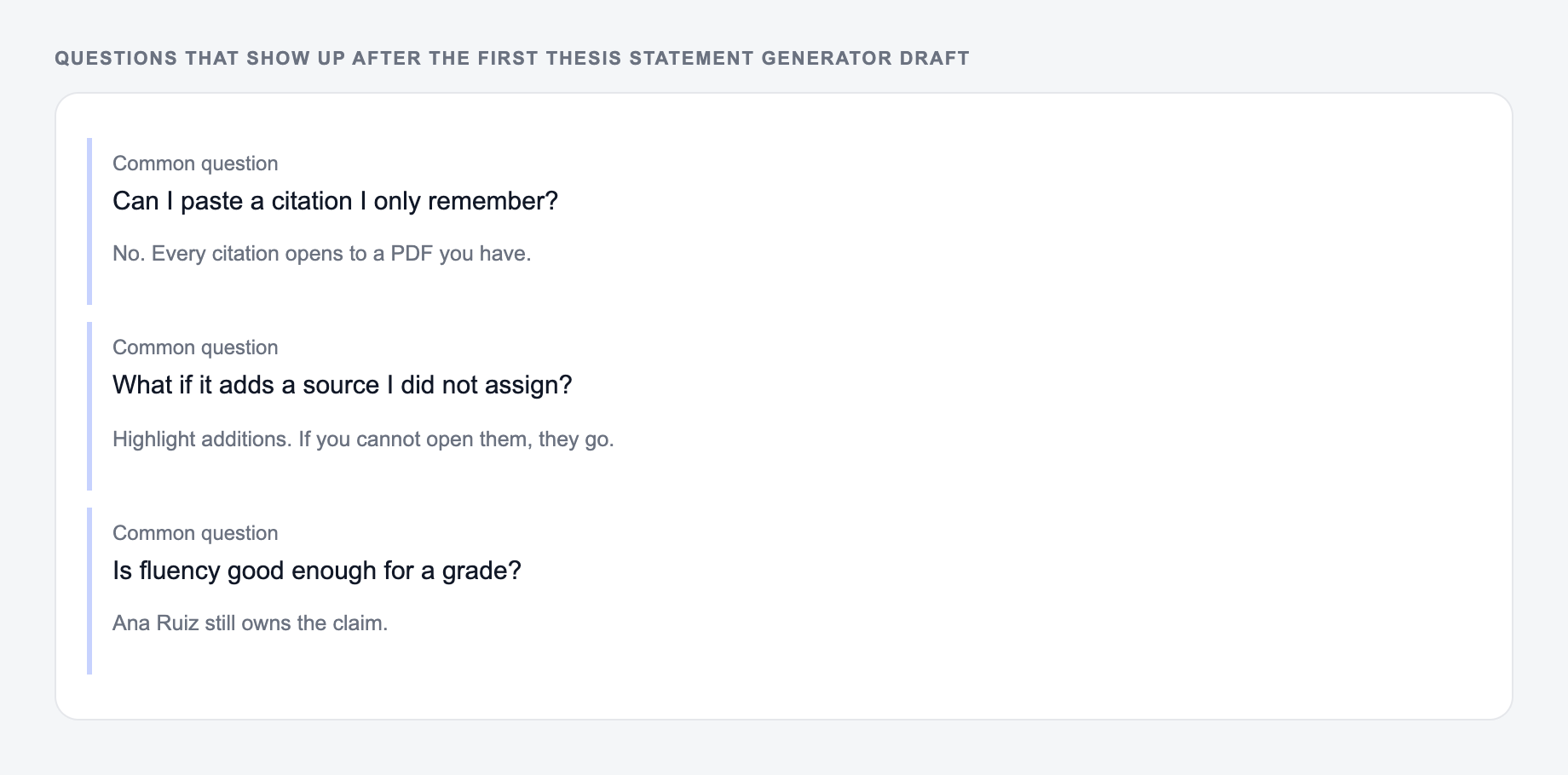
If you cannot explain a sentence without looking it up, do not leave it in. The AI Thesis Statement Generator drafts structure; you still own the claim.
If the task is graded, cited, or used with students, the named writer still owns the claims.
Social media affects politics in many ways.
Better generated thesis:
Because recommendation algorithms can amplify misinformation faster than traditional media systems, social media platforms should be required to publish clearer moderation and recommendation standards while preserving protections for legitimate political speech.
Why it works:
- it names a mechanism: recommendation algorithms
- it makes a claim: platforms should publish clearer standards
- it adds nuance: protect legitimate speech
- it suggests body sections: amplification, standards, speech concerns
How to Refine the Output With Your Evidence
After you generate a thesis, compare it to the sources or examples you already have.
If your evidence is mostly about teenagers, narrow the thesis to teenagers. If your examples are from one country, name that country. If your research focuses on one novel, policy, time period, dataset, or historical event, add that scope.
A generated thesis should be edited around your evidence, not the other way around.
Avoid These Generator Mistakes
The same three questions show up after people generate once and then stall.
Do not pick the broadest thesis because it sounds more important. Broad claims are harder to prove.
Do not keep vague words like "many," "things," "society," or "important" unless the sentence also explains what changes and why.
Do not use a thesis that simply announces the topic:
This essay will discuss climate change.
Turn it into a claim:
Municipal climate adaptation plans should prioritize flood-resistant infrastructure because extreme rainfall creates immediate risks for housing, transportation, and public health.
When you need to tighten wording after choosing the claim, a broader writing workspace like Junia AI can help you revise the sentence, outline body sections, and keep the academic tone consistent.
Final Thesis Checklist
Before you submit or build your outline, make sure the thesis:
- responds to the exact assignment prompt
- makes a claim, not just a topic statement
- fits the required paper length
- gives you a clear direction for body paragraphs
- can be supported with real evidence
- sounds like your paper, not a generic essay template
Once the thesis passes those checks, use it as the anchor for your outline. Every body section should help prove, explain, or develop that central claim.
Frequently Asked Questions
What is a thesis statement?+
A thesis statement is the central claim of an essay or research paper. It tells the reader what you will argue or explain and (often) previews the main reasons or categories your paper will cover.
How do I write a strong thesis statement?+
A strong thesis is specific, arguable, and focused. It should directly answer the prompt, avoid vague language, and reflect a claim you can support with evidence in the body paragraphs.
Can this tool generate an argumentative thesis with reasons?+
Yes. Choose an argumentative assignment type or mode and (optionally) add key points. The generator can produce a thesis that takes a clear stance and previews 2–3 supporting reasons.
What if I don’t know my stance yet?+
Select “I’m not sure yet” under stance. The tool will generate multiple thesis options across different positions (for, against, and nuanced) so you can choose the most defensible angle.
Will the thesis match my academic level (high school vs college)?+
Yes. Use the academic level field to adjust complexity and formality. College and graduate outputs aim for tighter, more nuanced claims and more precise academic wording.
Should a thesis be one sentence or two?+
Most thesis statements are one sentence, especially for typical essays. For complex research topics, a two-sentence thesis can work if it stays concise and clearly states the main claim plus scope.