
Free Topic Sentence Generator
Create focused topic sentences for essays, reports, articles, and SEO content. Enter the paragraph idea, add supporting points, choose the purpose, and generate clear sentence options that introduce the main point, connect to your thesis or section heading, and improve flow.
Topic Sentences
Your topic sentence options will appear here...
How the AI Topic Sentence Generator Works
Get results in seconds with a simple workflow.
Enter Your Paragraph Topic
Type the main idea of your paragraph (or section). This becomes the basis for clear, focused topic sentence options.
Add Optional Context and Purpose
Include supporting points and choose the paragraph purpose (explain, argue, compare, problem-solution, etc.) to generate more precise, on-target topic sentences.
Generate Options and Pick the Best Fit
Get multiple variations in your chosen tone and language. Choose one, edit lightly for your voice, and ensure it aligns with the paragraph’s evidence.
See It in Action
Turn a vague paragraph opener into a clear, specific topic sentence that sets up the paragraph’s main point and supporting details.
There are many reasons internal linking is important for SEO.
Internal linking strengthens SEO by helping search engines discover important pages, distributing authority across your site, and guiding users to relevant content.
Why Use Our AI Topic Sentence Generator?
Powered by the latest AI to deliver fast, accurate results.
Stronger Paragraph Structure and Flow
Generates topic sentences that clearly state the paragraph’s main idea and set up supporting details—improving readability for essays, reports, and blog posts.
Purpose-Aware Topic Sentences
Tailors topic sentences for common paragraph goals like compare/contrast, cause-and-effect, problem-solution, definitions, examples, and step-by-step explanations.
Thesis- and Section-Alignment Support
Creates sentences that connect naturally to the broader argument or section heading, helping your writing stay coherent and logically organized.
SEO-Friendly Options for Blog Content
Provides scannable, intent-aligned topic sentences for SEO writing—useful for improving on-page structure, clarity, and keyword relevance without keyword stuffing.
Multiple Variations to Match Your Voice
Get several distinct topic sentence options in your chosen tone so you can pick the best fit for academic, professional, or marketing writing.
Pro Tips for Better Results
Get the most out of the AI Topic Sentence Generator with these expert tips.
Make the topic sentence specific enough to ‘promise’ the paragraph
If your paragraph will cover 2–3 points, hint at them without listing everything. Aim for a sentence that sets expectations and makes the paragraph easy to follow.
Avoid empty openers
Replace vague starters like “There are many reasons…” with a concrete claim or clear idea. Specific topic sentences improve academic clarity and SEO readability.
Match the paragraph purpose to your structure
Use problem-solution for pain points, cause-effect for explanations, compare/contrast for alternatives, and example/definition when introducing supporting evidence.
For SEO, prioritize clarity over keywords
If you include a keyword, keep it natural and reader-first. Strong structure and helpfulness typically outperform forced keyword placement.
Use transitions to connect paragraphs
If paragraphs build on each other, choose a topic sentence that references the previous idea (“However…”, “In contrast…”, “As a result…”) to improve cohesion.
Who Is This For?
Trusted by millions of students, writers, and professionals worldwide.
Generate Stronger Paragraph Openers with a Topic Sentence Generator
A topic sentence generator is most useful when you already know the paragraph's job but cannot find a clean opening line. Instead of starting with a vague sentence like "There are many reasons..." you can give the tool the paragraph topic, supporting points, audience, tone, and purpose, then choose from several focused options.
The goal is not to let the generator decide your argument. The goal is to turn your rough idea into a sentence that tells readers what the paragraph will explain, prove, compare, define, or demonstrate.
What to Enter into the Topic Sentence Generator
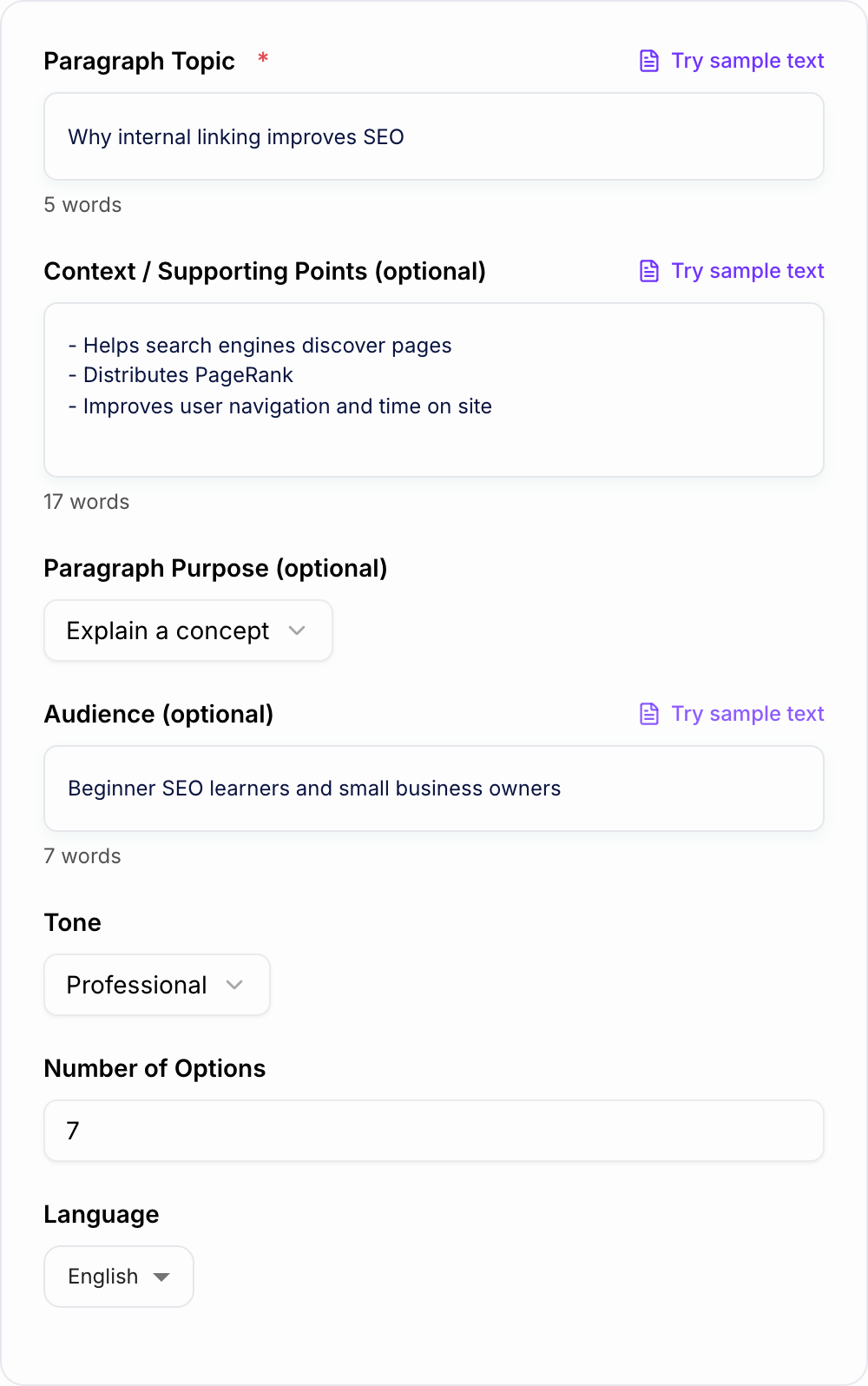
Start with the paragraph topic in plain language. A short phrase is enough if the idea is simple:
- Why internal linking improves SEO
- How homework affects student sleep
- Benefits of renewable energy for cities
For stronger results, add the supporting points you already plan to use. This keeps the generated topic sentence aligned with the actual paragraph instead of producing a broad opener that sounds polished but does not match your evidence.
Good context looks like this:
- Helps search engines discover deeper pages
- Passes authority to important URLs
- Gives readers a clearer path through related content
That context gives the generator enough information to produce a sentence such as:
"Internal linking improves SEO by helping search engines find important pages, distributing authority across a site, and guiding readers toward related content."
Choose the Right Purpose Before You Generate
The purpose field matters because a topic sentence for an argument should not sound like a topic sentence for a definition.
Use explain when the paragraph will clarify how something works. Use argue when the sentence needs to make a claim that supports a thesis. Use compare when the paragraph weighs two ideas. Use cause and effect when you want the sentence to show why something happens. Use problem and solution when the paragraph will introduce a problem and point toward a fix.
For example, the same topic can lead to different openings:
- Explain: "Internal linking improves SEO by making site structure easier for search engines and readers to understand."
- Argue: "Internal linking deserves more attention because it often improves crawlability and user navigation faster than publishing new content."
- Compare: "Unlike external backlinks, internal links give site owners direct control over how authority and context move through their pages."
The best option is the one that matches the paragraph you are actually about to write.
How to Review the Generated Topic Sentences
Do not pick the sentence that sounds the fanciest. Pick the one that creates the clearest promise for the paragraph.
Before you use an output, check three things:
- Does it match the supporting points you will include?
- Is it specific enough that the paragraph cannot drift?
- Does the tone fit the essay, report, blog post, or SEO page?
If the generated sentence is close but too broad, add more context and generate again. If it is accurate but stiff, keep the structure and rewrite a few words in your own voice.
Example Input and Output
Here is a practical example:
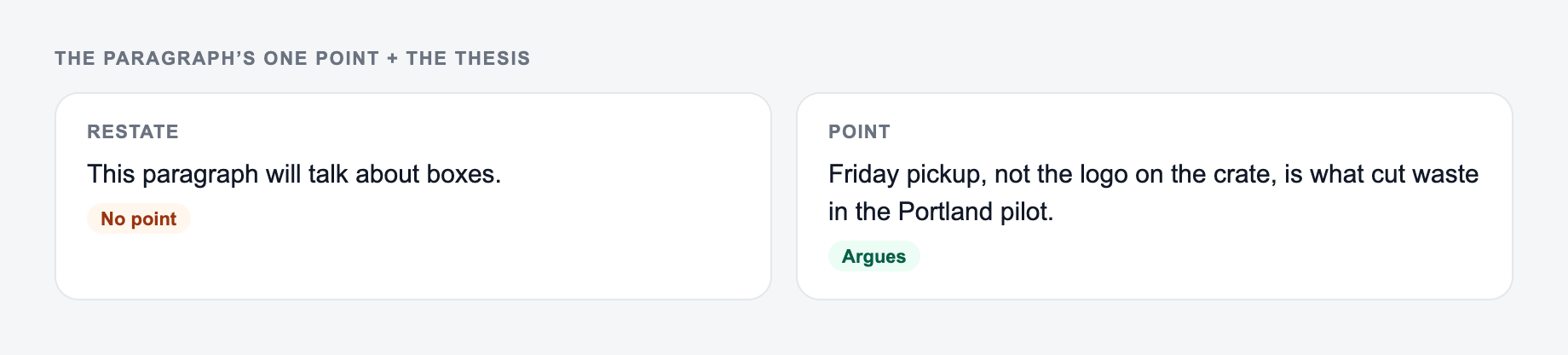
The paragraph’s one point and the essay thesis belong on the form.
How to verify topic-sentence output:
- The sentence names the claim the paragraph will prove
- It does not announce “this paragraph will discuss”
- It still fits the thesis you typed
If the task is graded, cited, or used with students, the named writer still owns the claims.
Topic: Why product descriptions matter for ecommerce
Context: Search visibility, buyer confidence, fewer returns, clearer product expectations
Purpose: Explain a concept
Generated topic sentence: "Strong product descriptions improve ecommerce performance by helping shoppers understand the product, trust the purchase, and find the page through relevant search queries."
That sentence works because it previews the paragraph's main points without listing every detail mechanically.
Common Mistakes to Avoid
The Topic Sentence Generator drafts structure. You still own the claim. If you cannot explain a sentence without looking it up, do not leave it in.
The first mistake is entering only one vague word. "Marketing" or "climate change" is too broad. Add the exact angle the paragraph will cover.
The second mistake is choosing a sentence that does not match the evidence. A topic sentence is a promise. If the paragraph cannot prove or explain it, choose another option.
The third mistake is overusing keywords in SEO content. A topic sentence can include a keyword naturally, but it should still read like a useful opening sentence for a real reader.
The fourth mistake is using the same sentence rhythm in every paragraph. Generate several options and vary the structure so the article does not feel repetitive.
Final Checklist Before You Use the Sentence
Use this as a preflight, not a caption. If a box fails, change the input or cut the line.
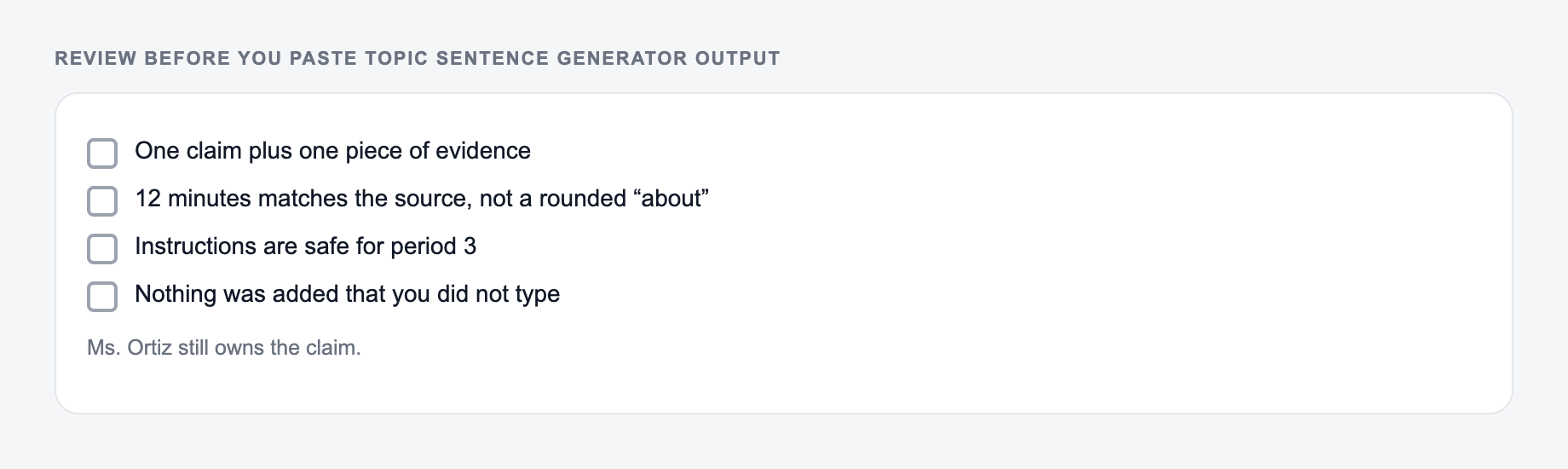
Use the generated topic sentence when it passes this quick review:
- It states one clear main idea.
- It fits the paragraph purpose.
- It connects to the thesis, heading, or previous point.
- It gives the reader a reason to keep reading.
- It sounds natural in the surrounding draft.
If you are building a larger writing workflow, the topic sentence is only one part of the structure. The broader writing tools on Junia AI can help with outlines, thesis statements, conclusions, and section-level clarity so the full piece stays coherent from start to finish.
Frequently Asked Questions
What is a topic sentence?+
A topic sentence is the main sentence of a paragraph that states the central idea and signals what the paragraph will explain, argue, compare, or demonstrate. It helps readers understand the point quickly and improves overall structure.
How do I write a strong topic sentence?+
A strong topic sentence is specific, relevant to your thesis or section heading, and sets up the paragraph’s supporting details. It avoids being too broad (“There are many reasons…”) and instead makes a clear point the paragraph can prove or explain.
Can this help with SEO blog writing?+
Yes. Clear topic sentences improve scannability, section clarity, and on-page organization—helping users (and search engines) understand your content. For SEO, use a natural keyword or related phrase when it fits the paragraph topic and intent.
Should every paragraph have a topic sentence?+
Most body paragraphs benefit from a topic sentence, especially in academic and informational writing. Short transitional paragraphs or narrative paragraphs may place the main idea later, but clarity usually improves when the topic is introduced early.
How many topic sentence options should I generate?+
Generate 5–10 options when you’re drafting so you can choose the best angle and tone. During editing, 3–5 options are often enough to replace a weak opener quickly.
Will the generator keep my meaning accurate?+
It generates options based on your topic and any context you provide. For best accuracy, add 2–5 supporting points (or a short paragraph summary) so the topic sentence matches your intended evidence and direction.