
Free Unique Selling Proposition Generator
Create unique selling propositions that explain your offer, target audience, customer outcome, and real differentiator. Add proof, alternatives, tone, and keywords to generate homepage messaging, ad angles, product-page copy, and positioning statements for SaaS, ecommerce, agencies, and service businesses.
Unique Selling Proposition (USP)
Your unique selling proposition, positioning statement, and messaging options will appear here...
How the AI Unique Selling Proposition Generator Works
Get results in seconds with a simple workflow.
Describe Your Offer (Minimum Input)
Enter what you sell or provide. Optionally add your business name, target customer, and the main problem you solve to sharpen the positioning.
Add Differentiators, Proof, and Keywords (Optional)
List what makes you different (niche focus, speed, quality, pricing model, support, unique features) and add proof like ratings or results. Include SEO keywords if you want search-aligned messaging.
Generate USPs and Pick a Winner
Get multiple USP statement options plus positioning and hero-copy variants. Choose the clearest option, then lightly edit to match your brand voice and add proof-ready specifics.
See It in Action
Example of turning generic messaging into a clear, differentiated USP for a website homepage.
We offer a powerful platform to help businesses grow with great features and support.
USP: The CRM built for cleaning companies—schedule jobs, follow up on leads, and get paid faster with prebuilt workflows.
Positioning: For owner-operators of local cleaning businesses who need simpler scheduling and invoicing, TrailSpark CRM is a niche CRM that turns quotes into paid invoices in minutes. Unlike generic CRMs, it comes with ready-to-use cleaning job templates and onboarding designed for local service teams.
Why Use Our AI Unique Selling Proposition Generator?
Powered by the latest AI to deliver fast, accurate results.
USP Statements That Highlight Real Differentiation
Generates unique selling propositions that clearly explain why customers should choose you—focusing on specific outcomes, niche fit, and defensible differentiators instead of vague claims.
Value Proposition + Positioning Variants
Produces multiple USP and positioning statement options so you can pick the best fit for your homepage, landing pages, product pages, pitches, and sales collateral.
SEO-Friendly Messaging (Natural Keywords)
Optionally incorporates your primary SEO keywords and search intent language naturally—helping your headings and hero copy match what people actually search for without keyword stuffing.
Conversion-Focused Copy for Website & Ads
Includes practical message formats like homepage hero headline + subheadline + benefit bullets—optimized for clarity, scannability, and higher conversion rates.
Clear, On-Brand Tone Control
Adapts USP wording to your preferred tone—professional, friendly, bold, premium, or simple—while keeping the core promise consistent across channels.
Pro Tips for Better Results
Get the most out of the AI Unique Selling Proposition Generator with these expert tips.
Lead with an outcome, not a feature
Customers buy results. Convert features into outcomes (save time, reduce errors, increase revenue, improve visibility, simplify workflows), then support with a differentiator.
Make the audience explicit for instant clarity
USPs become stronger when they include the target customer (e.g., “for local service businesses” or “for B2B SaaS teams”). This filters out poor-fit buyers and boosts conversion intent.
Use proof to make big claims believable
If you claim “fastest” or “most trusted,” add proof like review ratings, customer counts, case study results, certifications, or guarantees. Credibility increases both conversions and trust.
Keep it scannable for homepage and SEO
A strong hero section often needs: one USP headline, one supporting subheadline, and 3 benefit bullets. This improves readability, time on page, and message retention.
Avoid category-level vague language
Phrases like “best-in-class” or “cutting-edge” don’t differentiate. Replace them with specific constraints (who, where, timeframe) or mechanism (how you deliver the outcome).
Who Is This For?
Trusted by millions of students, writers, and professionals worldwide.
Generate a Unique Selling Proposition That Customers Understand
A USP generator is most useful when your offer is real but your messaging still sounds like every competitor. The tool helps turn your product, audience, outcome, differentiators, proof, and tone into clear unique selling proposition options for homepages, ads, product pages, pitch decks, and landing pages.
The point is not to create a clever tagline. A strong USP explains why someone should choose you instead of the obvious alternative.
What to Enter into the USP Generator
Start with the offer. Be specific enough that the generator knows the category:
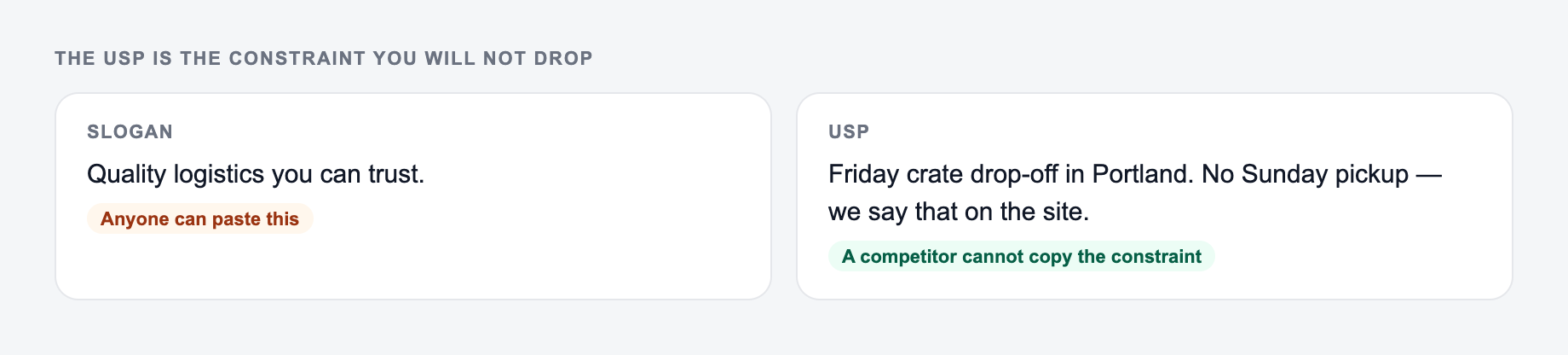
- CRM for cleaning companies
- Fractional CFO service for agencies
- Skincare subscription for sensitive skin
- AI onboarding tool for customer success teams
Then add the details that make the USP defensible:
- Audience: who the product or service is best for
- Problem: what pain or inefficiency you solve
- Outcome: what customers get after choosing you
- Differentiator: what makes your way meaningfully different
- Proof: reviews, results, guarantees, credentials, customer count, or process
- Alternatives: spreadsheets, agencies, manual work, generic tools, doing nothing
The more specific your inputs are, the less the output will rely on vague phrases like "powerful," "innovative," or "all-in-one."
Choose the Output You Actually Need
Use the standard USP mode when you need short statement options. This is useful for homepage hero copy, pitch decks, ads, and product pages.
Use positioning-style outputs when you need a fuller explanation of audience, category, benefit, and differentiation. This is better for internal messaging docs and sales enablement.
Use hero-copy or ad-angle variants when the USP needs to become publishable copy, not just a strategic sentence.
If you are working on SEO pages, use the keyword guidance carefully. A USP can include a search term, but it should still read like a promise to a human buyer.
Example Input and Generated USP
Offer: CRM for local cleaning businesses
Audience: owner-operators and small cleaning teams
Problem: quoting, scheduling, follow-up, and invoicing are spread across spreadsheets and text messages
Differentiator: prebuilt workflows for cleaning jobs
Proof: onboarding included, templates built around cleaning-service operations
Generated USP direction: "The CRM built for cleaning companies: quote jobs, schedule crews, follow up with leads, and get paid faster using workflows designed for local service teams."
This works because the audience, category, outcome, and differentiator are all visible in one sentence.
How to Pick the Best Generated USP
Keep the line you could publish. Put facts back. Do not outsource the judgment call.
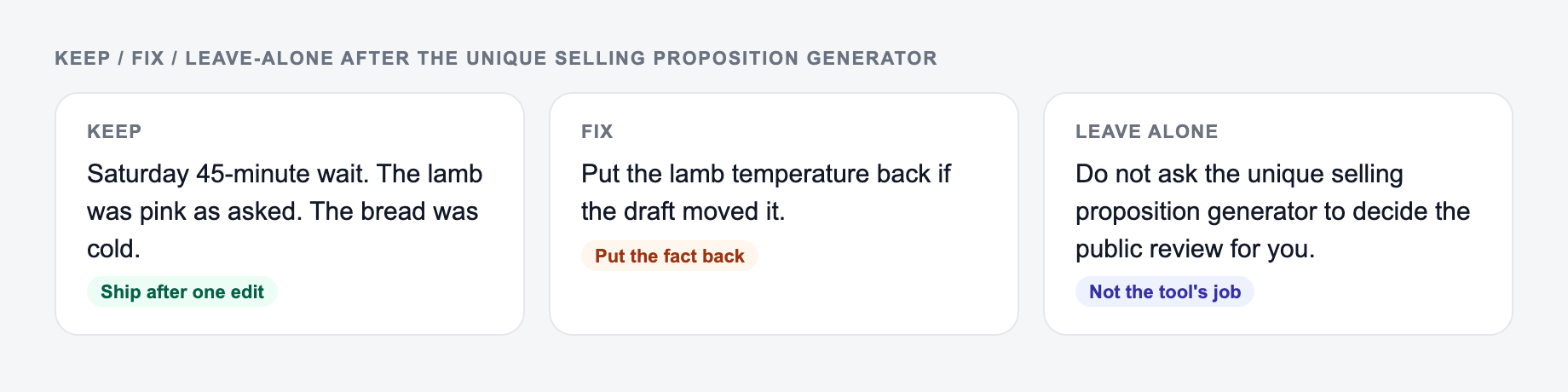
Do not choose the line that sounds most dramatic. Choose the line that a real buyer can understand fastest.
A strong generated USP should pass these checks:
- It names or clearly implies the audience.
- It gives a concrete outcome.
- It includes a real differentiator, not just adjectives.
- It avoids unsupported superiority claims.
- It can become a homepage headline, subheadline, or ad angle with light editing.
If the output sounds good but could fit any company in your category, generate again with sharper differentiators and proof.
Common USP Generator Mistakes
The first mistake is entering only the product category. "Project management software" will produce generic messaging. "Project management software for architecture studios managing client revisions" gives the generator a real angle.
The second mistake is inventing proof. If you do not have the metric, do not ask the tool to imply it. Use process proof, niche focus, support, guarantees, or customer language instead.
The third mistake is confusing USP and tagline. A tagline can be short and brand-led. A USP has to explain the buying reason.
The fourth mistake is ignoring the alternative. Your USP gets sharper when it explains what customers are replacing: spreadsheets, agencies, manual work, generic tools, slow onboarding, or fragmented systems.
Final Review Before Publishing the USP
Before you paste the generated USP into a page or campaign, ask:
- Can a stranger understand the offer in five seconds?
- Would the right customer recognize themselves?
- Is the promised outcome specific?
- Is the difference real enough that a competitor cannot copy it instantly?
- Is there proof nearby to support the claim?
- Does the wording match the channel where it will appear?
A USP is part of a larger messaging system. If you are turning the chosen line into landing page copy, ad hooks, product descriptions, or content briefs, the broader writing tools inside Junia AI can help keep the promise consistent across every channel.
Differentiator That a Competitor Cannot Paste
Discard pile:
- Fake urgency with no date you will honor
- Personalization tokens that resolve empty
- A line a competitor could paste without lying less than you
A USP is weak when a rival could put the same sentence on their homepage without lying. Force a “competitor paste test.”
Put the constraint you will not drop on the form. That is the USP, not a slogan.
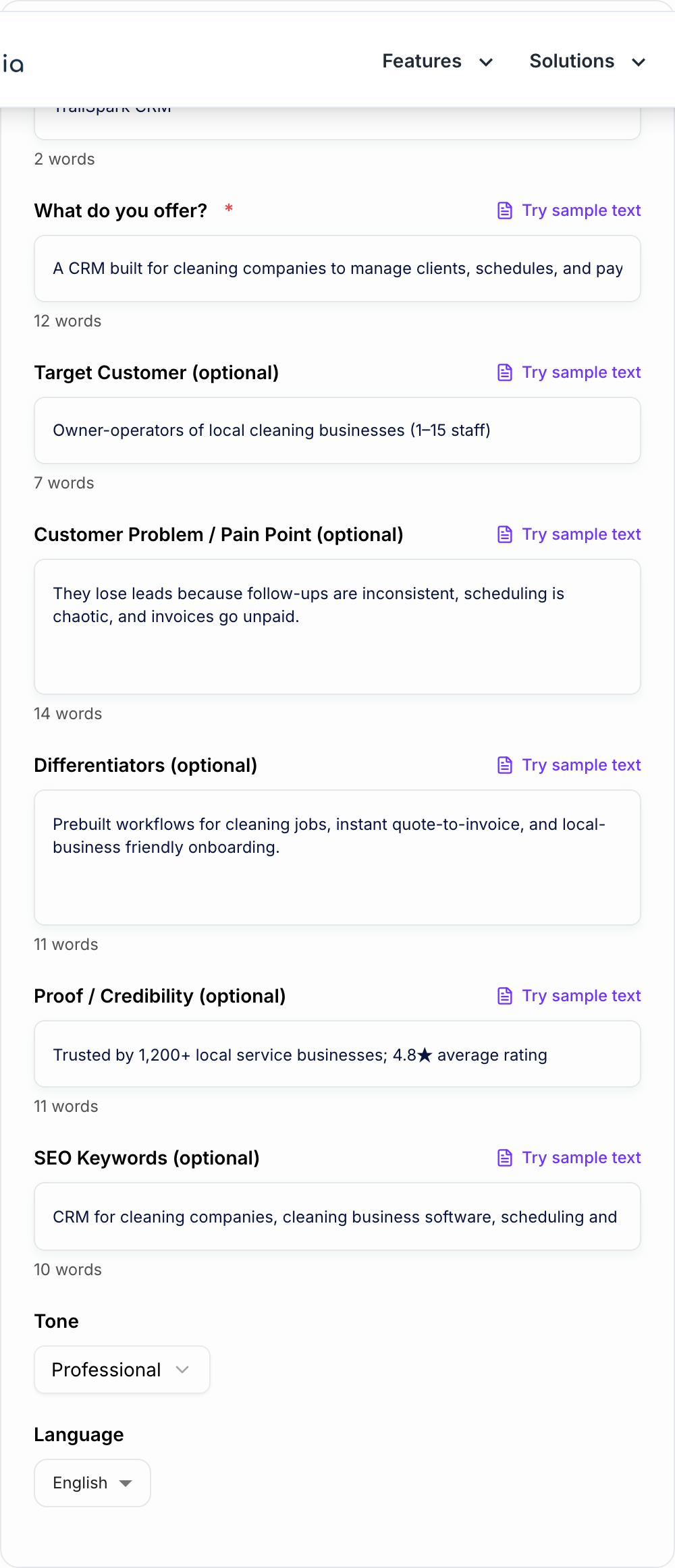
Discard pile for AI Unique Selling Proposition Generator drafts:
- Fake urgency with no date you will honor
- Personalization tokens that resolve empty
- Claims a competitor could paste without lying less than you
Weak: “Fast, simple invoicing for growing teams.” Stronger, if true: “Invoicing that starts from the approved timesheet, so PMs do not retype hours.”
The second line names a workflow constraint. Fill this card before generating:
- Customer: who specifically
- Job: what they are trying to finish
- Replacement: what they stop using
- Constraint you accept: niche, method, or limit you will not drop
- Proof nearby: screenshot, policy, or process
If you cannot name a constraint, you have a slogan, not a USP. Channel variants should keep the same constraint: ads can shorten it; a homepage can add proof; a sales one-pager can add the replacement.
Frequently Asked Questions
What is a unique selling proposition (USP)?+
A USP is a clear statement that explains what you offer, who it’s for, and why it’s meaningfully better or different than alternatives. A strong USP is specific, outcome-focused, and easy to understand quickly.
How is a USP different from a value proposition?+
A value proposition explains the primary value and outcome customers get. A USP includes that value plus a differentiator—why customers should choose you over competitors or alternatives.
What makes a USP strong (and not generic)?+
Strong USPs are specific (who it’s for), concrete (what result you deliver), and differentiated (how you’re different). Adding proof—reviews, customer count, guarantees, certifications—makes it more credible and less “AI-generic.”
Can this help with SEO?+
Yes. Your USP often becomes your homepage H1/hero copy and key on-page messaging. If you add SEO keywords, the generator can weave them naturally into a human-readable USP that matches search intent and improves relevance.
Should I include competitors in my USP?+
Usually no. It’s better to describe the alternative category (e.g., “spreadsheets,” “generic tools,” “agencies”) and state your advantage without naming competitors—unless comparison content is part of your strategy.
What inputs do I need for best results?+
The minimum is what you offer. For more precise positioning, add your target audience, the main problem you solve, your differentiators, and any proof (reviews, results, guarantees, credentials).