
AI Autoblogging SEO Quality Control Checklist

Thu
AI SEO Specialist, Full Stack Developer

AI autoblogging can help you publish faster, but speed only helps if the content is worth publishing.
The risk is obvious: when drafts are easy to generate, weak pages are easy to approve. A site can go from a strong content plan to dozens of thin, repetitive articles before anyone notices the quality drop.
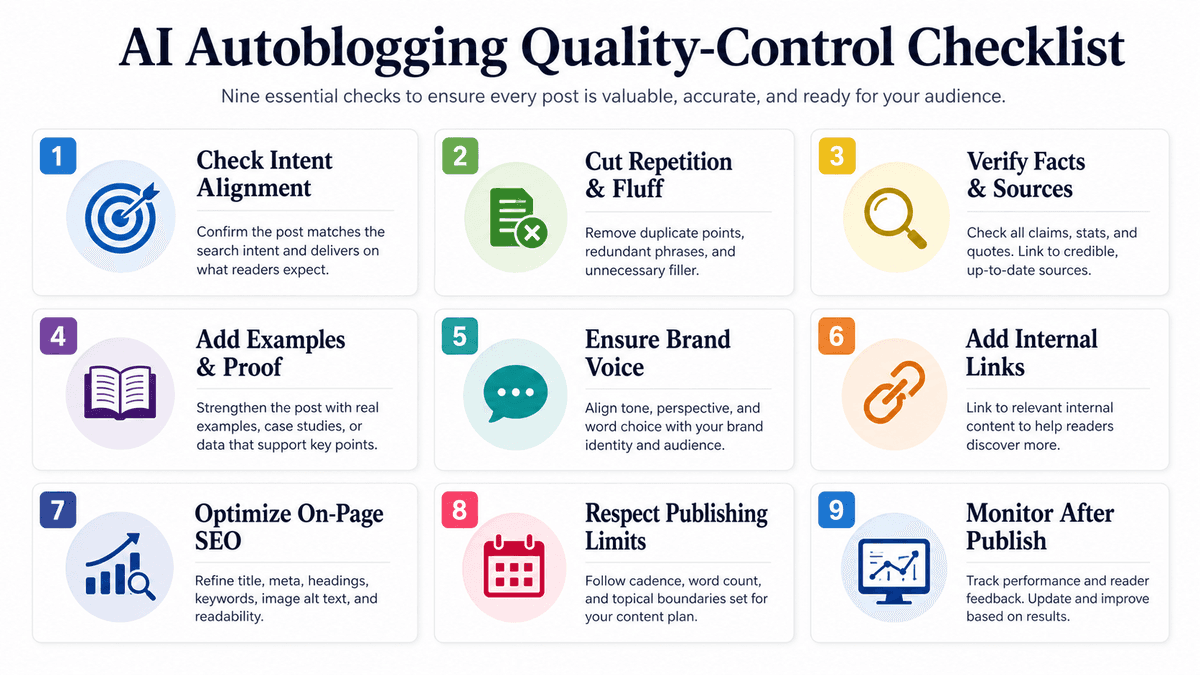
Use this checklist before publishing AI-generated blog posts at scale.
- AI draft
- Rewrite or kill the page
- Cut repetition
- Verify facts
- Add a real example
- Voice, links, metadata
- Publish fewer posts
- Publish, then monitor
- No
- Yes
View diagram source
flowchart TD
    A[AI draft] --> B{Matches search intent?}
    B -->|No| C[Rewrite or kill the page]
    B -->|Yes| D[Cut repetition]
    D --> E[Verify facts]
    E --> F[Add a real example]
    F --> G[Voice, links, metadata]
    G --> H{Can we review this cadence?}
    H -->|No| I[Publish fewer posts]
    H -->|Yes| J[Publish, then monitor]
I would rather publish four reviewed posts than twenty pages that all say the same thing in slightly different order.
1. Check the Search Intent First
Before editing the article, ask one question: does this page match what the searcher wants?
If the keyword is informational, the article should explain the topic clearly. If it is commercial, it should help the reader compare options. If it is a template or tool query, the page should help the reader take action quickly.
Do not publish a generic article against a specific intent.
Check for:
- a clear answer in the introduction
- headings that match the query
- examples that fit the audience
- no unnecessary detours
- a logical next step
This step catches many AI drafts that sound polished but miss the real job.
If the intro could sit on any article in the niche, the intent check failed. A query like "best AI autoblogging tools" needs a comparison and a recommendation. A query like "what is autoblogging" needs a definition and a risk warning. Same topic. Different page.
2. Remove Thin or Repetitive Sections
AI often repeats the same idea in different words.
Cut sections that do not add anything new. Merge overlapping headings. Replace vague claims with practical examples.
Watch for phrases like:
- in today's digital world
- game changer
- unlock the power of
- boost your online presence
- it is important to note
A few generic lines will not ruin an article, but repeated generic writing makes the whole page feel low effort.
This is one of the biggest bulk content generation risks: not one bad article, but many average articles with the same weak patterns.
3. Verify Facts, Tools, and Claims
Do not trust every claim in an AI draft.
Check tool names, feature descriptions, dates, statistics, and any statement that sounds specific. If you cannot verify it quickly, soften the claim or remove it.
For SEO content, unsupported certainty is dangerous. It can hurt trust with readers and make the article feel manufactured.
A safe review pass includes:
- checking product names and URLs
- removing made-up statistics
- avoiding exact pricing unless verified
- confirming dates and feature claims
- adding context where the draft is too broad
4. Add Real Examples
Examples are one of the fastest ways to improve AI content.
Instead of saying “AI can improve productivity,” show the workflow. For autoblogging, that might mean turning 40 keyword ideas into 12 articles, grouping them by intent, generating briefs, and reviewing three drafts per day.
I tested a version of this on a small niche site: the unreviewed batch looked finished and ranked nowhere useful. The reviewed batch was slower, had one original example per post, and actually got impressions. Volume was never the missing ingredient. Judgment was.
Specific examples make the page more helpful and less generic.
They also help readers understand whether the advice applies to them.
A start-to-finish writing walkthrough is useful here if the draft still has no scene, number, or named constraint. Watch it for the example layer, not as a second publishing checklist.
How to write a blog post from start to finish
5. Review Brand Voice
Autoblogging can create tone drift.
One post sounds casual, another sounds corporate, and another sounds like a generic SaaS landing page. Over time, the blog feels inconsistent.
Use AI brand voice controls or a manual voice checklist to keep the content aligned.
Check whether the article:
- sounds like the same brand as your other posts
- uses consistent terminology
- avoids overhyped claims
- explains before selling
- has natural transitions
Brand voice is not decoration. It is part of trust.
6. Add Internal Links With Context
Internal links should help the reader move to the next useful page.
Do not paste a block of links at the end just to satisfy SEO. Add links where they naturally support the explanation.
For example, a quality checklist can link to guidance on how many AI-generated blog posts to publish per day when discussing cadence. It can link to whether AI content can rank in Google when discussing ranking concerns.
Good links make the article more useful. Forced links make it feel engineered.
7. Check On-Page SEO Basics
Before publishing, review the basics:
- title matches the search intent
- meta description is specific
- H2s are clear
- slug is readable
- images have useful alt text if used
- introduction answers the query quickly
- conclusion gives a practical next step
This is also where AI autoblogging software with SEO controls can help, because the workflow can catch missing metadata and weak optimization before publishing.
8. Set a Publishing Limit
Publishing more is not always better.
If you cannot review 20 AI posts per day properly, do not publish 20 per day. Slow down and protect quality.
A practical limit depends on your site authority, editorial capacity, content type, and how much of the workflow is automated. Newer sites should usually publish more carefully than established sites with strong topical authority.
The rule is simple: your publishing speed should never exceed your review capacity.
A practical starting limit for most small teams is not 20 posts a day. It is as many as one editor can fact-check, add an example to, and still recognize as the same brand. If that number is three, publish three.
9. Monitor After Publishing
Quality control does not end when the post goes live.
After publishing, watch:
- indexing
- impressions
- click-through rate
- ranking movement
- engagement
- internal link performance
- cannibalization with similar pages
If a page gets impressions but no clicks, improve the title and intro. If it overlaps with another article, merge or reposition it. If it gets no traction, check whether the keyword, intent, or content quality is the problem.
Final Checklist
Before publishing an AI autoblogged post, confirm:
| Check | Pass looks like | Fail looks like |
|---|---|---|
| Search intent | The intro answers the actual query | A generic definition of the topic |
| Repetition | Each section adds a new job | The same benefit restated four times |
| Facts | Names, dates, and claims can be opened | A statistic with no source |
| Examples | A named workflow, page, or constraint | "Many businesses struggle with..." |
| Voice | It could sit next to your last human post | Brochure tone or sudden slang |
| Internal links | One useful next step in the paragraph | A dump of related posts at the end |
| On-page SEO | Title, slug, and H2s match the job | Keyword stuffing or a vague slug |
| Cadence | You can review every URL | You are hoping the CMS catches errors |
| After publish | You have a date to check indexing | "Set and forget" |
That is the difference between autoblogging as a useful SEO system and autoblogging as a risk multiplier.