
The 8 Elements of a Story (With Examples and a Checklist)

Thu
AI SEO Specialist, Full Stack Developer

The elements of a story are the parts that turn an idea into a narrative: a point of view, a setting, a character who wants something, obstacles that get harder, and a climax where the character has to act.
If your story feels flat, the problem is usually not "bad writing" in some vague way. More often, one of the core elements is weak or missing. When I review early drafts, I usually find the issue in one of four places: the protagonist wants something unclear, the conflict does not escalate, the setting is decorative instead of active, or the ending happens without changing anything meaningful.
Use this checklist to plan a story, revise a draft, or analyze a book for class.
TL;DR: The 8 Story Elements
| Story element | What it does | Quick test |
|---|---|---|
| Perspective | Controls whose experience shapes the story | Can you name who is telling or filtering the events? |
| Setting | Gives the story a time, place, mood, and set of limits | Does the world affect what characters can do? |
| Inciting incident | Disrupts normal life and starts the main action | Is there a clear moment when the story can no longer stay still? |
| Protagonist's goal | Gives the main character a direction | Can you state what the protagonist wants in one sentence? |
| Conflict and obstacles | Creates tension by blocking that goal | Do the problems get harder, not just different? |
| Character traits | Makes choices feel personal, not mechanical | Do strengths, weaknesses, and quirks affect the plot? |
| Character arc | Shows how the protagonist changes under pressure | Is the character different by the end in a meaningful way? |
| Climax and resolution | Pays off the central conflict and shows the new normal | Does the ending answer the main story question? |
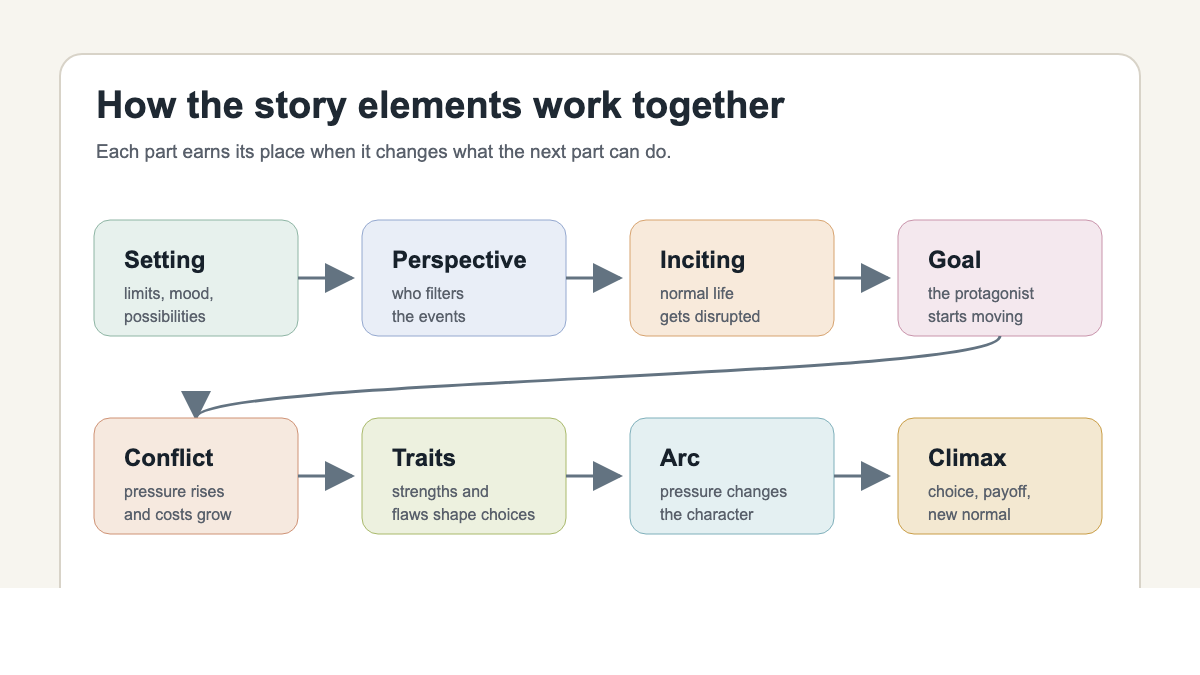
That is the short version. A story works when these elements are connected. In my experience, this matters more than memorizing the labels. The goal creates movement. The obstacles create pressure. The pressure reveals character. The climax forces a choice. The resolution shows what changed.
1. Perspective: Who Is Telling the Story?
Perspective is the lens through which the reader experiences the story. It includes point of view, narrator distance, and how much the reader is allowed to know.
The most common options are:
- First person: The narrator uses "I" and tells the story from inside one character's experience.
- Second person: The narrator uses "you" and puts the reader directly into the action.
- Third person limited: The narrator uses "he," "she," or "they," but stays close to one character's thoughts and perceptions.
- Third person omniscient: The narrator can move across multiple characters, histories, and private thoughts.
Purdue OWL describes point of view as the perspective through which a work is interpreted, which is a useful reminder: POV is not just grammar. It decides what the reader can see, what they misunderstand, and which character they instinctively trust.
For example, a mystery told from the detective's point of view feels very different from the same mystery told by the murderer, a witness, or the victim's best friend. The events may be identical, but the story changes because the reader's access changes. I tend to test POV by asking which narrator can hide the most interesting thing without making the story feel dishonest.
When choosing POV, ask: whose version of this story creates the most tension, surprise, or emotional honesty?
2. Setting: Where and When Does the Story Happen?
Setting is the time, place, social world, and atmosphere of the story. It is not just scenery.
A weak setting gives the reader a backdrop: a town, a school, a spaceship, a castle, a city street.
A strong setting changes what characters can do. A snowstorm can trap people together. A strict school can punish rebellion. A future city can make surveillance normal. A small town can make secrets harder to keep.
The UNC Writing Center lists setting alongside plot, point of view, character, and other fiction components because it gives context for what happens and why it matters. In practice, setting should answer three questions:
- What does this world make possible?
- What does this world make difficult?
- What would change if the same plot happened somewhere else?
If the answer to the third question is "not much," your setting may be too passive. Personally, I like settings that behave almost like pressure systems: they narrow choices, create friction, and make certain mistakes more likely.
3. Inciting Incident: What Starts the Real Story?
The inciting incident is the event that interrupts normal life and pushes the protagonist into the main conflict.
It does not have to be explosive. It can be a letter, a diagnosis, a betrayal, a discovery, a public embarrassment, a job offer, a death, a dare, or one sentence that cannot be unsaid.
What matters is that it changes the character's situation. Before the inciting incident, the protagonist can often keep living the old way. After it, avoiding the conflict becomes harder than facing it. That is the test I use: could the character realistically ignore this event and return to normal? If yes, the story may not have truly started yet.
Good inciting incidents usually do three things:
- They disturb the protagonist's normal life.
- They connect directly to the main conflict.
- They create a question the reader wants answered.
If you are using a story generator to brainstorm premises, pay close attention to this moment. A strong premise is not only "a person in an interesting situation." It is a person whose life has been pushed out of balance.
4. The Protagonist's Goal: What Does the Main Character Want?
A story needs a protagonist who wants something.
That goal can be external, like winning a trial, escaping a city, solving a murder, saving a sibling, or getting home. It can also be internal, like earning forgiveness, becoming brave, letting go of guilt, or learning to trust someone.
The clearest stories often have both:
| External goal | Internal need |
|---|---|
| Win the competition | Stop believing their worth depends on approval |
| Find the missing person | Admit they failed someone in the past |
| Escape the island | Learn to rely on others |
| Expose the truth | Choose integrity over comfort |
If a draft feels aimless, I would check the goal before polishing the prose. A beautiful scene still feels weak if the reader cannot tell what the character is trying to do. I have wasted plenty of editing time fixing sentences in scenes that were not actually pulling the story forward; the cleaner move is usually to clarify the want first.
This is also where a simple story outline helps. You do not need to plan every scene, but you should know what the protagonist wants, why it matters, and what will happen if they fail.
5. Conflict and Obstacles: What Gets in the Way?
Conflict is the pressure that keeps the story moving. It appears when the protagonist wants something and something else blocks them.
There are several common types of conflict:
| Conflict type | What blocks the protagonist | Example pattern |
|---|---|---|
| Character vs. self | Fear, guilt, doubt, desire, shame | A leader must act before they feel ready |
| Character vs. character | Rival, enemy, friend, family member | Two people want the same thing for different reasons |
| Character vs. society | Law, class, culture, institution | A character challenges a rule everyone else accepts |
| Character vs. nature | Weather, illness, wilderness, time | A character survives a force they cannot negotiate with |
| Character vs. technology | Machines, systems, algorithms, experiments | A character loses control of something built to help them |
| Character vs. fate | Prophecy, curse, destiny, inherited burden | A character resists a future everyone expects |
The key is escalation. Obstacles should not sit at the same level for the whole story. They should become more difficult, more personal, or more costly. My bias is that "more personal" is often stronger than "bigger." A world-ending threat can still feel flat if it never touches the protagonist's fear, guilt, pride, or relationships.
If the first obstacle is "the door is locked," the later obstacle should not simply be "another door is locked." The situation should worsen: the key is gone, the character is being watched, someone they trust lied, or opening the door now means hurting someone else.
This is one of the most common story writing mistakes: adding events without increasing pressure.
6. Character Traits: Strengths, Weaknesses, and Quirks
Characters do not become memorable because the author lists traits. They become memorable because their traits affect choices.
A brave character may take action quickly, but also rush into danger. A careful character may notice clues, but hesitate when speed matters. A loyal character may protect a friend, but ignore evidence that the friend is wrong.
That is why strengths and weaknesses often come from the same root.
| Trait | Strength | Possible weakness |
|---|---|---|
| Confidence | Acts decisively | Ignores warnings |
| Empathy | Understands others | Avoids necessary conflict |
| Curiosity | Finds hidden truth | Crosses boundaries |
| Loyalty | Protects relationships | Covers for the wrong person |
| Independence | Solves problems alone | Refuses help too long |
Small quirks matter too, but only when they reveal something. A character who always checks the exits may be anxious, trained, hunted, or carrying a secret. A character who jokes during serious moments may be charming, evasive, or terrified. I am skeptical of quirks added only to make a character "unique"; they work best when they quietly explain a decision later.
The test is simple: does this trait change what the character does? If not, it may be decoration.
7. Character Arc: How Does the Protagonist Change?
A character arc is the change a character goes through because of the story's pressure.
Not every story needs a dramatic transformation. Some protagonists change a lot. Some change slightly. Some stay firm while the world around them changes. But the ending should still feel affected by what happened.
Common character arcs include:
- Positive arc: The character grows, learns, heals, or becomes more honest.
- Negative arc: The character gives in to fear, pride, greed, or bitterness.
- Flat arc: The character stays committed to a belief and changes the people or world around them.
The strongest arcs are usually tied to the central conflict. If the protagonist's flaw never creates trouble, the arc will feel separate from the plot. If the final challenge does not test what they have learned, the ending will feel convenient.
Try this revision question: what can the protagonist do at the end that they could not have done at the beginning? I like this question because it keeps the arc visible. It turns change from an abstract theme into something the reader can actually see on the page.
The answer might be physical, emotional, moral, or relational. The important part is that the change is visible.
8. Climax and Resolution: How Does the Story Pay Off?
The climax is the moment of highest pressure, where the protagonist faces the central conflict and makes the choice or takes the action the story has been building toward.
The climax should not feel random. It should grow from the goal, obstacles, conflict, and character arc already in place.
A good climax usually:
- Forces the protagonist to act, not merely watch.
- Brings the central conflict to a decisive point.
- Uses the protagonist's strengths and exposes their weaknesses.
- Shows whether the character has changed.
- Makes the cost of success or failure clear.
The resolution comes after that. It does not need to explain every detail, but it should show the new normal. Something is different now: the relationship, the world, the character's belief, the balance of power, or the reader's understanding of what the story meant.
If the ending feels weak, check whether the climax actually answers the main story question. If the whole story asks "will she tell the truth?" the climax cannot be only a fight scene unless that fight forces the truth into the open.
How the Elements Work Together
Story elements are easiest to understand separately, but they matter most when they interact.
Here is a simple chain:
- The setting creates limits and possibilities.
- The perspective controls how readers experience those limits.
- The inciting incident disrupts the protagonist's life.
- The goal gives the protagonist direction.
- The conflict blocks that goal and raises the stakes.
- The character traits shape each choice.
- The arc shows how pressure changes the protagonist.
- The climax and resolution pay off the story's main question.
This is why a story can have all the "right" parts and still feel weak. The parts have to affect one another. When I diagnose a stalled draft, I do not ask whether it technically has a setting, conflict, and protagonist. I ask whether changing one of those pieces would force the others to change too.
For example, imagine a student who wants to win a debate tournament.
If the setting is an ordinary school, the story may focus on rivalry and confidence. If the setting is a school where public mistakes are punished harshly, the same goal becomes more dangerous. If the point of view stays close to the student, readers feel every panic spiral. If the protagonist's flaw is needing approval, each obstacle can test whether they will speak honestly or perform what others want to hear.
Same basic premise. Stronger story because the elements are connected. Once that foundation is clear, writing the story becomes less about filling pages and more about choosing scenes that force the character to act.
For more models, it can help to study short story examples by genre and ask which element is doing the most work in each one.
Quick Revision Checklist
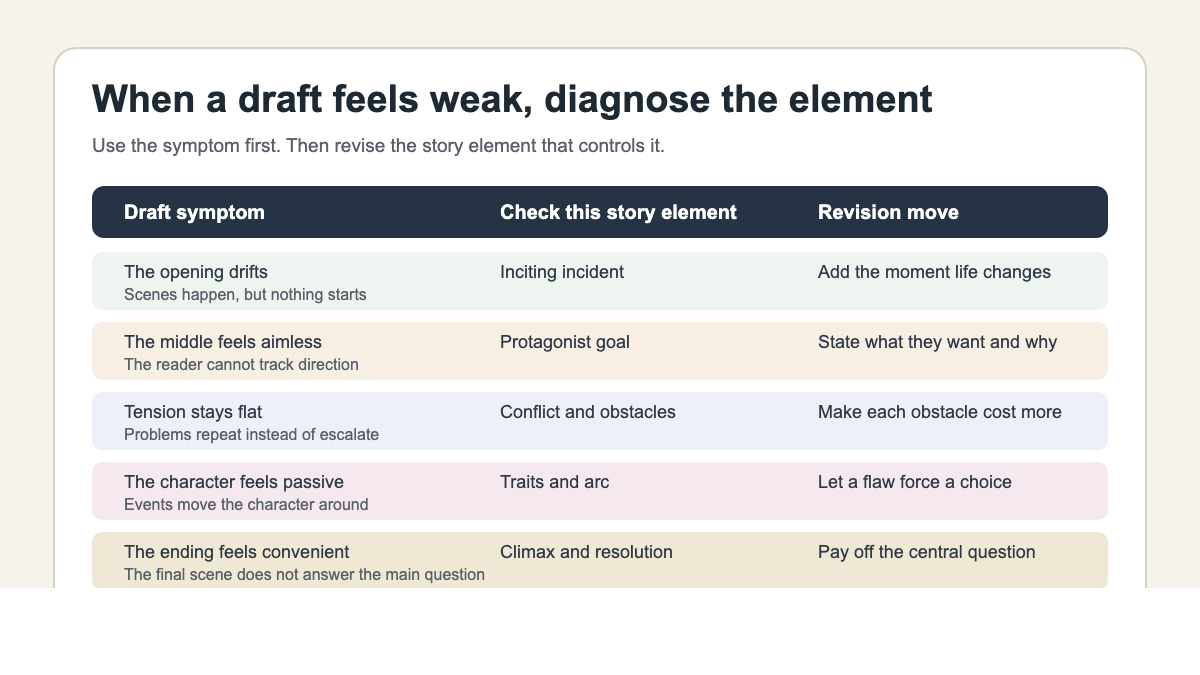
Use these questions when a draft feels unclear:
| Element missing | Symptom in the draft | Fix |
|---|---|---|
| Goal | Scenes wander | Ask: what does the protagonist want this scene? |
| Conflict | Everything is easy | Add an obstacle that forces a choice |
| Arc | Ending feels flat | Change a belief, not just a location |
| Inciting incident | Slow start | Cut until the first irreversible change |
Checklist beat: If you can remove a scene and nothing in the character’s want/conflict changes, the element is decoration.
STORY ELEMENTS: A COMPLETE GUIDE FOR STUDENTS AND TEACHERS
| Question | What it diagnoses |
|---|---|
| Whose perspective gives the story the most tension? | POV problems |
| What changes after the inciting incident? | Weak opening |
| What does the protagonist want? | Aimless middle |
| What gets harder as the story continues? | Flat conflict |
| Which character trait causes trouble? | Passive characterization |
| What does the protagonist learn, lose, or become? | Thin character arc |
| What choice does the climax force? | Weak payoff |
| What is different after the ending? | Unsatisfying resolution |
If you can answer these questions clearly, you probably have the foundation of a working story. If you cannot, do not panic. That is exactly what revision is for. I would rather see a messy draft with honest answers to these questions than a polished draft where the conflict, goal, and ending barely touch each other.
Story Elements vs. Story Structure
Story elements and story structure overlap, but they are not the same thing.
Story elements are the ingredients: character, setting, conflict, point of view, goal, and change.
Story structure is the arrangement of those ingredients across the beginning, middle, and end.
A flash fiction piece, short story, novel, screenplay, and serialized web story can use the same core elements in different shapes. A short story may imply the setting quickly and focus on one turning point. A novel has more room for subplots, secondary characters, and layered arcs. If you are unsure which form fits your idea, compare short stories, novels, and flash fiction before expanding the draft.
The practical point is this: do not treat the checklist as a rigid formula. Treat it as a diagnostic tool. If the story is not working, one of these elements will usually show you where to revise. The checklist should help you make better choices, not make every story sound like it came from the same template.
Final Takeaway
The core elements of a story are perspective, setting, inciting incident, protagonist goal, conflict, character traits, character arc, and climax with resolution.
You do not need to overthink them while drafting. Sometimes the best first draft comes from momentum. I usually prefer letting the first draft run a little loose, then using the elements as a second-pass diagnostic. That keeps the process creative without leaving revision completely vague.
Start with three questions:
- What does the protagonist want?
- What blocks them?
- What changes because of the struggle?
If those answers are strong, the rest of the story has something solid to build on. From there, use creative writing techniques to sharpen the scenes, dialogue, pacing, and voice around that foundation.