
Free Marketing Benefit Statement Generator
Generate persuasive benefit-driven messaging that explains why your product or service matters to customers. Create concise positioning lines for ads, landing pages, product pages, email campaigns, and sales copy.
Marketing Benefit Statements
Your benefit statements will appear here...
How the AI Marketing Benefit Statement Generator Works
Get results in seconds with a simple workflow.
Add Your Product and Features
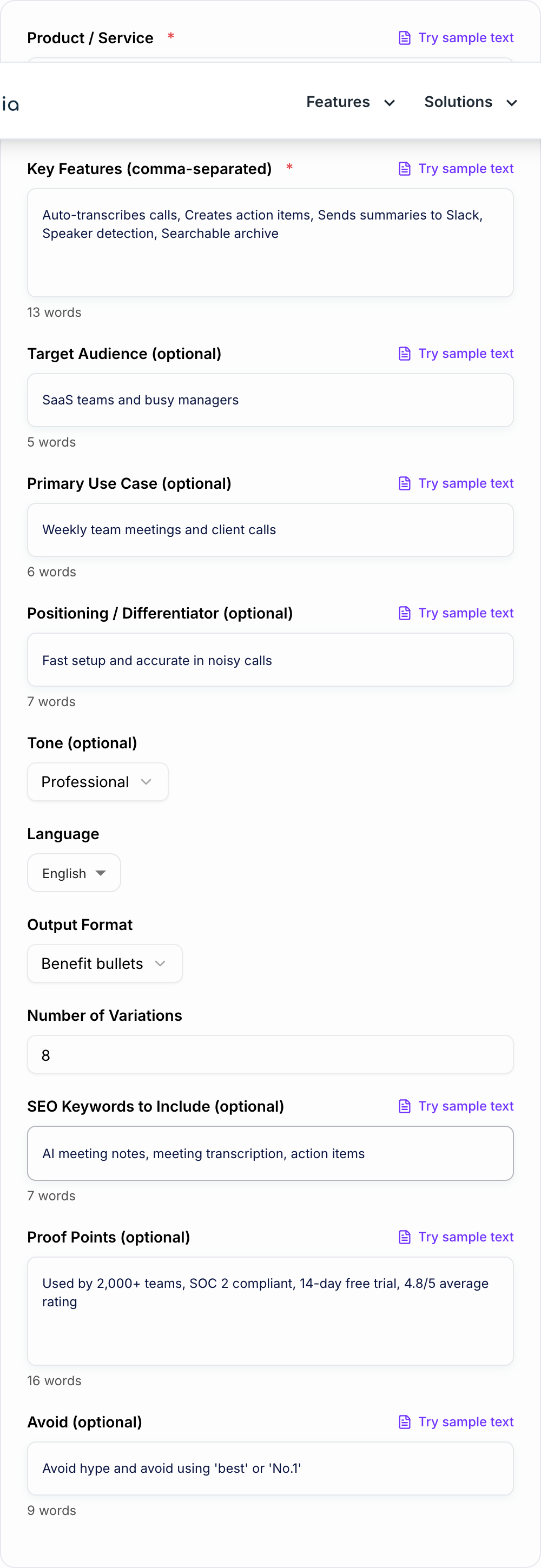
Enter your product/service and a simple feature list. The generator maps each feature to an outcome customers care about.
Optional: Set Audience, Tone, and Keywords
Add a target audience, use case, tone, and optional SEO keywords or proof points to tailor the messaging for your market and channel.
Generate Variations and Pick Winners
Get multiple benefit statements, then select the strongest ones for your landing page, ads, emails, or product descriptions—and test performance.
See It in Action
Example of transforming a feature list into clear, conversion-focused benefit statements.
Features: Auto-transcribes calls, Creates action items, Sends summaries to Slack, Searchable archive
• Never miss a detail—auto-transcribe calls so key decisions and commitments are captured automatically. • Turn conversations into next steps—action items are generated and assigned fast. • Keep your team aligned—send meeting summaries straight to Slack for instant visibility. • Find anything later—search a complete archive of meeting notes in seconds.
Why Use Our AI Marketing Benefit Statement Generator?
Powered by the latest AI to deliver fast, accurate results.
Feature-to-Benefit Copywriting (Outcome-Focused)
Turn product features into customer benefits that explain the outcome, not just the functionality—ideal for landing pages, product pages, and marketing copy.
Multiple Benefit Statement Variations for Testing
Generate several benefit angles at once so you can A/B test messaging across ads, email subject lines, hero sections, and CTAs.
Audience & Use-Case Targeting
Tailor benefit statements to a specific persona and scenario, improving relevance and conversion rate optimization (CRO).
Optional Proof Points (No Fake Claims)
Add real proof points like verified stats, guarantees, compliance badges, or testimonials. The generator won’t invent numbers or unsupported claims.
SEO-Friendly Benefit Copy (Keyword-Aware)
Optionally include SEO keywords naturally to support on-page optimization without keyword stuffing—useful for service pages and product-led SEO content.
Pro Tips for Better Results
Get the most out of the AI Marketing Benefit Statement Generator with these expert tips.
Write benefits as outcomes, not adjectives
Replace vague words like “powerful” or “easy” with specific outcomes like “cuts reporting time from hours to minutes” (only if true) or “reduces back-and-forth approvals.”
Match benefits to the buyer’s job-to-be-done
A benefit that converts is tied to the real job: reduce risk, save time, increase revenue, improve quality, or simplify workflows—based on your target audience.
Add proof to remove skepticism
If you have real proof (reviews, guarantees, compliance, benchmarks), include it. Benefits feel more credible when paired with evidence.
Use different benefit angles for different channels
Ads often need a punchy hook, while landing pages need clarity and specificity. Generate multiple formats to fit each channel.
Keep SEO keywords natural and intent-aligned
If you’re targeting commercial-intent queries, benefits should reflect what searchers want (speed, price clarity, reliability, outcomes) without forcing keywords unnaturally.
Who Is This For?
Trusted by millions of students, writers, and professionals worldwide.
How to Write Marketing Benefit Statements That Actually Convert
Most marketing pages fail for a boring reason. They list features, then hope the reader connects the dots.
But buyers rarely do that work. They skim. They ask, quietly, so what? And if your copy does not answer that in two seconds, they bounce.
A strong marketing benefit statement does one thing well: it takes a feature and turns it into an outcome the customer wants, in plain language, without hype.
Features vs benefits (and why this matters on landing pages)
A feature is a fact about your product.
A benefit is the result your customer gets because of that feature.
Simple example:
- Feature: “Speaker detection”
- Benefit: “Know who said what, so follow ups and accountability are crystal clear.”
When you rewrite your feature list into benefit statements, you usually see immediate improvements in:
- landing page clarity
- ad click through rate
- email engagement
- product page conversions
- SEO content relevance, because the copy matches intent better
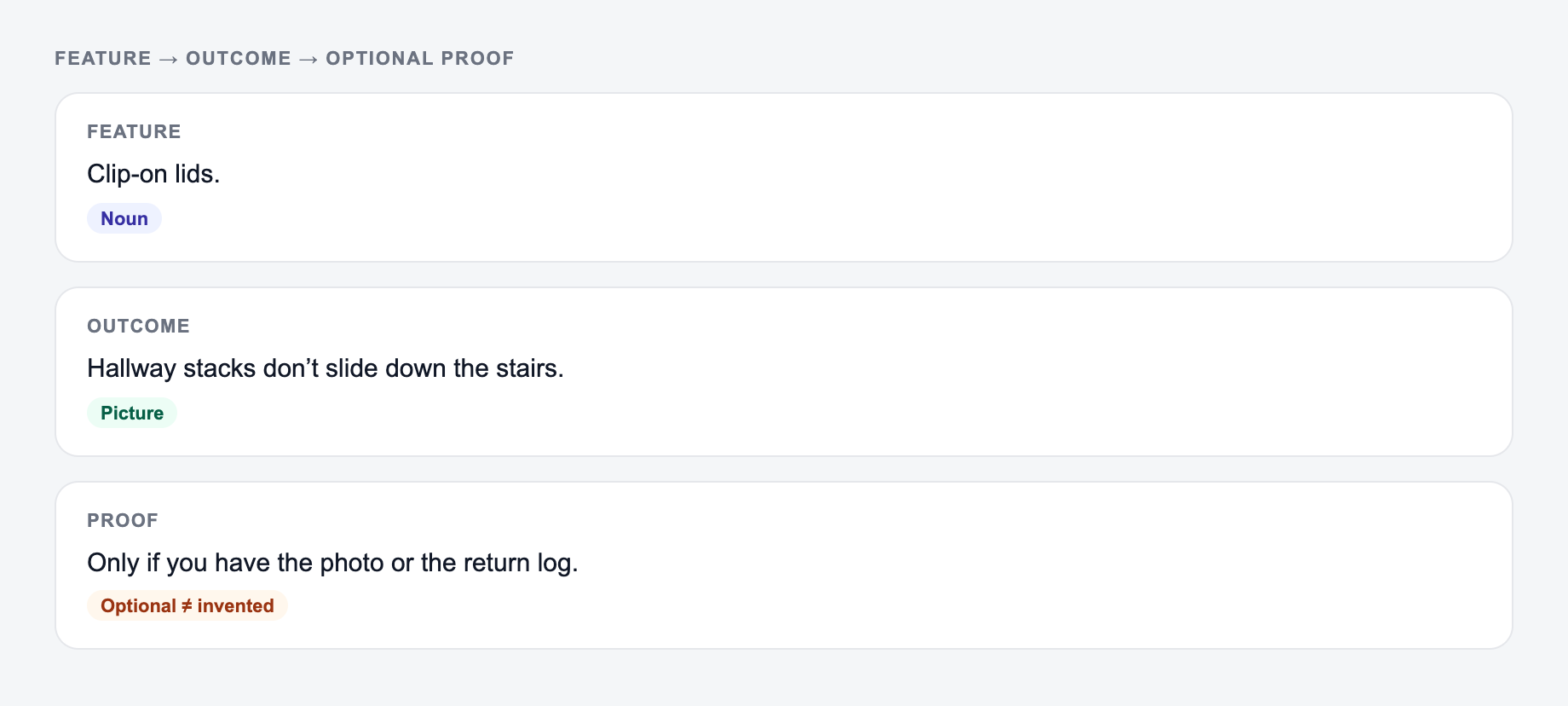
A quick formula: Feature → Outcome → Proof (optional)
If you are stuck, use this pattern:
Pair each feature with an outcome a customer would recognise. Proof is optional, but never invent it.
- Feature (what it does)
- Outcome (what the customer gets)
- Proof point (only if real)
Example:
- “Auto transcribes calls, so you never lose important details, backed by a 4.8/5 rating from verified users.”
No proof point? Totally fine. Do not invent numbers. Fake stats kill trust fast.
7 benefit statement angles you can test (without rewriting your whole page)
Different channels reward different styles. Here are angles you can rotate through.
- Time savings
- “Finish reports in minutes, not hours.”
- Risk reduction
- “Avoid costly mistakes with built in checks and approvals.”
- Revenue or growth
- “Convert more leads with follow ups that go out automatically.”
- Effort reduction
- “Cut busywork so your team stays focused on real work.”
- Speed
- “Go live today, not next month.”
- Confidence
- “Know exactly what is happening, with clear visibility for everyone.”
- Convenience
- “Everything in one place, so nothing gets lost across tools.”
Run a few variations, then keep the winners. You do not need perfect copy. You need copy that performs.
Benefit bullets for common pages (copy you can adapt)
These are templates you can steal and tweak.
Landing page hero benefits
- “Get [result] without [pain].”
- “Designed for [audience] who need [outcome] fast.”
- “Stop [problem], start [better state].”
Product page feature section
- “Do [task] automatically, so you can [higher value outcome].”
- “Built for [use case], which means [specific payoff].”
Ad hooks
- “Tired of [pain]? Try [outcome].”
- “The fastest way to [goal] without [tradeoff].”
Email benefits
- “In 5 minutes you will [outcome].”
- “Here is how to [result] without [friction].”
SEO tip: benefits can help rankings, but only if they match intent
SEO friendly benefit statements are not about cramming keywords into bullets.
They work when the benefits mirror what searchers actually want from that query. Commercial intent keywords usually imply outcomes like:
- faster turnaround
- fewer errors
- better reliability
- easier setup
- clear pricing or value
If you do include keywords, weave them in naturally, once, where it fits. Then support them with real detail elsewhere on the page.
When to use this generator (and what to input for the best results)
You will get the best outputs when you provide:
- a clean feature list (one per line is ideal)
- a real audience (who is buying and why)
- the main use case (where it is used, not every possible scenario)
- proof points you can stand behind (reviews, guarantees, compliance, verified stats)
If you want to build a consistent workflow for copy like this, you can also generate and refine variations using the writing tools on Junia AI and keep your messaging aligned across ads, landing pages, and emails.
A final checklist before you publish benefit statements
- Is it specific, or just flattering adjectives?
- Does it imply a real outcome the buyer cares about?
- Can you defend the claim if someone asks “how?”
- Does each benefit match a feature that supports it?
- Do you have a few variations to test? (you should)
Frequently Asked Questions
What is a marketing benefit statement?+
A benefit statement explains the outcome a customer gets (the “so what”), not just the feature. It connects your product or service to a real result like saving time, reducing risk, increasing revenue, or improving quality.
What’s the difference between features and benefits?+
A feature is what your product does (e.g., “auto-transcribes calls”). A benefit is the outcome for the customer (e.g., “captures every detail so you don’t miss action items”). Strong marketing copy uses features to support believable benefits.
Can I use these benefit statements on landing pages and ads?+
Yes. The outputs are designed for conversion-focused copy such as landing page sections, ad hooks, product page bullets, and email marketing—just review for accuracy and brand voice.
Will the generator include metrics or stats?+
Only if you provide them in the proof points field. It will not invent numbers, performance claims, or certifications you didn’t supply.
How do I make benefit statements more persuasive?+
Use specificity (who it helps and when), reduce vague adjectives, add a proof point if available, and match the benefit to a real pain point. Testing multiple variations is also one of the fastest ways to find what converts.
Can I include SEO keywords in benefit statements?+
Yes. Add target keywords and the tool will weave them in naturally. For best on-page SEO, use benefit statements alongside clear headings, supporting copy, and intent-matching sections—not keyword stuffing.