
Free Policy Generator
Create structured website policy drafts for ecommerce stores, SaaS products, agencies, blogs, creators, and online services. Generate privacy, terms, refund, shipping, cookie, and disclaimer pages from your business details and data practices.
Policy Draft
Your policy draft will appear here...
How the AI Policy Generator Works
Get results in seconds with a simple workflow.
Choose a Policy Type
Select the policy you need (Privacy Policy, Terms & Conditions, Cookie Policy, Refund Policy, Shipping Policy, or Disclaimer) to match your website or online business.
Add Optional Details (Recommended)
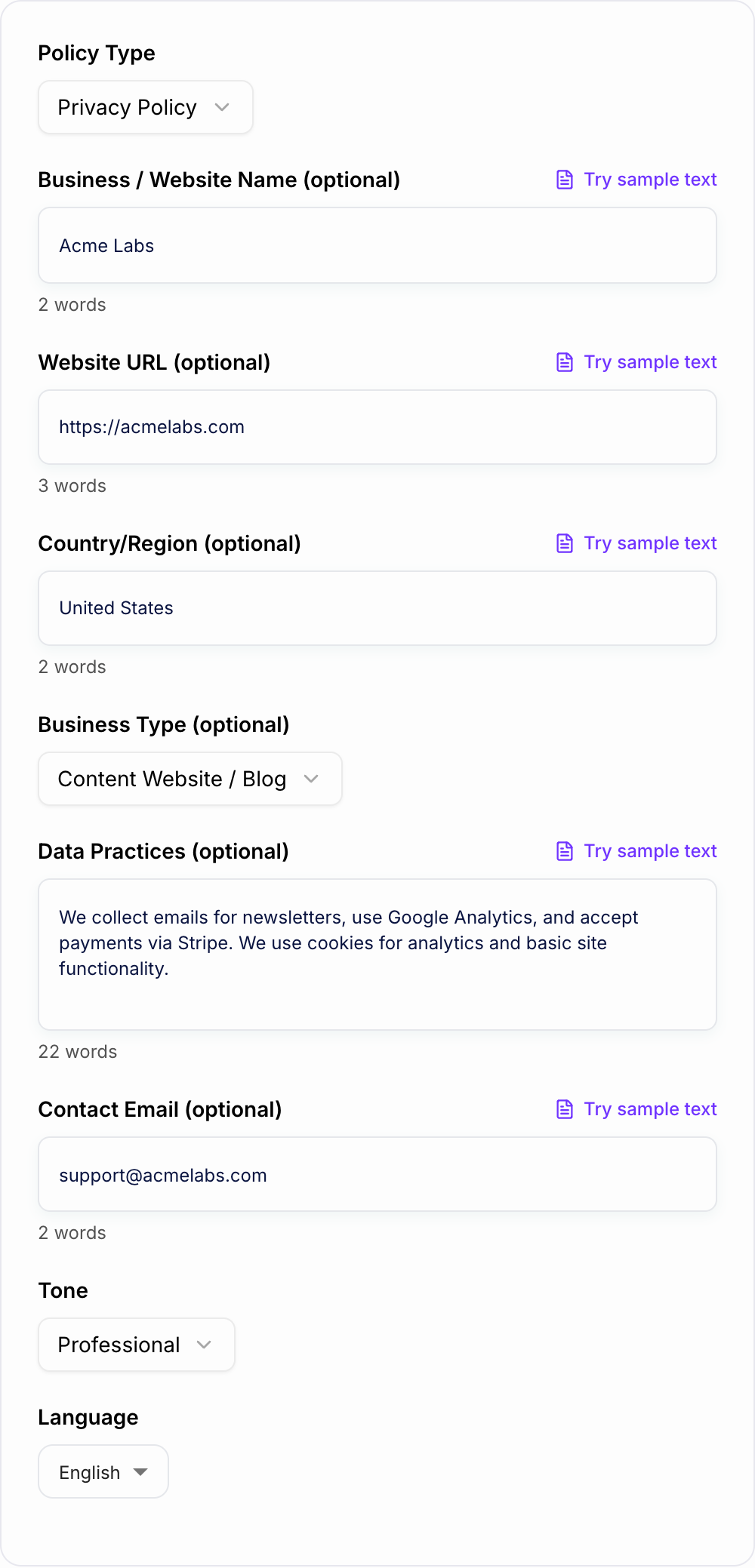
Enter your business name, website URL, country/region, contact email, and a short description of your data practices (analytics, email marketing, payments, cookies, third-party tools).
Generate and Review Before Publishing
Generate a structured draft, then review and edit the details to match your operations. For best results, validate requirements for your jurisdiction and business model.
See It in Action
Turn a few inputs into a structured policy draft you can edit and publish as a website policy page.
We need a privacy policy for our website. We collect emails and use analytics.
Privacy Policy (Draft)
-
Introduction This Privacy Policy explains how [Business Name] collects, uses, and shares information when you visit [Website URL].
-
Information We Collect
- Contact information: such as email address when you subscribe or contact us
- Usage data: such as pages visited, device/browser information, and approximate location
-
How We Use Information We use information to provide and improve the website, send communications you request, and understand site performance.
-
Cookies and Tracking We use cookies and similar technologies for essential functionality and analytics. You can control cookies through your browser settings.
-
Sharing of Information We may share information with service providers that help us operate the website (e.g., analytics, email delivery, payment processors if applicable).
-
Data Retention We retain information only as long as necessary for the purposes described in this policy.
-
Security We use reasonable administrative, technical, and organizational safeguards designed to protect information.
-
Your Rights and Choices Depending on your location, you may have rights to access, correct, or delete your personal information.
-
Contact Us Questions? Contact: [Contact Email]
Effective Date: [Date]
Why Use Our AI Policy Generator?
Powered by the latest AI to deliver fast, accurate results.
Generate Multiple Website Policies (Privacy, Terms, Refunds, Shipping, Cookies)
Create the most common legal policy pages websites need—Privacy Policy, Terms & Conditions, Cookie Policy, Refund Policy, Shipping Policy, and Disclaimers—formatted for easy publishing.
Business-Specific Customization
Add your business name, website URL, country/region, and basic data practices to generate policy language that matches your site, eCommerce store, SaaS product, or service business.
Clear, Structured Sections (Publish-Ready Formatting)
Outputs a clean policy layout with headings, definitions, and logically ordered clauses so users can quickly review, edit, and paste into a policy page.
Data Collection & Cookie Coverage
Includes practical clauses for common data collection methods (forms, email marketing, payments, analytics, cookies, and third-party tools) to help cover typical privacy and cookie disclosures.
Fast Drafts You Can Review with Counsel
Generates a strong starting draft for policy pages so you can iterate faster—then validate details and compliance requirements for your jurisdiction and business model.
Pro Tips for Better Results
Get the most out of the AI Policy Generator with these expert tips.
Be specific about third-party services
List tools like Google Analytics, Stripe, PayPal, Mailchimp, Meta Pixel, or ad networks in your data practices field so the policy includes more accurate processor and tracking language.
Match policies to your user flows
If you collect emails, run ads, accept payments, or ship products, ensure your Privacy, Refund, and Shipping policies reflect what users actually experience (timelines, eligibility, contact path).
Add a visible link in your footer
For SEO and usability, publish your policy pages with clear titles (e.g., “Privacy Policy”) and link them in the site footer so users and crawlers can find them easily.
Keep a changelog mindset
When you add new tracking, analytics, email marketing, or payment providers, regenerate or update your policies and note the effective date to reduce confusion and support compliance.
Avoid overpromising security
Use realistic security language (e.g., “reasonable measures”) rather than absolute claims. This keeps policy wording clearer and reduces risk if an incident occurs.
Who Is This For?
Trusted by millions of students, writers, and professionals worldwide.
Generate Website Policies You Can Review and Publish Faster
A policy generator is useful when you need a structured first draft of a Privacy Policy, Terms and Conditions page, Cookie Policy, Refund Policy, Shipping Policy, or Disclaimer. It does not replace legal advice, and it cannot know every rule that applies to your business. What it can do is turn your business details into organized policy language you can review, customize, and publish with less friction.
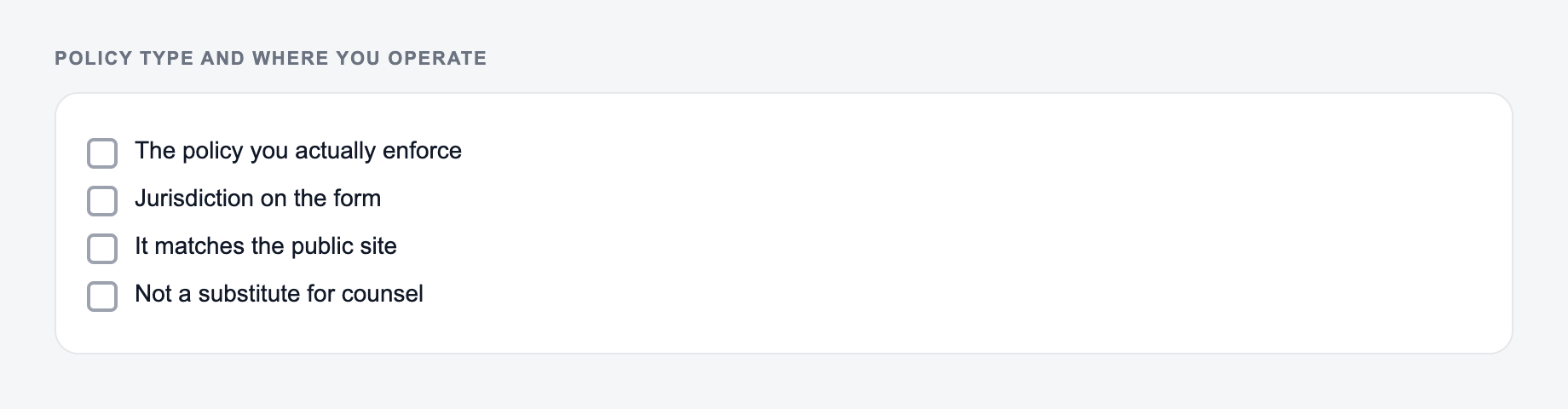
Policy type and where you operate belong on the form. This is not a substitute for counsel.
Treat the AI Policy Generator as a first draft. Compensation, legal effect, medical content, and anything you would not say in the room still need a person — and often counsel — before they leave your outbox.
This is a draft aid, not legal, medical, or financial advice.
The key is to give the tool accurate inputs. A vague policy draft may look polished, but it can miss the way your website actually collects data, sells products, handles payments, ships orders, or communicates with users.
Choose the right policy type first
Start by selecting the policy you actually need.
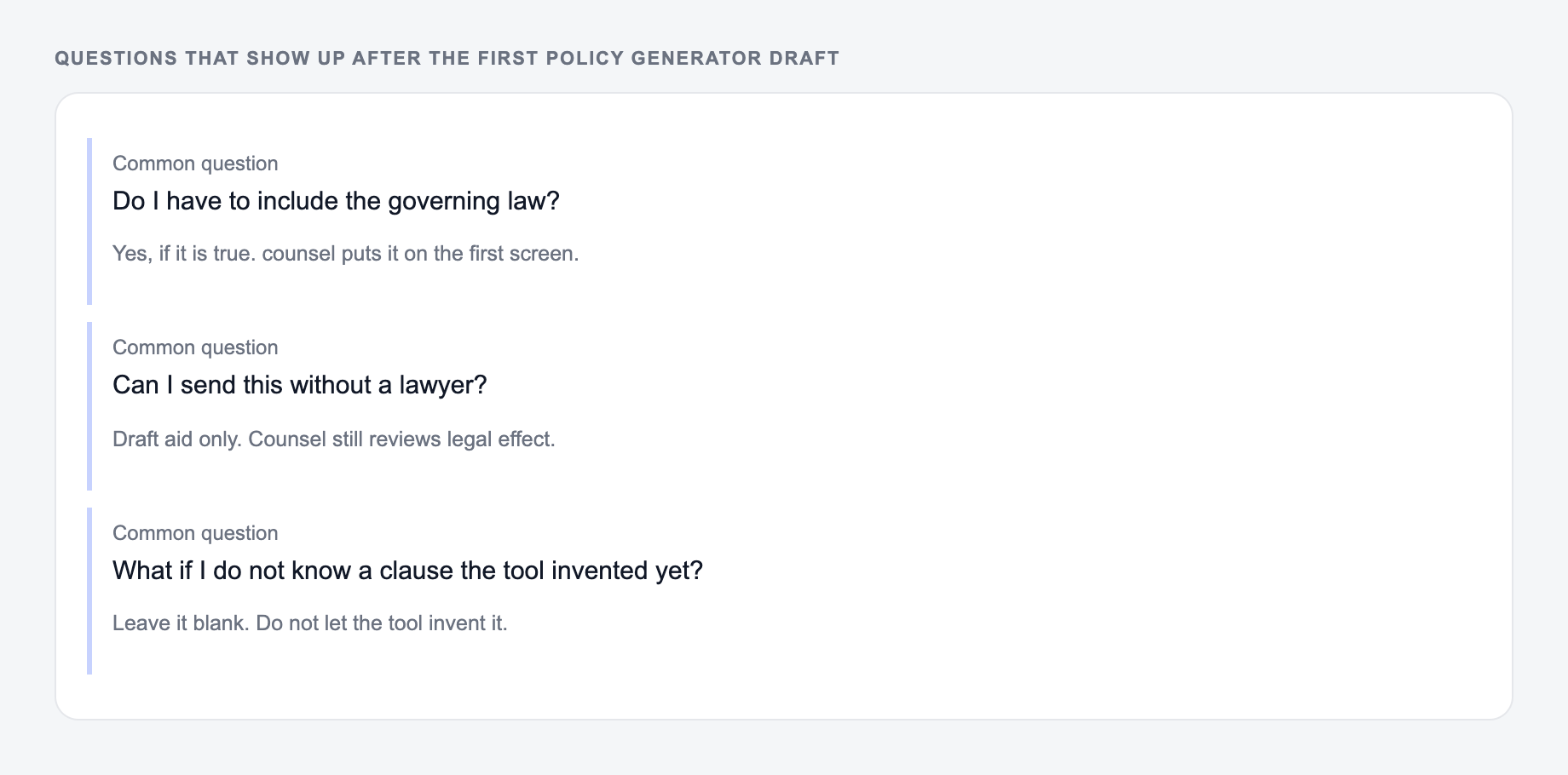
Answer these before you generate a second batch. A reroll will not fix a vague brief.
Before anything leaves the outbox:
- You can point to the number in a spreadsheet or a contract
- You would sign it if your name were the only one on it
- Compensation, legal effect, and medical content had a human pass
Use a Privacy Policy if your site collects personal information. That includes contact forms, newsletter signups, analytics, payment processing, user accounts, comments, advertising pixels, or customer support tools.
Use Terms and Conditions when you need rules for using your site, service, app, content, community, paid plan, trial, or user account.
Use a Cookie Policy if you want a dedicated page explaining analytics cookies, advertising cookies, preference cookies, or tracking technologies. Some sites include this in the Privacy Policy, but a separate page can make consent information easier to find.
Use a Refund Policy if you sell physical products, digital downloads, subscriptions, memberships, services, courses, or paid access.
Use a Shipping Policy if you sell physical goods and need to explain timelines, carriers, tracking, delivery issues, customs, or international shipping.
Use a Disclaimer if your site publishes advice, affiliate content, informational resources, reviews, financial commentary, health-adjacent content, or third-party links.
What to enter for a more accurate policy draft
The generator can work with limited details, but your draft gets better when you describe how the business really operates.
Include:
- business name and website URL
- country, state, or main operating region
- contact email or support channel
- business type, such as ecommerce, SaaS, agency, blog, creator, or marketplace
- data you collect, such as names, emails, billing details, account data, support messages, or usage data
- tools you use, such as Stripe, PayPal, Shopify, Google Analytics, Meta Pixel, Mailchimp, HubSpot, Intercom, or ad networks
- refund windows, shipping timelines, trial terms, cancellation rules, or account restrictions
You can paste rough notes. The tool's job is to organize them into sections and clauses; your job is to make sure the facts are correct.
How to review the generated policy
Read the generated policy against your actual website, not against what sounds professional. The most important question is simple: does this describe what users experience?
Check that:
- the business name, website, contact details, and effective date are correct
- every data collection method on your site is represented
- third-party tools are named or described accurately
- refund and shipping rules match your real support process
- payment processing language reflects who handles billing data
- user rights sections make sense for your operating regions
- security language is realistic and does not overpromise
Avoid absolute claims like "we guarantee complete security" or "we never share data" unless they are genuinely true. Most websites share data with service providers, even if they do not sell it.
Example input for a privacy policy
You might enter:
Business: BrightPath Studio Website: brightpath.example Region: United States, customers worldwide Data practices: newsletter signup, contact form, Stripe payments, Google Analytics, Meta Pixel for ads, customer support emails Contact: privacy@brightpath.example
A stronger generated draft should include sections for information collected, how it is used, cookies and tracking, service providers, retention, security, user choices, international users if relevant, contact details, and an effective date.
Where to publish policy pages
Policy pages should be easy to find. Link core policies in your site footer, checkout flow, account signup flow, consent banner, and any place where users make a decision involving data, payment, shipping, or service terms.
Use plain URLs and titles:
/privacy-policy/terms/cookie-policy/refund-policy/shipping-policy/disclaimer
Clear names help users and crawlers understand the page. They also reduce support friction because people can find the rules without contacting you.
When to regenerate or update a policy
Do not treat policy pages as one-time setup work. Regenerate or revise them when you add analytics, launch ads, change email tools, introduce subscriptions, expand to new regions, update refund terms, add shipping locations, or change how users create accounts.
Keep the effective date current. If the change is meaningful, add a short update note so users can see what changed.
If you are building several site pages at once, the content and SEO workflows on Junia AI can help keep page copy, tool pages, and policy-supporting content consistent. For legal wording, still review the final policy against your business reality and local requirements.
Final checklist before publishing
Before you publish a generated policy, confirm:
- there are no placeholders left in the draft
- the policy type matches the page title
- all tools and processors listed are tools you actually use
- the contact method works
- the effective date is present
- unsupported legal claims have been removed
- a qualified professional has reviewed it when the risk is high
The generator gives you a structured draft. Accuracy comes from the details you provide and the review you do before the page goes live.
Frequently Asked Questions
Is this policy generator free to use?+
Yes. You can generate policy drafts for common website legal pages like a Privacy Policy, Terms & Conditions, Cookie Policy, Refund Policy, Shipping Policy, and Disclaimer.
Are the generated policies legally binding or lawyer-approved?+
They are AI-generated drafts meant as a starting point. Laws vary by jurisdiction and business model, so you should review, customize, and (when appropriate) have a qualified legal professional verify compliance.
What information should I provide for a better Privacy Policy?+
Add your business name, website URL, country/region, contact email, and your data practices (e.g., email signups, contact forms, analytics, payments, advertising, cookies, third-party processors). More detail helps produce more accurate clauses.
Can I generate policies for eCommerce stores and SaaS apps?+
Yes. Choose a business type and describe your data practices. The generator can draft policies for content sites, eCommerce stores, SaaS products, agencies, creators, and more.
Does it include cookie and analytics language?+
Yes. The tool can generate cookie-related sections (or a dedicated Cookie Policy) that explain cookie categories, tracking, third-party cookies, and how users can manage preferences—based on your provided details.
Can I generate policy pages in another language?+
Yes. Select an output language and the tool will generate the policy in that language. Always double-check legal terminology and jurisdiction-specific requirements after translation.