
Are AI Content Detectors Accurate? What Writers Should Know

Thu
AI SEO Specialist, Full Stack Developer

I still run drafts through a detector. I just stopped treating the percentage as a verdict.
They can spot patterns that often show up in AI-generated writing, but they cannot reliably prove who wrote a passage. That matters because a lot of writers, students, SEOs, and content teams still treat detector scores like final judgment. They are not.
Use them as screening tools. They can flag robotic phrasing, repetitive structure, or overly generic sections. They are much weaker as evidence on their own.
Here is where they help, where they fail, and what I actually do instead of trusting a score blindly.
How AI content detectors usually work
Most detectors look for statistical patterns in language.
That includes things like:
- sentence predictability
- repetitive phrasing
- uniform paragraph structure
- low variation in syntax
- broad, generic wording without much specificity
That is why a tool can sometimes flag text that a human wrote from scratch. If the writing is formal, repetitive, or highly standardized, it may still look "AI-like" to a detector.
If you want to test your own draft, an AI text detector can still be useful. You just need to treat the result as a signal, not a verdict.
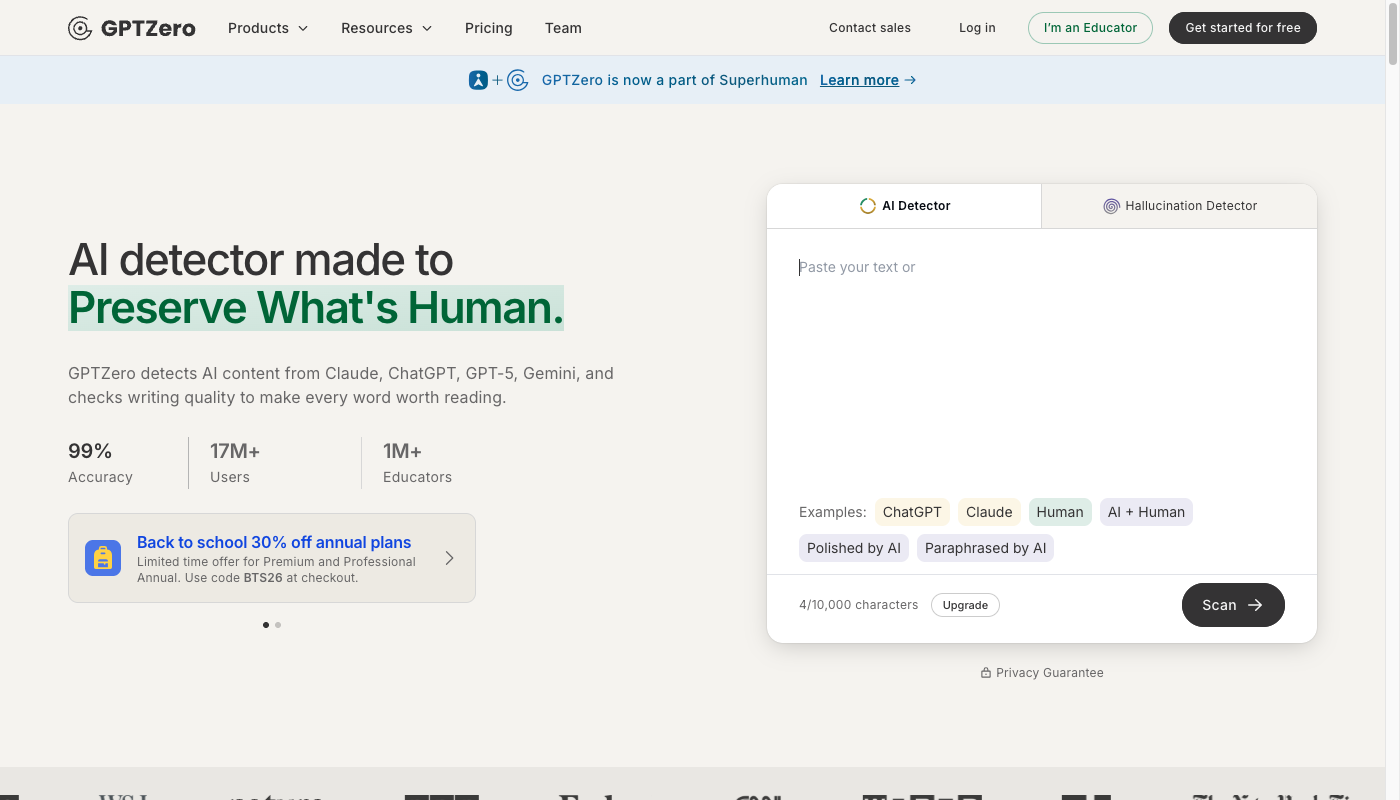
Public detectors make that workflow obvious. You paste text into a box, hit scan, and get a likelihood score. GPTZero's public detector is a typical example: a paste field, example chips, and a scan button. Nothing in that UI is a courtroom exhibit.
So, are AI detectors accurate?
They are directionally useful, not fully reliable.
On average, detectors can often identify obviously machine-written text. But accuracy drops when:
- a human edits the draft
- the sample is short
- the content is technical or formulaic
- the writer uses simple, predictable language
- the model output has already been revised for clarity
That means "accurate enough to investigate" is not the same as "accurate enough to accuse."
A score is not proof of cheating, and it is not a quality score. I have seen clean, useful drafts get flagged because they were too tidy, and I have seen messy AI dumps skate through because someone shuffled a few sentences. Treat the number as a prompt to reread, not as a pass/fail grade.
| What a detector can tell you | What it cannot tell you |
|---|---|
| The prose looks statistically uniform or "AI-like" | Who actually wrote it |
| A short sample is too thin to trust | Whether the page is accurate |
| Formal, ESL, or template-heavy writing may look machine-like | Whether a student cheated |
| Heavy editing often lowers the score | Whether Google will rank the page |
| A section may need more specifics and rhythm | Whether the draft is worth publishing |
Why false positives happen
False positives are the biggest reason writers should be cautious.
A detector can incorrectly flag human writing because:
- the writer is using a neutral academic tone
- the piece follows a rigid structure
- English is not the writer's first language
- the content is intentionally simplified for readability
- the topic relies on repeated terminology
This is one reason content teams should not use one score as a quality standard. A detector may tell you that a paragraph is too uniform, but it cannot tell you whether that paragraph is actually bad for the reader.
Why false negatives happen too
The opposite problem also exists.
If a generated draft gets enough manual editing, stronger examples, and better rhythm, some detectors will score it lower even though AI helped produce it.
That is not proof the content is high quality. It just means the obvious statistical fingerprints were reduced.
This is also why teams that want more natural copy often reach for a humanizer. The point is not to chase a perfect score. It is to improve the actual reading experience. A humanizer vs paraphraser distinction matters here: shuffling synonyms can drop a score while leaving the draft just as empty.
What writers should use detectors for
Detectors are most useful in a narrow role:
- identifying sections that sound generic
- spotting intros and conclusions that feel templated
- finding copy that needs more specificity
- prioritizing which pages need a stronger editing pass
That is a good workflow.
A weak workflow is treating detector output as if it were a plagiarism checker or a forensic tool.
A better way to judge AI-assisted writing
Instead of obsessing over the score, ask better editorial questions:
- Does the piece say anything specific?
- Does it include examples, constraints, or real judgment?
- Does it sound like it was written for this audience?
- Are the facts accurate and the claims supportable?
- Does the introduction earn the reader's attention?
If the answer is no, the content needs work whether AI was involved or not.
If the answer is yes, the content may already be stronger than what a detector score suggests.
What to do if your draft gets flagged
Do not panic and do not start rewriting blindly.
Start here:
- Review the highlighted sections, not just the score.
- Add concrete examples or a clearer point of view.
- Break predictable sentence patterns.
- Replace filler phrases with specific wording.
- Tighten weak intros and generic wrap-ups.
If the draft still feels stiff after that, humanize the awkward stretches before you scan it again. Adding a human touch to AI-generated content usually beats feeding the same paragraph through a detector on a loop.
Do AI detector scores matter for SEO?
Not directly, and not as a ranking signal.
Google does not rank pages based on whether a third-party detector thinks the writing looks machine-generated. Detector scores are not a ranking signal. What matters is whether the page is helpful, trustworthy, and worth reading.
Google Search Central's guidance on thin and unhelpful content is the better north star here than any paste-box percentage:
Google Search Central on thin and unhelpful content
That is why the better SEO question is not "can I lower the detector score?" It is does AI content rank in Google when it is genuinely useful, edited well, and aligned with search intent.
What I would do instead of chasing the score
If a detector flags a draft, I reread the weak sections and ask whether a reader would learn anything. If the answer is no, I add examples, trim filler, and take a position. If the answer is yes, I keep the draft and move on.
Use detectors to guide editing, not to replace judgment. Final quality still looks more like an AI vs human writers question than a detector-score question.