
SEO Content Brief Examples for Blog Posts, SaaS, and Ecommerce

Thu
AI SEO Specialist, Full Stack Developer

SEO content briefs are easier to understand when you can see what they look like in real situations.
A brief for a blog post is not the same as a brief for a SaaS landing page. And neither of those should look exactly like a brief for an ecommerce category page.
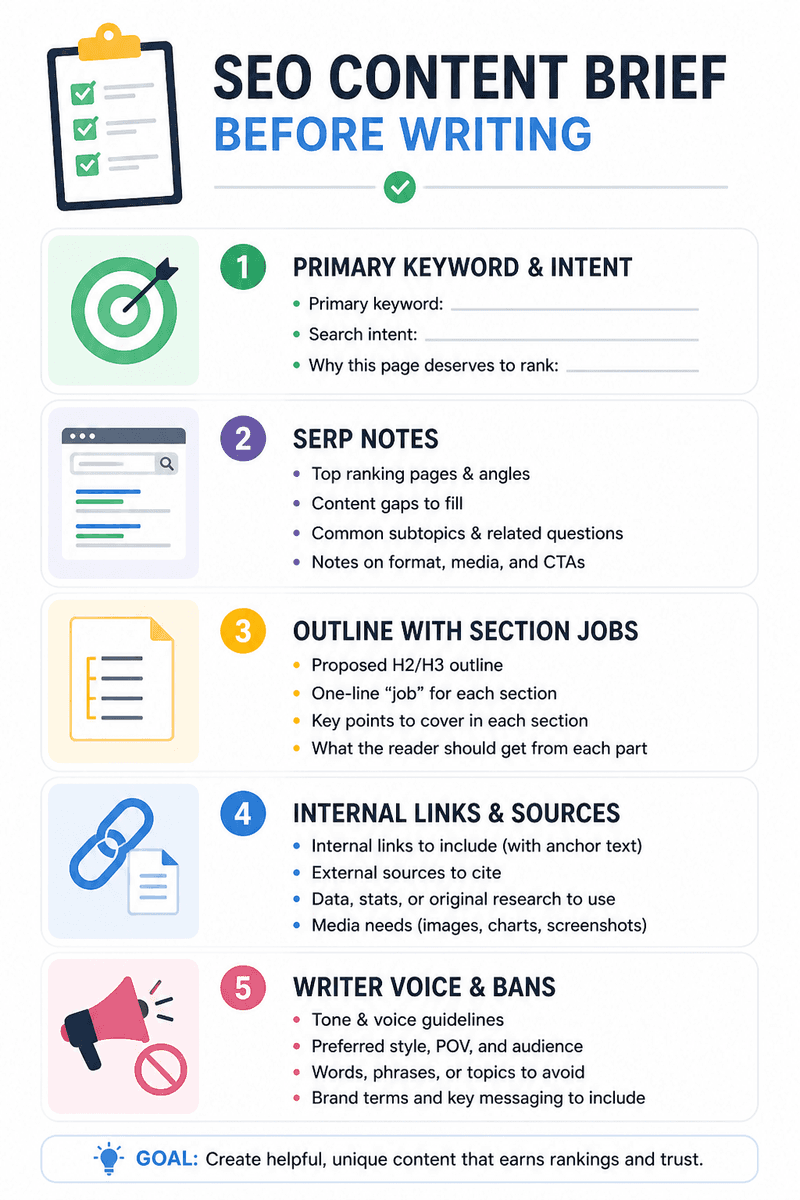
The structure is similar, but the emphasis changes. A blog post needs search intent, a useful outline, and examples. A SaaS page needs positioning, objections, features, and conversion intent. An ecommerce page needs product coverage, filters, buyer concerns, and internal links.
Below are three practical SEO content brief examples you can adapt.
If you want a reusable framework first, start with this SEO content brief template. If you already know the topic and want to generate a brief quickly, use Junia’s SEO content brief generator.
Example 1: Blog post brief
| Brief field | Blog post example |
|---|---|
| Primary keyword | content brief template |
| Intent | Informational / how-to |
| Angle | Show a filled brief, not just definitions |
| Must-include | Outline with section jobs + SERP notes |
| Internal links | Link to template page + related SEO guides |
Let’s say the article is about choosing long-tail keywords.
Page basics
| Field | Example |
|---|---|
| Working title | Long-Tail vs Short-Tail Keywords: Which Should You Target First? |
| Content type | Educational blog post |
| Primary keyword | long-tail vs short-tail keywords |
| Secondary keywords | long-tail keywords, short-tail keywords, keyword strategy |
| Search intent | Informational |
| Target reader | Marketers and site owners planning SEO content |
Article angle
Quick read: A brief that only lists keywords is a keyword sheet. A brief that names the SERP gap and the section jobs is something a writer can ship from.
Help readers understand when to use broad keywords and when to use specific long-tail keywords. The article should make the tradeoff clear: short-tail keywords can bring more search volume, but long-tail keywords often convert better and are easier to rank for.
Recommended outline
## What short-tail keywords are
Define short-tail keywords and give simple examples.

## What long-tail keywords are
Explain how long-tail keywords work and why they often show clearer intent.

## The real difference: traffic vs intent
Compare volume, difficulty, conversion potential, and content depth.

## When to target each type
Give practical scenarios for new sites, established brands, product pages, and blog posts.

## How to build a balanced keyword strategy
Show how to use both types inside a topic cluster.
Internal links
- Link to an AI keyword research tool in the section about finding keyword ideas.
- Link to a content clustering guide in the section about building a balanced strategy.
- Link to a blog writing guide when explaining how keyword choices affect the final article.
This kind of brief works because it gives the writer a clear teaching job. It does not just say “write about keywords.”
Example 2: SaaS content brief
Now imagine you are creating a comparison or solution page for a SaaS product.
Page basics
| Field | Example |
|---|---|
| Working title | AI Writing Software for Marketing Teams |
| Content type | SaaS solution page |
| Primary keyword | AI writing software |
| Secondary keywords | AI writing tool, AI content software, AI blog writer |
| Search intent | Commercial investigation |
| Target reader | Marketing teams comparing tools |
Article angle
Show how the product helps marketing teams move from idea to draft faster while keeping control over brand voice, SEO structure, and editing quality.
Recommended outline
## What AI writing software should actually help with
Explain the real workflow: research, outlining, drafting, editing, and optimization.

## Key features to look for
Cover SEO briefs, brand voice, long-form drafting, collaboration, and optimization.

## Where AI writing tools still need human review
Explain accuracy, originality, tone, and examples.

## How Junia helps teams create SEO content faster
Connect features to practical team workflows.

## Best use cases
List blog posts, landing pages, product descriptions, and content refreshes.
Internal links
- Link to the AI article writer where the page discusses moving from brief to draft.
- Link to SEO optimization tools where the page discusses improving a finished draft.
- Link to brand voice resources where the page discusses consistency.
SaaS briefs need more than keywords. They should tell the writer what objections to answer, what outcomes to highlight, and how the page should move readers toward action.
Example 3: Ecommerce content brief
Ecommerce SEO briefs need to balance rankings with buying decisions.
For example, let’s say the page is a category guide for ergonomic office chairs.
Page basics
| Field | Example |
|---|---|
| Working title | Best Ergonomic Office Chairs for Long Workdays |
| Content type | Ecommerce category guide |
| Primary keyword | best ergonomic office chairs |
| Secondary keywords | ergonomic desk chair, office chair for back pain, adjustable office chair |
| Search intent | Commercial |
| Target reader | Buyers comparing chair options |
Article angle
Help readers choose the right chair by explaining what matters: lumbar support, adjustability, seat depth, material, warranty, and fit for different work setups.
Recommended outline
## What makes an office chair ergonomic
Explain the core features in plain language.

## Best ergonomic office chairs by use case
Group recommendations by budget, back support, long hours, and small spaces.

## How to choose the right chair
Cover fit, adjustability, materials, and return policy.

## Common mistakes when buying office chairs
Warn against choosing only by looks, price, or vague comfort claims.

## FAQ
Answer practical buying questions.
Internal links
- Link to related category pages.
- Link to buying guides for desks, monitors, or home office setups.
- Link to product pages only where they match the use case.
For ecommerce, the brief should help the writer support a buying decision, not just describe the product category.
What all good brief examples have in common
Strong SEO content briefs usually include the same core pieces:
- one clear primary keyword
- a specific search intent
- a practical article angle
- a useful outline with section notes
- internal links with placement guidance
- instructions on examples, tone, and claims
- a final quality checklist
The details change by page type, but the job is always the same: help the writer create a page that satisfies the reader better than the current search results.
After the draft is finished, run it through an SEO improver or an editorial pass to check headings, keyword usage, internal links, and readability before publishing.
Final thoughts
The best way to learn briefs is to compare examples across different page types.
A blog brief teaches. A SaaS brief positions and persuades. An ecommerce brief helps people choose. Once you understand that difference, your briefs become much more useful to writers and much more likely to produce content that ranks.