
SEO Content Brief Template: What to Include Before Writing

Thu
AI SEO Specialist, Full Stack Developer

| Field | What to write | Example |
|---|---|---|
| Page basics | URL, type, primary KW | /blog/seo-content-brief-template |
| Article angle | Why this page wins | Filled template + SERP notes |
| SERP notes | What ranks + gaps | Guides lack examples |
| Outline | H2 jobs | Template → example → mistakes |
| Writer instructions | Voice, bans, proof | No fluff; include table |
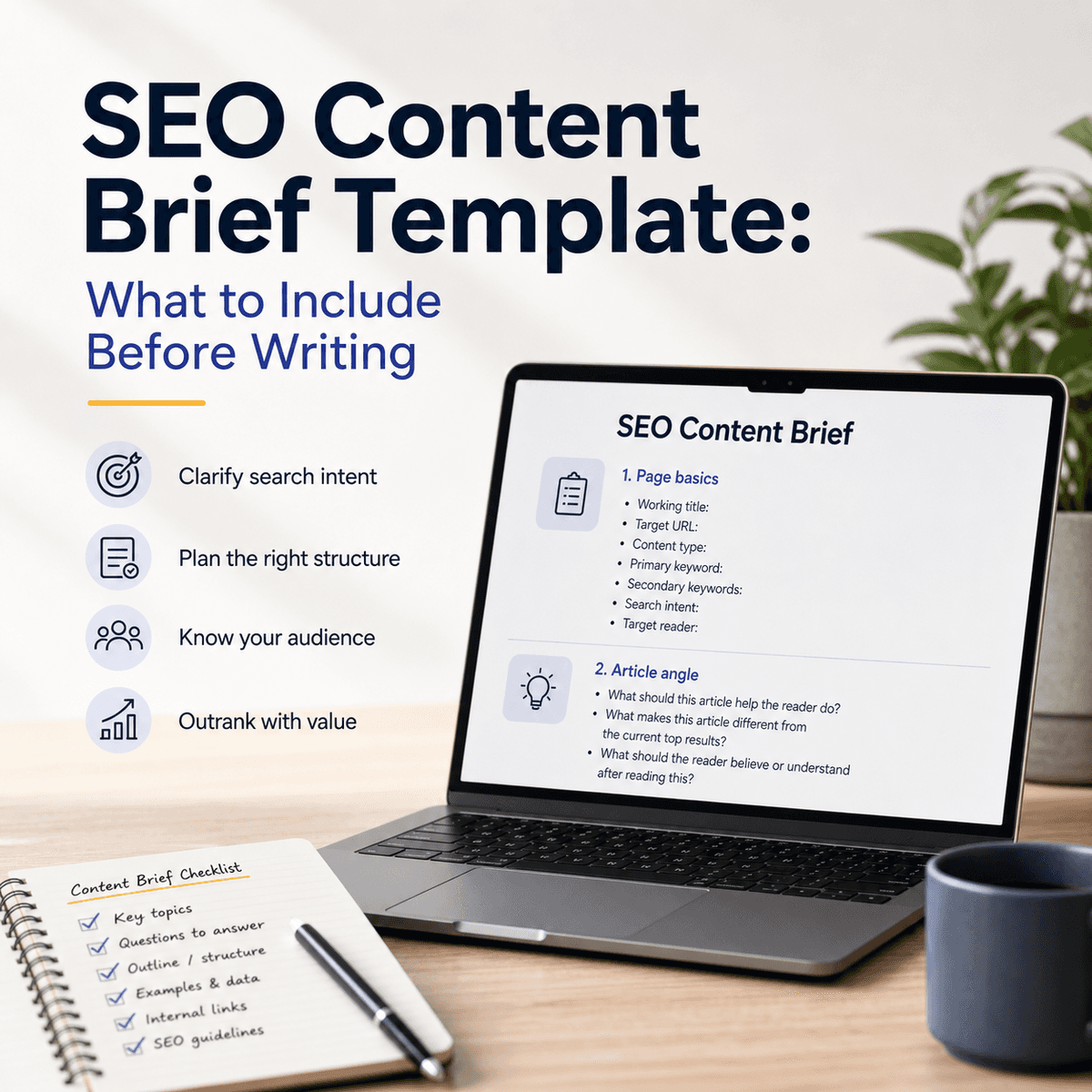
A good SEO content brief template should make planning faster, not turn the article into a form-filling exercise.
The goal is simple: give the writer enough context to understand the search intent, structure the article properly, include the right details, and avoid the usual SEO mistakes before the draft begins.
You can build the brief manually with the template below, or use an SEO content brief generator if you want to create the first version faster.
SEO content brief template
Use this as a practical starting point.
# SEO Content Brief

## 1. Page basics
- Working title:
- Target URL:
- Content type:
- Primary keyword:
- Secondary keywords:
- Search intent:
- Target reader:

## 2. Article angle
- What should this article help the reader do?
- What makes this article different from the current top results?
- What should the reader believe or understand by the end?

## 3. SERP notes
- Common ranking formats:
- Recurring subtopics:
- Questions people ask:
- Gaps in existing results:
- Examples worth including:

## 4. Recommended outline
- H1:
- H2:
  - Notes:
- H2:
  - Notes:
- H2:
  - Notes:

## 5. Internal links
- URL:
- Anchor:
- Placement idea:
- Reason:

## 6. External sources
- Source:
- What it supports:

## 7. Writer instructions

**Hand-off checklist**

- [ ] Primary keyword + intent set
- [ ] SERP notes filled (not “TBD”)
- [ ] Outline has section jobs
- [ ] Internal + external sources listed
- [ ] Voice / bans written for the writer

- Tone:
- Formatting:
- Examples to include:
- Claims to avoid:
- CTA or next step:

## 8. Final checklist
- Intent is clear
- Outline covers the topic fully
- Keywords fit naturally
- Links are relevant
- Draft adds something useful beyond the SERP
1. Page basics
Start with the simple information the writer needs before thinking about the draft.
This includes the working title, target URL, content type, primary keyword, secondary keywords, search intent, and target reader.
Do not overload this section. If the keyword list has 40 phrases, the writer will not know what matters. Pick one primary keyword and a few supporting terms that match the same intent.
If you are still deciding between keywords, do that research first. A tool like Junia’s AI keyword research tool can help you find long-tail variations and intent patterns before you turn the topic into a brief.
2. Article angle
The angle explains what the article is really trying to do.
For example, an article about content briefs could be:
- a beginner definition
- a step-by-step workflow
- a reusable template
- a set of examples
- a guide for briefing AI tools
Those are different articles, even if they share similar keywords.
If you are not sure how the angle should work, read a deeper guide on how to create an SEO content brief before filling out the template.
3. SERP notes
SERP notes help the writer understand what already ranks and what the article needs to beat.
Include the patterns that matter:
- Are the top results mostly templates, guides, tools, or examples?
- Do they use numbered steps?
- Do they include screenshots or tables?
- What questions appear repeatedly?
- What is missing or poorly explained?
This section should not tell the writer to copy competitors. It should show the baseline, then point out where the article can be more useful.
4. Recommended outline
The outline is where the brief becomes useful.
Write the H2s and H3s, but also add notes under each main section. A heading alone is often too vague.
For example:
## Identify search intent
Explain how to read the current SERP and decide whether the reader wants a guide, template, tool, or example.
That is much better than simply writing:
## Search Intent
The writer should know what each section needs to accomplish.
5. Internal links
Internal links should be planned before drafting, not sprinkled in at the end.
For each internal link, include the destination, anchor, placement idea, and reason. That helps the writer place links where they support the reader.
For example, a planning article could link to how to write a blog post when the brief moves from outline to drafting. An examples article could link to SEO content brief examples when readers need to see completed versions of the template.
6. External sources
Not every article needs a long source list, but factual claims should have support.
Use external sources for:
- industry data
- platform documentation
- search engine guidance
- definitions that need authority
- claims about user behavior or ranking factors
Do not add sources just to look credible. Add them when they help the writer avoid vague or unsupported claims.
7. Writer instructions
This section is where you protect the article from sounding generic.
Useful writer instructions include:
- Write short paragraphs.
- Explain the main idea before adding exceptions.
- Use practical examples instead of broad claims.
- Avoid keyword stuffing.
- Keep the introduction direct.
- Mention tools only where they naturally help the workflow.
If you want a specific voice, add a short style note. If you have brand rules, add them here too.
8. Final checklist
End the brief with a checklist the writer or editor can use before publishing.
Keep it short:
- The search intent is clear.
- The outline covers the topic without drifting.
- The primary keyword appears naturally in the title, intro, and body.
- Internal links support the reader.
- The draft includes examples where needed.
- The article gives the reader a useful next step.
Final thoughts
The best content brief template is not the longest one. It is the one writers actually use.
Start with the basics, define the angle, study the SERP, build a clear outline, and add link and style guidance before the draft begins. That gives the writer a real plan instead of a pile of SEO notes.