
Story vs Novel vs Flash Fiction: The Practical Difference

Thu
AI SEO Specialist, Full Stack Developer

A story, a novel, and flash fiction can all be fiction, but they do different jobs. I find this distinction useful because many draft problems are not really "writing problems" at first. They are form problems.
The fastest way to separate them is this:
| Form | Typical length | Best for | What readers expect |
|---|---|---|---|
| Flash fiction | Usually under 1,000 words, sometimes up to 1,500 | One charged moment, image, turn, or reveal | Compression, implication, and a strong landing |
| Short story | Usually 1,000 to 7,500 words | One central conflict with a complete arc | A focused beginning, middle, and end |
| Novel | 40,000+ words | Layered plot, subplots, world-building, and long character change | Immersion, development, and payoff over time |
That is the cheat sheet. But the real difference is not only word count. Length changes how much plot you can carry, how many characters you can develop, how much exposition you can afford, and how hard each sentence has to work.
When I am deciding what shape an idea wants, I start with the size of the emotional movement. One sharp reversal may be flash fiction. One conflict with a clear consequence may be a short story. A premise that needs time, scenes, subplots, and change across a wider cast probably wants to become a novel.
The Short Answer
Word count is a fence, not a genre. Pick the form by how many turns and cast members the idea needs — then cut or expand to fit.
A story is the broadest term. It simply means a narrative: something happens to someone, and the reader feels a change by the end.
A short story is a complete story in a compact form. It usually focuses on one main character, one main conflict, and one meaningful shift. You still need structure, tension, and an ending, but you do not have room for every backstory, subplot, or side character that a novel can hold. In practice, that limit is often a strength. It forces the writer to choose what actually matters.
A novel is a long work of fiction. Most award and publishing categories treat 40,000 words as the lower edge of novel length. The Nebula Awards rules define a novel as 40,000 words or more, and the Hugo Awards categories use the same threshold for science fiction and fantasy. Many commercial novels are much longer, especially in genres that need heavy world-building.
Flash fiction is a complete story told in miniature. Many writers and editors use 1,000 words as the common ceiling, though some markets stretch the form to 1,500 words. For example, SmokeLong Quarterly's guidelines publish flash narratives up to 1,000 words.
So, if you are asking "story vs novel vs flash fiction," the cleanest answer is:
- Flash fiction gives you one concentrated impact.
- A short story gives you one full arc.
- A novel gives you a larger world and deeper development.
Word Count Ranges Are Useful, But Not Absolute
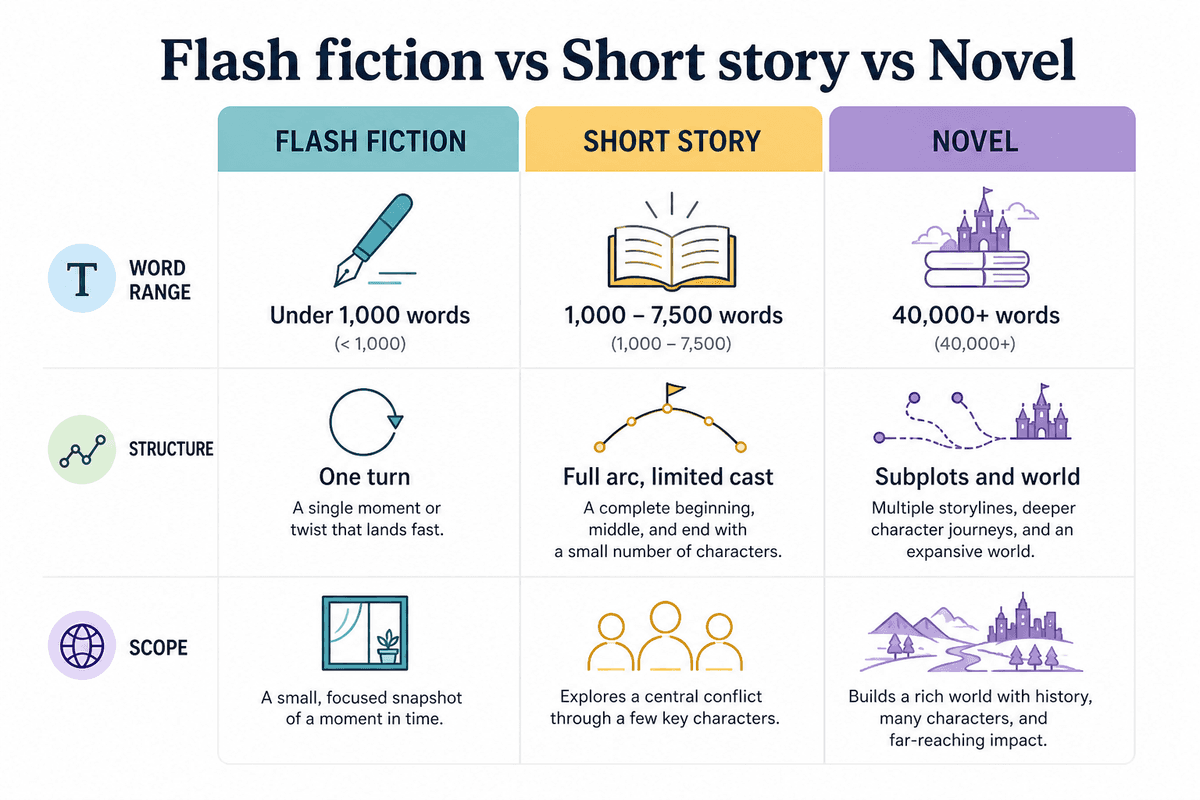
Short story vs novella vs novel — practical differences
| Form | Typical range | What it can hold |
|---|---|---|
| Flash | under ~1,000 | One turn / one image |
| Short story | ~1,000–7,500 | Arc, limited cast |
| Novel | ~40k+ | Subplots, sustained world |
Word count helps, especially when you are submitting to magazines, awards, competitions, or publishers. Still, fiction categories are not perfectly universal. A literary magazine may accept a 6,000-word short story. Another may cap short fiction at 4,000 words. A flash competition may ask for 500 words, 300 words, or exactly 100 words.
Here is the practical range most writers can use:
| Category | Common range | Notes |
|---|---|---|
| Microfiction | Under 300 words | Often built around one image, line, implication, or reversal |
| Flash fiction | Under 1,000 words | Some publications accept up to 1,500 words |
| Short story | 1,000 to 7,500 words | A common award boundary; many magazines prefer 3,000 to 6,000 words |
| Novelette | 7,500 to 17,500 words | Used often in speculative fiction award categories |
| Novella | 17,500 to 40,000 words | Longer than a short story, usually tighter than a novel |
| Novel | 40,000+ words | Many commercial novels land closer to 70,000 to 100,000 words |
The Nebula and Hugo categories are useful evidence here because they give clean public thresholds: short story under 7,500 words, novelette from 7,500 to 17,500, novella from 17,500 to 40,000, and novel at 40,000 or more.
But those thresholds do not solve every writing decision. A 900-word piece can still feel unfinished if it only describes a mood. A 6,000-word piece can feel padded if the conflict only needs one scene. I would treat the numbers as submission rules, not creative instructions. The better question is not "How long should this be?" It is "How much space does this idea honestly need?"
What Flash Fiction Can Do
Flash fiction works best when the story is small in size but not small in effect.
You might only show one conversation, one discovery, one strange image, or one final choice. The rest of the story is implied. The reader fills in the history from details you choose carefully. Personally, I like flash most when it trusts the reader enough to leave a little ache in the white space.
For example:
- A daughter deletes one voicemail from her father.
- A retired astronaut sees a new star that should not exist.
- A couple argues over a chair they both secretly want to keep.
- A title reveals the missing context before the first sentence begins.
That last point matters. In flash fiction, the title can do real narrative work. It can establish setting, stakes, speaker, irony, or backstory before the piece begins. In a novel, a title can be suggestive. In flash, it may need to carry weight.
Good flash fiction usually has:
- a narrow frame
- very few characters
- little or no exposition
- language that earns its place
- a clear shift, even if the ending is open
- a "landing" that feels intentional rather than simply stopped
The landing does not have to be a twist. It can be a turn in understanding, a final image, a line that reorders the whole piece, or a quiet emotional click. What matters is that the reader feels the piece arrive somewhere.
Flash fiction is also not a shortcut for writers who cannot write longer work. In many ways, it is less forgiving. I have seen 500-word drafts collapse because one vague sentence took up too much oxygen. A weak sentence is easier to hide in a novel than in a 500-word story.
What Short Stories Can Do
A short story gives you more room than flash fiction, but it still rewards focus.
Most strong short stories are built around one pressure point. A character wants something, avoids something, learns something, loses something, or finally understands something. The story does not need to explain the whole life. It only needs to show the slice where the important change happens.
Compared with flash fiction, a short story can usually support:
- a fuller opening situation
- a clearer sequence of events
- a few scenes instead of one compressed moment
- more dialogue and interiority
- a secondary character with real weight
- a more visible beginning, middle, and end
Compared with a novel, though, a short story has to stay disciplined. If you add three subplots, five major characters, and a full invented political system, the story will either collapse or start asking to become something longer.
This is where many early drafts go wrong. The idea may not be bad. It may simply be in the wrong container. When I read a short story draft that keeps explaining the world around the conflict, my first question is usually whether the writer is fighting the form.
If your draft keeps needing extra chapters of explanation, it may not be a short story. If cutting it down makes it sharper, it probably is.
For help building that focused arc, start with how to write a story and the basic elements of a story. Those fundamentals matter more in short fiction because there is less room to recover from a weak setup.
What Novels Can Do
A novel earns its length by giving the reader sustained development.
That can mean a larger plot, but it can also mean deeper psychological movement. A quiet literary novel may not have explosions or a huge external plot, but it still needs enough complexity to justify the long form. My bias is simple: if the added pages do not deepen pressure, choice, or consequence, they are probably decoration.
Novels can handle:
- multiple plotlines
- larger casts
- long character arcs
- changing settings
- layered themes
- world-building
- backstory that unfolds gradually
- consequences that ripple across time
This is why many fantasy, science fiction, mystery, romance, historical, and family-saga ideas naturally become novels. The reader needs time to learn the world, track relationships, understand stakes, and feel the payoff.
But longer does not automatically mean better. A novel that only has one small incident stretched across 80,000 words will feel thin. A short story idea can become a novel only if expansion adds meaningful pressure, not just more pages.
Before committing to a novel, ask:
- Does the protagonist change in stages?
- Are there consequences that cannot be shown in one scene?
- Do secondary characters affect the outcome?
- Would subplots deepen the main conflict?
- Does the world need gradual discovery?
If the answer is yes to several of those, the idea may need novel-length space. If not, a short story or flash piece may hit harder. Shorter is not less ambitious when it is the right fit.
If you are still searching for a premise big enough to carry a book, a book idea generator, book title generator, or writing prompt generator can help you test angles before you commit months to a draft.
Same Idea, Three Different Forms
The easiest way to understand the difference is to put one premise into all three containers. I use this test whenever a premise feels promising but shapeless.
Premise: A woman finds a letter from her mother that was hidden for twenty years.
| Form | How it might work |
|---|---|
| Flash fiction | She finds the letter, reads one line, and makes one irreversible choice. The mother's whole history is implied through a few details. |
| Short story | She finds the letter, confronts a sibling or parent, and realizes the family story she believed was incomplete. The arc resolves around one relationship. |
| Novel | The letter opens a larger family mystery across timelines, places, secrets, and multiple characters. The discovery changes several lives, not just one scene. |
The premise is the same. The scale is different. That difference matters more than the label.
Flash fiction asks: What is the single most powerful moment?
Short fiction asks: What is the central conflict and change?
A novel asks: What larger pattern of consequences is worth following?
That is usually a better guide than word count alone.
Structure Changes With Length
Fiction forms do not just get longer. Their structure changes.
In flash fiction, you often enter late and leave early. The reader does not need the full setup if one detail can imply it. A line of dialogue, an object, or a repeated image can do the work of a paragraph.
In a short story, you can usually afford setup, escalation, and resolution, but each piece still has to pull its weight. A short story can have scenes. It can have turns. It can give the reader enough grounding to understand what is at stake.
In a novel, structure becomes an endurance problem. You need movement across chapters, not just one clean arc. A novel usually needs smaller arcs inside the larger arc: chapter turns, act breaks, reversals, midpoint pressure, and consequences that accumulate.
Here is a simple structure comparison:
| Craft element | Flash fiction | Short story | Novel |
|---|---|---|---|
| Opening | Often begins close to the turn | Establishes character, tension, and situation quickly | Builds world, voice, conflict, and reader investment |
| Plot | One shift or compressed arc | One main arc | Main arc plus subplots and staged reversals |
| Character | Revealed through implication | Developed through selected scenes | Developed over many scenes and decisions |
| Backstory | Mostly implied | Used sparingly | Can unfold gradually |
| Ending | A landing, turn, image, or realization | Resolution or meaningful change | Payoff for major and minor threads |
This is why a flash fiction piece can sometimes feel closer to poetry than to a miniature novel. It still tells a story, but compression changes the mechanics. The mistake is treating flash as a shrunken novel instead of its own form.
Language Gets Tighter As The Form Gets Shorter
The shorter the form, the more each sentence matters.
Flash fiction has little room for throat-clearing. You cannot spend 200 words describing weather unless the weather is doing serious story work. Description, dialogue, title, image, rhythm, and white space all have to help carry meaning.
Short stories give you more room for texture, but not unlimited room. A beautiful paragraph still has to serve the piece.
Novels can breathe more. They can slow down for atmosphere, deepen a setting, build a metaphor across chapters, or let a character think through something complicated. Even then, good novels still need pressure. Length is not permission to wander.
A useful editing test I come back to:
- In flash fiction, ask: "Can one sharper detail replace this explanation?"
- In a short story, ask: "Does this scene change the pressure?"
- In a novel, ask: "Does this chapter move the book's larger promise forward?"
If the answer is no, the form is telling you what to cut. That is usually more useful than asking whether the draft is "good" in the abstract.
How To Choose The Right Form
Use the form that gives the idea enough room, but not more than it needs. This sounds obvious, but it is the decision writers skip when they fall in love with a premise too early.
Choose flash fiction when:
- the idea is built around one moment, reversal, or image
- the reader can infer most of the backstory
- the title can help carry context
- a longer version would weaken the impact
- you want to practice compression and precision
Choose a short story when:
- the idea needs a full arc but not a full book
- one conflict matters more than a whole world
- the emotional payoff can happen within a few scenes
- the cast is small
- the ending depends on one meaningful change
Choose a novel when:
- the premise needs multiple stages
- the protagonist changes over time
- subplots would strengthen the main story
- the world, history, or relationships need room
- the payoff depends on accumulated consequences
If you are drafting and unsure, write the smallest honest version first. Many good novels begin as short pieces, and many bloated drafts become stronger when reduced to the real center of the story. I would rather see a writer expand from a sharp center than trim a swollen draft that never knew what it wanted to be.
You can also study story examples by genre to see how different genres scale their ideas. A horror flash piece may rely on one final image. A mystery short story may rely on one clue and reversal. A fantasy novel may need a whole system of rules before the central conflict can fully work.
Common Mistakes When Writers Pick The Wrong Form
The wrong format usually shows up in the draft before the writer admits it.
Here are the signs:
| Problem | What it usually means | Better move |
|---|---|---|
| The flash piece needs paragraphs of explanation | The idea may be too large for flash | Expand it into a short story |
| The short story has too many named characters | The focus is spreading | Cut the cast or move toward a novella/novel |
| The novel has one thin conflict | The premise may not sustain long form | Compress it into a short story |
| The ending feels abrupt | The story stopped instead of landed | Add a clearer turn, consequence, or final image |
| The draft feels padded | The form is larger than the idea | Cut until the strongest shape appears |
One practical rule: if expansion only adds explanation, do not expand. If expansion adds pressure, consequence, contrast, or transformation, the idea may deserve more room. That distinction has saved me from trying to turn perfectly good short pieces into tired longer ones.
For revision help, these story-writing mistakes are worth checking before you decide the form is the problem. Sometimes the issue is not length. Sometimes the conflict, stakes, or ending just needs sharper handling.
Where AI Tools Can Help
AI tools are most useful here when you use them to test scale, not to replace judgment. I would not let a tool decide the form for you, but I do think it can expose whether an idea has natural room to grow.
You can use a story generator to explore a premise in multiple forms: first as a 300-word flash piece, then as a 3,000-word short story outline, then as a novel synopsis. The point is not to keep the first output. The point is to see which version creates the most natural pressure.
You can also use a dialogue generator or monologue generator to test whether a conflict works in a compressed scene. If the scene already carries enough tension by itself, it may suit flash fiction or a short story. If the scene keeps raising bigger questions, it may belong inside a novel.
For longer work, tools like a chapter generator or manuscript generator can help structure early drafts, but the core decision remains yours: does the story need length, or does it need focus? In my experience, that question catches more problems than another outline pass.
Final Takeaway
The difference between a story, a novel, and flash fiction is partly word count, but mostly narrative scale.
Flash fiction is not just a short story with fewer words. It relies on compression, implication, title work, and a strong landing.
A short story is not a failed novel. It is a focused form built around one central conflict or change.
A novel is not automatically deeper because it is longer. It earns its length when the idea needs development across scenes, characters, subplots, and consequences.
So choose the form by asking one question: What is the smallest shape that can hold the whole emotional truth of this idea?
I like that question because it keeps ambition and discipline in the same room. The answer will usually tell you whether you are writing flash fiction, a short story, or a novel.