
Creative Writing Tips for Beginners: Write Your First Story This Week

Thu
AI SEO Specialist, Full Stack Developer

Creative writing gets easier when you stop treating it like a talent test. I think beginners lose the most time trying to sound like "real writers" before they have learned how to finish a small piece.
If you are a beginner, your first job is not to write a perfect short story, poem, chapter, or script. Your first job is to finish something small enough that you can actually revise it. That might be one scene, one page, one character monologue, or a 700-word story with a beginning, middle, and end.
I would start there. Not with a novel. Not with a ten-part fantasy world. Not with a notebook full of rules. Start with one character who wants something, one obstacle, and one scene that changes by the end.
TL;DR: The Beginner Creative Writing Plan
If you only remember one thing from this guide, remember this: creative writing improves through finished drafts, not perfect intentions.
| Step | What to do | Why it helps |
|---|---|---|
| 1. Read like a writer | Pick one short story, chapter, poem, or scene and notice how it starts, moves, and ends. | You begin to see structure instead of only admiring the finished piece. |
| 2. Choose a small idea | Use a memory, prompt, overheard line, or "what if" question. | Small ideas are easier to finish than huge concepts. |
| 3. Give the character a want | Make someone want something specific right now. | Desire gives the story direction. |
| 4. Add friction | Put a person, fear, secret, deadline, or mistake in the way. | Conflict keeps the scene from becoming a diary entry. |
| 5. Write a messy draft | Finish the scene before polishing the sentences. | You cannot revise a story that does not exist yet. |
| 6. Revise for clarity | Cut slow openings, vague description, flat dialogue, and repeated words. | Revision turns raw material into a readable piece. |
| 7. Get one useful response | Ask a reader where they felt curious, confused, or bored. | Specific feedback is easier to use than general praise. |
That is enough to begin. In my experience, this plain sequence works better than waiting for a perfect idea, because it gives you something to revise by the end of the week.
What Creative Writing Actually Means
Creative writing is writing that uses imagination, voice, scene, image, rhythm, character, or story to create an experience for the reader. It includes fiction, poetry, memoir, personal essays, scripts, plays, and hybrid forms that do not fit neatly into one box.
The format matters less than the effect.
A short story might make the reader worry about a character. A poem might compress grief into a few sharp images. A memoir scene might turn one family dinner into a moment that explains a whole relationship. A script might reveal a character through what they refuse to say.
That is why beginner creative writing advice can feel contradictory. Some writers tell you to plan. Some tell you to follow the sentence. Some say to write every day. Some say to live more and write from that. I would treat all of that as advice, not law. The useful version is simpler: learn the craft, keep your voice alive, and finish small pieces often enough to improve.
Start With One Scene, Not Your Whole Dream Project
Most beginners make the same mistake: they start with the biggest idea they have.
I get the impulse. A novel, memoir, or screenplay feels exciting because it gives your imagination a large room to run around in. But a huge project also gives you more ways to stall. You can spend weeks naming characters, drawing maps, choosing themes, or researching historical details before you have written one real scene.
For a first creative writing exercise, choose a scene you can finish in one sitting. I like this constraint because it forces useful decisions: one person, one pressure point, one change.
Use this simple frame:
| Scene part | Beginner question | Example |
|---|---|---|
| Character | Who is this about? | A teenager working the closing shift at a grocery store. |
| Want | What do they want right now? | They want to leave early for an audition. |
| Obstacle | What gets in the way? | Their manager finds a wallet full of cash and asks them to help track the owner. |
| Pressure | Why does it matter now? | The audition starts in 25 minutes. |
| Change | What is different by the end? | They miss the audition but learn something about what they actually want. |
This is enough story fuel. You do not need a full outline yet, and honestly, a full outline can become a hiding place when you are new.
If you want a quick spark, a story generator can help you get a premise on the page, but do not let the tool make every decision for you. Change the details until the idea feels specific to your taste.
Read More Than You Write, But Read Actively
Every strong writer reads. That advice is everywhere because it is true, but it is also incomplete.
Reading alone does not automatically make you better. You need to read with a little pressure on the page. When I read for craft, I try to notice the moment my attention changes: where I leaned in, where I skimmed, and what the writer did right before that happened.
When a story holds your attention, ask:
- Where did I first become curious?
- What does the main character want?
- How soon does conflict appear?
- Which detail made the place feel real?
- Where did the writer skip time instead of describing everything?
- How did the ending change the meaning of the beginning?
If you are writing fiction, read short stories and novels in the genre you want to write. If you are writing memoir, read essays and memoir chapters. If you are writing poems, read poems out loud so you can hear line breaks, rhythm, compression, and surprise.
Reading outside your genre helps too. A thriller can teach pace. A romance can teach emotional escalation. A poem can teach image and compression. A screenplay can teach dialogue and scene movement.
You are not copying. You are training your eye, which is slower than collecting tips but much more useful.
Write From Specifics, Not Big Feelings
Beginners often reach for big emotional labels: sad, angry, lonely, excited, heartbroken, scared.
Those words are not wrong, but they usually arrive too early. Readers feel more when you give them something concrete to notice. I would rather see one precise action than three sentences explaining the emotion behind it.
Instead of:
Maya was nervous before the interview.
Try:
Maya folded the same corner of her resume until the paper split, then smoothed it flat before anyone could see.
The second version does not announce the emotion. It lets the reader infer it through action.
Here is a quick way to practice:
| Emotion | Weak version | Stronger direction |
|---|---|---|
| Anger | He was furious. | What does he refuse to look at? What does he do too carefully? |
| Grief | She felt empty. | What ordinary habit suddenly feels impossible? |
| Jealousy | He was jealous. | What detail does he notice that no one else cares about? |
| Fear | They were terrified. | What sound, smell, or small movement makes the danger feel close? |
This is the practical heart of "show, don't tell." You are not banned from telling. Sometimes a clean summary is better than three paragraphs of description. But important moments usually deserve action, sensory detail, dialogue, or image.
Give Characters Something To Want
A character does not need to be heroic, likable, or dramatic. They do need some kind of want.
The want can be large:
- Win custody of a child.
- Escape a dangerous town.
- Get revenge.
- Save a family business.
It can also be small:
- Get through dinner without arguing.
- Return a borrowed jacket before anyone notices the stain.
- Ask for an apology.
- Hide a bad grade.
Small wants are often better for beginners because they fit naturally inside one scene. If a character wants something, the reader has a reason to keep reading. If something blocks that want, the scene starts to move.
Before writing, answer this in one sentence:
This is a story about someone who wants ___, but ___ gets in the way.
If you cannot fill in the blanks, the idea may still be too blurry.
For a deeper structural check, use the basic elements of a story: character, setting, conflict, plot, theme, and point of view. You do not need to master all of them at once, but you do need enough of them for the reader to feel oriented.
Choose A Point Of View Before You Draft
Point of view changes the whole feeling of a piece.
First person sounds immediate and intimate:
I knew the letter was from my sister before I opened it.
Third person limited gives you closeness with a little more distance:
Mara knew the letter was from her sister before she opened it.
Third person omniscient lets the narrator move more widely, but it is harder to control:
Mara knew the letter was from her sister. Across town, her sister was already regretting every word.
For most beginner fiction, I would choose either first person or third person limited. They are easier to manage because you are mostly staying inside one character's experience. Omniscient narration can be beautiful, but I have seen it overwhelm beginners because every paragraph creates a new choice about distance.
If you are unsure, write the same paragraph twice, once in first person and once in third person. One version will usually feel more alive.
Use Prompts Without Becoming Dependent On Them
Writing prompts are useful when the blank page feels too open. The best prompts give you a doorway, not a cage.
Try prompts like:
- A character finds a note meant for someone else.
- Two people are lying in the same conversation, but for different reasons.
- A childhood object appears in the wrong place.
- Someone gets exactly what they wanted and regrets it.
- A character hears their own name in a room where no one should know them.
If the prompt feels generic, add a constraint. Set it in a laundromat during a thunderstorm. Make the character late for something. Give them a secret they cannot explain. Make the story happen in real time.
A writing prompt generator is most useful when you treat the output as a rough matchstick. Strike it, then build your own fire. The prompt should get you moving, not decide what the piece means.
Build Scenes With Sensory Detail
A scene feels flat when it only tells the reader what happened.
To make it more vivid, add details from the body and the room. Not all five senses every time. That becomes heavy fast. Choose the one or two details that reveal the mood, character, or conflict.
| Sense | Weak detail | Better detail |
|---|---|---|
| Sight | The kitchen was messy. | A spoon had dried into a bowl of cereal beside three unopened bills. |
| Sound | It was noisy outside. | A bus sighed at the curb, and someone downstairs laughed too loudly. |
| Smell | The room smelled bad. | The room smelled like wet towels and old coffee. |
| Touch | She was cold. | Her fingers stuck to the metal railing. |
| Taste | The tea was bitter. | The tea tasted like she had left the bag in out of spite. |
The goal is not decoration. The goal is meaning. Personally, I cut sensory details fastest when they only make the prose prettier; I keep them when they reveal pressure.
If a detail tells us something about the character, the relationship, the pressure, or the setting, keep it. If it only proves you can describe things, cut it.
Learn Dialogue By Cutting It Down
Real people ramble, repeat themselves, trail off, and talk around what they mean. Fictional dialogue should feel natural, but it cannot copy real speech exactly or the scene will drag.
A good dialogue scene usually has three layers:
- What the characters say.
- What they actually mean.
- What they are trying not to reveal.
Instead of writing:
"I am angry because you forgot my birthday," Lena said.
Try:
Lena looked at the grocery-store flowers in his hand. "They were out of the good ones?"
That line gives the reader more to do. We can hear the anger without being told to label it.
If dialogue is hard for you, draft the plain version first. Then rewrite it so the characters avoid saying the exact truth too directly. I find this easier than trying to write clever dialogue from the start. A dialogue generator can help you brainstorm exchanges, but the final lines should sound like your character, not like a perfectly balanced sample conversation.
Let The First Draft Be Uneven
Your first draft is not evidence that you are bad at writing. It is the raw material.
Almost every beginner needs to hear this because taste develops faster than skill. You may be able to tell that your draft is clumsy before you know how to fix it. That gap is normal. It is also uncomfortable.
The solution is not to wait until you feel ready. The solution is volume: write, finish, revise, and repeat. That can sound unromantic, but it is the part of writing that has helped me trust the process most.
That is why the most useful beginner advice often sounds plain. In one public r/writing discussion about tips for beginner writers, the strongest pattern was not perfectionism. It was momentum: keep writing, even when the draft is rough.
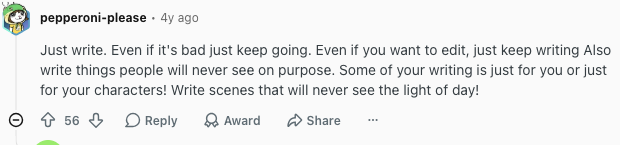
For your first draft, give yourself rules that protect momentum:
- Do not edit the opening until you reach the ending.
- Use brackets for missing details, like [name of town] or [better insult].
- If a sentence feels bad, move on anyway.
- If you get stuck, write the next visible action.
- Stop after a complete scene, not after a perfect sentence.
Finishing teaches you things that planning cannot.
Revise Big Problems Before Small Sentences
Revision is where the real writing happens, but beginners often revise in the wrong order. I have made this mistake too: fixing polished sentences in a scene that still starts too early or ends without a real turn.
| Pass | Fix these first | Leave for later |
|---|---|---|
| Story | Desire, conflict, stakes | Pretty sentences |
| Scene | Goal, obstacle, turn | Synonyms and adverbs |
| Line | Clarity and rhythm | Comma hunting |
Common mistake: Polishing line edits on a scene that still has no turn. That is rearranging furniture in a house without walls.
Stop Writing Boring Scenes -- Use this Secret 9-Step Formula
Do not start with commas. Start with the story.
The UNC Writing Center's guide to revising drafts makes the same broad point: step away from the draft, then return ready to look at the larger issues instead of only tinkering with small edits. That advice matters for creative writing too.
Use this order:
| Revision pass | What to check | Question to ask |
|---|---|---|
| Story | Character, want, conflict, change | Does something meaningful happen? |
| Scene | Opening, pacing, tension | Where does the scene really begin? |
| Clarity | Confusing actions or timeline jumps | Can a reader follow this without explanation? |
| Language | Repetition, weak verbs, vague images | Which words feel lazy or inflated? |
| Proofing | Grammar, punctuation, typos | Is the final version clean enough to share? |
Reading aloud helps in the last two passes. Cornell's writing center notes that reading a draft out loud can reveal awkward phrasing, long sentences, vague transitions, and missed opportunities. That is exactly why it works for stories and essays: your ear catches problems your eyes skip. If I stumble over a line twice, I usually rewrite it.
After that, a grammar checker can catch mechanical issues, but do not let it flatten your voice. Dialogue fragments, unusual rhythm, and sentence fragments can be intentional in creative work.
Get Feedback That You Can Actually Use
"What do you think?" is too broad.
Most people will either say "I liked it" or start rewriting the piece according to their own taste. Neither response helps much.
Ask focused questions:
- Where did you first feel interested?
- Where did your attention drop?
- Which character detail stayed with you?
- Was anything confusing?
- Did the ending feel earned?
- Which line felt strongest?
The National Writing Project's Bless, Press, Address feedback protocol is useful because it separates appreciation, questions, and suggestions. That keeps feedback from becoming a vague judgment of whether the piece is "good."
One strong reader is enough at the beginning. Later, a writing group can help you see patterns. If three readers are confused by the same moment, the draft probably needs work. If one reader dislikes your genre, that may not be a useful signal. Learn to separate useful discomfort from random preference.
Try Different Forms Before You Pick One
Creative writing is not only fiction.
If fiction feels intimidating, try a personal essay. If essays feel too exposed, try poetry. If poetry feels too compressed, try a script. The point is not to find the most impressive form. The point is to find the form that helps you keep writing.
Here is how different forms can teach different skills:
| Form | What it teaches |
|---|---|
| Short story | Character desire, conflict, scene, endings. |
| Flash fiction | Compression, implication, sharp images. |
| Poetry | Rhythm, line breaks, sound, metaphor. |
| Memoir | Memory, reflection, emotional honesty. |
| Screenplay | Dialogue, visual action, scene economy. |
| Monologue | Voice, subtext, character psychology. |
If you want to play across forms, try turning the same idea into a poem, a one-page story, and a short script. I like this exercise because it shows you what the idea is really asking for. A poem generator or screenplay scene generator can give you a starting shape, but the useful learning comes from comparing what each form reveals.
Build A Writing Routine You Can Keep
A writing routine should be boring enough to survive real life. That is my bias, at least: the routine that looks modest but repeats is usually better than the dramatic one that collapses after four days.
Do not start with a promise to write for three hours every morning if you have never written for three hours in a week. Start smaller:
- 15 minutes before work.
- 200 words after dinner.
- One scene every Saturday.
- Three prompt exercises a week.
- One revision pass every Sunday.
Consistency matters because it lowers the emotional cost of starting. If writing only happens when you feel inspired, every session becomes a referendum on whether you are a "real writer." That is exhausting.
Make the routine plain:
| If you have... | Do this |
|---|---|
| 10 minutes | Write one paragraph of description or dialogue. |
| 20 minutes | Draft one small scene beat. |
| 45 minutes | Finish a rough scene. |
| 1 hour | Revise one scene using the checklist above. |
The habit should help you return to the page, not punish you for having a life.
Use AI Carefully In Creative Writing
AI can help beginners brainstorm, outline, rephrase, and practice. It can also make your writing sound smoother and less like you.
Use it for support, not substitution. My rule is simple: AI can widen your options, but it should not replace your taste.
Good uses:
- Generate ten premise ideas when you feel blank.
- Ask for possible conflicts for a character.
- Create a list of setting details to choose from.
- Check grammar after your own revision.
- Ask for questions a reader might have after a scene.
Risky uses:
- Letting AI write the whole story before you have made any creative decisions.
- Accepting polished but generic description.
- Using dialogue that sounds too clean.
- Replacing revision with paraphrasing.
- Asking for "more emotional" writing without giving concrete context.
If you use a tool like Junia AI for brainstorming, keep control of the material. A book idea generator can help you find directions, and a chapter generator can help you think through sequence, but your taste still has to make the final call. The moment the draft sounds generically polished, slow down and make a more specific choice.
Common Beginner Mistakes To Avoid
The first mistake is waiting for confidence. Confidence usually comes after you have finished a few imperfect pieces, not before. I would not trust confidence as the starting signal; it is more often the reward.
The second mistake is opening too early. Many beginner drafts spend two pages waking the character up, looking in the mirror, thinking about life, or walking somewhere before the actual story starts. Cut to the first moment of pressure.
The third mistake is explaining emotion before dramatizing it. If the character is lonely, show what loneliness makes them do. Do they refresh a message thread? Save a seat for someone who is not coming? Leave the TV on for noise?
The fourth mistake is adding too many characters too soon. Readers need time to attach names to actions. Introduce people when they matter.
The fifth mistake is polishing one paragraph forever. A beautiful paragraph cannot save a scene with no movement.
The sixth mistake is ignoring revision patterns. If your drafts often have slow openings, flat endings, or confusing dialogue, keep a personal checklist. Junia's guide to common story writing mistakes can help you name those patterns before they become habits.
A 7-Day Creative Writing Challenge
If you want a practical way to begin, use this plan. It is intentionally small, because small is what makes it finishable.
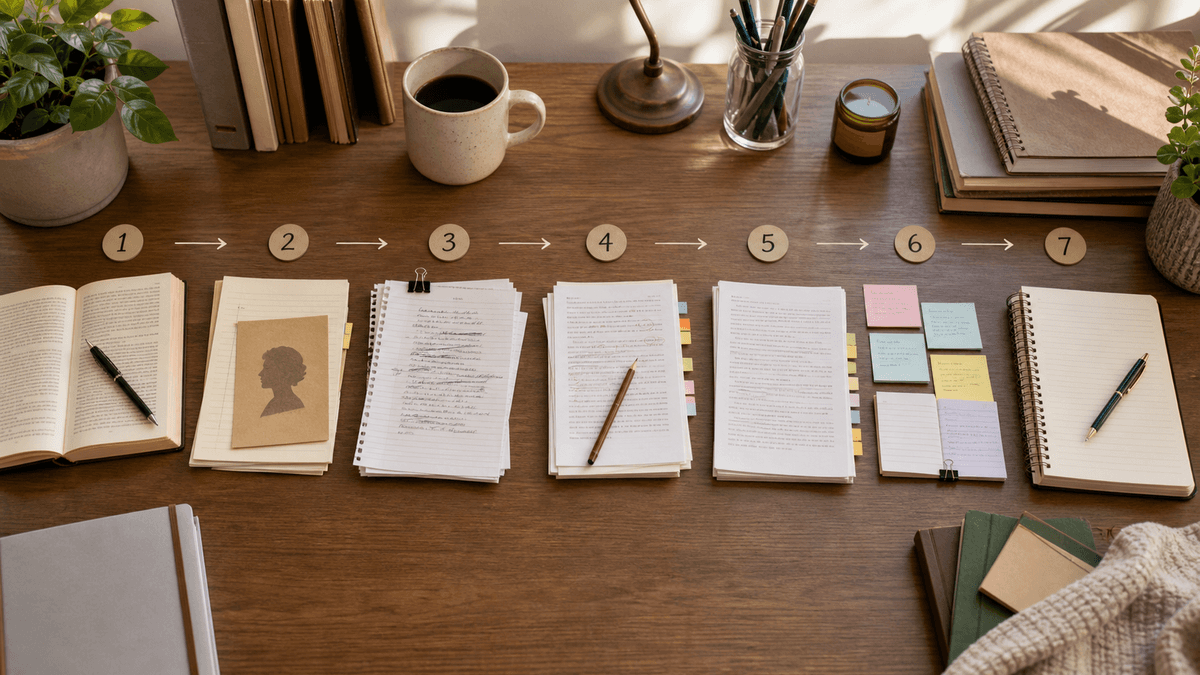
| Day | Task |
|---|---|
| Day 1 | Read one short story, essay, poem, or scene. Write down three craft choices you noticed. |
| Day 2 | Choose a prompt and create one character who wants something specific. |
| Day 3 | Draft a 500- to 800-word scene without editing the opening. |
| Day 4 | Let it rest. Read something in the same form you are trying to write. |
| Day 5 | Revise for story: want, obstacle, pressure, change. |
| Day 6 | Revise for language: cut weak openings, repeated words, vague description, and stiff dialogue. |
| Day 7 | Share it with one reader and ask three focused questions. |
At the end of the week, you will have something more valuable than an idea. You will have a finished draft and a process you can repeat. That repeatable process matters more than whether the first piece is good.
Final Advice
Creative writing is not about proving you were born with a gift. It is about paying attention, practicing craft, making choices, and staying with the work long enough to improve. I care less about whether a beginner has a dazzling first page and more about whether they can return to the page after it disappoints them.
Read widely. Write small things. Finish drafts. Revise the big problems first. Ask better questions when you get feedback. Keep the parts of writing that feel alive to you, because that is where your voice usually starts.
Your first story does not need to be brilliant. It needs to exist.