
How to Write a Short Story: A Practical Step-by-Step Guide

Thu
AI SEO Specialist, Full Stack Developer

If you want to write a short story, start smaller than you think.
Not with a whole world. Not with a family history. Not with a cast of twelve people and three timelines.
Start with one character, one pressure point, and one moment where something has to change.
That is the practical heart of short fiction. Dictionary.com defines a short story as a short fictional prose narrative. In plain terms: a short story has less room than a novel, so every choice has to matter more.
This guide walks you from blank page to finished draft: idea, character, conflict, outline, opening, dialogue, ending, and revision.
TL;DR
To write a short story, build it around one focused question:
Who wants something, what gets in the way, and what changes because of it?
Here is the full process:
| Step | What to Do | Why It Matters |
|---|---|---|
| 1. Choose a small idea | Pick one situation, image, question, or character | Keeps the story finishable |
| 2. Define the character | Give them a want, fear, flaw, or pressure | Gives the reader someone to follow |
| 3. Create conflict | Put a real obstacle in the way | Turns the premise into a story |
| 4. Add stakes | Decide what failure costs | Makes the reader care |
| 5. Pick POV and tone | Choose who tells the story and how close we are | Controls the reader's experience |
| 6. Outline 5-7 beats | Map the opening, trigger, attempts, turn, and ending | Prevents wandering |
| 7. Draft fast | Finish the rough version before polishing | Gives you material to revise |
| 8. Revise from big to small | Fix structure before sentences | Makes the final draft stronger |
If you only remember one thing, remember this: a story is not just something happening. A story is pressure on a character.
What Makes a Short Story Different?
A short story is not a tiny novel.
A novel can sprawl. It can carry subplots, side characters, slow world-building, and long stretches of backstory. A short story usually cannot. It works by compression.
That does not mean the story has to feel thin. It means you choose one angle and make it sharp.
For most beginners, a short story works best when it has:
- One main character
- One central conflict
- A small number of scenes
- A limited setting or time frame
- A clear emotional or dramatic turn
- An ending that lands soon after the decisive moment
Many short stories fall somewhere around 1,000 to 7,500 words, though flash fiction is shorter and some literary stories run longer. Word count matters less than focus. If the story needs six scenes, write six. If it only needs one conversation at a kitchen table, do not inflate it into a saga.
1. Choose an Idea Small Enough to Finish
Most weak short stories begin with an idea that is too large.
"A kingdom collapses."
"A family is cursed for generations."
"A detective uncovers a global conspiracy."
Those can become good fiction, but they are hard starting points for a short story. Narrow the camera.
Instead of "a kingdom collapses," try: a palace guard has ten minutes to decide whether to open the gate.
Instead of "a cursed family," try: a daughter finds the one object her mother told her never to touch.
Instead of "a global conspiracy," try: a detective notices one impossible detail in a witness statement.
The smaller version is stronger because it can be dramatized. Readers can see the choice, the obstacle, and the cost.
Good story ideas often come from:
- A strange image you cannot stop thinking about
- A memory with unresolved emotion
- A private fear
- A contradiction in a person
- A place that already feels tense
- A "what if?" question
- A small choice with big consequences
If you are stuck, a writing prompt generator can give you raw material. Just do not use the prompt as-is. Turn it into a situation with pressure.
| Generic Prompt | Stronger Story Premise |
|---|---|
| Write about a lost key | A landlord finds a key to an apartment that burned down years ago |
| Write about jealousy | A bridesmaid realizes she has been edited out of every photo |
| Write about a storm | A father and daughter get trapped in a car before an apology can happen |
| Write about a secret | A teacher recognizes a student's essay as a confession |
Notice the difference. The stronger premises already suggest character, conflict, and a question the reader wants answered.
2. Decide What Kind of Story You Are Writing
Before you outline, decide what kind of reading experience you want to create.
You do not need to lock yourself into a rigid genre, but a horror story, mystery, romance, literary story, and fantasy story all create pressure in different ways. Knowing the mode helps you choose the right conflict and ending.
| Story Type | Best For | Common Engine |
|---|---|---|
| Literary short story | Regret, relationships, moral tension, identity | Character pressure |
| Mystery | A clue, secret, disappearance, or hidden truth | Information gap |
| Horror | Fear, guilt, danger, dread, or the uncanny | Escalating threat |
| Romance | Attraction, misunderstanding, vulnerability, choice | Emotional risk |
| Science fiction | A technology, future rule, or strange possibility | Consequence of an idea |
| Fantasy | A magical rule, bargain, curse, or transformation | Wonder plus cost |
| Flash fiction | One turn, joke, image, reveal, or emotional hit | Compression |
Before choosing a direction, compare a few story examples by genre. The same basic elements behave differently in horror, romance, mystery, fantasy, and literary fiction, and seeing those differences makes it easier to choose the right pressure for your own draft.
You can also borrow a familiar pattern: a confession, a test, a homecoming, a rescue, a revenge attempt, a temptation, a bargain, or a reversal. The point is not to be formulaic. The point is to give the draft a pressure system.
3. Build the Five Core Elements
Every short story needs the same basic pieces: character, desire, conflict, stakes, and change.
Purdue OWL's fiction guidance connects plot, character, conflict, and theme closely. That matters because plot is not just a list of events. The events matter because they test a character and reveal meaning.
Character
Pick one main character. Two or three important characters is usually enough.
Do not write a full biography before you begin. You only need the details that matter inside this situation.
Ask:
- What does this person want right now?
- What are they afraid will happen?
- What would they rather avoid?
- What do they misunderstand?
- What behavior makes them feel specific?
"Maya is nervous" is thin. "Maya deletes every voice message before listening to it" is stronger because it shows nervousness through action.
If character, setting, plot, and theme still feel blurry, review the elements of a story before you draft. The goal is not to memorize labels. The goal is to make sure the parts are working together.
Desire
Your character should want something the reader can track.
It can be external:
- Get home before curfew
- Hide a mistake
- Win back a friend
- Return a stolen object
- Escape a room
- Tell the truth
Or internal:
- Be forgiven
- Feel brave
- Stop needing approval
- Accept a loss
- Admit love
- Let go of guilt
The strongest short stories often use both. The character wants the external thing, but the story reveals the internal need underneath.
Conflict
Conflict is whatever blocks the desire.
It might be another person, a rule, a lie, a deadline, a physical danger, a social expectation, a secret, a memory, or the character's own fear.
Weak conflict says:
She wanted to leave, and then she left.
Stronger conflict says:
She wanted to leave, but her younger brother had hidden the car keys because he knew she would never come back.
That single obstacle creates story.
Stakes
Stakes answer the reader's quiet question: why should I care?
They do not need to be life and death. In short fiction, the cost is often emotional:
- A friendship ends
- A family truth comes out
- Someone loses trust
- A person repeats an old mistake
- A character finally sees themselves clearly
- A chance disappears
Make the cost specific. "Everything will change" is vague. "If he tells the truth, his daughter will know he blamed her for the accident" is concrete.
Change
Something should be different by the end.
That does not always mean the character improves. They may understand something, miss their chance, make the wrong choice, expose a truth, or stay the same while the reader sees them differently.
For a short story, that is often enough. You do not need a huge transformation. You need a meaningful turn.
4. Pick the Right Point of View
Point of view decides whose version of events the reader receives.
The same story changes completely depending on who tells it. A breakup told by the person leaving is different from the same breakup told by the person being left. A robbery told by the robber is different from the same robbery told by the cashier.
| POV | How It Feels | Best For |
|---|---|---|
| First person: "I" | Close, subjective, voice-driven | Confession, memory, unreliable narration |
| Third person limited: "she/he/they" | Close but slightly more controlled | Most beginner-friendly fiction |
| Third person omniscient | Wider, more authorial | Fables, broad social stories, complex casts |
| Second person: "you" | Direct, intense, unusual | Experimental or intimate stories |
If you are unsure, use third person limited. It gives you closeness without forcing the whole story into a distinctive first-person voice.
If the voice is the story, use first person.
To test POV, write the same opening three ways:
- I knew the letter was not for me, but I opened it anyway.
- Elena knew the letter was not for her, but she opened it anyway.
- You know the letter is not for you, but you open it anyway.
Each one creates a different contract with the reader.
5. Outline the Story in 7 Beats
You do not need a huge outline. For a short story, a simple beat list is usually enough.
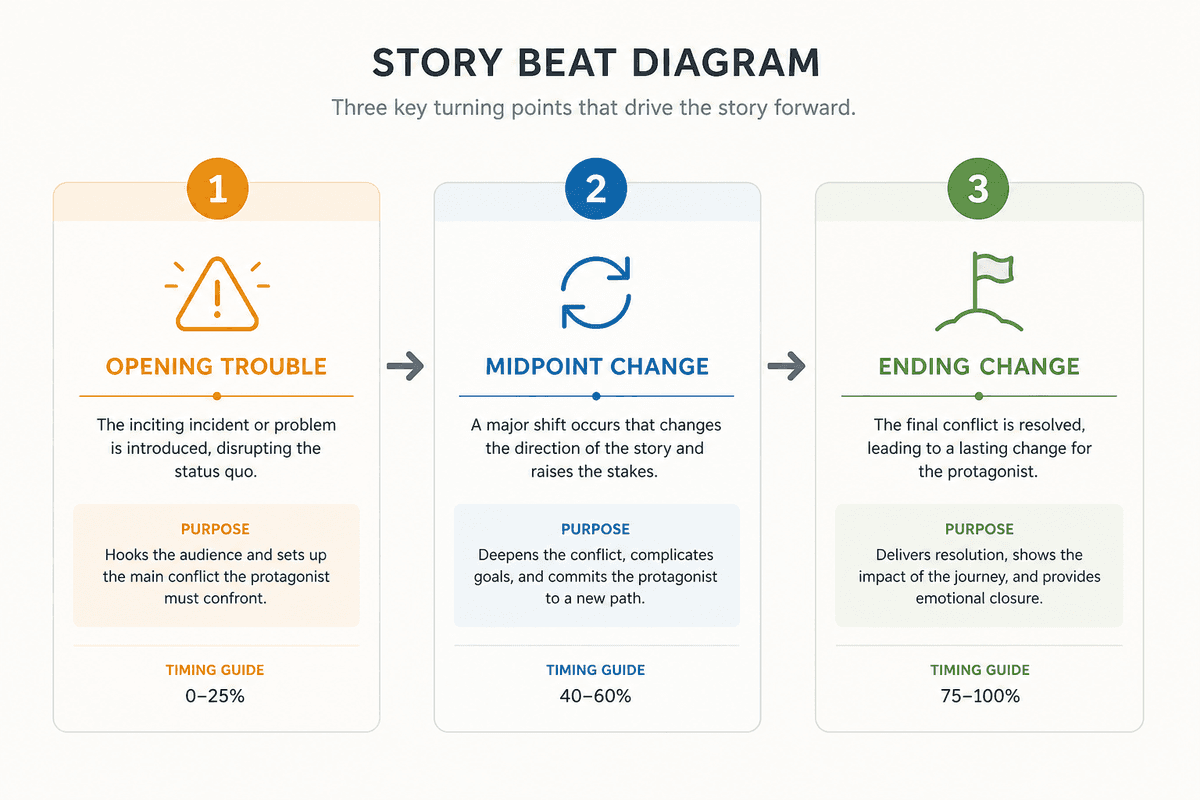
| Beat | Must move… | If missing… |
|---|---|---|
| Opening | Character into trouble | Slow throat-clearing |
| Midpoint | Belief or plan | Flat middle |
| Ending | Change | Coincidence finish |
Small enough to finish beats ambitious and abandoned. Write the short version first.
How to Write a Short Story (for BEGINNERS) | 4 Easy Steps
Use this structure:
| Beat | Purpose | Question to Answer |
|---|---|---|
| 1. Opening image | Drop the reader into a specific moment | What do we see first? |
| 2. Existing pressure | Show what is already tense | What is wrong before the plot begins? |
| 3. Trigger | Force the character to act | What changes? |
| 4. First attempt | Let the character try something | What do they do first? |
| 5. Complication | Make the easy answer fail | What gets worse? |
| 6. Climax | Push the character into a decisive move | What choice, reveal, or refusal matters? |
| 7. Ending | Show the result or emotional turn | What has changed? |
Here is a quick example:
Premise: A teenage boy finds his missing father's watch in his mother's desk.
| Beat | Story Beat |
|---|---|
| Opening image | He is looking for batteries before a school trip and opens the wrong drawer |
| Existing pressure | His mother never talks about his father |
| Trigger | He finds the watch his father was supposedly wearing when he disappeared |
| First attempt | He hides it and asks casual questions at dinner |
| Complication | His mother notices the drawer has been moved |
| Climax | He confronts her and has to decide whether to believe her answer |
| Ending | He wears the watch on the trip, but sets it to the wrong time |
That is not a finished story, but it is enough to draft.
You can use Junia's story generator to explore alternate beats when you are stuck. Treat the output as scaffolding, not the final shape. The emotional turn still has to come from your judgment.
6. Start Close to the Trouble
Many first drafts begin too early.
The character wakes up. They look in the mirror. They make breakfast. They explain their family history. Three pages later, the actual story begins.
Cut the warm-up.
Start near the moment when pressure arrives.
Instead of:
Lena had always loved the sea. Ever since she was a child, she would visit the beach with her grandfather...
Try:
Lena found her grandfather's boat tied to the pier at midnight, though he had been dead for six years.
The second version gives the reader a reason to continue.
Strong openings often do one of these things:
- Present a strange image
- Raise a question
- Put the character in motion
- Show a contradiction
- Create immediate tension
- Establish a voice
- Hint at a secret
A hook generator can help you brainstorm opening options, but do not let the opening sound like a blog headline. A fiction hook should feel like the story's world has already started moving.
7. Draft the Messy Version
The first draft is not where you prove you are a good writer. It is where you discover what the story is actually about.
Write the whole thing before you polish the sentences.
This is difficult because polishing feels productive. You can spend an hour improving the first paragraph and still have no story. A finished rough draft gives you something real to revise.
During the first draft:
- Keep moving when a sentence is ugly
- Use brackets for missing details:
[better description here] - Skip a scene if you know what it needs to do but not how to write it yet
- Let dialogue run too long
- Let backstory spill out
- Let the ending be imperfect
You are making clay, not a statue.
If you use AI while drafting, use it for momentum, not replacement. Ask for five possible complications, three alternate endings, or a sharper version of a scene summary. Junia's AI ghostwriter can help you keep moving, but the final choices should still sound like your story, not a generic answer.
8. Write Dialogue That Creates Pressure
Real conversation is full of filler. Fictional dialogue has to feel real while doing more work.
Good dialogue can:
- Reveal character
- Create conflict
- Hide information
- Show power dynamics
- Change the direction of a scene
- Make the reader infer what is not being said
Weak dialogue says exactly what everyone means:
"I am angry because you lied to me."
Stronger dialogue gives the anger a shape:
"You rehearsed that, didn't you?"
The second line creates history, suspicion, and tone.
When revising dialogue, cut greetings, small talk, repeated names, and explanations the characters already know. Then read the scene aloud. If every character sounds the same, give each one a different rhythm, vocabulary, or way of avoiding the truth.
If a scene feels flat, isolate the spoken lines and test them separately. A dialogue generator can give you alternate phrasings, but the real fix is usually subtext: what the character refuses to say directly.
9. Use Backstory Sparingly
Backstory is useful, but it can easily stop the story.
The reader does not need to know everything that happened before page one. They need enough to understand the pressure in the current scene.
Use this rule:
Add backstory only when it changes how the reader understands the present moment.
Instead of pausing for the full history of a friendship, show one charged detail:
She still had my house key on her ring, though she had painted over it with red nail polish so she would not have to look at my name.
That one image suggests history without explaining everything.
This is one reason short stories can feel powerful. They leave room for the reader to participate. They show the keyhole, not the whole house.
10. End After the Turn
Short story endings often fail for two opposite reasons:
- They stop before anything meaningful changes.
- They explain too much after the change has already happened.
You want the ending to land close to the story's turn.
The turn might be:
- A decision
- A reveal
- A refusal
- A confession
- A loss
- A reversal
- A small gesture that changes the meaning of everything before it
You do not need to explain the moral. Trust the reader.
For example, if the climax is a daughter finally asking her father why he left, you probably do not need three pages of reflection afterward. You might only need the answer, the silence after the answer, and one final image that shows what the daughter now understands.
An ending should feel both surprising and inevitable. The reader should think: I did not know this would happen, but now that it has happened, it feels true.
11. Revise in the Right Order
Do not start revision by fixing commas.
Start with the big problems. Then move smaller.
| Revision Pass | What to Fix | Questions to Ask |
|---|---|---|
| Story shape | Plot, conflict, stakes, ending | Does the story move? Does the ending pay off? |
| Character | Motivation, choice, change | Does the character want something clear? |
| Scenes | Relevance and order | Does every scene create pressure or reveal something? |
| Pacing | Slow openings, rushed turns, repeated beats | Where do I lose interest? |
| Dialogue | Voice, subtext, conflict | Are characters saying too much directly? |
| Sentences | Clarity, rhythm, word choice | Is the prose clean and specific? |
| Proofread | Grammar, typos, formatting | Is it ready for someone else to read? |
Many short stories improve quickly when you cut the first paragraph and the last paragraph. The first paragraph is often throat-clearing. The last paragraph is often the writer explaining what the reader already understood.
At the sentence pass, a sentence generator is only useful if it gives you alternate phrasing to judge, not if it smooths away the story's voice. Keep the line that sounds most precise for the character, mood, and moment.
Once the draft exists, broader creative writing tips become more useful because you can apply them to real pages: a slow opening, a weak scene, a flat line of dialogue, or an ending that explains too much.
12. A 60-Minute Short Story Plan
If you need to write a short story quickly, use this timed plan.
It will not produce a perfect literary magazine submission in one hour. It can get you from blank page to complete draft.
| Time | Task | Output |
|---|---|---|
| 0-5 minutes | Choose one premise | One sentence |
| 5-10 minutes | Define character, want, obstacle, stakes | Four bullets |
| 10-15 minutes | Pick POV and ending direction | One POV, one possible final moment |
| 15-25 minutes | Outline 5-7 beats | A rough map |
| 25-50 minutes | Draft without stopping | Full rough story |
| 50-57 minutes | Cut confusion and strengthen the ending | Cleaner story shape |
| 57-60 minutes | Proofread | Ready enough to share |
Use this fill-in template:
This is a story about [character] who wants [desire], but [obstacle] gets in the way. If they fail, [stakes]. By the end, they [choice/change/reveal].
Example:
This is a story about a retired magician who wants to sell his last trick, but his granddaughter discovers the trick is real. If he gives it away, she loses the only proof that magic ever existed. By the end, he burns the instructions and teaches her the trick instead.
That template is simple, but it gives you a draftable story.
13. Common Story Writing Mistakes
If your story feels weak, the problem is usually one of these:
| Mistake | What It Looks Like | How to Fix It |
|---|---|---|
| Starting too early | Pages of setup before anything happens | Begin closer to the trigger |
| No clear desire | The character drifts through events | Give them a specific want |
| Weak conflict | Problems resolve too easily | Add an obstacle with a cost |
| Too much backstory | The story pauses to explain the past | Reveal only what affects the present |
| Too many characters | The reader cannot track who matters | Combine or cut roles |
| Flat dialogue | Characters say exactly what they mean | Add subtext, avoidance, tension |
| Over-explained ending | The story tells the reader the lesson | End on action, image, or choice |
| Polishing too early | Perfect first page, no finished draft | Finish the rough version first |
For a deeper revision pass, look for repeatable story writing mistakes after the first draft exists. Problems are easier to diagnose when you can point to the exact scene where the story loses pressure.
14. Study Short Stories Like a Writer
Reading short stories is one of the fastest ways to improve, but do not read only for plot. Read for decisions.
After finishing a story, ask:
- Where does the story actually begin?
- What does the main character want?
- What information is withheld?
- What details are doing more than one job?
- Where does the tension increase?
- How much backstory is included?
- Where does the ending stop?
- What changed for the character or the reader?
Then reverse-outline the story in 5-7 beats. This teaches structure better than memorizing abstract rules.
You can do this with classic literary stories, genre fiction, flash fiction, or scenes from novels. If your idea keeps expanding, decide whether it belongs as a story, novel, or flash fiction piece before you draft too far in the wrong form.
Final Checklist
Before you share or publish your story, check these:
- Does the story start near the trouble?
- Can the reader tell who the main character is?
- Does the character want something specific?
- Is there an obstacle, not just a mood?
- Do the stakes feel concrete?
- Does every scene change the situation?
- Is the backstory limited to what the reader needs?
- Does the ending create a turn or recognition?
- Have you cut the first paragraph if it was only warm-up?
- Have you cut the final explanation if the story already lands?
- Does the title add meaning, tension, or curiosity?
Writing a short story is not about cramming a novel into fewer words. It is about choosing one meaningful pressure point and making every line serve it.
Start small. Put a character under pressure. Let them make a choice. Then revise until the story feels sharper, cleaner, and more inevitable than it did in the first draft.