
Free Competitor Analysis Tool
Analyze competitor URLs with a competitor analysis tool that works like a report generator and strategy template. Uncover positioning gaps, content ideas, SEO opportunities, page type patterns, offer differences, and weak spots you can use across content, marketing, SEO, and product positioning.
Competitor Analysis Report
Your competitor analysis report will appear here...
How the AI Competitor Analysis Tool Works
Get results in seconds with a simple workflow.
Add Competitors (URLs Preferably)
Paste 2–8 competitor websites (or brand names). Include your site if you want clearer differentiation and a more tailored SEO action plan.
Set Context (Optional Keywords, Market, Location)
Add target keywords, industry, and location to focus the analysis on the searches you care about—especially useful for local SEO and niche markets.
Generate a Prioritized Plan
Receive a structured competitor analysis report with keyword/content gaps, page recommendations, positioning insights, and a prioritized roadmap you can execute.
See It in Action
Example of turning a vague competitor review into a specific, SEO-ready action plan.
Competitors have better SEO and more content. We should write more blog posts and improve our website.
Priority SEO plan: (1) Create 6 high-intent pages competitors use to convert: “Brand vs Competitor”, “Brand Alternatives”, 3 use-case landing pages, and 1 pricing explainer. (2) Build a topic cluster around “competitor analysis” with a pillar page plus 8 supporting articles targeting keyword gaps (keyword gap analysis, content gap analysis, SERP analysis, backlink gap). (3) Improve on-page SEO on existing pages: rewrite titles for intent, add comparison tables, expand FAQs, and add internal links from top blog posts to money pages.
Why Use Our AI Competitor Analysis Tool?
Powered by the latest AI to deliver fast, accurate results.
AI Competitor Analysis Report (SEO + Content + Positioning)
Generate a structured competitor analysis that covers SEO opportunities, content gaps, messaging, and strategic recommendations—so you can make faster, smarter marketing decisions.
Keyword Gap & Content Gap Opportunities
Uncover likely keyword gaps, missing topic clusters, and content opportunities competitors use to capture search demand—then turn them into a prioritized content plan.
Top Pages & Funnel Mapping
Identify the pages competitors likely rely on (blog, landing pages, comparisons, templates) and map them to funnel stages to replicate what works and improve it.
Differentiation & Messaging Angles
Extract competitor positioning and propose unique angles, value propositions, and proof points to help your site stand out and improve conversion rate optimization (CRO).
Actionable SEO Recommendations (Quick Wins + Long-Term)
Get a clear list of next steps: quick on-page improvements, internal linking ideas, new page recommendations, and a pragmatic roadmap to close the competitive gap.
Pro Tips for Better Results
Get the most out of the AI Competitor Analysis Tool with these expert tips.
Use direct competitors, not aspirational ones
Choose sites competing for the same keywords and customers. Comparing a small site to a massive brand can produce less actionable priorities.
Add 10–20 target keywords for sharper recommendations
Even a small keyword set helps the analysis focus on high-intent queries, comparison keywords, and content formats that win in your SERPs.
Look for page-type gaps (not just topics)
Competitors often win with specific page types: alternatives pages, comparisons, templates, use cases, and tool pages—these can outperform generic blog posts.
Turn gaps into a topic cluster plan
Convert missing topics into a pillar page plus supporting articles. Add internal links between them to build topical authority and improve rankings.
Validate with real SERPs before writing
Use the report to shortlist opportunities, then check the live SERP for search intent, page formats, and common headings to align content with what ranks.
Who Is This For?
Trusted by millions of students, writers, and professionals worldwide.
Competitor Analysis Tool and Template Generator
This competitor analysis tool is for one job: turning competing pages into a useful strategy report or template. Use it as a competitor analysis generator when you want a structured comparison instead of a blank spreadsheet. Paste competitor URLs, add your market, keyword, offer, or topic, and use the report to decide what to create, refresh, reposition, link, or ignore.
The best inputs are specific:
- your site or target page
- 3 to 10 competitor URLs
- the target keyword, product, offer, or topic
- the audience you care about
- any pages you already have
- whether you want positioning gaps, content gaps, SEO opportunities, page type ideas, or a SERP plan
If you only paste a competitor homepage, the report will be broad. If you paste the pages actually ranking for your query, the output becomes much more useful.
What the Tool Looks For
A good competitor analysis is not just a list of rival websites. The tool checks for several kinds of gaps:
| Gap type | What it means | What to do next |
|---|---|---|
| Positioning gap | Competitors explain value, proof, or use cases more clearly | Improve messaging, proof, CTA, and differentiation |
| Offer gap | Competitors package features, templates, pricing, or services differently | Clarify your offer or create a stronger comparison |
| Keyword gap | Competitors target searches your page does not cover | Add missing query coverage or build a new page |
| Content gap | Competitors answer subtopics your page skips | Refresh the page with better sections and examples |
| Page type gap | Competitors rank with a format you do not have | Build a tool, template, comparison, or alternatives page |
| Internal link gap | Competitors likely have stronger topical support | Add contextual links from relevant hubs and articles |
This is why the report may mention positioning, offers, keyword gaps, content gaps, and page type gaps together. They are different levers, and each one leads to a different action.
How to Use the Report Without Turning It Into Busywork
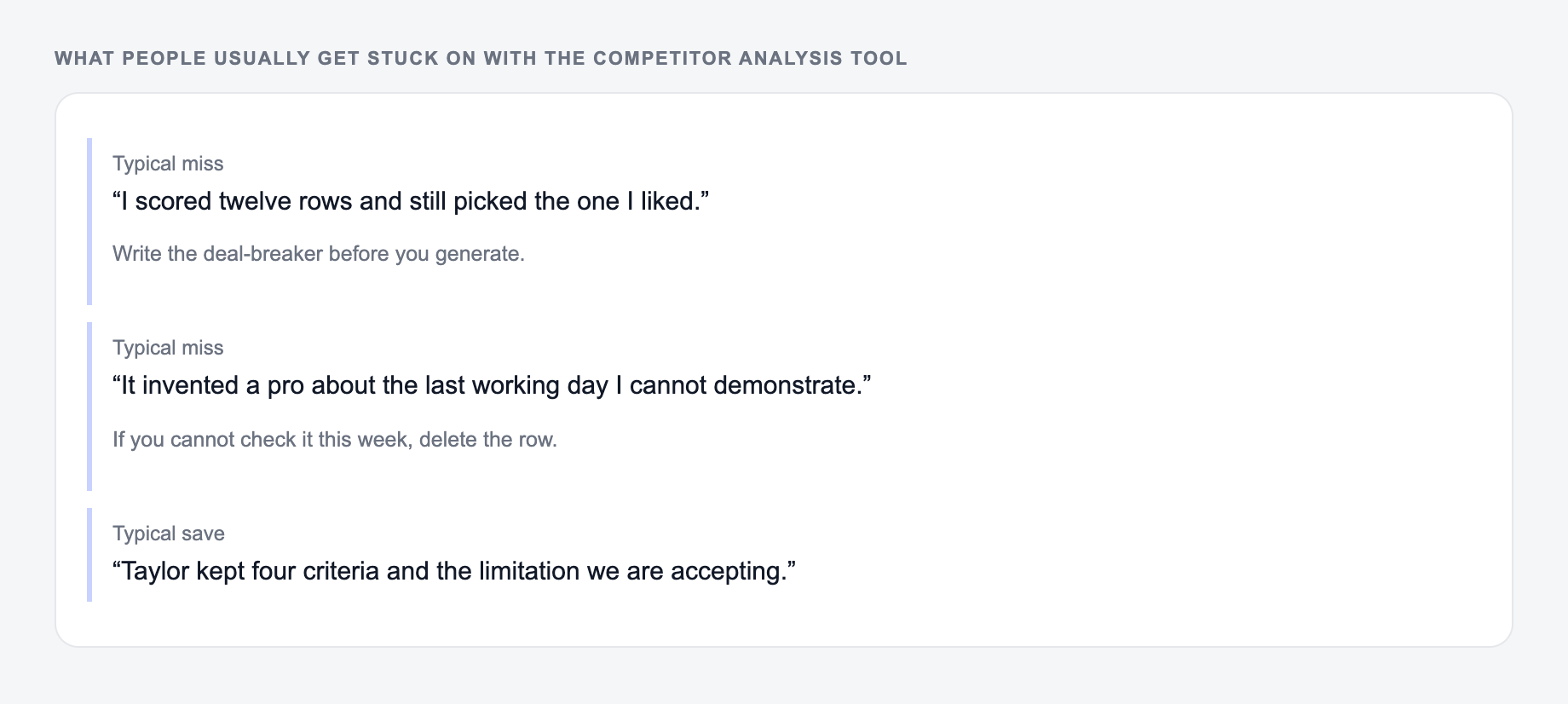
Write the deal-breaker before you run the Competitor Analysis Tool. If that line would make you walk away, and the output still recommends the option, the scores are decoration.
After generating the report, sort recommendations into four buckets:
- Refresh an existing page when your page already targets the query but lacks depth, examples, proof, or internal links.
- Create a new page or template when competitors rank with a page type you do not have, such as an alternatives page, comparison page, template, calculator, or free tool.
- Add supporting content when a money page needs topical support from guides, FAQs, or related tools.
- Reposition a weak offer when competitors explain the value, proof, or next step more clearly than you do.
This keeps the analysis tied to execution. The output should end with a short roadmap, not a huge research dump.
Page Types the Tool May Recommend
These are the complaints that show up after the first draft — they are almost always about the brief, not the model.
Competitors often win because they match the page format searchers expect. Watch for:
- alternatives pages for commercial comparison searches
- comparison pages for "X vs Y" queries
- use-case pages for specific industries or roles
- templates and free tools for repeatable tasks
- pricing, ROI, or value pages for commercial investigation
- supporting guides for early-stage education
If the SERP is full of tools, writing another generic article is usually the wrong move. If the SERP is full of detailed comparisons, a thin product page will struggle.
Simple Input Prompt
Paste something like this into the tool:
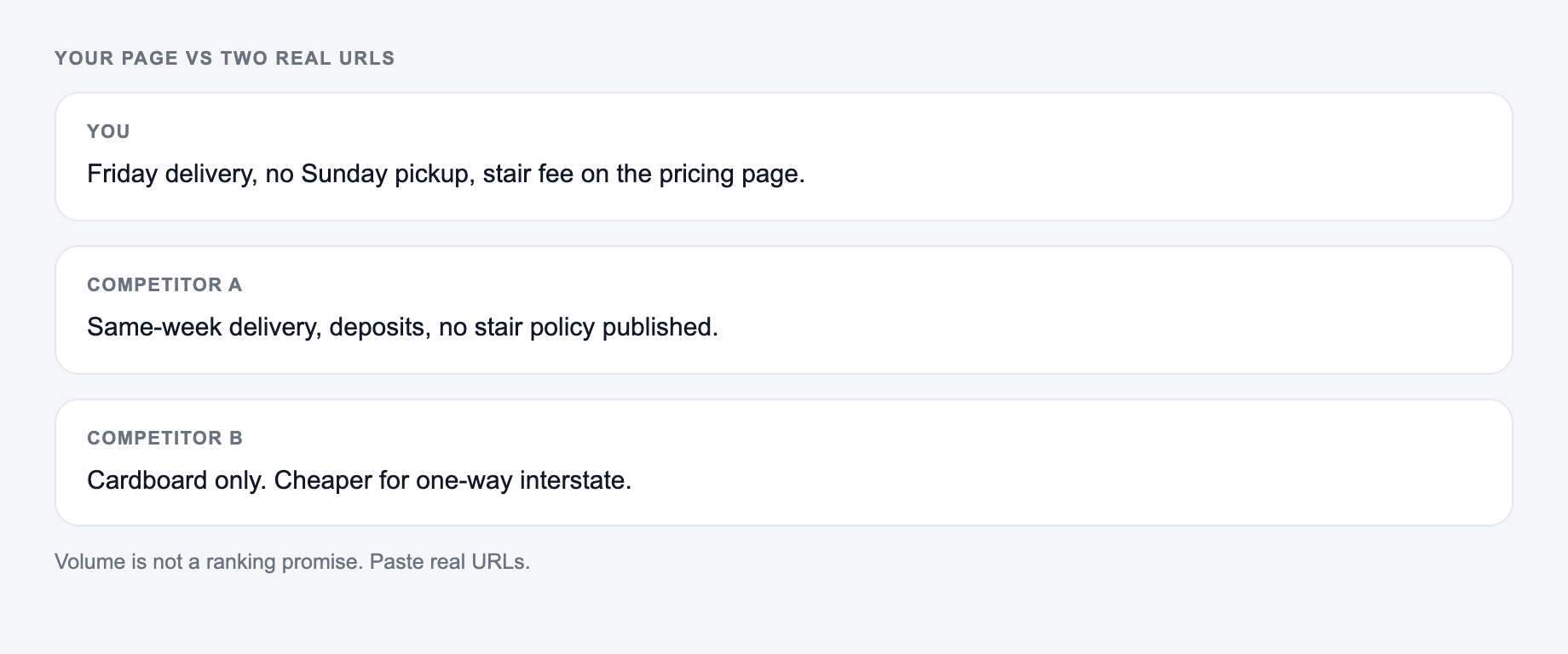
Your page and two real competitors belong on the form. Volume is not a ranking promise.

Score the decision the AI Competitor Analysis Tool is helping with. A longer list is not a better call.
- Setup speed — how fast can you try this without a project?
- Predictable cost — what do you pay if it works, and if it fails?
- Control vs simplicity — who has to maintain it next quarter?
- Deal-breaker — if this fails, you stop. Write that line before you generate.
A longer list is not a better decision. Score what you will actually live with.
My site is [your site]. My goal is [goal]. Competitors are [URLs]. Analyze positioning gaps, offer gaps, content gaps, SEO opportunities, page type gaps, trust signals, and internal linking opportunities. Prioritize actions by impact and effort.
For keyword expansion after the report, use the AI keyword research tool. When you are ready to turn one opportunity into a page plan, use the SEO content brief generator.
Frequently Asked Questions
What is a competitor analysis tool?+
A competitor analysis tool helps you evaluate competing websites or brands to understand their SEO strategy, content coverage, positioning, and growth opportunities. It typically highlights gaps you can target—like missing keywords, weak content areas, or unclear messaging.
How do I use this competitor analysis tool for SEO?+
Add a few competitor URLs, optionally include your site and target keywords, then generate a report. Use the keyword gap and content gap sections to plan new pages, improve existing content, and prioritize on-page SEO, internal linking, and topic clusters.
Do I need my own website URL to run the analysis?+
No. You can run a competitor analysis using competitor URLs or brand names only. Adding your website helps the tool tailor recommendations and identify clearer opportunities based on your positioning and goals.
How many competitors should I analyze?+
Start with 3–5 direct competitors for the most actionable insights. Add more only if you need broader market coverage, since too many competitors can dilute the priorities.
Will this give exact keyword rankings and traffic numbers?+
No. This tool generates strategic insights and a practical plan based on the information you provide. For exact rankings, traffic estimates, and backlink metrics, pair this with an SEO data tool—then apply the recommendations here.
What’s the difference between keyword gap and content gap analysis?+
Keyword gap analysis focuses on search queries competitors likely target that you don’t. Content gap analysis looks at missing topics, page types, and coverage depth—often expressed as topic clusters, FAQs, comparison pages, and use-case pages you should create.