
Free Product Review Generator
Write detailed product reviews with comparison sections, feature breakdowns, performance analysis, pros and cons, FAQs, and final recommendations. Ideal for affiliate marketers, review publishers, ecommerce blogs, and editorial product content.
Generated Product Review
Your product review will appear here...
How the AI Product Review Generator Works
Get results in seconds with a simple workflow.
Enter the Product Details
Add the product name and any helpful details like features, price range, pros/cons, and who it’s for. The more specific your inputs, the more credible and useful the review will be.
Choose Review Style + Optional SEO Keywords
Pick a review style (balanced, ecommerce, comparison-led, affiliate SEO). Optionally provide a primary keyword and secondary keywords to guide on-page SEO without keyword stuffing.
Generate, Verify, and Publish
Generate the review, then verify specs, pricing, and any claims. Add hands-on notes, images, internal links, and a disclosure (if affiliate) to improve trust and conversions.
See It in Action
Example of turning basic product notes into an SEO-friendly, buyer-focused review section with a clear verdict.
This desk converter is sturdy and easy to adjust. It has enough space for a monitor and laptop. The keyboard tray is a bit small.
If you want a sturdy sit-stand upgrade without replacing your whole desk, this desk converter is a strong value. Height changes feel stable and quick, and the top surface fits a typical monitor + laptop setup. The main downside is the narrower keyboard tray, which may feel cramped if you use a full-size keyboard or prefer more mouse space.
Why Use Our AI Product Review Generator?
Powered by the latest AI to deliver fast, accurate results.
SEO-Friendly Product Review Structure (Verdict, Pros/Cons, FAQs)
Creates a scannable review layout optimized for buyer-intent queries like “{product} review”, including quick verdict, key features, pros/cons, who it’s for, and FAQs that support search snippets.
Honest, Non-Misleading Copy (No Invented Claims)
Generates trustworthy review content using only the details you provide—helpful for affiliate marketing compliance, ecommerce accuracy, and reader trust.
Keyword-Guided Reviews Without Stuffing
Optionally include a primary keyword and secondary SEO keywords. The tool places them naturally in headings and body copy to help on-page SEO while keeping readability high.
Comparison + Alternatives Section (Optional)
Add competitors to generate an alternatives section that helps rank for “vs” and “best alternatives” searches, supporting commercial investigation intent.
Multilingual Product Reviews
Generate product reviews in multiple languages for international SEO, localized affiliate sites, and multilingual ecommerce content.
Pro Tips for Better Results
Get the most out of the AI Product Review Generator with these expert tips.
Add real-world constraints to boost trust (and SEO)
Include limitations like battery life range, sizing fit, setup time, compatibility, or learning curve. Specificity improves user satisfaction and helps your review stand out in search results.
Target “review” + “alternatives” keywords
Add competitors to capture “{productName} alternatives” and “{productName} vs {competitor}” queries—often high-converting commercial investigation searches.
Use a clear ‘Who it’s for / not for’ section
This reduces bounces, improves conversion quality, and increases perceived honesty—especially important for affiliate and ecommerce review content.
Don’t guess specs—paste them
To avoid inaccuracies, provide exact specs (dimensions, weight, compatibility, materials, warranty). Search engines and users punish incorrect product info.
Improve E-E-A-T with original media and experience
Add your own photos, testing notes, measurements, and comparisons. Unique evidence and firsthand detail are hard to copy and often correlate with better performance in search.
Who Is This For?
Trusted by millions of students, writers, and professionals worldwide.
How to generate a product review that feels honest (and still sells)
Most “product reviews” online are either thin summaries or straight up sales copy. Readers can tell in about two seconds, and Google can too. A good review is basically a decision tool. It helps someone figure out if the product fits their situation, not just whether it is “good”.
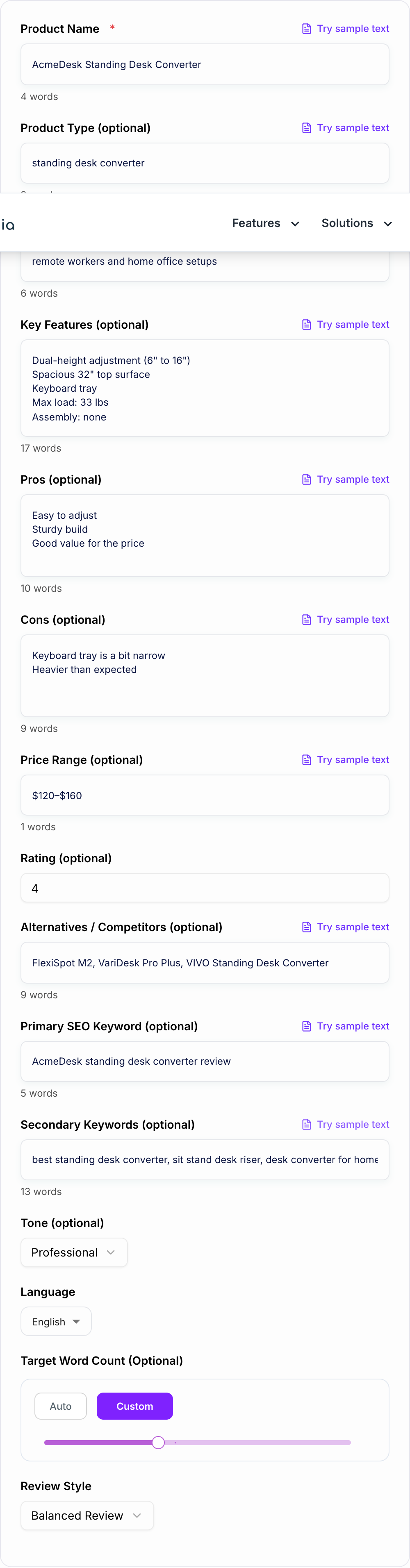
That is exactly what this Product Review Generator is built for: quick verdict first, clear pros and cons, who it is for, who should skip it, then the details that actually matter.
If you are building a bunch of reviews and want them to stay consistent across your site, using a structured template like this is a lifesaver.
What a high ranking product review page usually includes
You do not need to overcomplicate it, but you do need the basics done well:
- A quick verdict near the top so the reader gets the answer fast.
- Who it’s for and not for (this is weirdly persuasive because it feels honest).
- Key features explained as benefits, not copied specs.
- Performance and real world usage context, even if it is “based on the details provided”.
- Pros and cons that match the rest of the review (no generic filler).
- Alternatives and comparisons to capture “vs” and “alternatives” searches.
- FAQs that match buyer intent, not random questions.
This tool generates that structure automatically so you can focus on accuracy and adding your own experience where you have it.
Inputs that make the review 10x better
You can generate a review with only a product name, sure. But if you want the output to feel credible and specific, add at least a few of these:
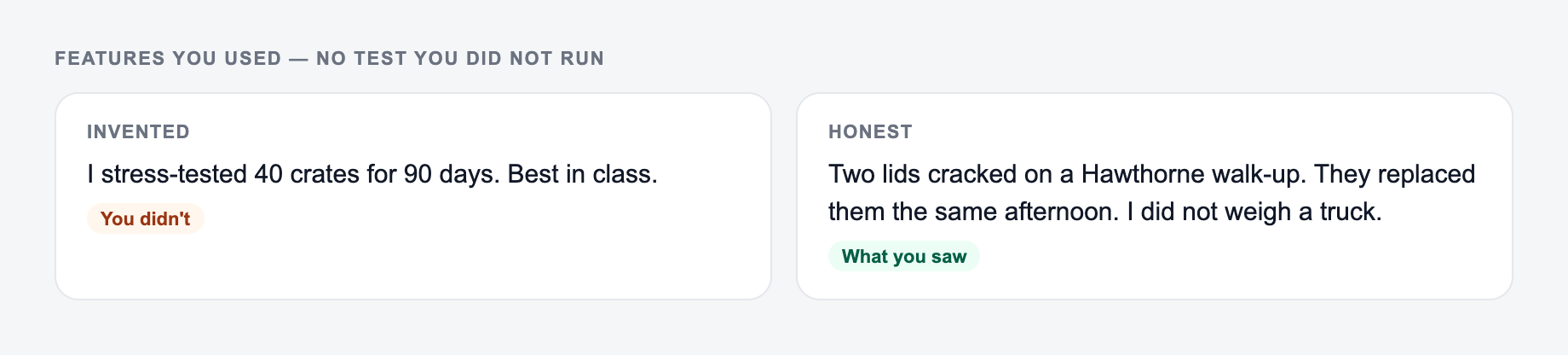
Features, price context, and who it is for belong on the form. Do not invent a test you did not run.
Publish checklist for ai product review generator output:
- Matches the live page, not the outline you meant to write
- Primary phrase is early, not stuffed twice
- Still makes sense if the last 12 characters are cut
- No rating, price, or city the page does not support
- Distinct from the other URLs in the same folder
A useful SERP-shaped check (not a live Google capture): title, URL path, and one line a searcher would believe after the click.
1) Key features, but in plain language
Paste the features as bullet points. Include numbers if you have them. Dimensions, compatibility, warranty, materials, battery life range, stuff like that.
2) Real pros and cons (even small ones)
Small drawbacks are gold because they make the whole review feel more trustworthy. Like “keyboard tray is narrow” or “setup takes 15 minutes”.
3) Price context
Instead of just a price, add framing. “Budget option”, “mid range”, “premium”, or “good value if you need X”.
4) Alternatives
Even two competitors is enough to create a strong alternatives section. This is one of the easiest ways to expand keyword coverage without fluff.
SEO tips for affiliate and ecommerce reviews (without keyword stuffing)
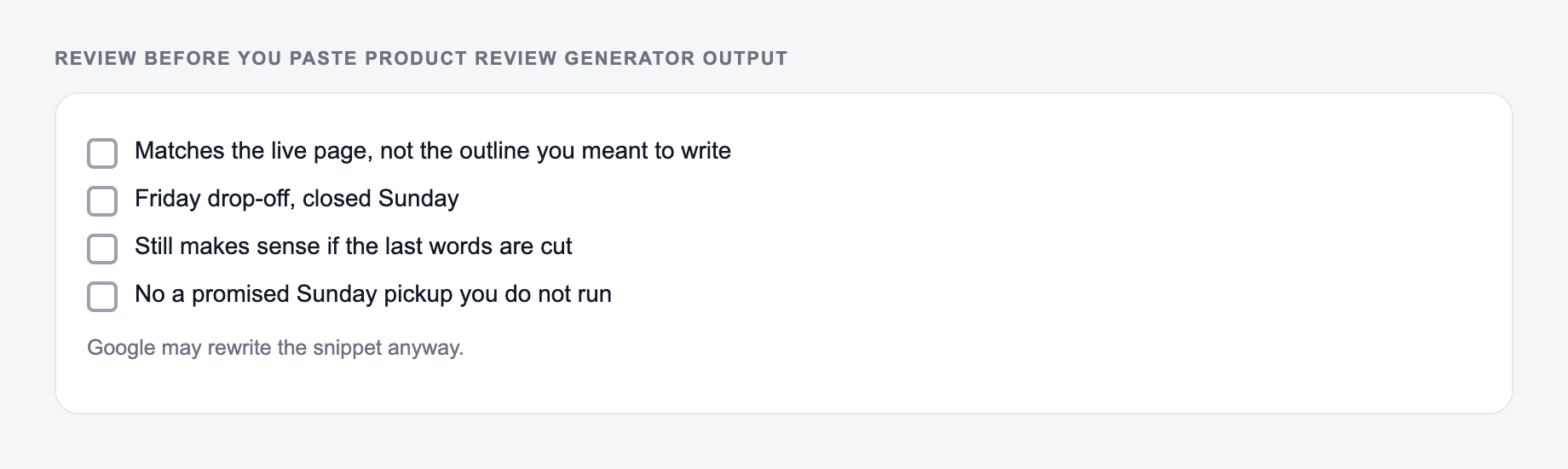
Before you publish the product review generator draft:
- You used or observed the thing you described
- No rating, price, or test you did not run
- A stranger knows what worked and what failed
Use this as a preflight, not a caption. If a box fails, change the input or cut the line.
If you are trying to rank for product review keywords, here is what tends to move the needle:
- Use a primary keyword like “{productName} review” in the H1 or first main heading and naturally in the intro.
- Add secondary keywords as supporting context, not forced phrases. Think “best alternatives”, “is it worth it”, “for {audience}”, “pros and cons”.
- Make sure your headings match how people scan. “Verdict”, “Pros and Cons”, “Who it’s for”, “Alternatives”, “FAQ”.
- Add unique signals: your photos, a short test note, a measurement, a comparison you did yourself. Even one or two details can separate your page from copycat reviews.
- Include an affiliate disclosure if needed, and keep claims accurate. If you did not test it, do not pretend you did.
If you are publishing at scale, using an AI writing workflow from a single place like Junia AI helps keep tone, structure, and formatting consistent across dozens (or hundreds) of product pages.
A simple product review template you can reuse
Use this as a checklist, whether you generate the review here or write it manually:
- Quick verdict (2 to 4 sentences)
- Best for / Not ideal for
- Key features (and why they matter)
- Performance and usability (setup, comfort, durability, speed, etc)
- Pros and cons
- Alternatives (and who should choose them)
- FAQ (pricing, warranty, compatibility, common concerns)
- Final recommendation (clear and specific)
That is basically the format this tool produces, so you can publish faster and then spend your time improving it with real details.
Frequently Asked Questions
Is this product review generator free to use?+
Yes. You can generate product reviews for free. Some advanced modes (such as Affiliate SEO) may be marked as premium depending on your settings.
Will the review include pros and cons?+
Yes. The generator can include a clear pros and cons section. If you provide your own pros/cons, it will incorporate them; otherwise it will keep the section conservative and based only on details you provided.
Can it write SEO-friendly product reviews that rank?+
It creates a search-intent-friendly structure (verdict, features, who it’s for, FAQs, and alternatives). Rankings also depend on originality, accuracy, internal linking, topical authority, and meeting user intent—so review and add real testing notes when possible.
Does it invent features or performance claims?+
No. The prompts are designed to avoid making up specs, test results, certifications, or guarantees. Provide accurate details (features, limitations, pricing context) for best results.
Can I use this for affiliate marketing content?+
Yes. It’s well-suited for affiliate review pages and product roundups. Make sure your final page includes required affiliate disclosures and that all claims match your sources.
How do I optimize the review for SEO?+
Use a primary keyword (like “{productName} review”), add a few secondary keywords, include alternatives, and keep the review helpful with concrete details (who it’s for, use cases, limitations). Add internal links, images, and unique insights to strengthen E-E-A-T.