
Free Book Idea Generator
Generate original book ideas for fiction, nonfiction, memoirs, guides, and creative projects. Add a genre, audience, theme, or seed idea to create hooks, premises, loglines, synopses, and outlines you can actually develop.
Book Ideas
Your book ideas will appear here...
How the AI Book Idea Generator Works
Get results in seconds with a simple workflow.
Add a Seed (Optional) and Choose Fiction or Nonfiction
Enter a topic, theme, or quick premise—or leave it blank to generate fresh ideas. Select Fiction or Nonfiction to guide structure and angle.
Refine With Genre, Audience, and Constraints (Optional)
Add genre/category and target reader to get better-fit concepts. Include constraints (tone, POV, framework, setting) to improve originality and clarity.
Generate, Compare, and Expand Your Favorite
Get multiple ideas, pick the best hook, then expand into a logline, synopsis, or chapter outline you can draft from immediately.
See It in Action
Example of turning a vague seed into a strong, marketable concept with a clear hook and outline direction.
Seed idea: A book about productivity.
I want something helpful but not boring.
High-Concept Nonfiction Idea: Title: The Two-Minute Reset: A Busy Person’s System for Getting Unstuck Every Day Hook: Instead of relying on motivation, this book teaches a repeatable “reset” routine you can do in two minutes to regain focus, reduce overwhelm, and choose the next right task. Ideal Reader: Busy professionals who feel scattered, procrastinate under stress, and want simple systems. Unique Angle: Micro-interventions + decision rules (not long routines). Chapter Outline (sample):
- Why You’re Stuck (and Why Willpower Fails)
- The Two-Minute Reset Framework
- The “Next Right Task” Rule
- Focus Triggers: Environment, Timing, and Defaults
- The Overwhelm Loop (and How to Break It)
- Planning in 10 Minutes: The Weekly Map
- Keeping Momentum on Bad Days
- Templates, Checklists, and a 14-Day Reset Plan
Why Use Our AI Book Idea Generator?
Powered by the latest AI to deliver fast, accurate results.
Fiction and Nonfiction Book Ideas With Strong Hooks
Generates high-concept book premises, story hooks, and nonfiction angles tailored to your genre, audience, and style—ideal for beating writer’s block and finding a marketable concept.
Loglines, Synopses, and Chapter Outlines
Go beyond vague prompts: get loglines, elevator pitches, short synopses, and structured chapter-by-chapter outlines that help you start drafting immediately.
Reader-Focused Positioning (Audience + Promise)
Creates ideas with a clear target reader and value promise—useful for writing compelling blurbs, pitching agents, and aligning your book with reader expectations.
Genre-Accurate Tropes and Differentiators
Suggests genre-appropriate tropes, conflicts, and stakes while highlighting unique twists so your concept feels familiar enough to sell—but fresh enough to stand out.
Fast Iteration for Better Concept Development
Generate multiple variations quickly, compare concepts, and refine the best one into a more detailed premise—perfect for rapid ideation, plotting, and content planning.
Pro Tips for Better Results
Get the most out of the AI Book Idea Generator with these expert tips.
Specify the reader promise in one line
For nonfiction, state the transformation (problem → outcome). For fiction, state the core tension (desire → obstacle → stakes). Clear promises create stronger hooks and blurbs.
Add one constraint to make the idea feel unique
Try a constraint like a distinctive setting, a time limit, a narrative device, or a thematic rule. Constraints create sharper premises and reduce generic outputs.
Generate 10–20 ideas, then score the top 3
Quickly rate each idea for clarity, originality, audience fit, and ‘I would actually write this.’ Then expand only the winners into synopses and outlines.
For nonfiction, anchor each chapter to an action
If your outline feels vague, ensure every chapter ends with a checklist, exercise, template, or decision the reader can apply—this improves usefulness and reviews.
Test your concept with a one-sentence pitch
If you can’t explain the premise simply, the book may be too broad. Refine until the pitch is clear, specific, and intriguing in one sentence.
Who Is This For?
Trusted by millions of students, writers, and professionals worldwide.
Generate Book Ideas You Can Actually Develop
The AI Book Idea Generator helps you move from a vague spark to a usable book concept. It can generate fiction premises, nonfiction angles, hooks, loglines, synopses, and outlines, but the quality of the result depends heavily on the constraints you give it.
A strong book idea is not just a topic. It has a reader or audience, a clear promise, a reason to keep turning pages, and enough structure to survive the outline stage. The generator gives you options quickly so you can compare concepts before spending weeks on the wrong one.
What to Enter Into the Book Idea Generator
Start with the genre or category. "Mystery" is useful, but "cozy mystery set in a coastal town with a reluctant amateur detective" gives the tool a stronger direction.
For fiction, add a setting, character type, theme, trope, conflict, or constraint. A remote lighthouse, a 72-hour deadline, a found family cast, or a moral dilemma can make the generated premise more distinct.
For nonfiction, add the reader and the problem. "Productivity" is broad. "ADHD founders who need flexible systems on chaotic workdays" gives the generator a marketable audience and promise.
If you already have a rough idea, paste it as the seed. The tool can turn that seed into a list of variations, a sharper high-concept premise, a synopsis, or an outline.
Choosing the Right Output Mode
Use Idea List when you want several concepts to compare. Do not judge too early. Generate a broad set, then look for the ideas with the clearest hook.
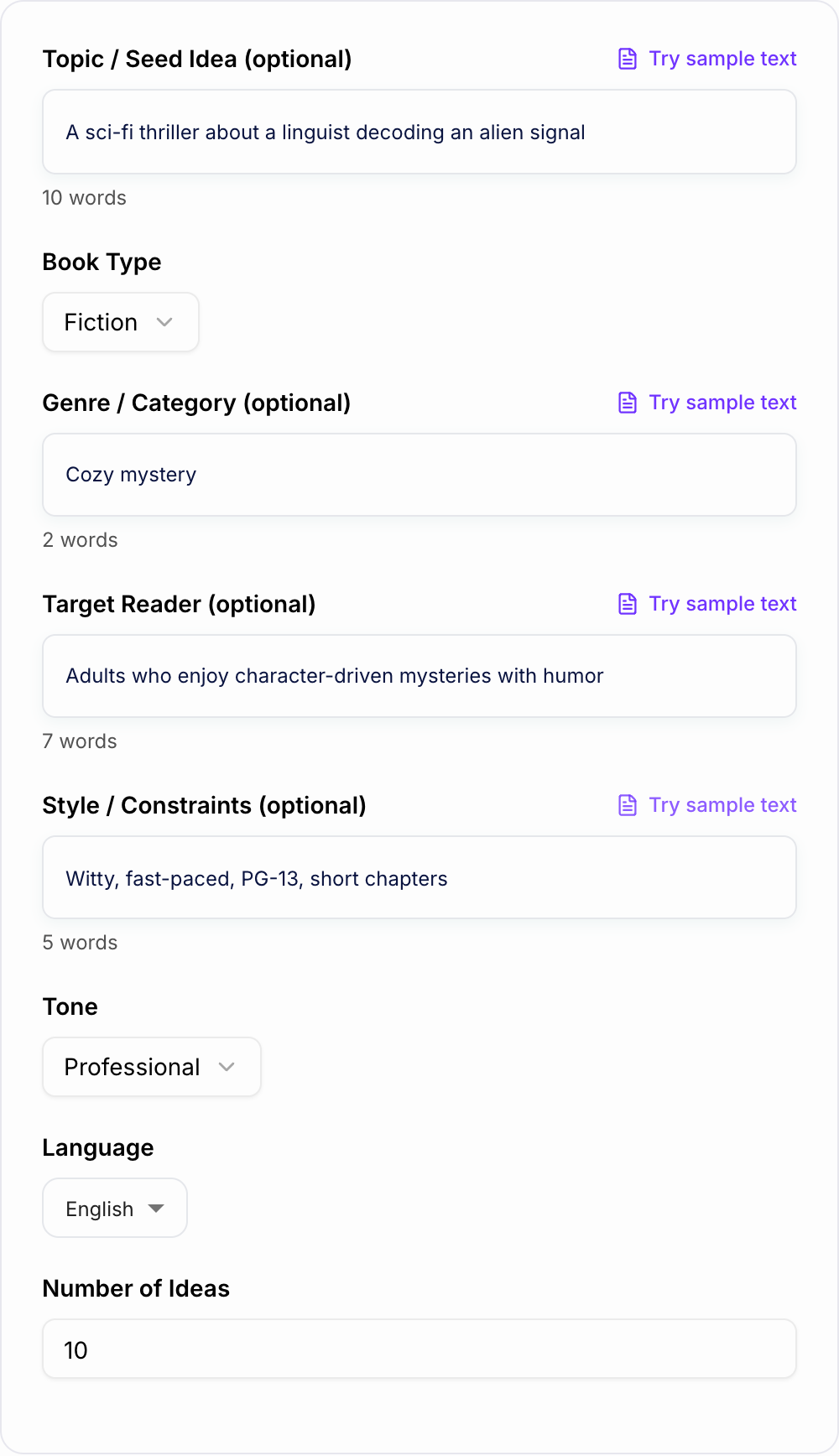
Use High-Concept Premise when you need a pitchable version of one idea. This mode should clarify the audience, conflict or transformation, stakes, and twist.
Use Synopsis when you want to see whether the idea has enough movement. For fiction, this exposes plot holes. For nonfiction, it shows whether the promise can support a full book.
Use Chapter Outline when you have chosen a direction and need structure. Outlining too early can make a weak premise look more developed than it really is, so use this mode after the hook is clear.
How to Evaluate Generated Book Ideas
The left side is what most people type. The right side is the brief that actually steers the draft.
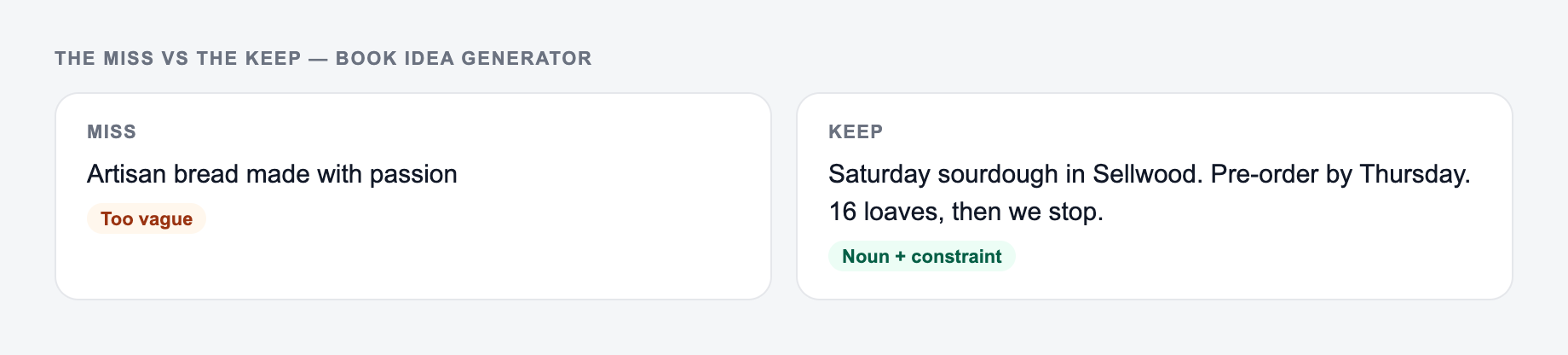
Score each idea against four questions:
- Can you explain the premise in one sentence?
- Is the target reader or genre obvious?
- Does the idea have a fresh twist, specific promise, or strong conflict?
- Would you still want to write it next month?
For fiction, check whether the protagonist wants something, what blocks them, and what changes if they fail. For nonfiction, check whether the reader problem is specific and the promised outcome is believable.
A generated idea that sounds exciting but cannot be outlined is probably still too vague. Send it back through the generator with more constraints.
Turning One Generated Idea Into a Stronger Concept
Before you publish book idea generator output:
- A stranger can repeat the promise
- The page can keep that promise today
- No number, guest, or deadline you did not type
Once you find a promising idea, ask for a logline or one-paragraph pitch. If that pitch is clear, expand it into a synopsis. If the synopsis has momentum, move into an outline.
For fiction, look for escalating stakes, meaningful choices, and a setting that affects the plot. For nonfiction, look for a simple framework, chapter progression, examples, exercises, and a clear reader transformation.
Do not keep every generated detail. The best workflow is to use the tool for range and structure, then add your own taste, lived experience, research, and imagination.
Final Checklist Before You Commit to a Book Idea
Before you start drafting, confirm:
- The idea has a clear genre, shelf, or category.
- The reader or audience is specific.
- The hook is easy to pitch in one sentence.
- The premise has conflict, stakes, transformation, or a useful framework.
- The idea feels distinct from books you already know.
- You have enough interest to outline and draft it beyond the first chapter.
Generate more ideas than you need, then expand only the strongest. Junia AI's AI writing tools can help with outlines, blurbs, and draft support, but the final book concept should still carry your perspective and judgment.
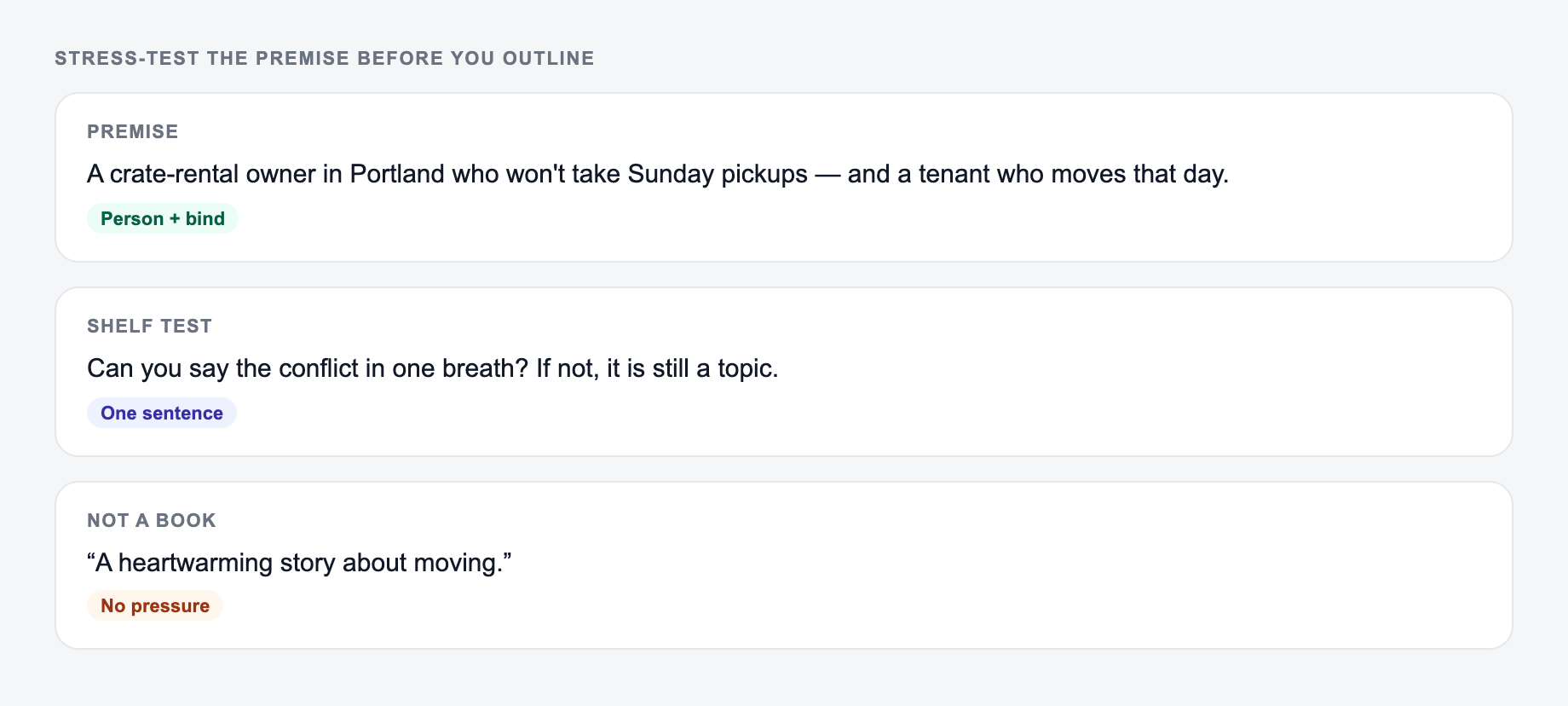
Stress-Test a Premise Before Outlining
Take this generated fiction seed: “A lighthouse keeper receives tomorrow’s distress calls.” Build three versions by changing only the story engine:
A premise you can stress-test starts as this kind of brief on the form.
Use the AI Book Idea Generator when you need volume. Do not use it when you still owe the reader a fact.
-
Keep a line you could publish after one edit.
-
Reroll a line that only works if the reader already knows your product.
-
Throw away a line that invents proof, a guest, a deadline, or a result.
-
Mystery: each call contains a clue to one connected disappearance.
-
Thriller: answering a call changes who is in danger the next day.
-
Literary speculative: the keeper must choose which voices deserve intervention.
Now test each with the same questions: What does the protagonist want by chapter two? What repeatable action drives scenes? Why can the conflict not be solved immediately? How do choices escalate cost? What ending would fulfill the premise rather than merely stop it? This isolates structural strength from attractive atmosphere.
For nonfiction, use a promise-evidence map. A concept for “flexible planning for ADHD founders” needs a defined reader, bounded outcome, chapter sequence, source plan, case-study permissions, and caveats about where professional guidance belongs. The generator can suggest a market angle, but it cannot confirm demand, originality, lived experience, or factual authority. Compare books in the intended category and revise away from accidental imitation.
Frequently Asked Questions
Is this book idea generator free to use?+
Yes. You can generate book ideas for free. Some advanced modes—like series planning or market-fit positioning—may be marked as premium.
Can it generate both fiction and nonfiction book ideas?+
Yes. Choose Fiction or Nonfiction, then optionally add genre/category, audience, and constraints. The tool adapts the structure (premise vs. problem/solution promise) to match your selection.
Will the ideas be original?+
The generator creates new combinations of themes, conflicts, and angles. However, you should still review for similarity to existing works and add your own unique voice, experience, and details—especially for nonfiction.
How do I get ideas that are more marketable?+
Add a clear target reader, genre/category, and a constraint (e.g., ‘cozy mystery in a small seaside town’ or ‘business book for solo consultants’). Marketable ideas usually have a specific audience and a simple, compelling promise.
Can this help with outlining a book?+
Yes. Use Outline mode to generate chapter-by-chapter structure with goals and key beats. Then refine by adding your characters, key scenes, or a specific framework (for nonfiction).
What should I include in the seed idea?+
A seed can be as small as a setting, problem, character type, or outcome. Examples: “a locked-room mystery on a train,” “a book about anxiety for teens,” or “a romance in a bakery with a rivals-to-lovers trope.”