
Free Headline Generator
Generate clickable headlines for blog posts, SEO pages, ads, email subject lines, YouTube videos, social posts, and landing pages. Add a topic, keyword, audience, platform, and tone to create title ideas that are clear, specific, and built for the right intent.
Headlines
Your generated headlines will appear here...
Have the headline? The AI article writer turns it into a complete, SEO-optimized article.
How the AI Headline Generator Works
Get results in seconds with a simple workflow.
Enter Your Topic (and Optional Keyword)
Add your page topic or working title. Optionally include a primary keyword to influence SEO phrasing and align the headline to what people search for.
Choose Platform, Tone, and Intent
Select where the headline will be used (blog, landing page, email, ads) and optionally choose search intent and tone to guide structure and wording.
Generate, Shortlist, and Test
Generate multiple headline options, shortlist the best 3–5, and test the winner with A/B testing, Search Console performance, or campaign results.
See It in Action
Example of turning a vague title into specific, SEO-friendly headline options designed to improve click-through rate.
Keyword research
- Keyword Research for a New Website: A Step-by-Step Guide
- How to Do Keyword Research (For Beginners) + Free Tools
- 15 Keyword Research Tips to Find Low-Competition Keywords
- Keyword Research Checklist: Find Keywords You Can Actually Rank For
- Keyword Research: How to Choose Keywords for SEO (Without Guessing)
Why Use Our AI Headline Generator?
Powered by the latest AI to deliver fast, accurate results.
SEO-Friendly Titles With Natural Keyword Placement
Generate headline ideas that include your primary keyword naturally, match search intent, and stay readable—helpful for improving organic CTR without keyword stuffing.
Platform-Specific Headline Formats
Create titles tailored to blogs, landing pages, email subject lines, ads, social posts, and YouTube—each with the right length, structure, and message style.
Multiple Angles: Benefit, How-To, Mistakes, and Comparisons
Get a diverse set of headline angles to test: outcome-driven benefits, step-by-step how-to titles, common mistakes, myths, comparisons, and quick-win frameworks.
Tone and Audience Control for Better Relevance
Match your brand voice and target reader (beginners, executives, creators, local customers) to create headlines that feel specific and click-worthy.
Built for A/B Testing and Content Planning
Generate enough headline variations to support A/B testing, editorial calendars, topic clusters, and content briefs—so you can ship faster and iterate based on performance.
Pro Tips for Better Results
Get the most out of the AI Headline Generator with these expert tips.
Put the keyword early—but keep it natural
If you’re optimizing for SEO, try to place the primary keyword near the beginning of the title without forcing awkward phrasing. Read it out loud to check flow.
Match the headline to search intent
Informational queries perform well with how-to and guides. Commercial intent performs well with comparisons, “best,” “vs,” and decision-driven criteria.
Add specificity to improve clicks
Numbers, timeframes, audience qualifiers, and outcomes (e.g., “in 20 minutes,” “for beginners,” “without ads”) often raise CTR by making the promise concrete.
Write 2 versions: one for SEO, one for humans
Draft a keyword-aligned SEO title and a more benefit-driven variant, then choose based on SERP competition and your brand voice.
Use Search Console to iterate
If impressions are high but clicks are low, test a clearer benefit, stronger specificity, or a different angle (mistakes, checklist, templates, examples).
Who Is This For?
Trusted by millions of students, writers, and professionals worldwide.
Generate Clickable Titles with the AI Headline Generator
A headline generator is most useful when you give it more than a topic. The best outputs come from a clear publishing context: who the headline is for, where it will appear, what keyword or promise it needs to carry, and what kind of click you actually want.
This AI Headline Generator creates SEO titles, blog headlines, landing page headlines, ad headlines, email subject lines, social hooks, and YouTube titles. Generate a batch, remove the weak options, then analyze the finalists before publishing.
What to Enter for Stronger Headlines
Start with the basics:
- Topic or page title: what the content is actually about
- Primary keyword: important for SEO titles and blog posts
- Audience: beginners, founders, teachers, SaaS marketers, local businesses, or another clear group
- Platform: blog, landing page, email, YouTube, ads, or social
- Intent: informational, commercial, transactional, or navigational
- Tone: practical, bold, friendly, professional, playful, or brand-specific
- Length limit: useful for email, ads, title tags, and mobile previews
Weak input:
keyword research
Better input:
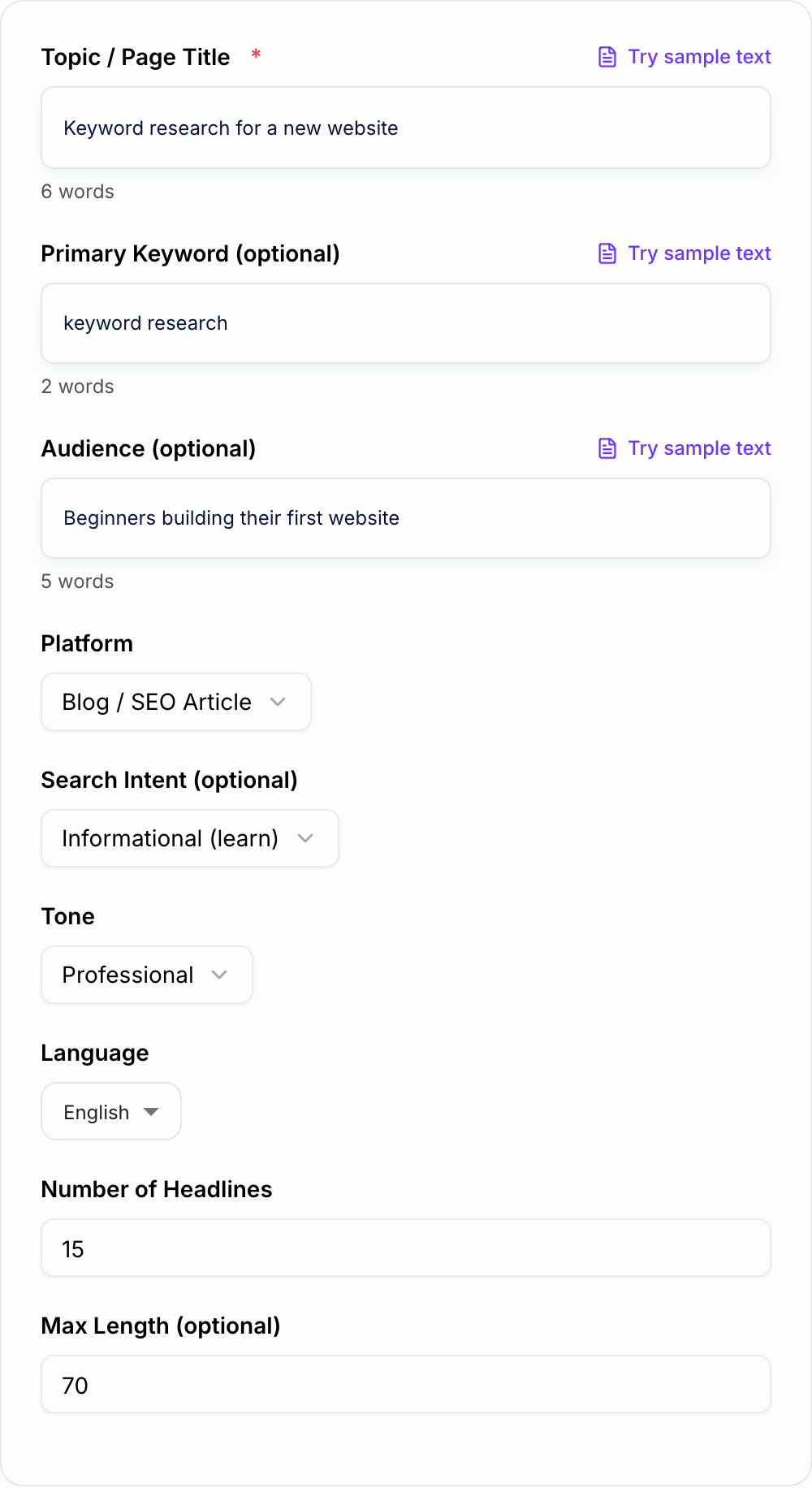
Topic: keyword research for a new website
Keyword: keyword research
Audience: beginners building their first site
Platform: blog / SEO article
Intent: informational
Tone: practical and beginner-friendly
The second prompt gives the generator enough direction to create headlines that match search intent instead of generic title ideas.
- Use case: Blog / SEO · What the form should emphasize: Keyword early, honest promise · Weak output to discard: Clever line that hides the topic
- Use case: Email subject · What the form should emphasize: Short, specific, no fake urgency · Weak output to discard: ALL CAPS or unexplained “last chance”
- Use case: YouTube · What the form should emphasize: Curiosity plus a visible payoff · Weak output to discard: Mystery with no video content
- Use case: Ads · What the form should emphasize: Benefit inside a tight character limit · Weak output to discard: Claims the landing page cannot prove
Choose the Right Headline Mode
Use SEO Titles when ranking and search snippet clarity matter. The headline should put the main topic early and make the page promise obvious.
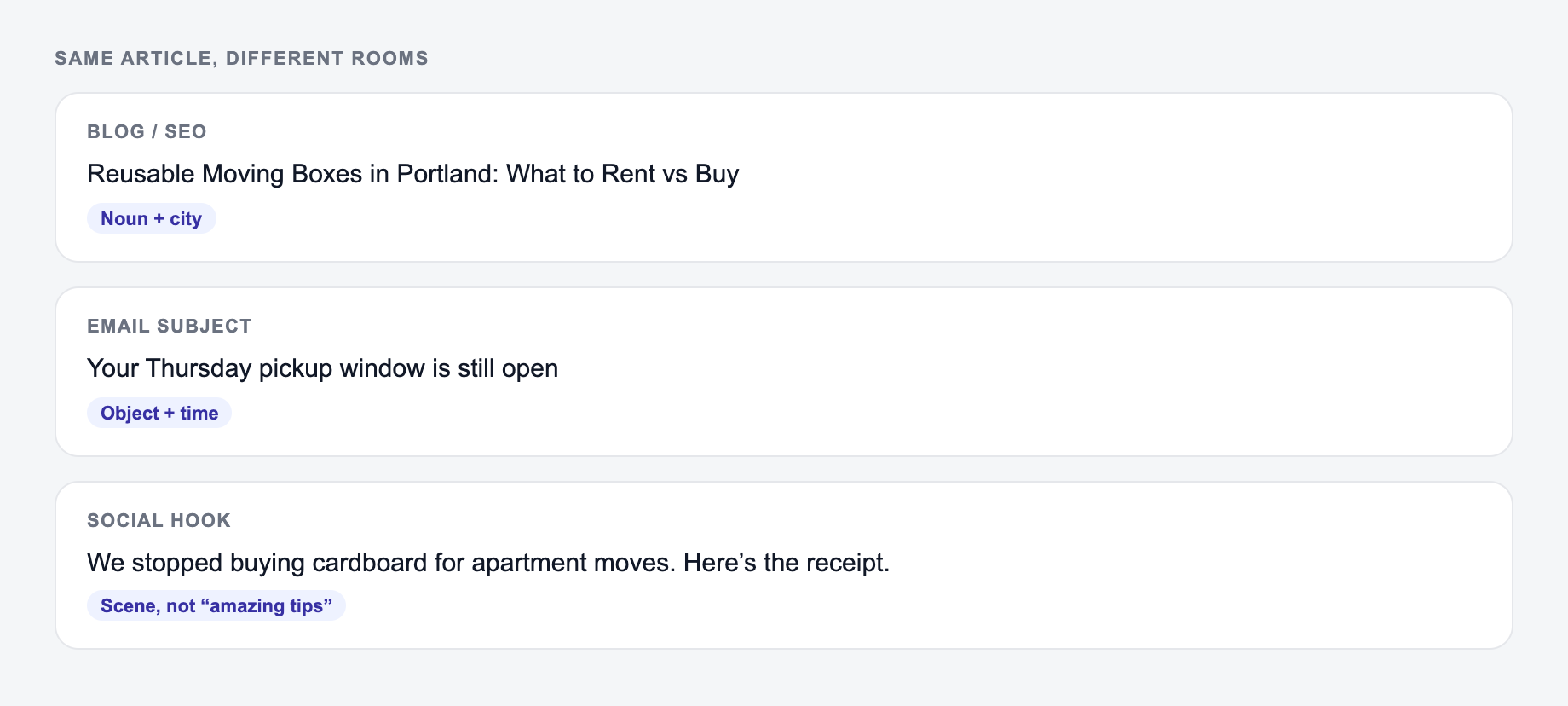
Use High-CTR when you want more curiosity, contrast, or urgency without making misleading claims.
Use How-To for instructional content where the reader wants a clear outcome.
Use Listicle when the page is built around examples, tips, tools, reasons, mistakes, or templates. Before choosing a format, look at a few real blog post examples that rank for your topic. The format they share is usually the one searchers expect.
Use Email Subject Lines when the headline needs to be short, specific, and preview-friendly.
Use Ad Headlines when the output needs to stay concise and benefit-led inside character limits.
Use YouTube Titles when curiosity matters, but the viewer still needs to know what the video is about.
Use Brand Voice Pack when several headline options need to sound like the same company, creator, or campaign.
Headline Formulas the Generator Can Build From
Good generated headlines usually follow a clear structure. A few reliable patterns:
- How to [outcome] without [pain]
- [Number] [things] to [outcome]
- [Topic] checklist: [clear benefit]
- [Option A] vs [Option B]: which is better for [audience]
- [Number] mistakes that [negative result]
- [Audience] guide to [topic]
These headline formulas are useful because they force the title to make a promise. The generator can vary the angle quickly, but you still need to choose the version that best matches the content.
How to Shortlist Generated Headlines
Do not publish the first title just because it sounds polished. Generate 15 to 25 options, then cut aggressively.
Keep headlines that:
- state the topic clearly
- match the chosen platform
- include the keyword naturally when SEO matters
- add a real differentiator
- avoid exaggerated claims
- fit the page content you actually have
Remove headlines that:
- sound clever but vague
- promise more than the page delivers
- hide the main topic
- use filler adjectives instead of specifics
- combine too many ideas in one line
Once you have three to five finalists, use the analyzer to analyze your headline for clarity, keyword fit, length, and click potential before publishing.
Platform-Specific Editing Tips
Blog and SEO Titles
Search titles should be clear before they are clever. Put the keyword or main topic early, then add a benefit, audience, number, year, or constraint if it helps the result stand out. For deeper search-focused editing, use the principles behind writing headlines for SEO: intent match, specificity, and a title that accurately reflects the page.
Landing Page Headlines
Landing page headlines should connect the offer to the outcome. "Project management software" is a category. "Plan client work without losing billable hours" is closer to a promise.
Email Subject Lines
Subject lines need to be short enough to scan. Specific beats loud. Avoid spammy phrasing, unexplained urgency, and tricks that make the email feel misaligned after the open.
YouTube Titles
YouTube titles can lean more curious, but they still need a visible payoff. "I Tried X for 30 Days" works because it promises a result, not just mystery.
Ad Headlines
Ad headlines need benefit, clarity, and restraint. Generate several variants because small wording changes can matter when space is limited.
Pair the Headline With the Right Next Step
The headline is only one part of the page. After you choose it, check whether the intro, page promise, and title tag support the same angle.
If the headline will become an article title, compare it with real headline examples to make sure the final version is not too generic. If you need a full draft after choosing the title, move from the headline into the AI blog post generator and keep the article aligned with the promise you selected.
For SEO snippets, the title tag may need a slightly different shape from the visible H1. A concise SEO meta title generator can help create a search-friendly version without making the page headline feel stiff.
When to Use a Clickbait Title Generator
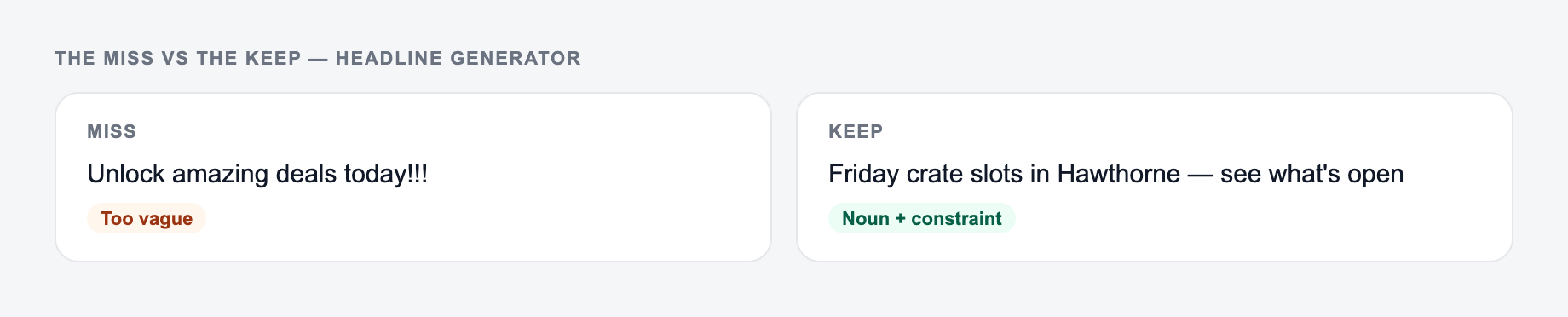
Curiosity-led headlines can be useful for social, entertainment, and awareness campaigns. The risk is overpromising.
If you use the clickbait title generator for ideation, treat the output as raw material. Pull out the strongest hook, then edit it back toward accuracy, brand fit, and the actual page content. The goal is a title that is catchy without being clickbait: it creates curiosity but tells the reader exactly what they will get.
Final Checklist Before Publishing
Before you lock in the headline, confirm:
- the main topic is obvious
- the intended audience is clear or implied
- the headline matches the platform
- the promise is specific and honest
- the keyword fits naturally if SEO matters
- the title is not too long for its context
- the page, email, ad, or video delivers on the headline
If you are producing headlines across several content types, keeping them inside Junia AI makes it easier to maintain consistent tone while still adapting each title to its channel.
Worked Shortlist: One Topic, Three Channels
For an illustrative article about reducing food waste at small restaurants, a search title might be Restaurant Food Waste: A Practical Reduction Checklist; an email subject could be Where this week’s food cost leaked; and a short-video hook could be Three prep habits filling your waste bin. They share a topic but make different promises. Do not reuse a curiosity-led subject line as an SEO title without checking intent.
AI Article Writer
Turn one keyword into a complete, SEO-optimized article
- Researches the topic and outlines the article for you
- Writes headings, images, FAQs, and internal links in one go
- Publishes to WordPress, Webflow, Shopify, Ghost, and more
Frequently Asked Questions
Is this headline generator free to use?+
Yes. You can generate headline ideas for free. Some advanced modes (like ad-focused or brand-voice packs) may be marked as premium depending on your setup.
Will the headlines be SEO-friendly?+
The tool is designed to produce SEO-friendly titles by keeping keywords natural, matching search intent, and prioritizing clarity. For best results, combine a primary keyword with a clear topic and validate against your SERP competitors.
How many headlines should I generate?+
For most pages, generate 10–25 headlines, shortlist 3–5, then choose the strongest option based on clarity, specificity, and intent match. For A/B testing, generate 25–50 to explore more angles.
What makes a good headline for Google search?+
A strong SEO title clearly states the topic, includes the primary keyword early (when possible), matches intent (how-to, list, comparison), and promises a specific benefit without being misleading.
Can I generate headlines in other languages?+
Yes. Choose your output language to generate headlines for multilingual SEO, international campaigns, or localized marketing.
How do I avoid clickbait headlines?+
Use benefit-driven specificity (what the reader gets) and avoid exaggerated claims. This generator prioritizes compelling clarity over misleading hooks, especially in High-CTR mode.