
AI SEO for Plumbers: Get More Local Calls From Search

Thu
AI SEO Specialist, Full Stack Developer

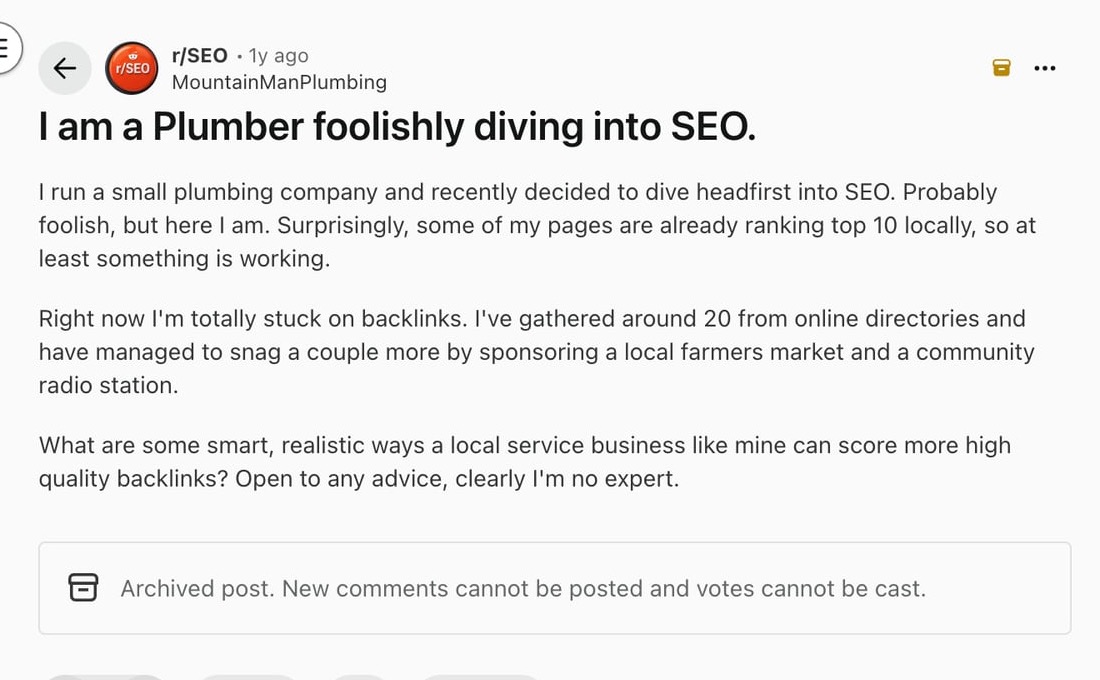
AI SEO for plumbers is not about asking a chatbot to write a few generic blog posts. In my experience, that is where plumbing SEO projects start to drift. The useful version is much more practical: use AI to find local search opportunities faster, build better service pages, improve your Google Business Profile, answer urgent customer questions clearly, and track which searches turn into booked jobs.
That distinction matters because plumbing SEO has a different job from ordinary content marketing. A homeowner searching "emergency plumber near me" does not want a thought leadership article. They want a local plumber who looks legitimate, answers the exact problem, serves their area, and is easy to call from a phone.
If I were improving SEO for a plumbing company, I would focus on calls and jobs before traffic. Rankings are useful only when they bring the right local customers into the business. A smaller number of qualified emergency or repair calls usually beats a larger pile of vague informational visits.
TL;DR
The best plan for plumbers starts with local search fundamentals, then uses AI SEO to speed up the work that actually produces calls.
| Priority | What to do | Why it matters |
|---|---|---|
| Google Business Profile | Complete services, categories, hours, service areas, photos, reviews, and posts | Local visibility depends heavily on relevance, distance, and prominence |
| Service pages | Create pages for high-intent jobs like drain cleaning, water heater repair, leak detection, sewer line repair, and emergency plumbing | Specific service pages match specific customer problems better than one broad services page |
| Location coverage | Build useful city or service-area pages only where you genuinely work | Local pages help search engines and customers understand where you operate |
| Reviews | Ask for reviews consistently and reply to them | Reviews influence trust and can support local prominence |
| Mobile conversion | Make the phone number, booking form, emergency CTA, and service-area proof easy to find on mobile | Many plumbing searches happen when the customer is already stressed |
| AI workflow | Use AI for keyword grouping, content briefs, internal links, GBP posts, and page refreshes | AI saves time, but the facts, pricing, service area, and proof still need human review |
What SEO for Plumbers Actually Means
SEO for plumbers is the process of making your plumbing business easier to find in Google Search, Google Maps, and AI-assisted search experiences when nearby customers search for plumbing help.
In practice, that usually means five things:
- A complete Google Business Profile.
- Clear service pages for the plumbing jobs you want.
- Local pages for cities, neighborhoods, or service areas you can actually cover.
- Reviews, photos, citations, and local proof that build trust.
- A fast, mobile-friendly website that turns visits into calls.
Those five pieces do different jobs. Mixing them up is how plumbing sites end up with a blog post trying to rank for "emergency plumber" while the Google Business Profile still says "closed."
| Asset | Best for | Weak when used as |
|---|---|---|
| Google Business Profile | Map pack, "near me" calls, reviews, hours, photos | A substitute for service pages |
| Service pages | High-intent jobs like drain cleaning, water heater repair, leak detection | A dumping ground for every city you might someday serve |
| Blog or FAQ content | Pre-call questions and related searches that support a service | The main conversion page for an emergency job |
AI can help with each of those steps, but it should not replace your local knowledge. A plumber knows which jobs are profitable, which neighborhoods matter, what questions customers ask before booking, and which calls are usually a bad fit. I would treat that knowledge as the raw material, not the final polish. Without it, AI tends to produce neat pages that sound plausible and still miss the real business.
Google says local results are mainly shaped by relevance, distance, and prominence. For plumbers, that means your profile and website need to show what you do, where you do it, and why customers trust you. Google's local ranking guidance is still the simplest evidence-backed way to understand the map-pack side of this.
Start With Local Intent, Not Generic Keywords
The biggest mistake I see in plumber SEO is targeting broad terms first. "Plumber" is not useless, but it is too vague to guide a real page strategy. It tells you the market exists; it does not tell you which page to build next.
A better keyword plan separates searches by service, urgency, and location.
| Search type | Example keyword | What the customer likely wants | Best page or asset |
|---|---|---|---|
| Emergency | emergency plumber in Austin | Immediate help and a phone number | Emergency plumbing page |
| Service-specific | water heater repair near me | Diagnosis, pricing clues, booking | Water heater repair page |
| Problem-specific | sewer smell in bathroom plumber | Explanation plus service fit | Service page section or blog support |
| Local | plumber in Round Rock | Nearby company with reviews | City page or homepage |
| Commercial | commercial plumbing contractor Dallas | Licensed business contractor | Commercial plumbing page |
| Comparison | plumber vs drain cleaning company | Decision help | Educational article or FAQ section |
AI is useful here because it can group hundreds of terms into cleaner clusters. When I review plumbing keyword lists, the first pass is usually messy: city modifiers, "near me" searches, repair terms, replacement terms, emergency terms, and DIY questions all mixed together. Junia's AI keyword research tool can help turn that export into groups like emergency plumbing, drain cleaning, water heaters, leak detection, gas lines, sewer lines, and commercial service.
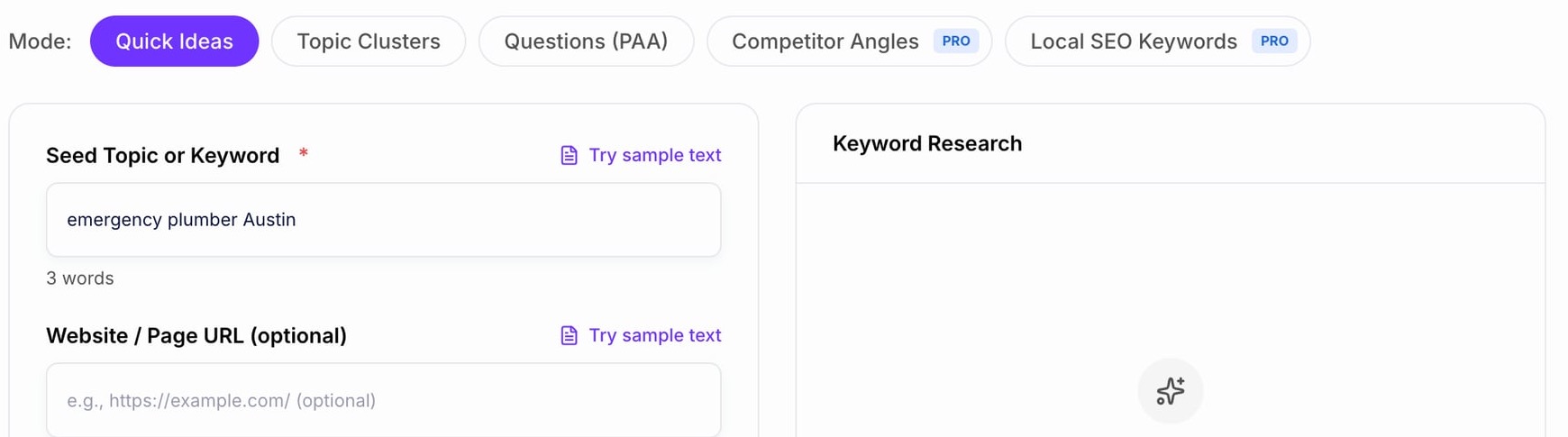
The human decision comes after that. Do not create a page for every keyword variation. Create a page when the searcher has a distinct problem and deserves a distinct answer. That restraint matters; thin keyword pages are easy to create and hard to make trustworthy.
Build Service Pages Around Real Plumbing Jobs
Competitor articles on plumber SEO tend to agree on one thing: a plumbing website needs dedicated service pages. I would go further and say those pages should be built like booking pages, not encyclopedia entries.
A strong plumbing service page should answer these questions quickly:
- What problem does this service solve?
- Do you offer emergency or same-day help?
- Which areas do you serve?
- What signs mean the customer should call now?
- What happens after they call?
- Are you licensed, insured, experienced, or specialized?
- Can the customer call or book from mobile without hunting?
For example, a drain cleaning page should not just say "we offer drain cleaning." It should mention clogged kitchen sinks, slow tubs, backed-up floor drains, recurring blockages, sewer line warning signs, equipment used when appropriate, and the areas served. Personally, I trust pages more when they describe the messy realities customers recognize instead of staying at the brochure level.
A strong emergency page usually leads with the phone number and booking CTA, then proves the service. This plumber site does that before it tries to explain anything:
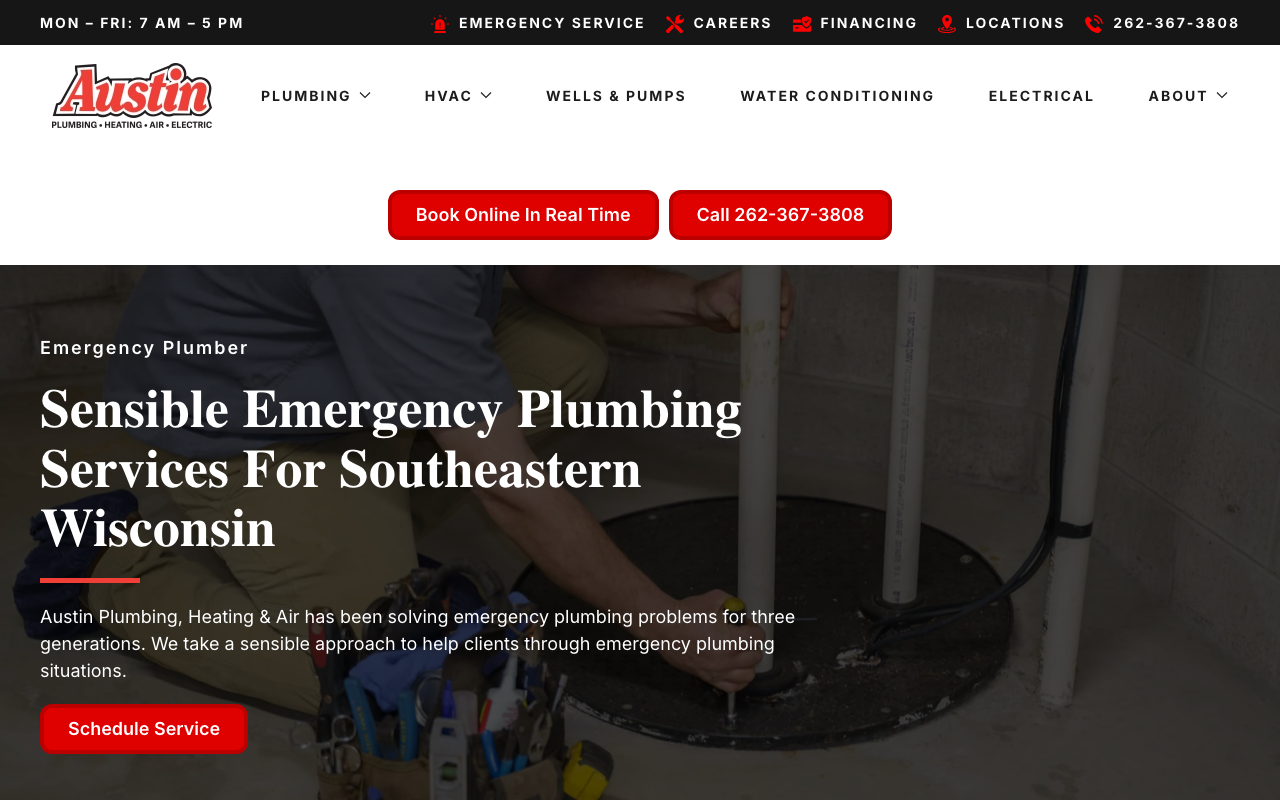
Here is a simple service-page structure that works well:
| Page section | What to include |
|---|---|
| H1 and opening | Service + location + direct promise |
| Emergency CTA | Phone number, hours, and response expectations |
| Common problems | Symptoms customers recognize |
| Service details | What you inspect, fix, replace, or clean |
| Local proof | Reviews, photos, neighborhoods, nearby landmarks, technician experience |
| Pricing guidance | Explain inspection fees, variables, or quote process honestly |
| FAQs | Short answers to booking objections |
| Internal links | Related services, nearby city pages, financing, maintenance plans |
If you serve multiple cities, location pages for SEO are worth building only when each page has real local value. A copied city page with the city name swapped out is weak, and customers can usually feel that weakness before search engines even get involved. A useful city page includes the services offered there, proof you work there, local photos when available, reviews from nearby customers, and clear dispatch or coverage details.
Optimize Google Business Profile Like a Revenue Channel
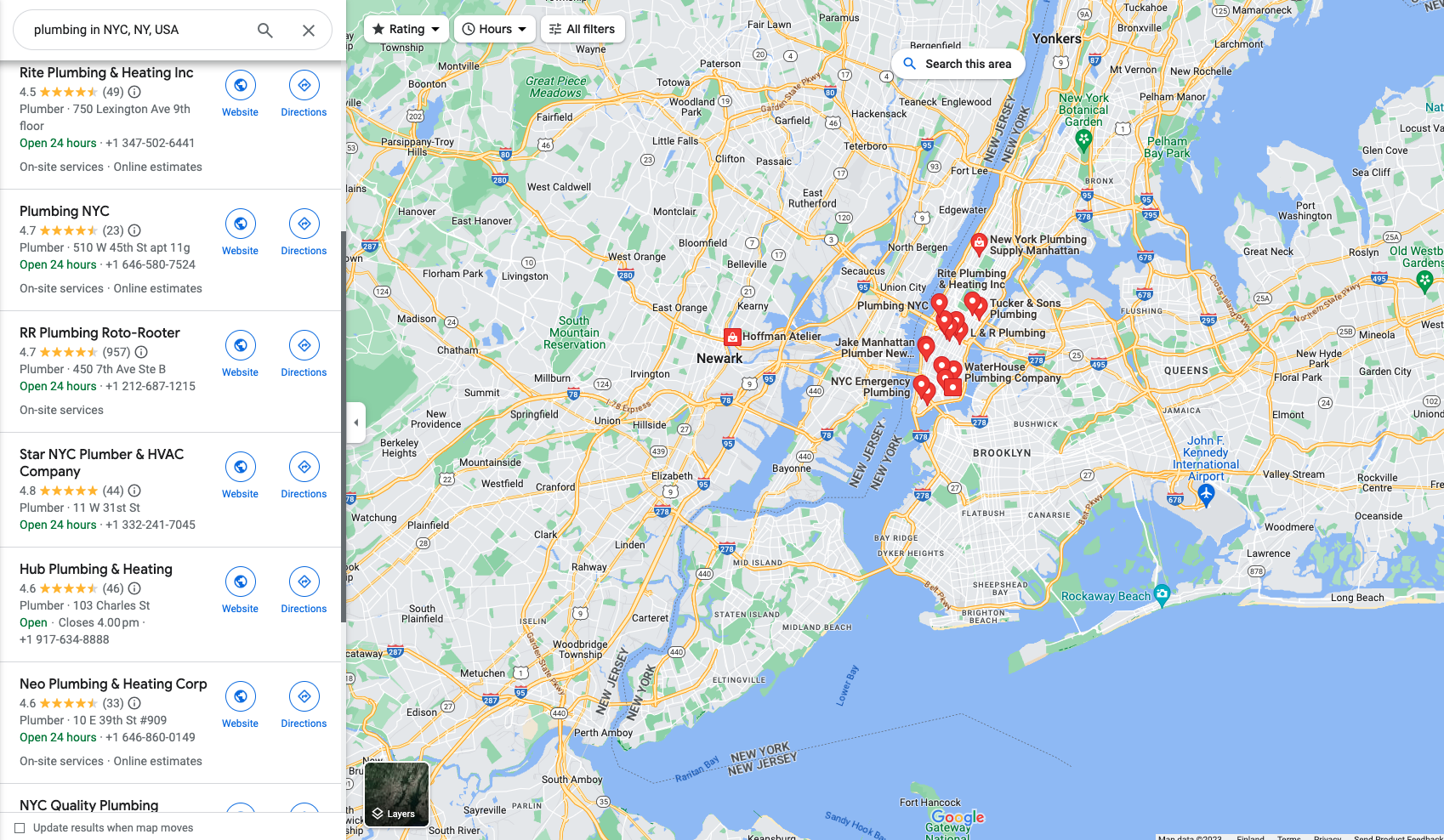
For many plumbing companies, the Google Business Profile is more important than the homepage. I do not say that lightly. Customers can call, read reviews, check hours, view photos, get directions, and compare nearby competitors before they ever click through to the website.
This is what that comparison looks like in Maps. The listings that get the tap are the ones with a clear category, recent reviews, hours that match reality, and a phone number that works:
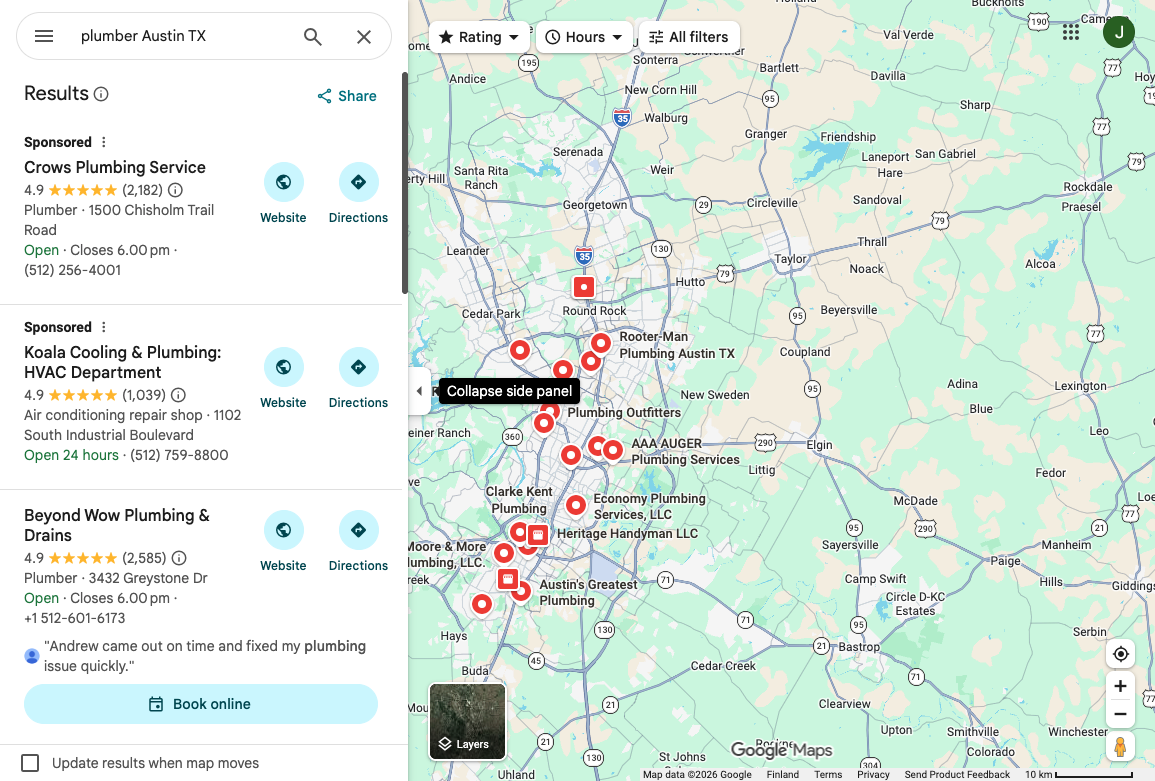
If the profile is the main revenue channel, treat it like one. This walkthrough from Sterling Sky is a useful GBP checklist for home services, including plumbers:
5 Secrets to Optimize Your Google Business Profile in 2026
Start with the basics:
- Use the most accurate primary category, usually plumber.
- Add secondary categories only when they genuinely match your business.
- Keep your phone number, website, hours, service area, and appointment link accurate.
- List core services with plain descriptions.
- Upload real photos of vans, staff, jobs, equipment, and completed work.
- Ask for reviews after completed jobs.
- Reply to reviews in a calm, specific, professional way.
- Use posts for seasonal services, emergency reminders, financing, maintenance, and local offers.
Google notes that reviews can help businesses stand out and provide useful information next to Business Profiles in Search and Maps. Its review guidance also makes clear that verified businesses can reply to reviews, which is worth doing because replies show future customers that someone is paying attention. Use Google's review guidance as the baseline, then build your own review request process around real completed jobs.
AI can help here, but keep it grounded. A Google Business Profile post generator can draft weekly posts about water heater maintenance, frozen pipes, drain cleaning, sump pumps, or emergency service. The final version should still include your actual service area, availability, and offer details. Generic posts are better than silence only up to a point; specific, local posts are what make the profile feel active and real.
Use AI to Create Better Briefs, Not Unchecked Pages
.png?token=eyJhbGciOiJIUzI1NiIsInR5cCI6IkpXVCJ9.eyJ1cmwiOiJ1c2VyLWdlbmVyYXRlZC1pbWFnZXMvZjJmOThkNWUtNjNjNC00MTJiLTkyY2QtZjgyNDI5NTE3YWRkL1NjcmVlbnNob3QgMjAyMy0xMi0xNiBhdCAyMi4yMi40MCAoMSkucG5nIiwiaWF0IjoxNzA5OTI2OTgyLCJleHAiOjIwMjUyODY5ODJ9.NxlMdWLT7hJ7G-gdVhEoSN3czw1rVEk245yl0zE-C5U)
The safest way to use AI in plumber SEO is to treat it as a planning and drafting assistant. I like AI most in the unglamorous parts of the process: sorting keywords, shaping briefs, turning rough technician notes into clearer language, and finding obvious gaps before a page goes live.
For example, you can use AI to:
- Group plumbing keywords by service and intent.
- Draft content briefs for service pages.
- Find missing FAQs from competitor pages and People Also Ask style questions.
- Turn technician notes into plain-language explanations.
- Create Google Business Profile post drafts.
- Suggest internal links between related services.
- Refresh old pages with updated services, photos, and calls to action.
- Summarize Search Console data into action items.
What you should not do is publish AI-written service pages without review. Plumbing content can affect real customer decisions. If a page gives bad advice about gas lines, sewer backups, water damage, permits, or emergency repairs, it can damage trust fast. This is one area where speed is not the win; accuracy is.
Google's guidance on generative AI content is practical: AI can help with research and structure, but scaled content that does not add value for users can violate spam policies. In other words, the problem is not that AI touched the page. The problem is publishing unhelpful, generic, inaccurate content. Google's generative AI content guidance is worth following closely if you plan to produce pages at scale.
For page planning, a SEO content brief generator is most useful when you feed it real inputs: service area, services offered, license details, review themes, customer objections, pricing constraints, and competitor gaps.
Create a Keyword Map Before You Write
Before writing new pages, map keywords to pages. This prevents two problems I see often: one page trying to rank for everything, and ten pages quietly competing for the same search.
Here is a practical keyword map for a plumbing company:
| Page | Primary intent | Supporting terms |
|---|---|---|
| Homepage | plumber + city | licensed plumber, plumbing company, local plumber |
| Emergency plumbing | urgent help | 24 hour plumber, burst pipe, emergency leak repair |
| Drain cleaning | clogged drains | blocked drain, sewer drain cleaning, sink clog, shower drain |
| Water heater repair | hot water problems | no hot water, leaking water heater, water heater replacement |
| Leak detection | hidden leaks | slab leak, water leak, pipe leak, moisture damage |
| Sewer line repair | sewer issues | sewer backup, sewer line replacement, trenchless repair |
| Commercial plumbing | business services | restaurant plumber, office plumbing, commercial contractor |
| City page | local service area | plumber in [city], emergency plumber [city], drain cleaning [city] |
This is also where AI helps with internal linking. A plumbing site often has many related pages: water heater repair connects to emergency plumbing, leak detection connects to pipe repair, drain cleaning connects to sewer line repair, and city pages connect back to major services. Junia's AI internal linking tool can suggest connections, but the final link should still help the reader move to a genuinely related service. If I cannot explain why a link helps the customer, I would leave it out.
Make the Website Easy to Use on a Phone
Mobile usability is not a nice extra for plumbers. It is central to conversion. I would put this ahead of almost any cosmetic website improvement.
Someone with a leaking pipe may be standing in a kitchen with one hand on a towel and the other hand on a phone. If your site hides the phone number, loads slowly, or makes the contact form painful, that person will go back to Google and call the next plumber.
At minimum, check these items:
- Tap-to-call button visible near the top of every service page.
- Emergency service language above the fold when you offer it.
- Short forms with only necessary fields.
- Clear service area list.
- Fast-loading images.
- Reviews or trust proof near the CTA.
- No intrusive popups on mobile.
- Simple navigation to services, locations, reviews, and contact.
Google uses the mobile version of a site's content for indexing and ranking, which makes mobile content parity and mobile usability important beyond conversion. Google's mobile-first indexing guidance is a good technical reference for this.
Add LocalBusiness Schema and Keep NAP Consistent
Structured data will not magically make a plumbing company rank. But it can help search engines understand the business details on the page. I think of it as cleanup work: rarely exciting, often worth doing, and easy to get wrong if nobody checks the details.
For plumbers, the most relevant schema usually includes LocalBusiness or a more specific subtype when appropriate, plus core details such as:
- Business name.
- Phone number.
- Address or service area.
- Opening hours.
- URL.
- Logo.
- SameAs profiles.
- Service details where appropriate.
Google's LocalBusiness structured data documentation says this markup can tell Google about details such as business hours, departments, and reviews where supported. Use it to clarify real business information, not to mark up claims that are not visible on the page. Google's LocalBusiness structured data guide is the right source to follow.
Also keep NAP consistent: name, address, and phone number. For service-area businesses, this can be a little trickier because some plumbers hide their street address. That is fine when it matches your actual business setup, but your website, Google Business Profile, and major citations should not contradict each other.
NAP mismatches cost calls. This matters most when you have two phone numbers, a tracking number on the website, an old address on Yelp, and a service-area profile on Google. Pick one public name, one public phone number, and one address or service-area setup. Then copy those details everywhere else. AI can help you find the mismatches. It cannot decide which version is the real business.
Reviews Are SEO and Sales Proof
Reviews matter twice. They can support local prominence, and they help customers decide whether to call. For plumbers, I would argue the second part matters even more because the customer is often making a fast trust decision under pressure.
A good review system does not need to be complicated:
- Ask after the job is complete.
- Make the request short and easy.
- Do not pressure customers or script fake language.
- Reply to positive reviews with specific thanks.
- Reply to negative reviews calmly and move private details offline.
- Track review themes so your website answers common objections.
If customers often mention "arrived fast," "explained the problem," or "cleaned up after the repair," use that language on your service pages. That is real trust-building copy. It sounds more credible than generic claims like "best plumbing services," and it gives AI-generated drafts a much more human base to work from.
AI can summarize review themes, but be careful with privacy and accuracy. Do not invent testimonials, do not rewrite reviews as if customers said something they did not say, and do not publish private job details.
Write Content That Helps Before It Sells
Plumbers do not need a blog full of generic posts. They need helpful content that supports real searches and real customer decisions. I would rather see ten useful support articles tied to profitable services than fifty thin posts written only because a keyword tool found volume.
Good content ideas include:
- "Why does my drain keep clogging?"
- "When is a leaking water heater an emergency?"
- "What causes low water pressure in one bathroom?"
- "Do I need a plumber or a drain cleaning company?"
- "What should I do before the plumber arrives?"
- "How often should sewer lines be inspected?"
- "Tank vs tankless water heater: which makes sense for this home?"
These articles support service pages when they answer related questions and link naturally to the next step. They also make the site more useful for AI search because the answer is clear, specific, and easy to extract.
Google's newer guidance for generative AI features says core SEO best practices still matter because AI features draw from Google's Search systems. For a plumbing site, that means clear answers, crawlable content, helpful original information, useful images or videos, and pages that satisfy real local intent. Google's guide to generative AI optimization is useful here because it pushes the conversation back toward fundamentals instead of gimmicks.
Prepare Plumbing Pages for AI Search
AI Search does not remove the need for SEO. It raises the bar for clarity. The pages most likely to survive that shift are the ones that already answer the customer's question plainly.
If you want plumbing pages to be easier for AI systems to cite, summarize, or use in answers, make the page structure explicit:
- Put the direct answer near the top.
- Use descriptive headings.
- Define the service in plain language.
- Include service-area details.
- Add short FAQs in metadata and on-page sections where appropriate.
- Use tables for pricing variables, symptoms, or service comparisons.
- Include original details from your business, not generic filler.
- Keep your business details consistent across the web.
For example, instead of writing "We provide comprehensive water heater solutions," write something closer to: "We repair leaking water heaters, replace failed units, flush sediment buildup, and install tank and tankless systems in [service area]."
That sentence is easier for a customer, a search engine, and an AI summary to understand.
Track Calls, Not Just Rankings
Plumbing SEO should be measured by commercial outcomes.
Useful metrics include:
| Metric | Where to check | What it tells you |
|---|---|---|
| Calls from Google Business Profile | Business Profile performance | Whether map visibility is producing customer actions |
| Website clicks from profile | Business Profile performance | Whether profile visitors want more detail |
| Queries and pages | Google Search Console | Which services and cities are gaining impressions |
| Form submissions | Analytics or CRM | Which pages generate leads |
| Booked jobs by source | CRM or call tracking | Which SEO work produces revenue |
| Review volume and rating | Google Business Profile | Whether trust is improving |
Google Business Profile performance reports include customer interactions on Search and Maps, including clicks and other activity. That data is a practical starting point for deciding whether your profile optimization is helping. Google's Business Profile performance documentation explains what owners can review.
For the website, Search Console can show whether a drain cleaning page is getting impressions but not clicks, or whether a city page gets clicks but no leads. That tells you whether the problem is the title, the page content, the CTA, the service fit, or the offer. I would not obsess over daily ranking movement until these larger signals are visible.
AI SEO Workflow for a Plumbing Business
Here is the workflow I would use for a small or mid-sized plumbing company. It keeps AI in the parts of the job where it is genuinely useful and keeps business judgment where it belongs.
| Step | AI can help with | Human review should check |
|---|---|---|
| Audit | Summarize pages, rankings, service gaps, and technical issues | Whether the recommendations match business goals |
| Keyword research | Cluster keywords by service, urgency, and location | Which jobs are profitable and worth targeting |
| Page briefs | Build outlines for service and city pages | Accuracy, licensing, pricing, service area, and claims |
| Drafting | Create first drafts from approved briefs | Specificity, tone, expertise, compliance, and trust |
| Optimization | Improve headings, internal links, metadata, and FAQs | Whether the page still reads naturally |
| GBP posts | Draft local updates and seasonal reminders | Actual availability, offers, and emergency policy |
| Reporting | Summarize Search Console and GBP performance | Which leads became booked jobs |
This is where an AI SEO agent can be useful for repeatable work: identifying gaps, organizing recommendations, and speeding up optimization. The plumber or marketer still needs to decide what is true for the business. In my view, the best setup is not "AI runs SEO." It is "AI keeps the work moving so a person can make better decisions faster."
Common Mistakes to Avoid
The first mistake is building one thin "services" page and expecting it to rank for every plumbing job. Specific searches need specific pages.
The second mistake is creating city pages with the same copy repeated across every location. If the page does not prove you serve that area, it will not help much.
The third mistake is treating Google Business Profile as a set-it-and-forget-it listing. Photos, services, reviews, hours, and posts all need maintenance.
The fourth mistake is publishing AI content without field-level review. A page about gas line repair, sewer backups, or emergency leaks needs accuracy more than volume.
The fifth mistake is chasing traffic that cannot become revenue. A post about "history of plumbing" may get visits, but it probably will not produce many booked jobs. Service-intent content is usually more valuable.
The sixth mistake is ignoring internal links. Related pages should help customers move from symptom to service. For example, a low water pressure article may naturally link to leak detection, pipe repair, or water heater service depending on the explanation. Strong internal links also help search engines understand how your service pages connect; Junia's SEO improver can help spot pages that need clearer optimization.
The pattern behind most of these mistakes is the same: doing more SEO activity without asking whether it makes the next customer more likely to call. I would use that as the filter for almost every recommendation.
Final Recommendation
If you run a plumbing business, start with the work closest to revenue:
- Fix your Google Business Profile.
- Build or improve your core service pages.
- Add useful local pages for real service areas.
- Create a review request process.
- Make the site fast and easy to call from mobile.
- Use AI to speed up keyword research, briefs, page refreshes, posts, and reporting.
AI can make plumber SEO faster, but it cannot fake local trust. The pages that win are still the ones that answer the customer's problem clearly, prove the business serves the area, and make the next step obvious. That is the part I would protect most carefully as AI enters the workflow.