
12 Best AI SEO Tools (Only the Ones That Actually Move Rankings)

Yi
SEO Expert & AI Consultant

The useful AI SEO tools are not the ones that simply rewrite text. They are the ones that help you make better SEO decisions faster.
A strong tool should help with at least one meaningful part of the workflow: keyword discovery, content briefs, on-page optimization, internal linking, competitor analysis, or content refresh prioritization. If it only spins copy, it is not really moving rankings. If you need several of those steps coordinated together, an AI SEO agent is usually a better fit than another disconnected point tool.
My bias after testing tools in this category is simple: I care less about how fluent the AI sounds and more about whether it helps me make a better SEO decision. A tool that saves ten minutes on drafting but creates two hours of review work is not a win.
That buyer skepticism is not theoretical. When I looked through public discussions, this Reddit thread about whether AI SEO is worth the investment captured the real concern well. The question was not "which tool writes fastest?" It was whether small businesses should pay for AI SEO at all when AI answers are already changing search traffic.

Best AI SEO Tools: Top Picks
| Rank | Tool | Best for | Pros | Cons | Pricing |
|---|---|---|---|---|---|
| 1 | Junia ai | End-to-end AI SEO content workflow | Strong keyword research, optimization help, Google Search integration, brand voice tools | Learning curve for beginners, can feel pricey for small teams | Creator: $22/month, Unlimited: $42/month |
| 2 | Hypotenuse AI | SEO content production | Fast blog and product content generation, SEO Pro mode | Limited free plan and integrations | Starts at $29/month |
| 3 | Surfer SEO | On-page optimization | Detailed page analysis, practical optimization suggestions | Can feel overwhelming, premium features are expensive | Starts at $89/month |
| 4 | Frase | Content briefs and optimization | Useful content research, briefs, and competitor analysis | Some learning curve, customization is limited | Solo $14.99/mo, Basic $44.99/mo, Team $114.99/mo |
| 5 | SEMrush Writing Assistant | Keyword and competitor intelligence | Deep keyword data, strong competitor research, useful integrations | Expensive for smaller teams, lots of data to learn | Pro $119.95/mo, Guru $229.95/mo, Business $449.95/mo |
| 6 | Clearscope | Content optimization | Excellent topic and term recommendations | Expensive, less beginner-friendly | Essentials $170/month |
| 7 | WordLift | Structured data and entity SEO | Structured data support, knowledge graph help | Weaker writing workflow | Blogger $59/mo, Professional $99/mo, Publisher custom |
| 8 | Serpstat | All-in-one SEO platform | Broad feature set, solid keyword and backlink tools | Advanced features take time to learn | Starts at $69/month |
| 9 | MarketMuse | Content gap analysis | Strong topical depth and content audit insights | Expensive for smaller operators | Starts at $79/month |
| 10 | Jasper | AI-assisted writing | Good for fast draft creation and short-form SEO copy | Less reliable for nuanced long-form content | Creator $49/mo, Teams $125/mo |
| 11 | Outranking | Competitor-led optimization | Strong competitor analysis and actionable recommendations | Keyword depth is lighter than dedicated tools | Starts at $99/month |
| 12 | Scalenut | General SEO workflow support | Accessible interface, decent optimization and tracking features | Keyword research can feel limited | Varies by plan |
If you are choosing by workflow problem rather than brand name, use this faster filter:
| Your main bottleneck | Best tool category | Good options from this list | What to check before paying |
|---|---|---|---|
| Finding topics worth publishing | Keyword and SERP research | Junia ai, SEMrush, Serpstat | Search volume, difficulty, SERP intent, and refresh opportunities |
| Turning research into publishable pages | End-to-end SEO content workflow | Junia ai, Hypotenuse AI, Scalenut | Brief quality, brand voice controls, internal linking, and human review steps |
| Improving an existing draft | On-page optimization | Surfer SEO, Clearscope, Frase | Term suggestions, outline gaps, readability guidance, and editor usability |
| Building topical authority | Content gap and entity SEO | MarketMuse, WordLift, Frase | Topic modeling, entity coverage, structured data, and content inventory support |
| Understanding competitors | Competitive intelligence | SEMrush, Outranking, Serpstat | Ranking data depth, backlink context, and actionability of recommendations |
Why Should You Care?
Modern SEO is too broad to run well with manual guesswork alone. AI tools matter because they help you shorten the gap between research and action.
That does not mean every AI feature deserves your budget. I would rather pay for one tool that improves prioritization than three tools that produce slightly different versions of the same draft.
The best ones help you:
- Save time on repetitive work like keyword clustering, SERP review, and optimization checks.
- Prioritize better opportunities by showing which topics, pages, or competitors deserve attention first.
- Improve user experience by highlighting readability, structure, and search-intent gaps.
- Increase organic traffic potential by helping you produce pages that are better aligned with what searchers want.
- Spot semantic and trend signals earlier so you can create or refresh content before the opportunity is obvious to everyone else.
Optimizing Content for a Moving Google Algorithm
Google’s ranking systems keep changing, which means SEO teams are constantly adapting. Tools alone do not “solve” Google updates, but the right AI SEO platform can make the work more manageable.
Used properly, these tools help you spot weak pages faster, identify search-intent gaps, and respond to changes before rankings slip too far. If algorithm volatility is a concern, it also helps to understand how to recover from a Google algorithm update instead of treating every drop as a mystery.
That is the real value of AI SEO tools. They reduce manual analysis, surface useful patterns, and help you make better optimization decisions faster.
Google's people-first standard still sits above any tool score. If a page exists mainly to rank, the optimizer will happily help you ship a more complete version of a weak article. Watch this Search Central explanation before you treat AI drafting as a ranking strategy:
Creating great content that performs well in Google search results
A coverage score is not a quality score. I have used Surfer and Clearscope on drafts that "hit green" and still would not publish them. Missing examples, invented claims, and a page that could belong to any brand in the niche are still editorial failures. The tool did its job. The page did not.
Top AI SEO Tools
Not every AI SEO tool solves the same problem. Some are best for keyword discovery, some are strongest at on-page optimization, and others are better for content operations, structured data, or competitor analysis.
That is why the list below focuses less on hype and more on where each tool is actually useful in a real SEO workflow.
1. Junia ai
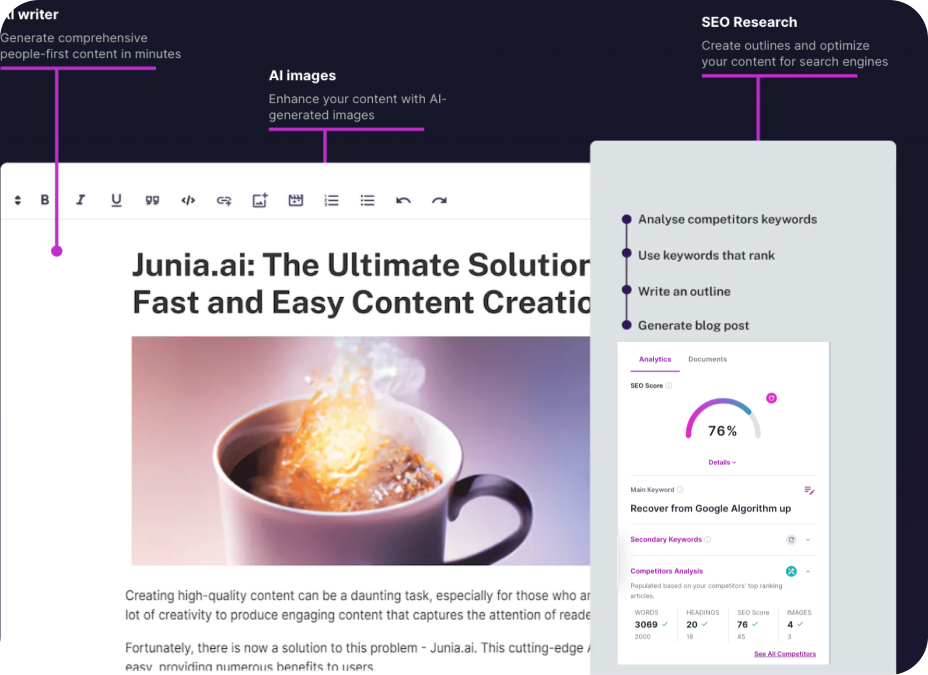
Junia ai is one of the strongest options if you want AI support across the full content SEO workflow, not just one isolated task. It helps with research, drafting, optimization, and content production in one place, which makes it especially useful for teams that want fewer handoffs between tools.
What sets Junia AI apart from other AI SEO tools?
1. Efficient Keyword Research
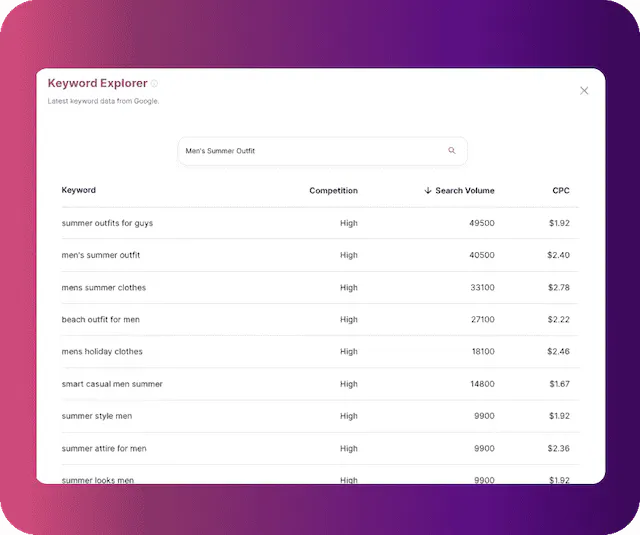
At the core of Junia's feature set is its AI-assisted keyword research. It can scan large keyword sets and surface opportunities with meaningful volume, realistic competition, and clearer search intent.
That balance matters. In my experience, the best keyword target is rarely the biggest keyword on the list. It is the one you can satisfy better than the current SERP.
2. Streamlined Content Optimization
Junia also helps with optimization after the keyword research step. Instead of leaving you with a list of terms and a blank page, it supports outlining, drafting, and refining content so the article stays aligned with search intent.
That matters because good SEO content is not just about adding keywords. It is about covering the topic clearly, structuring the page well, and building a page that is worth reading in the first place.
If you are comparing options, this is where AI SEO tools tend to separate into categories:
- tools for keyword and topic discovery
- tools for on-page optimization
- tools for content generation and editing
- tools for technical or structured data work
Junia is strongest when you want several of those jobs handled in one workflow instead of stitching together five different tools.
2. Hypotenuse AI
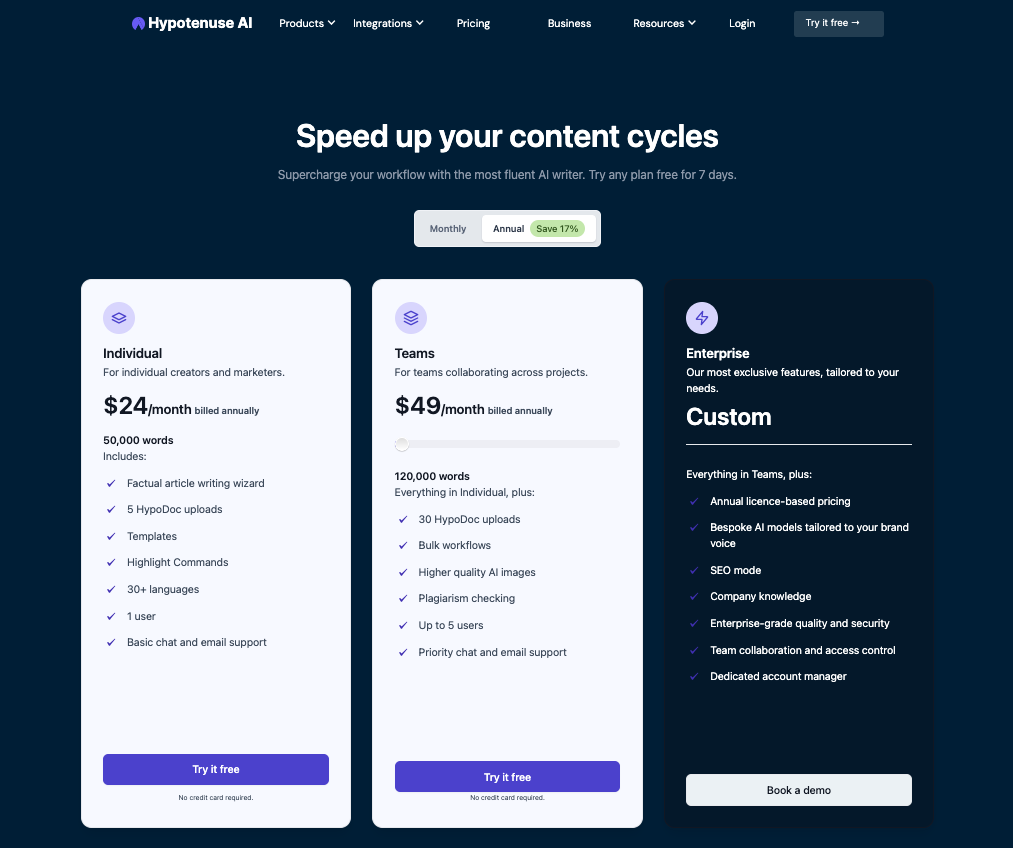
Hypotenuse AI is built for fast content production, especially blog posts, product pages, landing pages, and catalog content. Its main appeal is speed: you can move from keyword input to publishable draft quickly while still keeping SEO requirements in view.
One of its standout features is SEO Pro mode. For teams producing content at scale, that matters because it combines research, outline support, and optimization prompts in the same workflow instead of forcing you to jump between separate tools.
Hypotenuse AI's SEO Pro mode includes:
- Research and analysis with AI: Hypotenuse AI can generate outlines from SERP data and PAAs. It reviews competitors to find topic gaps, content opportunities, and semantically related keywords worth considering.
- SEO optimization: Hypotenuse AI helps blend primary keywords into the content without making the copy feel forced. That matters more than chasing density for its own sake.
- SEO score and checklist: Hypotenuse AI gives you an SEO score for generated content, plus a checklist of suggestions based on common SEO best practices.
Pros and Cons of Using Hypotenuse AI:
Pros
- Full control at each step of the article generation workflow
- Automatically optimizes your content for SEO
Cons
- Its free plan has limitations, such as low word count and integrations
Pricing
Hypotenuse AI gives first-time users a 7-day free trial, which is useful if you want to test the workflow before committing. After that, subscription plans start from $29/month for 50,000 words, and you also get access to a broader suite of AI-powered tools.
If you plan to use Hypotenuse AI's SEO Pro mode across a team, I would look closely at the Enterprise plans because they are better suited to repeat production workflows.
Compare To Other AI SEO Tools
Hypotenuse AI stands out from many general AI writing tools because its output often reads more natural than a plain first-draft generator. Its custom AI models can be trained on past writing and brand guidelines, which helps the tool stay closer to your voice, tone, and style.
The pricing is also reasonable if your team publishes often enough to use the workflow consistently. I would not buy it just to generate the occasional article, but for repeat production with brand controls, it deserves a test.
Effectiveness of Its AI-powered SEO Optimization
Hypotenuse AI's SEO Pro mode does a solid job of adding important SEO elements into the content. The output usually ends up more complete and better aligned with what searchers are actually looking for.
Hypotenuse AI's SEO Pro mode is capable of producing relevant, SEO-optimized content. But, like with all AI tools, human review is still recommended to keep the quality high and make sure the details are accurate.
Overall, Hypotenuse AI is strongest for marketers who want an all-in-one production assistant that can create solid, human-sounding drafts at scale. I would still keep an editor in the loop, especially for pages where expertise and accuracy matter.
3. Surfer SEO
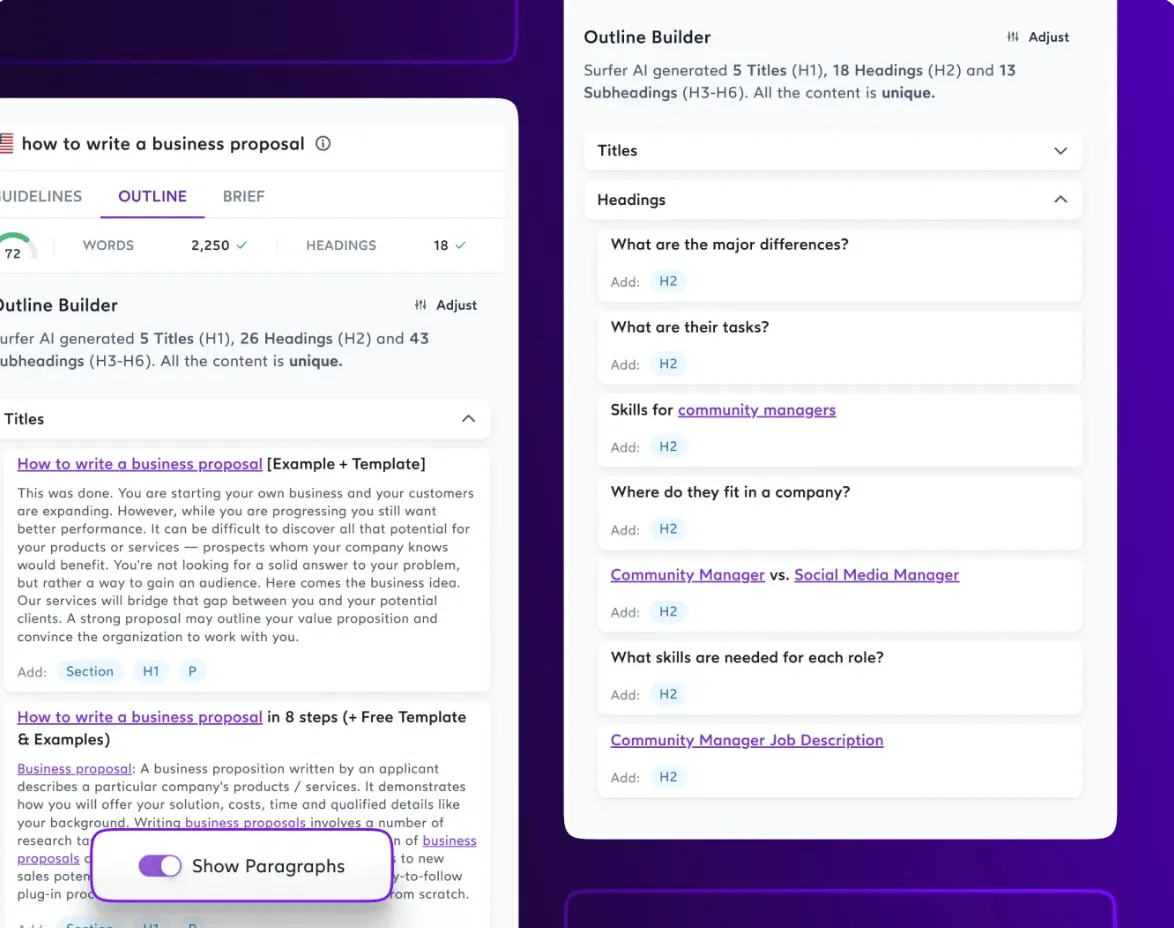
Surfer SEO is one of the best-known tools for on-page optimization. It is strongest when you already have a draft and want clearer direction on term coverage, structure, and content gaps.
What makes Surfer useful is that its recommendations are grounded in SERP patterns rather than gut feel. Instead of guessing how detailed a page should be, you get a more concrete view of what top-ranking results are covering.
Compared with broader platforms like SEMrush or all-in-one content tools like Junia ai, Surfer is more specialized. Its value is not breadth. Its value is helping you tighten page-level execution.
How Does Surfer SEO Improve Content Performance?
Surfer SEO evaluates the page against competing SERP patterns and shows where the draft may be thin, overbuilt, or poorly aligned. It checks things like:
- How you use keywords
- The length of your content
- Optimization of images
- And more!
Those insights give you a more practical editing checklist. The goal is not to chase a perfect content score. It is to make the page clearer, more complete, and easier for actual readers to use.
Pros and Cons of Surfer SEO
Like any AI SEO tool, Surfer SEO has strengths and tradeoffs:
Pros:
- It examines all the elements on your page in a lot of detail.
- It gives suggestions for improving your content that are based on data, not random opinions.
- It has a clean, easy-to-use interface that makes on-page SEO less intimidating.
Cons:
- For beginners, it might feel a bit overwhelming because it has so many features.
- There aren’t a lot of options for integrating it with other CMS platforms.
- Some of the more advanced features can become expensive.
Compare To Other AI SEO Tools
Compared with tools like SEMrush or Clearscope, Surfer SEO holds its own by staying focused. Those tools cover a wider range of SEO work, while Surfer is mainly about page-level optimization. If your main problem is improving an existing draft, that specialization is a strength.
Pricing
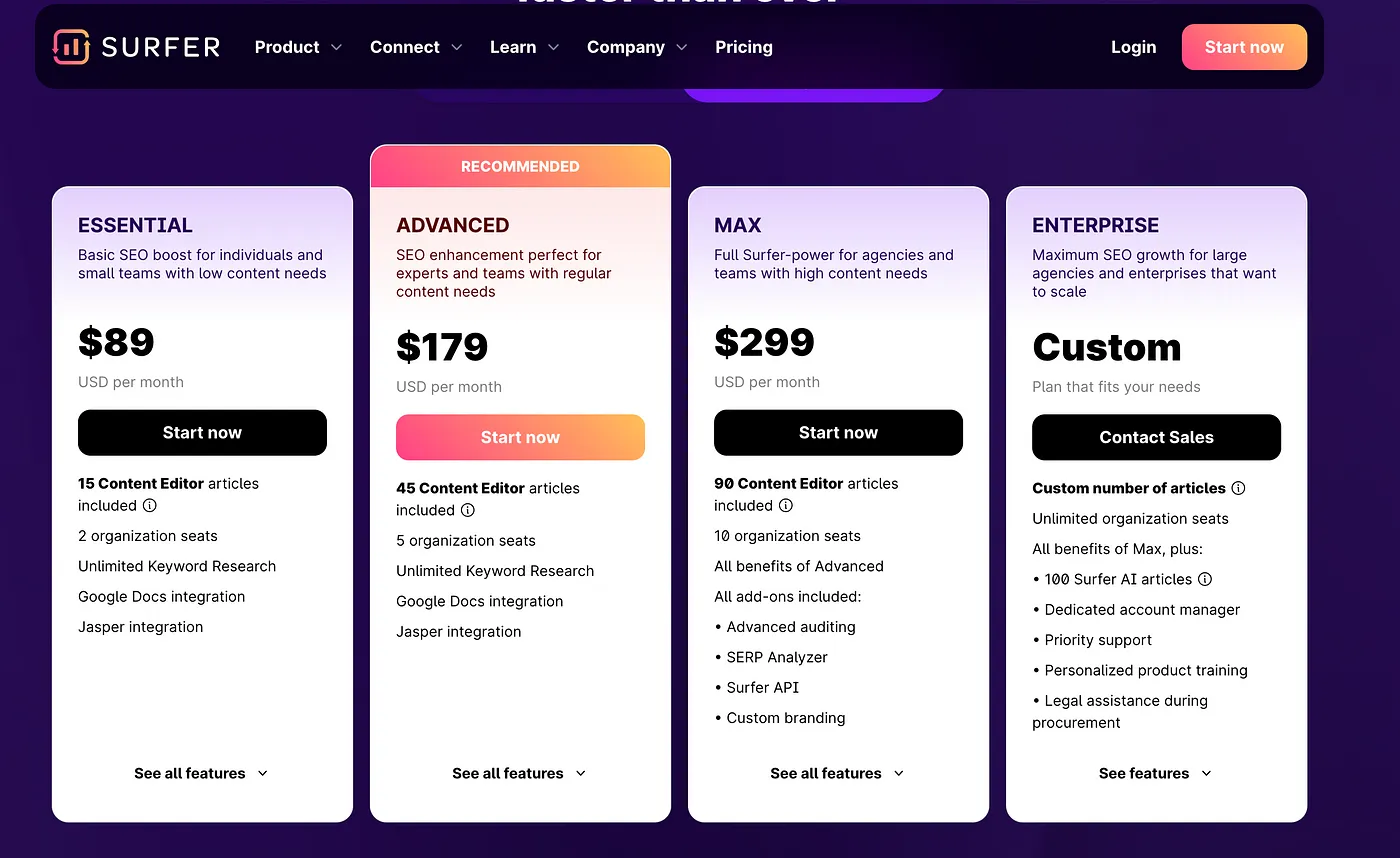
The pricing might look a bit high compared to some other tools at first. But you’re paying for advanced AI features and solid, accurate data analysis. There are a few different plans for different needs and budgets, with prices starting from $89/month.
Effectiveness of Its AI-Powered SEO Optimization
In practice, Surfer SEO is most useful when you already have a draft and want clearer on-page direction. It is less about replacing editorial judgment and more about tightening the page around topical coverage, missing terms, and structure.
I like Surfer most when there is already a draft on the page and the team needs a second set of eyes on topical coverage. It takes some practice, and it is not the cheapest option, but the value is clear when the recommendations are treated as editorial input rather than instructions to follow blindly.
4. Frase
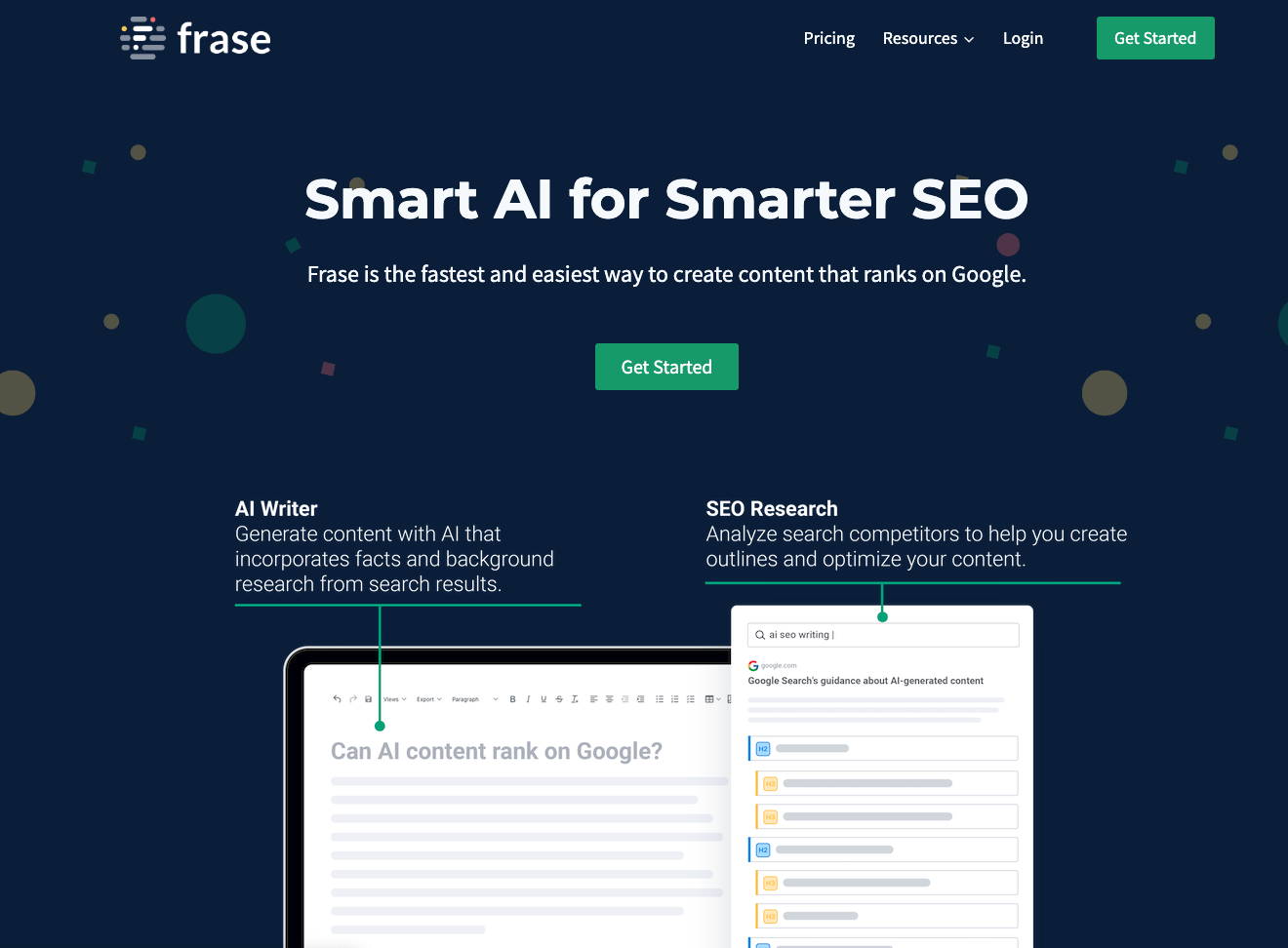
Frase is another AI-based SEO platform focused on content briefs, optimization, and keyword research. Its strongest use case is helping writers understand what a page needs to cover before they spend hours drafting.
Pricing Options
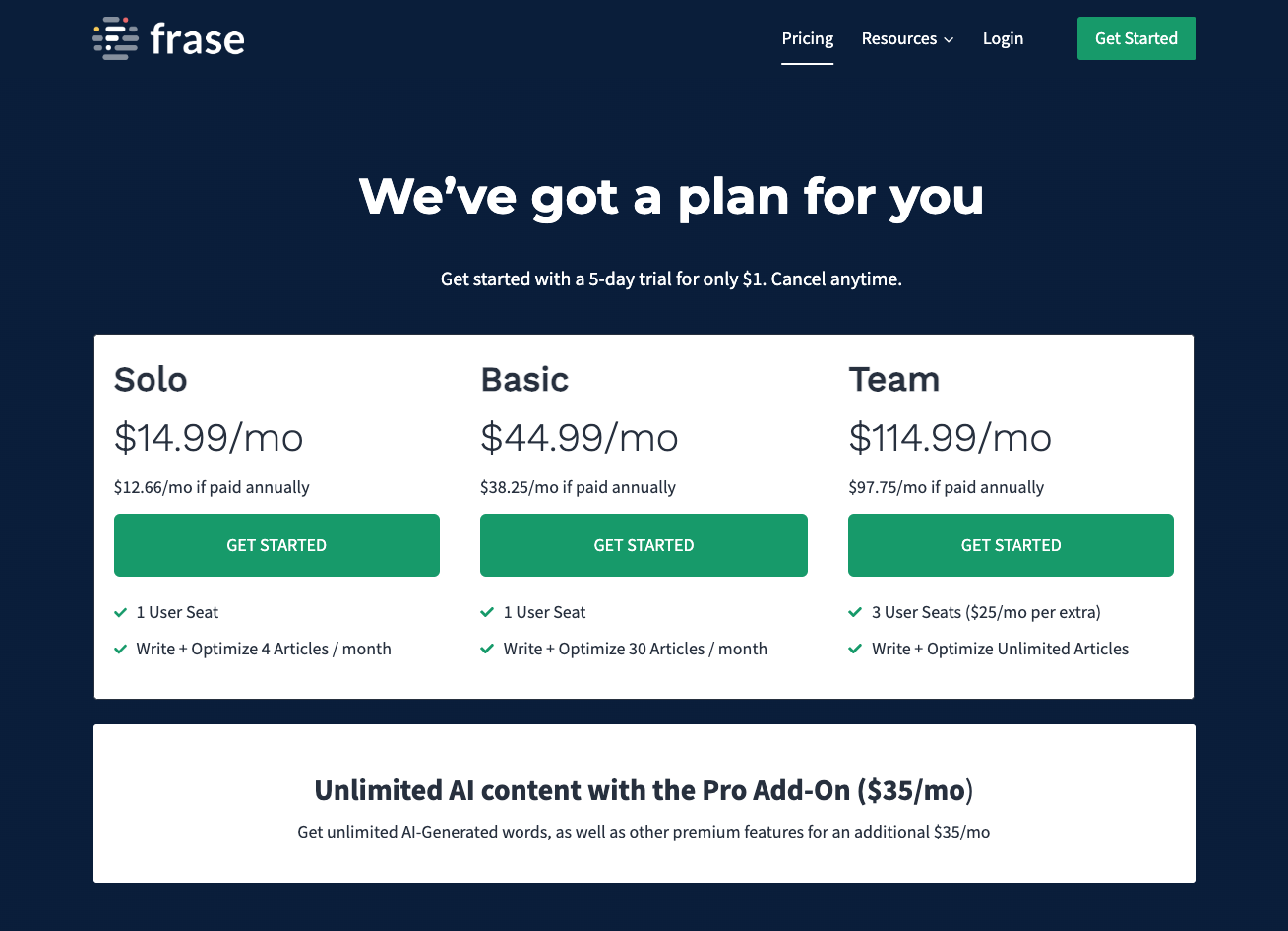
Frase has three pricing tiers for different kinds of users:
- Solo: This plan works well for individual bloggers or small business owners who are just getting into SEO. It costs $14.99 per month and gives you basic tools for optimizing content without taking on a heavier platform.
- Basic: The Basic plan is $44.99 per month and includes more advanced features. It is better for businesses or agencies that need a fuller set of SEO tools to support organic traffic growth.
- Team: This plan is meant for larger teams working on more complex SEO projects. At $114.99 per month, it includes Frase's broader suite of SEO tools and collaboration features.
Exploring Frase's Features
No matter which subscription plan you choose, Frase gives you several features that can support organic performance:
- Content Optimization: With Frase's AI-driven Content Brief feature, you get detailed insights on how to optimize your content around search intent, subtopics, and competitive coverage.
- Keyword Research: Frase's keyword research tool helps you find relevant keywords in your niche, so your content planning is based on actual demand rather than assumptions.
- Competitor Analysis: With Frase, you can review competitors' content strategies and spot gaps your page should address.
- Automated Content Creation: Frase supports automated content creation, which can save time when you are managing multiple pages or recurring briefs.
- Website Monitoring & Analytics: Frase has solid website monitoring and analytics reports, so you can keep track of your SEO progress and make decisions based on actual data instead of just guessing.
- SEO Audit Tool: The platform also includes a detailed SEO audit tool that lets you thoroughly inspect your own site and even your competitors’ sites, so you can see what’s working and what isn’t.
Pros and Cons of Using Frase
Like any tool, Frase has strengths and limitations:
Pros:
- Affordable Pricing: Frase is competitively priced compared with many SEO tools, which makes it easier for smaller teams to justify.
- Comprehensive Features: Even though it’s affordable, Frase still gives you a range of advanced features like content optimization, keyword research, and competitor analysis.
- User-Friendly Interface: The interface is intuitive enough that most editors can find the core research and optimization features quickly.
Cons:
- Learning Curve: There is a learning curve at the start, especially if you are new to SERP-led briefs.
- Lack of Customization: Frase's features are solid, but some users may want more control over how reports, briefs, and recommendations are shaped.
- Limited Reporting: While Frase gives you useful insights, its reporting features are a bit limited compared to some other SEO tools. So you might end up exporting data and analyzing it somewhere else.
Compare To Other AI SEO Tools
Compared with AI-driven SEO tools like Jasper and MarketMuse, Frase stands out because it combines useful content research with a more accessible price point. MarketMuse can offer deeper content strategy insights, but it usually costs more. Frase sits in the practical middle, which makes it a good fit for SMBs and startups with tighter budgets.
Effectiveness of Its AI-Powered SEO Optimization
When I used Frase for content strategy work, the most useful part was not the AI writing itself. It was the competitor framing: what the top pages covered, what they skipped, and where a cleaner outline could win.
There is a learning curve while you get used to the reports. Once that clicks, Frase becomes a practical tool for building better briefs and improving drafts without turning the workflow into a full enterprise SEO setup.
5. SEMrush Writing Assistant
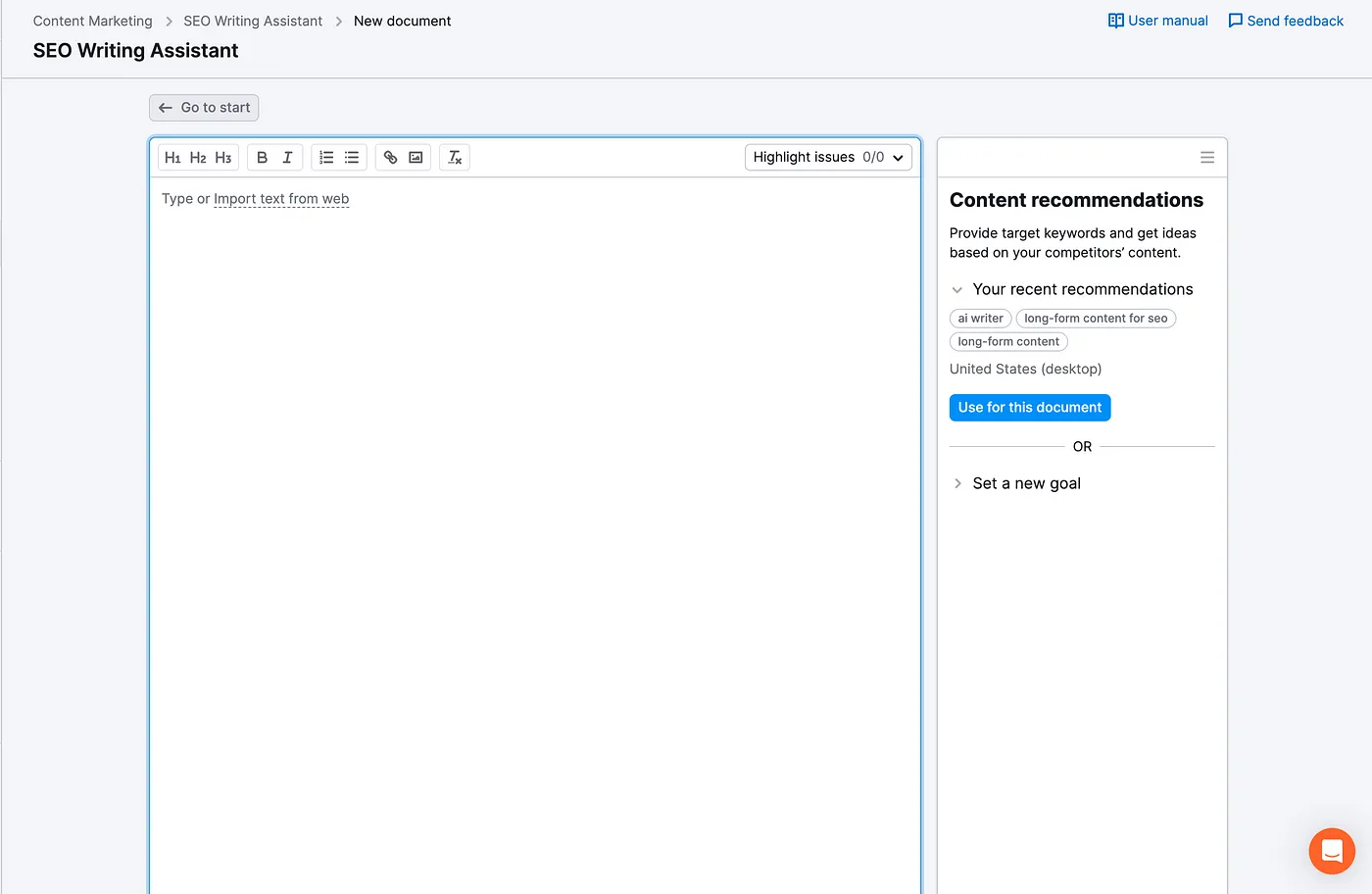
When it comes to AI SEO tools, SEMrush Writing Assistant stands out because it sits inside a much broader SEO platform. You are not just getting writing suggestions. You are getting keyword, competitor, and performance context around the content.
The tradeoff is complexity. SEMrush is powerful, but it rewards users who are willing to learn the data instead of treating the writing assistant as a simple plug-in.
Advanced Keyword Explorer
Creating content without keyword context usually means guessing. SEMrush helps solve that with a strong keyword exploration feature. It does not just return keyword lists; it shows keyword difficulty, search volume, and variations related to your main keyword.
That context helps you write pages around real search behavior instead of publishing first and hoping the page finds demand later.
Superior Competitor Analysis
Competitor context often matters as much as keyword context. SEMrush is useful here because its AI-powered competitor analysis helps you understand why other pages may be winning.
With this tool, you can review backlinks, target keywords, ranking changes, and broader marketing signals. I find this especially useful before rewriting an important page, because it stops the edit from being based only on opinion.
Fast SEO Content Creation
SEMrush Writing Assistant is also really helpful for speeding up content creation. While you write, it gives you real-time suggestions so you can fix SEO issues, improve readability, and adjust your tone on the spot.
It also comes with a plagiarism checker, which helps protect originality during high-volume content production. The better use case is not just saving time. It is catching quality issues before the article reaches publication.
Seamless Integration
Another useful advantage is how easily SEMrush Writing Assistant integrates with tools people already use, including Google Docs and WordPress. You can review recommendations inside the writing environment instead of constantly switching tabs.
This makes the workflow smoother, especially for editors who do not want to leave the draft every time they check a recommendation.
Compare To Other AI SEO Tools
Compared with AI SEO tools like Junia ai or Surfer SEO, SEMrush stands out because of its data depth. Junia ai is strong for content workflow, and Surfer SEO is useful for on-page recommendations.
SEMrush goes deeper into keyword and competitive analysis, which can give experienced marketers an edge if they know how to turn the reports into decisions.
Pricing
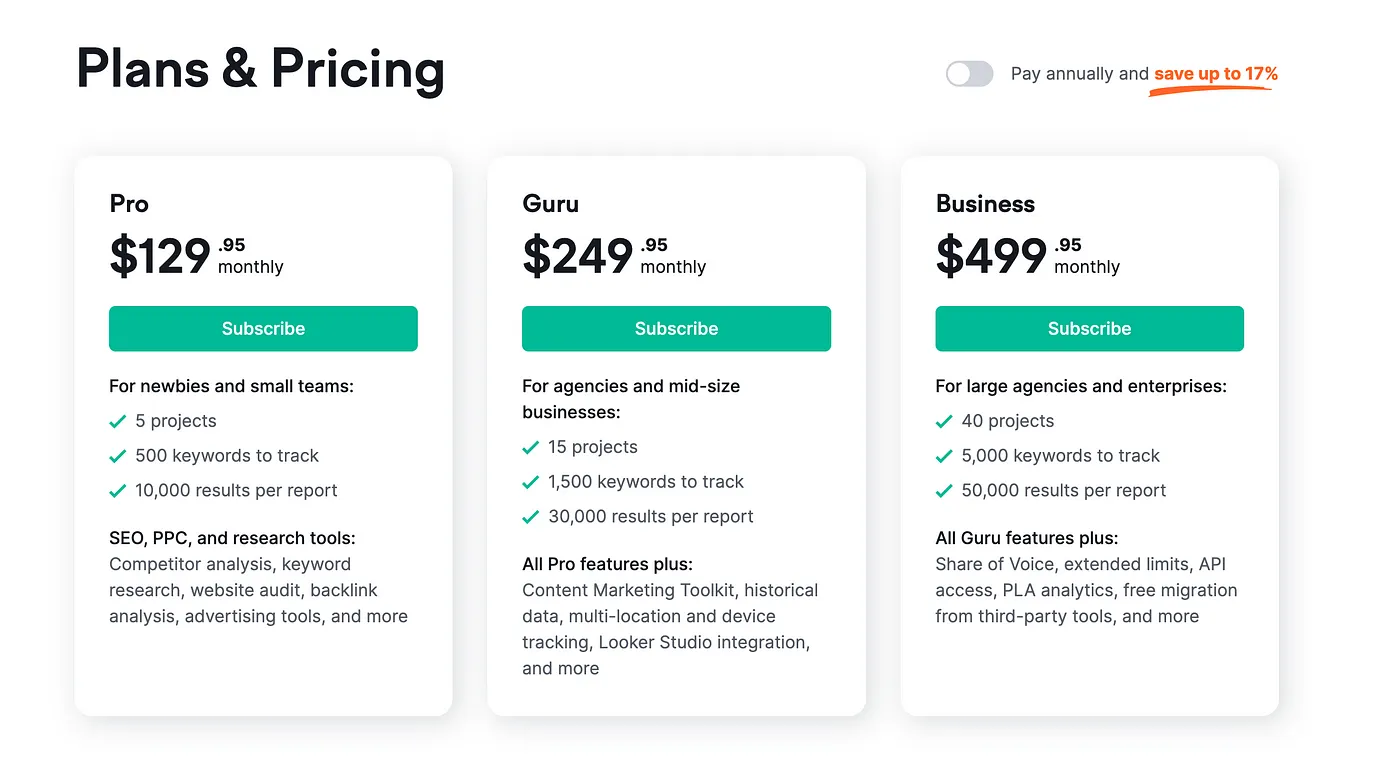
For pricing, SEMrush has three main plans: Pro ($119.95/month), Guru ($229.95/month), and Business ($449.95/month). It is not the cheapest option on this list.
But if SEO is already a serious acquisition channel, the data depth can justify the cost. I would hesitate to recommend it to a casual blogger, but for agencies and growth teams, it can pay for itself quickly.
Pros and Cons of SEMrush:
Pros:
- Provides detailed information on keyword effectiveness
- Comprehensive competitor research capabilities
Cons:
- Can be overwhelming for beginners because of the large amount of data
- Higher-end plans may be expensive for small businesses
- Interface can be hard to navigate at first
Effectiveness of Its AI-Powered SEO Optimization
From my own experience using SEMrush, I would describe it as a flexible but demanding tool. The reports can reveal useful opportunities across your own site and your competitors' sites, but you need a clear workflow or the data becomes noise.
That said, SEMrush can feel heavy if you are new to SEO. I would not start by opening every report. Start with the keyword, competitor, and page-level recommendations that directly affect the article you are working on.
SEMrush is easiest to recommend for teams that need serious keyword and competitor intelligence. But any tool is only as useful as the decisions it helps you make.
Whether you choose SEMrush, Junia AI, or Surfer SEO, spend time learning the features that match your workflow. That is where the return usually comes from.
6. Clearscope

Clearscope is best known for content optimization. Instead of trying to be a full SEO suite, it focuses on helping you understand which terms, subtopics, and themes are commonly present in strong-performing content.
That narrower focus is exactly why some teams like it. If your main challenge is improving content depth and topical coverage, Clearscope can be more useful than a broader platform with dozens of secondary features.
How Does Clearscope Improve Your SEO?
Clearscope starts by analyzing content that already performs well in your niche or industry. It looks for common themes, keywords, and subtopics across top-ranking articles, then turns that analysis into recommended terms and coverage areas.
That roadmap is useful, but it still needs judgment. I treat Clearscope recommendations as prompts for better coverage, not a checklist to stuff into the draft.
Streamline Your Content Creation with Clearscope's Essentials
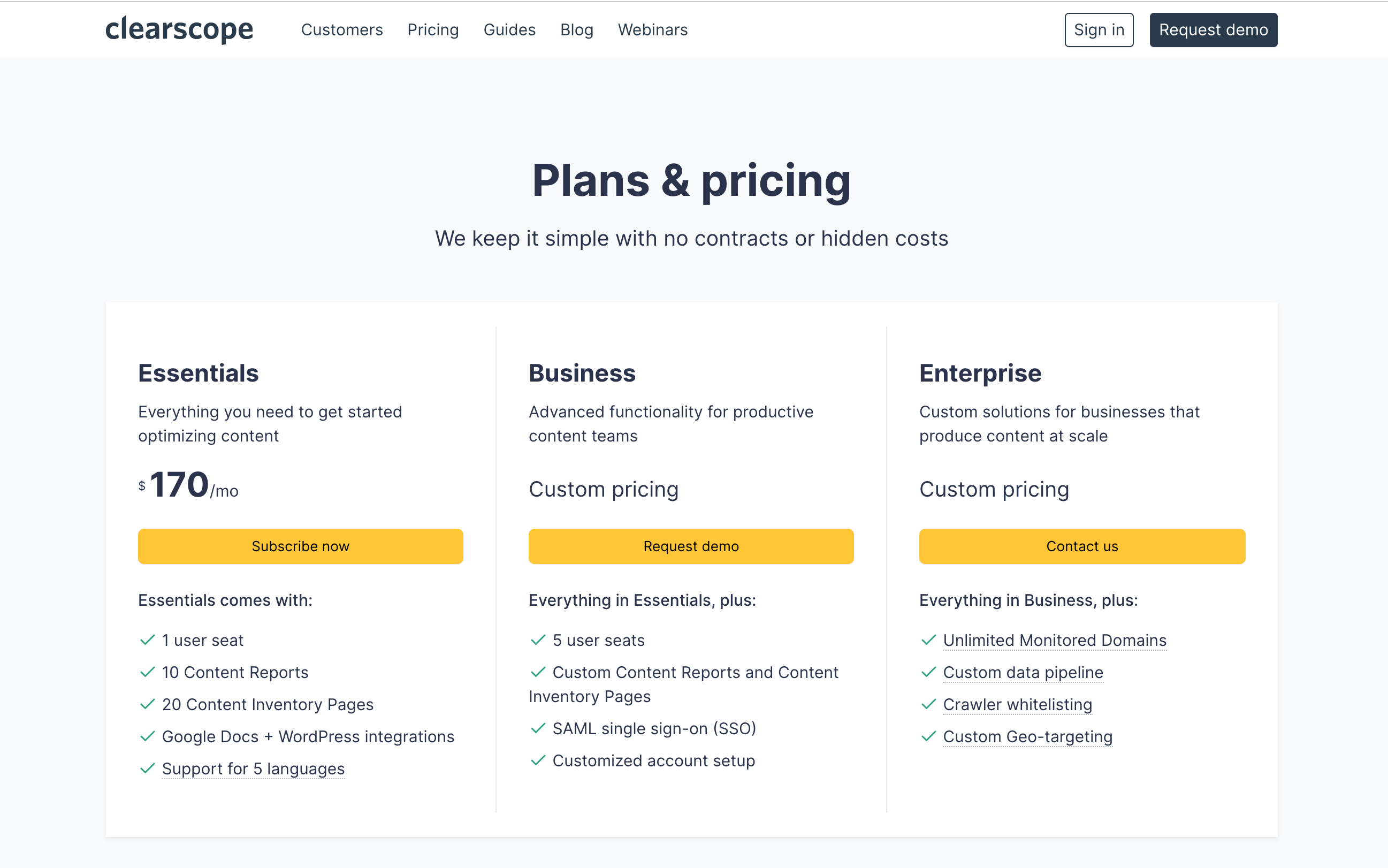
With its Essentials plan at $170 per month, Clearscope gives you the core features needed to optimize content properly. This plan includes:
- Keyword and topic recommendations based on content that’s already successful in your industry
- An outline to help you create highly optimized content
- Use of advanced AI algorithms to improve accuracy and make the data more reliable
Pros and Cons of Clearscope
Clearscope has clear strengths and a few practical limitations:
Pros
- Content Recommendations: Clearscope is strong at analyzing top-ranking content and recommending relevant keywords and topics.
- Advanced AI Algorithms: These algorithms help give you more accurate data, which can really improve how well your content is optimized.
- Comprehensive Essentials Plan: The plan includes keyword and topic recommendations, content outline creation, and several helpful optimization features.
Cons
- Not Beginner-Friendly: If you are new to SEO, the tool may feel overwhelming at first.
- Higher Pricing: Compared to other tools out there, Clearscope’s plans can seem a bit pricey.
- Content recommendations are not always accurate: Most Clearscope recommendations are useful, but some will not match your specific page intent. You still need editorial judgment.
- Limited Integrations: Clearscope doesn’t have as many integrations with other tools as some of its competitors, which can be slightly annoying if you rely on a big stack of tools.
Compare To Other AI SEO Tools
Compared with tools like Surfer SEO or SEMrush Writing Assistant, Clearscope leans more into content recommendations than keyword or backlink workflows. Other tools offer a wider spread of SEO features, but Clearscope specializes in improving content quality and topical coverage. If your main focus is content creation and optimization, that narrower focus can be an advantage.
Effectiveness of Its AI-Powered SEO Optimization
After using Clearscope for content optimization, I found it most useful for sharpening topical coverage. The best recommendations helped me see missing subtopics and weak sections, not just extra terms to insert. The price is higher than some alternatives, so I would reserve it for teams that publish or refresh enough content to use it regularly.
In the end, Clearscope is worth the investment only if you have enough content volume to use its recommendations regularly. For occasional blog updates, the price may be hard to justify. For serious content teams, it can sharpen the review process quickly.
7. WordLift
WordLift stands out because it focuses on structured data and entity SEO rather than only writing or keyword recommendations. It helps connect your content to semantic data, which can support stronger context, better internal linking, and clearer signals for search engines.
Features of WordLift
WordLift can be a solid choice if structured data is a serious part of your SEO strategy:
- Structured Data Support: WordLift uses semantic technologies to organize, enrich, and present your content in a way that is easier for both users and search engines to understand. This does not just improve how you appear in search; it can also support better internal linking because the tool understands relationships between pieces of content.
- Content Enrichment: WordLift improves your content by linking it to open data. It helps you build connections between what you write and existing web entities like people, places, and concepts. That makes your content more relevant and also makes internal linking to related content easier.
- SEO Recommendations: Using AI analysis, WordLift gives you personalized tips to boost your content’s SEO. This includes ideas for more strategic internal linking, not just random links thrown in.
- Knowledge Graph Creation: WordLift creates a knowledge graph for your website. That way search engines can better understand the overall context of your content and how different pages and topics connect to each other.
The limitation is obvious: WordLift is not a strong writing assistant. It is useful for content structure, entities, and semantic context, but it does not replace tools that help with drafting, grammar, or real-time style suggestions.
Pricing
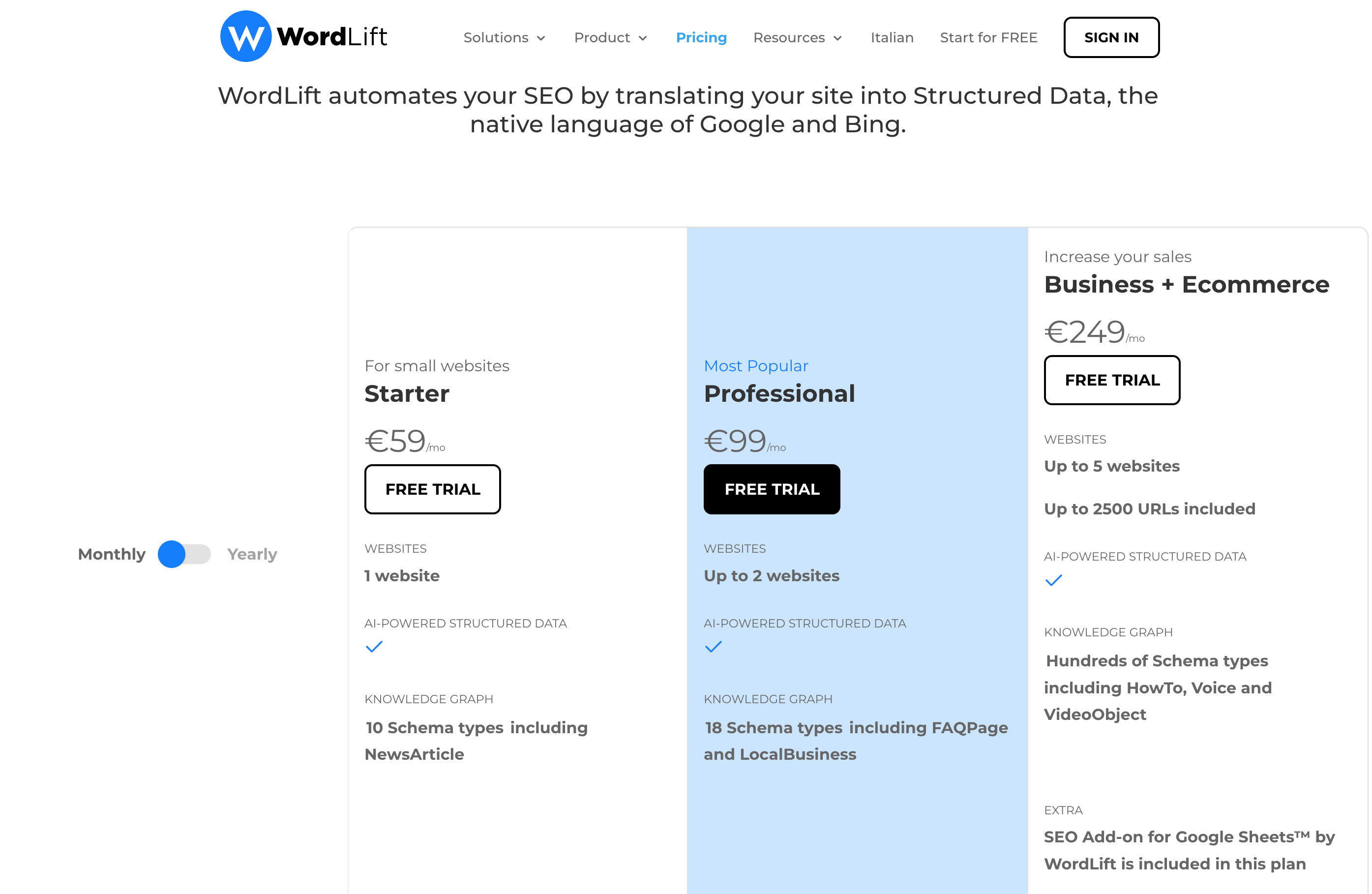
WordLift offers three pricing plans:
- Blogger: At $59/month, this plan works well for bloggers and small website owners who are just getting serious about SEO.
- Professional: Priced at $99/month, this business plan is better for bigger sites with more complex SEO needs and more content to manage.
- Publisher: For large enterprises and publishers, WordLift has a custom-priced plan, so you’d have to talk to them to get an exact number.
Pros and Cons
Here are the main pros and cons:
Pros:
- Helps create structured data without needing any deep technical expertise
- Provides detailed SEO recommendations
- Builds a Knowledge Graph so your content has better context for search engines
Cons:
- Lacks comprehensive writing tools
- Can be challenging for beginners, especially if you are not used to structured data
Compare To Other AI SEO Tools
When you compare it to other tools on the list, WordLift’s main unique selling point is its focus on structured data. Most tools are mostly about keyword analysis and content optimization. WordLift does that but also goes further by helping you build a knowledge graph for your website. That makes it really useful if you want to use structured data as a main part of your SEO strategy, not just as an extra.
But if you’re mainly looking for powerful writing assistance, WordLift might not be enough. It doesn’t have the real-time grammar and style suggestions that tools like SEMrush Writing Assistant provide, which might be a dealbreaker for some people.
Effectiveness of Its AI-Powered SEO Optimization
As someone who likes data-driven SEO, I found WordLift most valuable when the content already had a strong topical structure. The tool helped make relationships between entities clearer, which is exactly where structured data work should help.
So while WordLift is not the best choice if you need heavy writing assistance in one place, its structured data features make it a strong addition for SEO teams that care about entity relationships and semantic context.
8. Serpstat
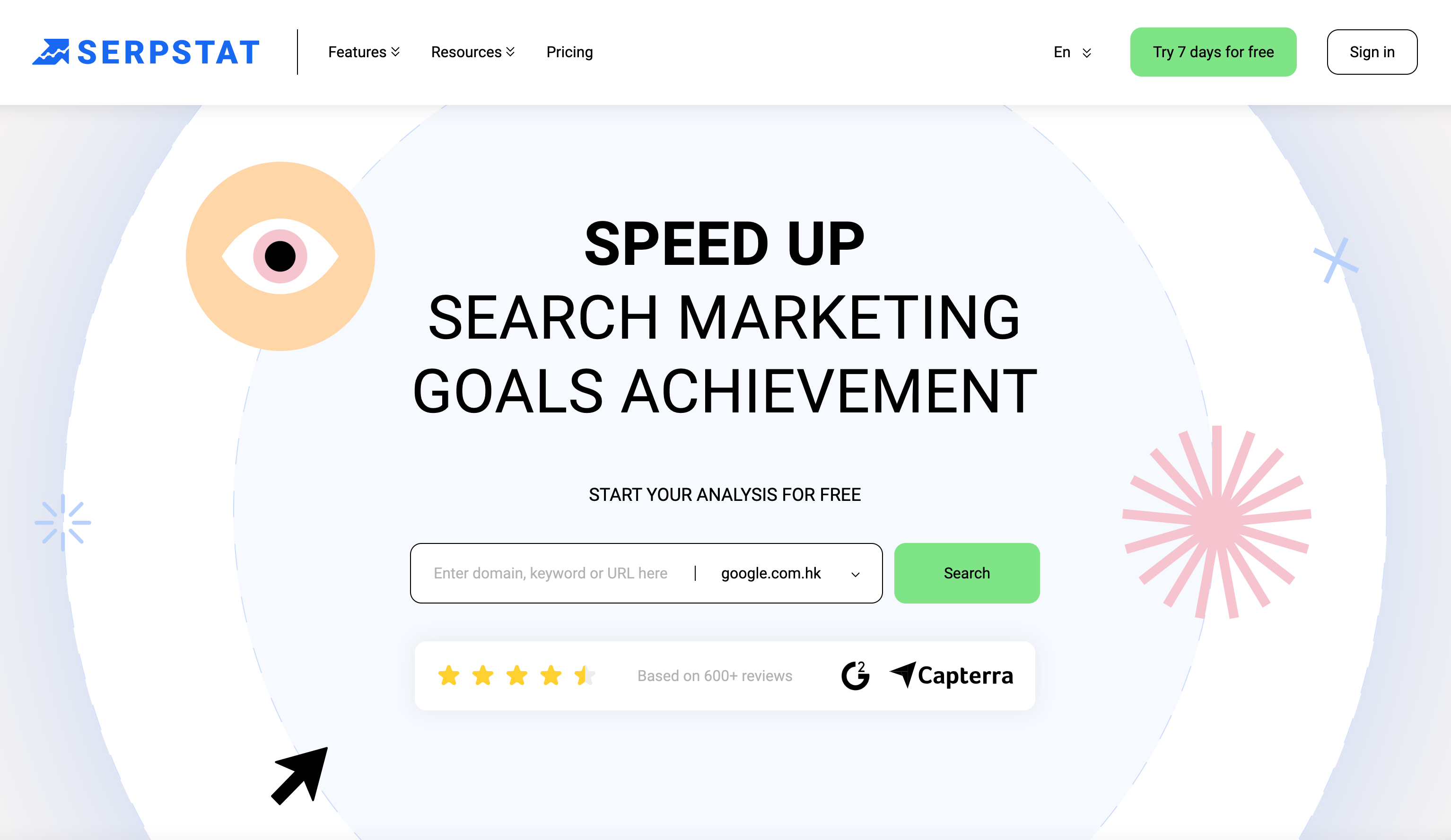
Serpstat is an all-in-one AI SEO platform with tools for keyword research, backlink analysis, audits, and visibility tracking.
What Sets Serpstat Apart From Other AI SEO Tools?
Serpstat stands out because it tries to cover the core SEO workflow for both experienced SEO professionals and newer users. Here are the main features that make it useful:
- AI-Driven Keyword Research: Serpstat helps find the keywords your potential audience actually uses when searching for content like yours. That can sharpen your content strategy and reveal opportunities competitors may be missing.
- AI-Driven Backlink Analysis: Backlinks are a huge part of SEO. By checking which websites link back to yours, Serpstat gives you helpful info about your online reputation and how visible you are in your niche or industry.
- Site Audits: Serpstat runs detailed site audits that spot problems that might be holding your site back from ranking better in search engines. These audits can also help you fix and improve internal linking so visitors get a smoother user experience.
My Experience with Serpstat
After testing several AI SEO tools, I found Serpstat surprisingly straightforward. The keyword research feature stood out most because the suggestions were practical enough to influence how I planned content.
The backlink analysis feature was also useful. It showed who was linking to the site, which helps with authority building, relationship outreach, and competitive research.
The site audits were simple but still effective. They pointed out where the site needed SEO improvements and gave practical tips for fixing those issues. That clarity matters when you are trying to move from "we should audit the site" to an actual list of fixes.
Pros and Cons of Serpstat
Like any tool, Serpstat has both good and not-so-good sides.
Pros:
- Offers a broad range of SEO services
- Interface is approachable once you understand the main sections
- Accurate keyword research and backlink analysis that you can actually use
Cons:
- Beginners might feel a bit overwhelmed at first because there are so many features
- Some of the more advanced features take extra time to understand properly
Compare To Other AI SEO Tools
Compared with AI SEO tools like SEMrush or Ahrefs, Serpstat holds its own by offering a strong feature mix at a more accessible price point. Its biggest advantage is consolidation: keyword research, backlink analysis, and audits live in one platform. The drawback is that some advanced features still take time to learn.
How Much Does Serpstat Cost?
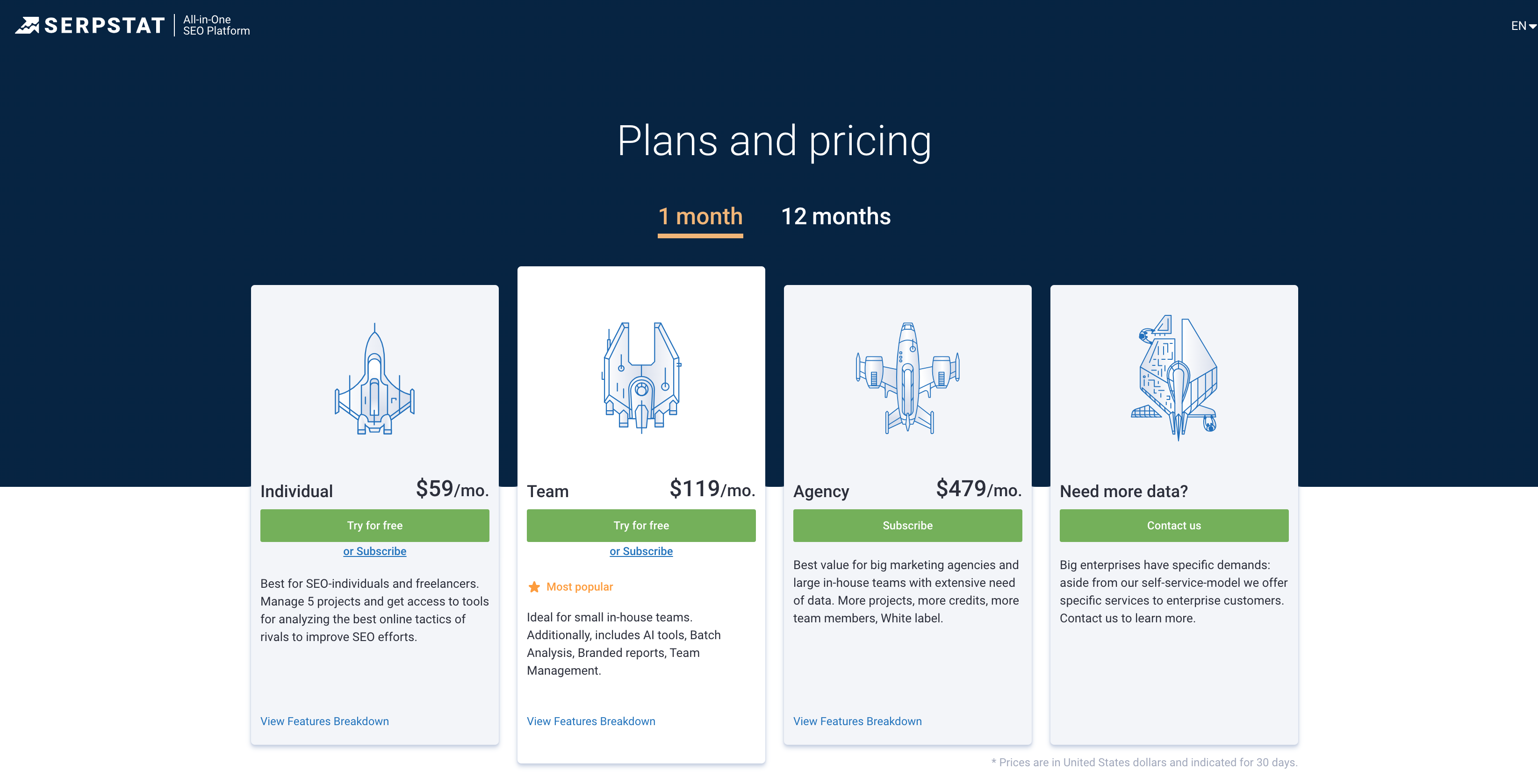
Serpstat offers several pricing plans for different needs and budgets. The Lite version starts at $69 per month and includes basic features that work well for freelancers or small businesses. If you are a bigger company or an agency, there are higher tier plans with more advanced features, but of course at a higher price.
Serpstat is a strong option if you want broad SEO coverage without paying for the most expensive enterprise suite. I would shortlist it for smaller teams that need more than a writing assistant but are not ready for a heavier platform.
9. MarketMuse
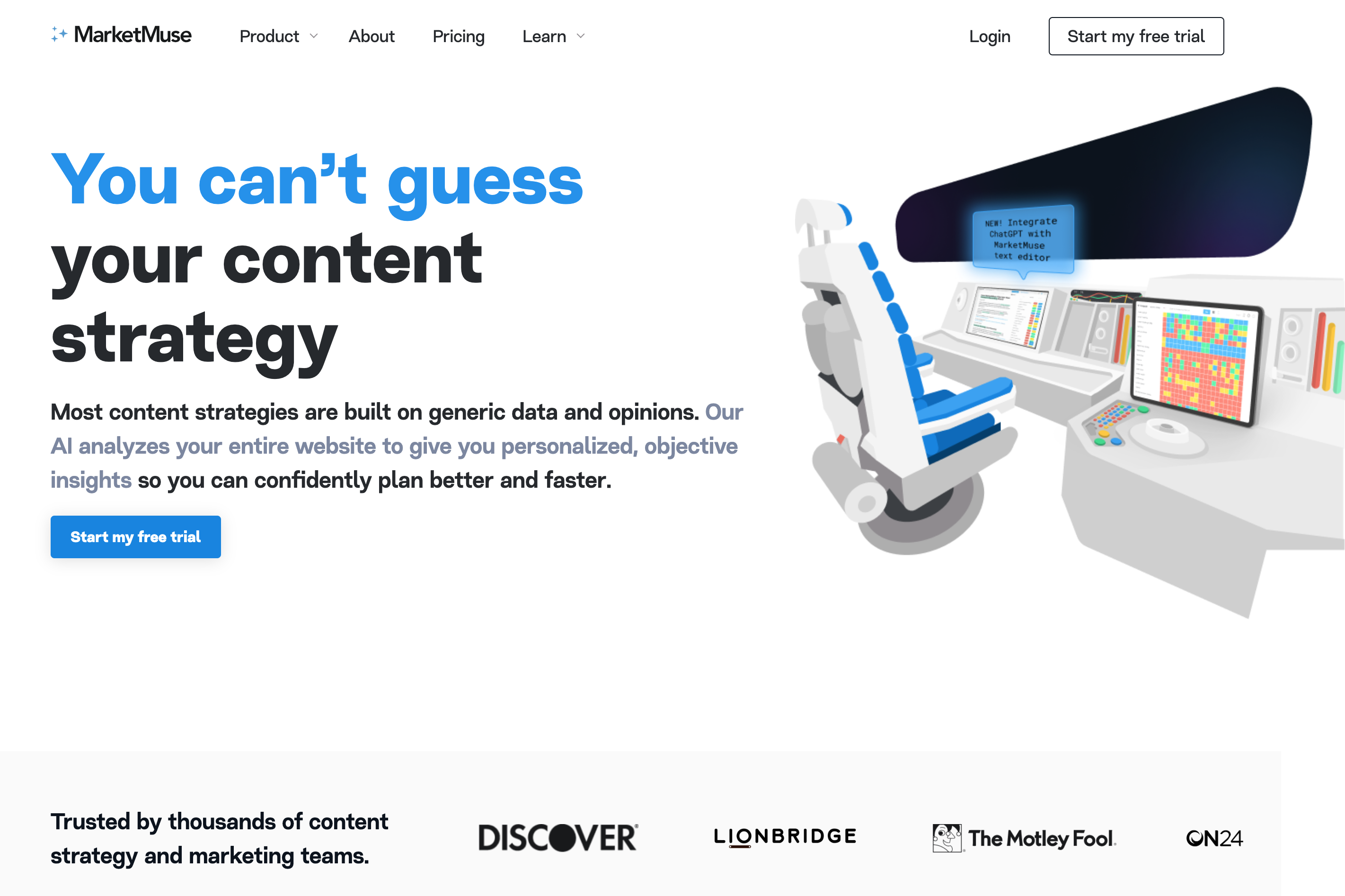
MarketMuse is a well-known AI SEO tool for content gap analysis. If you have ever reviewed top-ranking pages and wondered what your article is missing, MarketMuse is built for that problem.
How MarketMuse Helps Fill Content Gaps
Instead of focusing only on keyword research or backlink analysis, MarketMuse evaluates your content and highlights places where it can be improved, expanded, or made more complete. It also gives topic suggestions based on patterns in your niche.
Content Audit
First, MarketMuse runs a content audit on what you already have, from blog posts to product descriptions and related pages.
Gap Analysis
Then it compares that audited content with high-performing articles in the same space so you can see where your coverage is weaker than the competition.
Suggestion Generation
From that gap analysis, MarketMuse creates a list of suggested topics or subtopics that could make your content more complete and more relevant.
All of this is powered by an AI system that turns large-scale content analysis into practical ideas for improving your pages.
Pros and Cons of MarketMuse
MarketMuse has a clear strategic upside, but it is not the right fit for every budget.
Pros:
- Gives very detailed insights into how your current content is performing
- Shows you where your existing content can be improved
- Offers suggestions based on trending topics
Cons:
- Can be a bit expensive for smaller businesses or solo creators
- You need at least some SEO knowledge to really understand and use the data properly
Compare To Other AI SEO Tools
MarketMuse approaches SEO differently from tools like SEMrush and Junia AI. Many platforms focus first on keyword research, backlinks, or site audits. MarketMuse goes directly at content quality by auditing what you have, comparing it with strong competing pages, and suggesting where to improve. It feels more like a content strategist than a standard SEO dashboard.
Effectiveness of Its AI-Powered SEO Optimization
Compared with Surfer SEO, which also focuses heavily on content quality, MarketMuse feels more strategic. Both can help improve relevance and depth, but MarketMuse has an edge when you are planning content portfolios or deciding which gaps matter most.
However, Jasper is better when it comes to actually writing content for you. Jasper helps you create SEO-friendly content from scratch, which is something MarketMuse doesn’t really do. MarketMuse is more about optimizing what you already have.
Pricing
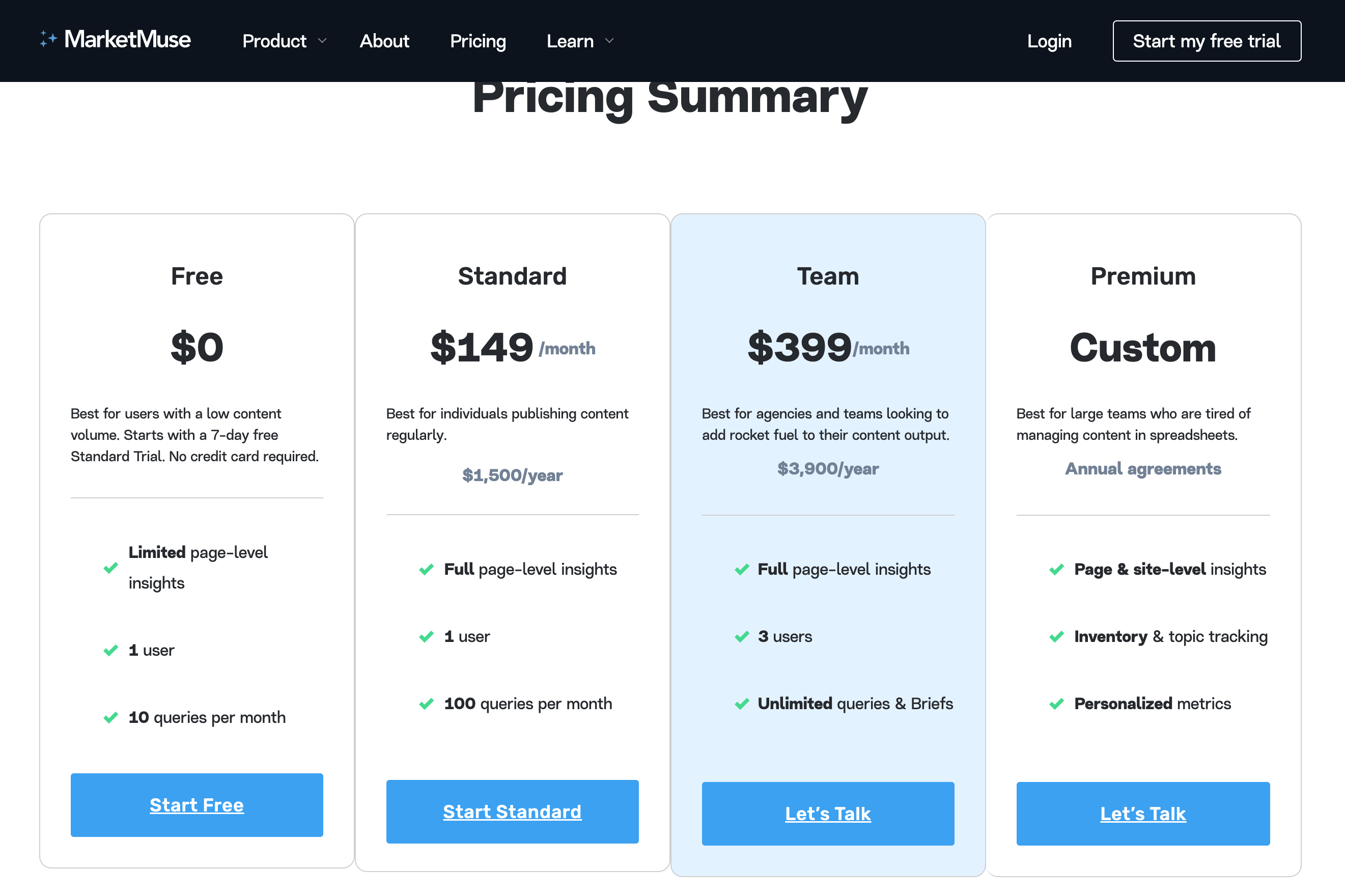
MarketMuse has three main pricing tiers for different needs. The “Essentials” plan starts at $79 per month. Then there’s the “Plus” plan at $179 per month, and the “Premium” plan is $499 per month.
Personal Experience with MarketMuse
When I used MarketMuse, it was most helpful for spotting holes in the content strategy before they became expensive rewrites. The interface was manageable, and the recommendations made it clearer which pages needed expansion.
That said, there is a learning curve. Because it gives you a lot of data, it takes time to understand which recommendations deserve action and which can wait. Once you learn that filter, the tool becomes much more useful.
10. Jasper
Jasper is a strong AI writing tool for marketers, content creators, and SEO teams that need fast draft support. It is best treated as a writing accelerator, not a full SEO strategy platform.
Key Features of Jasper
- AI Content Generation: Jasper creates tailored content for blog posts, product descriptions, social media posts, and other marketing assets.
- SEO Optimization: Jasper's AI is built with the latest SEO best practices in mind. It can suggest keywords, improve your text structure, and even generate meta descriptions to help boost your site’s visibility on search engines.
- Multi-Language Support: With Jasper, you're not stuck with just English. It supports multiple languages, so you can reach an international audience if you want.
Pros and Cons
Jasper has real strengths, especially for production speed, but it also has limits:
Pros
- User-Friendly Interface: Even if you are new to AI tools or SEO, Jasper is easy to navigate.
- High-Quality Content: Jasper usually produces smoother copy than many basic AI writing tools.
- Time-Saving: Since it automates parts of the writing process, Jasper can save time on first drafts and repeatable copy tasks.
- Short-form Content Creation: Jasper is especially useful for short-form content like social posts and meta descriptions.
Cons
- Pricing: Jasper's pricing may feel high if you only need occasional copy support.
- Limited Customization: Jasper does well with clear prompts, but it may miss the mark for highly specific or deeply technical content.
- Limited Long-form Content: Jasper can create blog posts, but the quality may not match what a skilled human writer can do with deep research, interviews, or original analysis.
- Lack of Creativity: Jasper can produce polished copy, but it often works from familiar patterns. For truly original positioning, you still need human direction.
- Language Accuracy: While Jasper supports multiple languages, accuracy depends on the topic and language. For complex or specialized topics, human review is still necessary.
Pricing
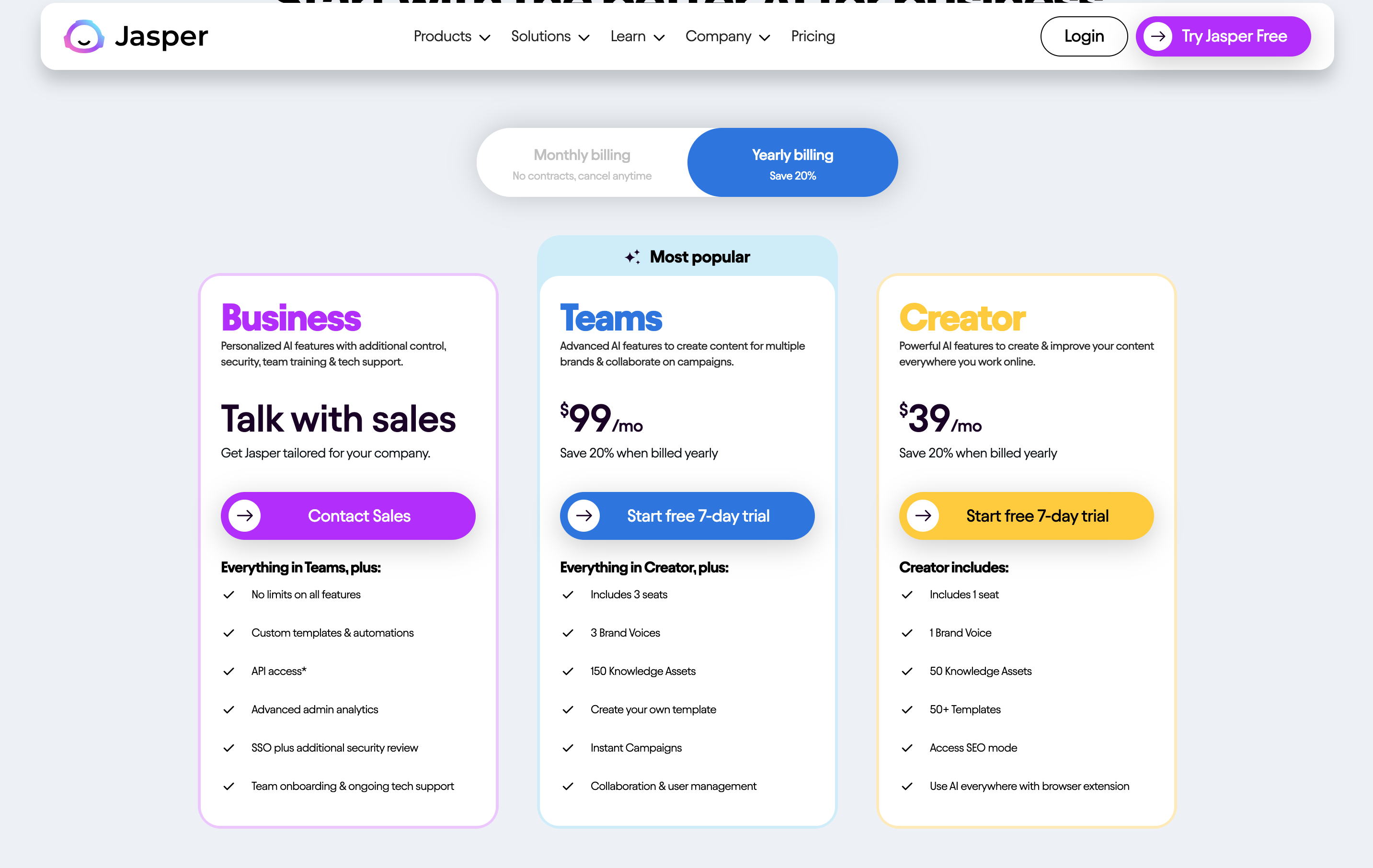
Jasper offers two main pricing plans:
- Teams: This plan is best for agencies or businesses that manage multiple brands. It has advanced AI features to create content for different brands and helps teams collaborate on campaigns. It’s priced at $125/mo.
- Creator: This one is made for individual creators. It includes strong AI features that help you create and improve your content wherever you’re working online. It’s priced at $49/mo.
Effectiveness of Its AI-Powered SEO Optimization
I use Jasper most comfortably for ideation, short-form copy, and early drafts. It can speed up content production, but I still would not rely on it alone for SEO pages that require deep SERP interpretation or original expertise.
The Teams plan is useful when you manage content across multiple brands because it supports a more organized production workflow.
There is still a learning curve. You need to understand how Jasper responds to prompts, what it handles well, and where human editing is non-negotiable.
If you need an AI writing tool that improves production speed, Jasper is worth considering. If you need deeper SEO research and optimization, pair it with a more specialized SEO platform.
11. Outranking
If competitor-led optimization is your priority, Outranking is worth a look. It is designed to compare your pages against competing results and turn those gaps into practical recommendations you can act on.
How Outranking Improves Website Performance
Here is how Outranking works:
- Analyzing Your SEO Performance: Outranking starts by checking your website's current SEO performance and showing where you stand.
- Comparing Competitors: Then it compares your site with your competitors, looking at things like keyword usage, backlink quality, and your overall content structure.
What makes it useful is the competitor-led angle. You may have already optimized a page, researched keywords, and improved the draft, yet still trail stronger competing results.
This is where Outranking jumps in. It doesn’t just show you what your website is missing or where it’s weak. It also gives you specific suggestions on how to fix and improve those areas, based on what’s already working for the top-performing sites in your niche.
This kind of competitor analysis is useful when you need to understand what separates your page from the pages already ranking.
Pros and Cons of Using Outranking
Like any other tool, Outranking has clear strengths and limitations:
Pros:
- Detailed competitor analysis: Compared with many AI SEO tools, Outranking gives you a complete look at what competitors are doing well.
- Actionable advice: It doesn’t just throw data at you. It offers clear recommendations on how to improve your SEO strategies, based on what’s working in your industry.
- User-friendly interface: Even if you are not an advanced SEO specialist, it is fairly easy to use and understand.
Cons:
- Limited keyword analysis: While Outranking is great for competitor analysis, its keyword analysis isn’t as deep as some tools like Junia AI.
- Pricing may be high for small businesses: The advanced features are useful, but the cost may be too high for some smaller teams.
Pricing
Outranking's SEO Writer plan starts at $99/month and is aimed at individuals or small teams that want to optimize and refine up to ten articles per month.
Effectiveness of Its AI-Powered SEO Optimization
From my own experience, Outranking is strongest when the question is, "Why is this competitor page winning?" It is less impressive as a standalone keyword research tool, so I would not use it as the only SEO platform in a serious workflow.
In the bigger picture of SEO AI, Outranking works best beside specialized tools like SEMrush for keyword research or Surfer SEO for on-page optimization. Used that way, it can strengthen the competitive analysis part of your workflow.
The best AI SEO tool is not always the one with the most features. It is the one that fits the decision you are trying to make. With Outranking, that decision is usually how to close the gap between your page and stronger competitors.
12. Scalenut
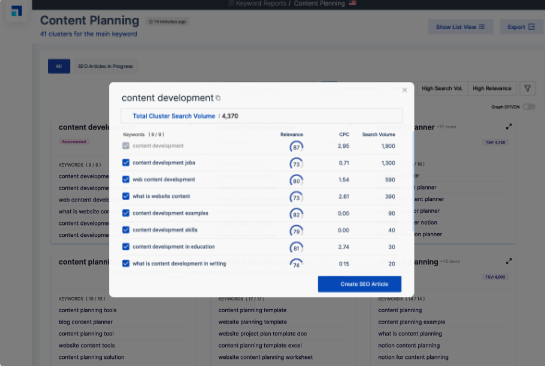
Scalenut is an AI-powered SEO tool for keyword research, content optimization, competitor analysis, and performance tracking. It is positioned as a practical workflow tool rather than a specialist platform for one narrow SEO task.
Key Features of Scalenut
Here are some of its main features:
- Keyword Research: Scalenut uses AI algorithms to review search trends and find relevant keywords for your content.
- Content Optimization: Scalenut gives tips on keyword placement, meta tags, headings, and other on-page SEO elements.
- Competitor Analysis: Scalenut gives you insight into competitors' strategies, including backlinks, rankings, and content gaps.
- Performance Tracking: Scalenut's analytics dashboard helps you monitor keyword rankings, organic traffic, and other key metrics.
Where Scalenut actually helps
Scalenut's main benefits are practical rather than revolutionary:
- Time-saving: Scalenut automates repetitive SEO tasks like keyword research and competitor analysis so you can spend more time on decisions.
- Data-driven Insights: Scalenut gives you recommendations based on keyword, content, and competitive data. The quality of the decision still depends on how well you interpret those signals.
- Increased Visibility: With better optimized content and targeted keywords, Scalenut can help improve search visibility over time.
Pros of Scalenut
Scalenut has a few clear advantages:
- User-Friendly Interface: Scalenut has a clean interface that works for both beginners and more experienced SEO users.
- Comprehensive Analysis: The tool provides suggestions for keyword research, content optimization, and competitor analysis in one place.
Cons of Scalenut
The drawbacks are mostly about depth:
- Limited Keyword Research: Even though Scalenut has keyword research features, some users might feel the keyword suggestions are a bit limited compared to other dedicated keyword research tools.
- Pricing: Depending on your budget and needs, Scalenut may feel expensive. Compare the feature set with your actual workflow before committing.
Effectiveness of Its AI-Powered SEO Optimization
In my experience, Scalenut is useful but not the strongest tool in this list. The keyword research feature can produce relevant suggestions, and the content optimization tips are helpful for basic on-page improvements.
The limitation is depth. When I paired Scalenut with dedicated keyword research tools, I found more opportunities than Scalenut surfaced on its own.
Overall, Scalenut is a capable AI SEO tool for teams that want a broad feature set in one place. I would compare it carefully against more specialized tools before choosing it as the center of an SEO workflow.
When these tools earn the subscription
The main benefit is not automation. It is better SEO judgment at a faster pace.
Most teams I talk to do not lack data. They lack a way to decide which page to refresh this week. A good tool turns rankings, competitor URLs, and content gaps into a short list. That is the job. If a product cannot help you prioritize, it is a writing toy with an SEO label.
Automation only helps when it removes mechanical work: clustering a keyword export, comparing a draft to ranking pages, flagging missing subtopics. It does not choose the angle. It does not check a statistic. If you skip that human pass, you will publish faster and still stall.
I would rather keep one tool that I open every publishing day than three tools that produce slightly different drafts of the same page. For the strategy layer around that, AI-driven content clustering is usually a better next step than buying another optimizer.
How buyers actually use the category
People shop "AI SEO tools" as if they were one product. They are not.
Some platforms are research-first. They tell you what moved: traffic, CTR, competitor pages, queries that gained impressions. If a URL gets impressions and loses users, that is usually an intent mismatch, not a missing synonym.
Some platforms are production-first. They cluster terms, draft a brief, and score the page. Useful, as long as you still reject a brief that copies the SERP outline without a point of view.
Link and competitor modules sit in the middle. They speed up prospecting and comparisons. If links are a real part of your week, link building with AI is the longer version of that workflow. The tool still cannot invent a reason for someone to cite you.
Personally, this is where I see the category create value: less busywork between the strategist and a decision. Not a replacement for the strategist.
What I would actually buy
Pick the tool for the decision you need to make this month. Not the longest feature list.
If you want research, optimization, and publishing in one workflow, Junia.ai is the easiest recommendation on this list. I would start there if you do not want to stitch four products together to get from a keyword to a page.
For narrower jobs:
- Surfer SEO when the draft exists and the SERP is the scoring problem
- SEMrush when you need keyword depth and competitor data every week
- Clearscope or MarketMuse when topical coverage is the gap
- WordLift when schema and entities are the gap
- Outranking when you already know the competitor page is winning and need a closer
If you are still comparing writing-led products, AI writing tools for SEO is the better next page than another round of "best AI SEO" lists.
The goal is stronger pages, smarter priorities, less wasted effort. In my experience, that beats the tool with the longest homepage.