
11 AI Tools for Parasite SEO (Write, Optimize & Publish Fast)

Thu
AI SEO Specialist, Full Stack Developer

If you want to use AI for parasite SEO, the tool stack matters more than the tool count.
You do not need eleven subscriptions. You need a way to find the right opportunity, write a useful page, optimize it for the query, publish it cleanly, and track whether the placement is actually worth repeating.
That is the lens I would use for this list. Some tools are best for writing. Some are better for content briefs, SERP analysis, semantic coverage, or performance work. In my experience, the weakest parasite SEO workflows usually do not fail because the writer picked the wrong AI model. They fail because nobody owned the brief, the placement, and the final editorial pass.
Here is the short version:
| Tool | Best for | Use it when |
|---|---|---|
| Junia AI | All-in-one AI SEO writing and publishing | You want one workflow for research, writing, optimization, and publishing |
| ChatGPT | Ideation, outlines, rewrites, prompt-based editing | You already know the SEO brief and need flexible drafting help |
| SEMrush Writing Assistant | On-page SEO and readability checks | You use SEMrush data and want live content recommendations |
| Surfer SEO | SERP-driven content optimization | You want a detailed content score and term coverage guidance |
| Clearscope | Relevance and topic coverage | You want a cleaner, editorial-friendly optimization layer |
| WordLift | Entities and structured data | You control the page or supporting asset and want stronger semantic markup |
| Serpstat | Keyword and competitor research | You need affordable research data before choosing placements |
| MarketMuse | Content planning and gap analysis | You are building a cluster, not just one page |
| NitroPack | Speed optimization for owned pages | You are supporting parasite pages with pages on your own site |
| Jasper | Fast marketing drafts | You need quick first drafts for repeatable campaign formats |
| Outranking | SEO briefs and optimization guidance | You want writing plus SERP-based recommendations in one editor |
What Parasite SEO AI Tools Actually Need to Do
Parasite SEO means publishing content on a third-party site that already has authority, visibility, or an existing audience. That can include guest posts, contributor pages, community platforms, partner pages, or other third-party publishing opportunities.
The AI part does not change the core job. It just speeds up the steps, which is useful only if the underlying strategy is sound:
- Find the right keyword and placement.
- Match the search intent better than the current ranking pages.
- Create a draft that is useful enough to deserve the ranking.
- Add entity, internal link, external citation, and conversion context.
- Publish or distribute it without wrecking formatting.
- Track whether the placement gets indexed, ranks, and sends useful traffic.
There is also a risk side, and I would not treat it as a footnote. Google's spam policies include site reputation abuse, and Google is clear that third-party content is not automatically a problem, but publishing mainly to exploit another site's ranking signals can become one. Google's guidance on AI-generated content also points in the same direction: AI use is not the issue by itself; low-value, manipulative, or scaled content is.
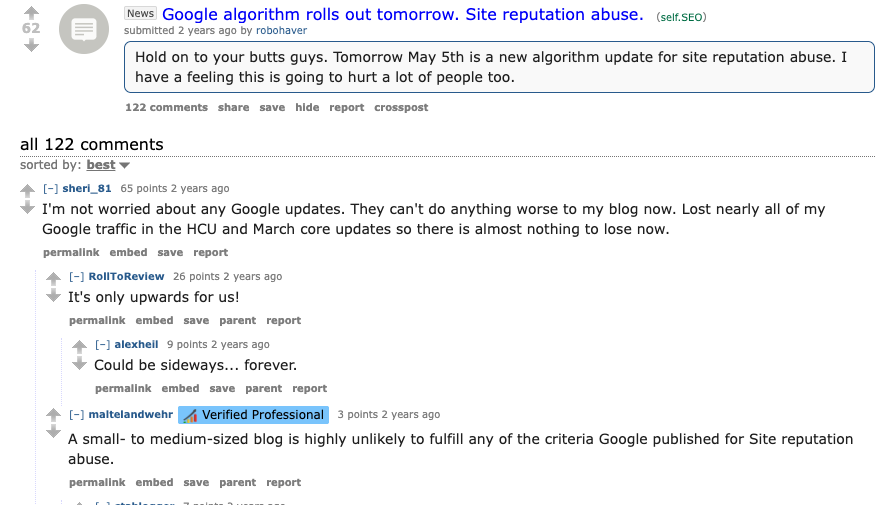
That concern shows up outside Google's documentation too. In one r/SEO discussion about the site reputation abuse rollout, the split was not simply "parasite SEO works" or "parasite SEO is dead". People were weighing host quality, update exposure, and whether a placement actually fits Google's criteria.
So the best AI tools for parasite SEO are not the ones that simply generate the most text. They are the ones that help you create a page that can pass a real editorial review. My bias here is simple: if a page would feel embarrassing to pitch as a guest contribution, it probably should not be published just because the host domain is strong.
If your workflow depends on volume, it is worth treating bulk AI content generation as a drafting step, not a publishing plan. Repeating the same page across hosts is how bulk content generation can ruin a site. The tool is only helpful when the final page still has a clear reason to exist.
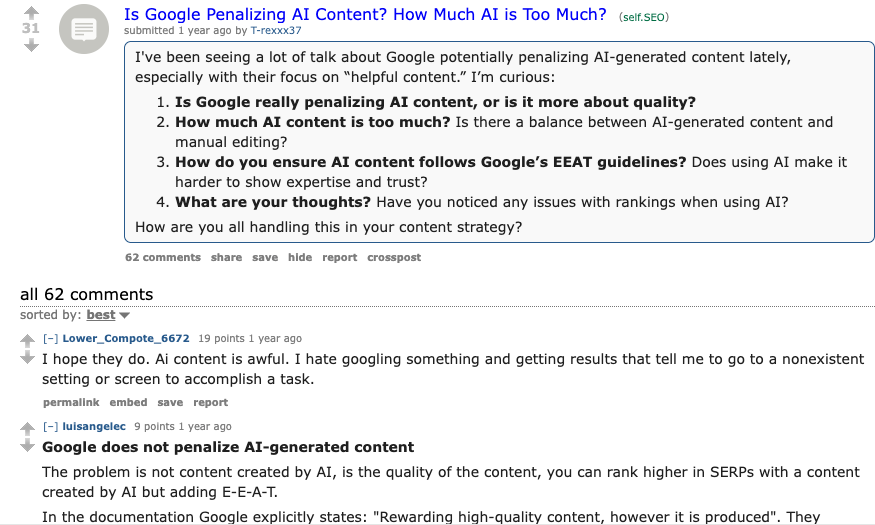
The same quality question comes up in SEO community threads about AI-generated content: the useful distinction is not whether AI touched the draft, but whether the page adds enough accuracy, editing, and original value to satisfy the searcher.
The Best AI Tool Stack for Parasite SEO
For a lean stack, do not start with every tool on this list.
For most people, a practical setup looks like this:
| Workflow stage | Best tool choices |
|---|---|
| Keyword and opportunity research | Junia AI, Serpstat, MarketMuse |
| Content brief | Junia AI, Surfer SEO, Clearscope, Outranking |
| First draft | Junia AI, ChatGPT, Jasper |
| SEO optimization | Junia AI, SEMrush Writing Assistant, Surfer SEO, Clearscope |
| Semantic improvement | WordLift, MarketMuse, Junia AI |
| Publishing workflow | Junia AI |
| Owned-site support pages | NitroPack, Junia AI, WordLift |
That matters because parasite SEO usually fails in one of two ways.
Either the content is too thin, so it looks like a disposable ranking page. Or the workflow is too manual, so every placement takes too long to produce consistently. I've seen both problems create the same outcome: a campaign that looks productive in a spreadsheet but never turns into durable search value.
The right AI stack should solve both problems.
1. Junia AI
%20(1).png?token=eyJhbGciOiJIUzI1NiIsInR5cCI6IkpXVCJ9.eyJ1cmwiOiJ1c2VyLWdlbmVyYXRlZC1pbWFnZXMvZjJmOThkNWUtNjNjNC00MTJiLTkyY2QtZjgyNDI5NTE3YWRkL0dyb3VwIDM3OSAoMSkgKDEpLnBuZyIsImlhdCI6MTY5NzM5NjY4NywiZXhwIjoxODU1MDc2Njg3fQ.oRV8tDCplsQhy5zc2EGCA6L9I6-hDdgAWvPBbQHk9_8)
Junia AI is the strongest fit here if you want the parasite SEO workflow in one place: keyword research, writing, optimization, and publishing.
That matters because parasite SEO has more moving parts than a normal blog post. You are not just writing an article. You are usually adapting the content to a third-party platform, keeping the draft aligned with search intent, and trying to publish before the opportunity gets crowded. This is the kind of workflow where I prefer fewer tools with tighter handoffs over a larger stack that looks impressive but slows every decision down.
Why Junia AI Works Well for Parasite SEO
Junia AI is useful because it connects the parts of the process that are usually split across several tools.
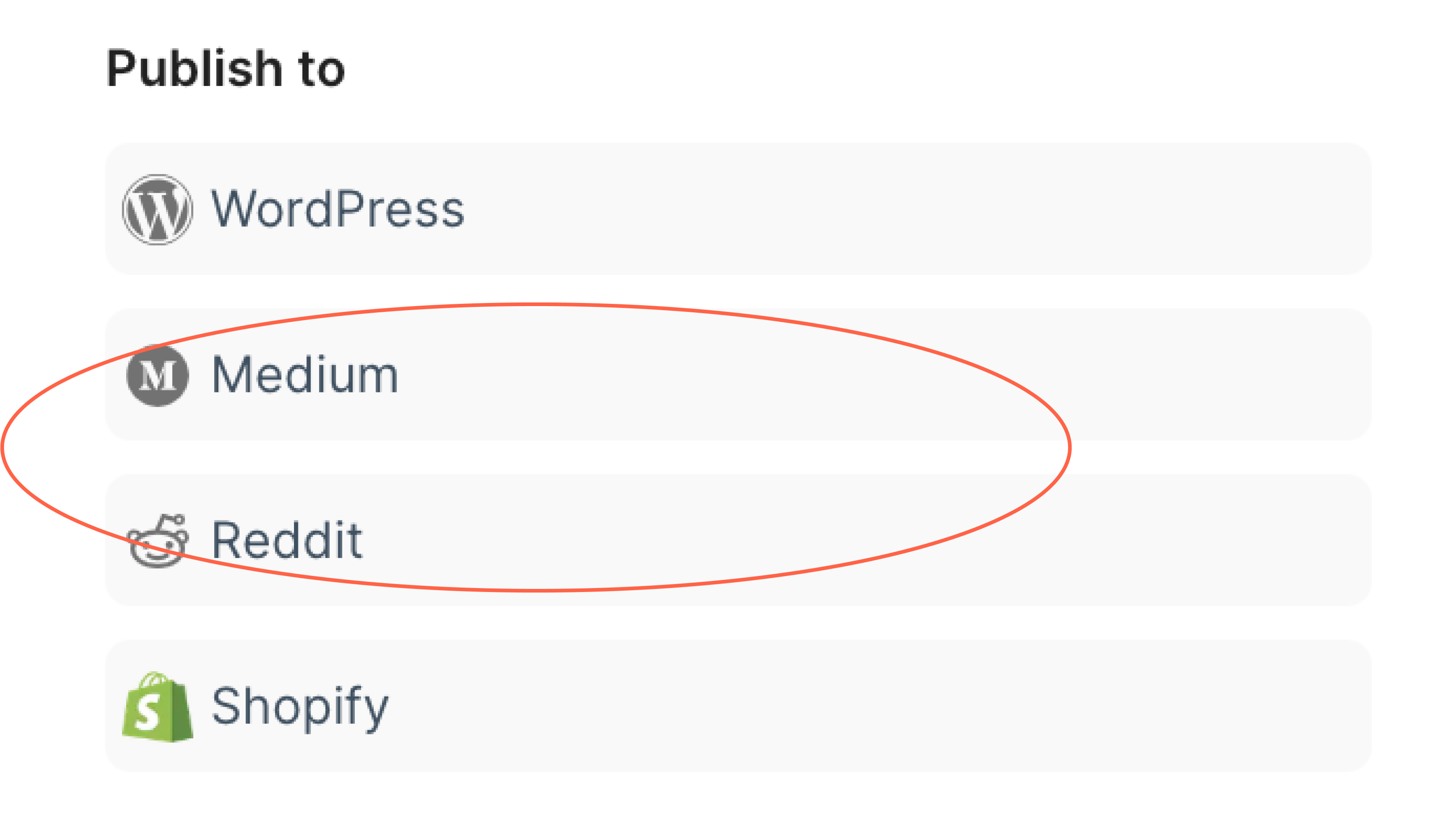
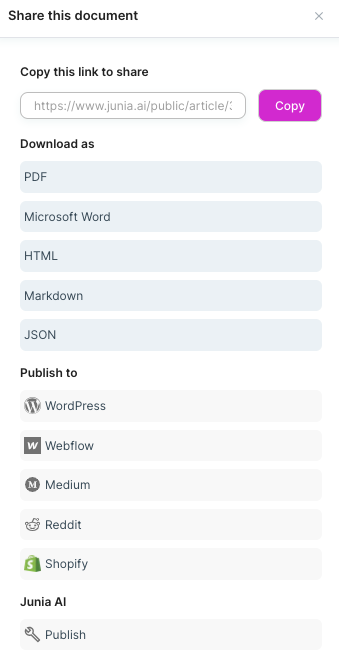
You can use the AI keyword research tool to find angles, build a content brief, generate the first draft, improve the SEO structure, and then publish to supported platforms. For parasite campaigns, that is a real advantage because the publishing step is often where teams lose time and introduce formatting mistakes.
It also fits naturally with other Junia workflows, including the AI article writer, bulk content creation, SEO improver, and AI internal linking tools.
Best Use Case
Use Junia AI when you want one tool to handle most of the process:
- keyword discovery
- content brief creation
- AI-assisted drafting
- SEO optimization
- publishing to supported third-party platforms
- scaling repeatable content workflows
It is especially useful if you want to write more content in less time without turning every draft into generic AI output.
Watch Out For
No tool can turn a weak placement into a strong one. If the host platform is low quality, the topic is too competitive, or the page adds nothing new, better writing software will not fix the strategy. I would rather publish fewer pages on placements that make sense than push a bigger batch into irrelevant hosts and hope authority carries it.
Use Junia AI to move faster, but still make the final article specific, edited, and useful.
2. ChatGPT
ChatGPT is best as a flexible assistant, not as your whole parasite SEO system.
Use it for:
- brainstorming angles for a target keyword
- turning SERP notes into outlines
- rewriting introductions for different platforms
- creating comparison tables
- generating meta title and description options
- improving clarity after a draft is already written
The main advantage is flexibility. You can ask ChatGPT to create ten different title angles, rewrite a section for a more expert audience, or turn a rough outline into a structured first draft.
The drawback is that it does not know your SEO data by default. It can also sound confident when it is missing facts, so you still need a brief, sources, and human review. I get the best results when I feed it tight notes and ask for specific improvements, not when I ask it to invent the whole strategy from scratch.
Best Use Case
Use ChatGPT when you already know the target keyword, placement, and angle, and you need help moving from notes to usable copy.
For parasite SEO, it works best as a drafting and editing layer next to a dedicated SEO tool.
3. SEMrush Writing Assistant
SEMrush Writing Assistant is useful when you want live feedback on readability, SEO, originality, and tone while editing.

This is especially helpful for parasite SEO because third-party placements often have different editorial standards. A post that works on a casual platform may need a very different tone than a contributor article on a niche publication.
Best Use Case
Use SEMrush Writing Assistant when:
- you already use SEMrush for keyword research
- you want optimization guidance inside your writing workflow
- you need readability and tone checks before submission
- you want a second pass after generating the first draft
It is not the best standalone tool for the whole campaign, but it is a strong editing layer.
4. Surfer SEO
Surfer SEO is built around SERP-driven content optimization. It looks at ranking pages and gives recommendations around structure, length, headings, terms, and topic coverage.
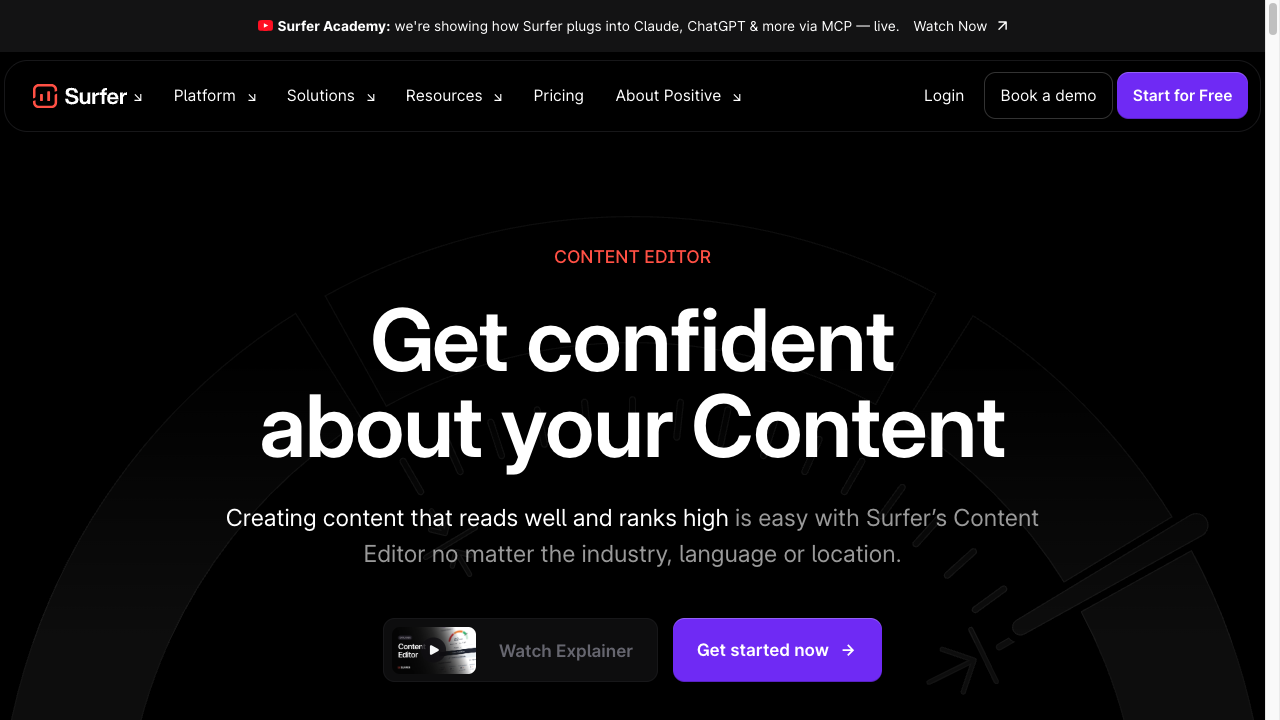
That can be useful when a parasite page has to compete in a crowded search result. You can use Surfer to understand what ranking pages tend to cover, then decide what your page should include, improve, or avoid.
The important part is not to follow content scores blindly. A page can hit a high score and still be boring, repetitive, or over-optimized. Personally, I treat Surfer-style scores as a diagnostic, not a finish line.
Best Use Case
Use Surfer SEO when you need:
- a SERP-based content brief
- keyword and entity coverage ideas
- heading and structure guidance
- a final optimization pass before publishing
It is best paired with a writer or editor who can keep the page readable.
5. Clearscope
Clearscope is another content optimization tool, but it tends to feel more editorial than mechanical. It is good for identifying the terms and concepts a strong article should probably cover without forcing you into awkward keyword repetition.

For parasite SEO, that is useful because many placements fail by being too shallow. Clearscope can help you spot missing subtopics before you publish. The value is not that it tells you to mention more terms; it helps you notice where the article has skipped a reader's obvious next question.
Best Use Case
Use Clearscope when you care more about topic relevance than raw content volume.
It is a good fit for:
- contributor posts
- software comparison pages
- review-style pages
- informational content that needs stronger topical coverage
If your parasite SEO strategy depends on quality placements instead of mass publishing, Clearscope is a better fit than many cheaper writing-only tools.
6. WordLift
WordLift is different from most tools on this list. It focuses on semantic SEO, entities, and structured data.
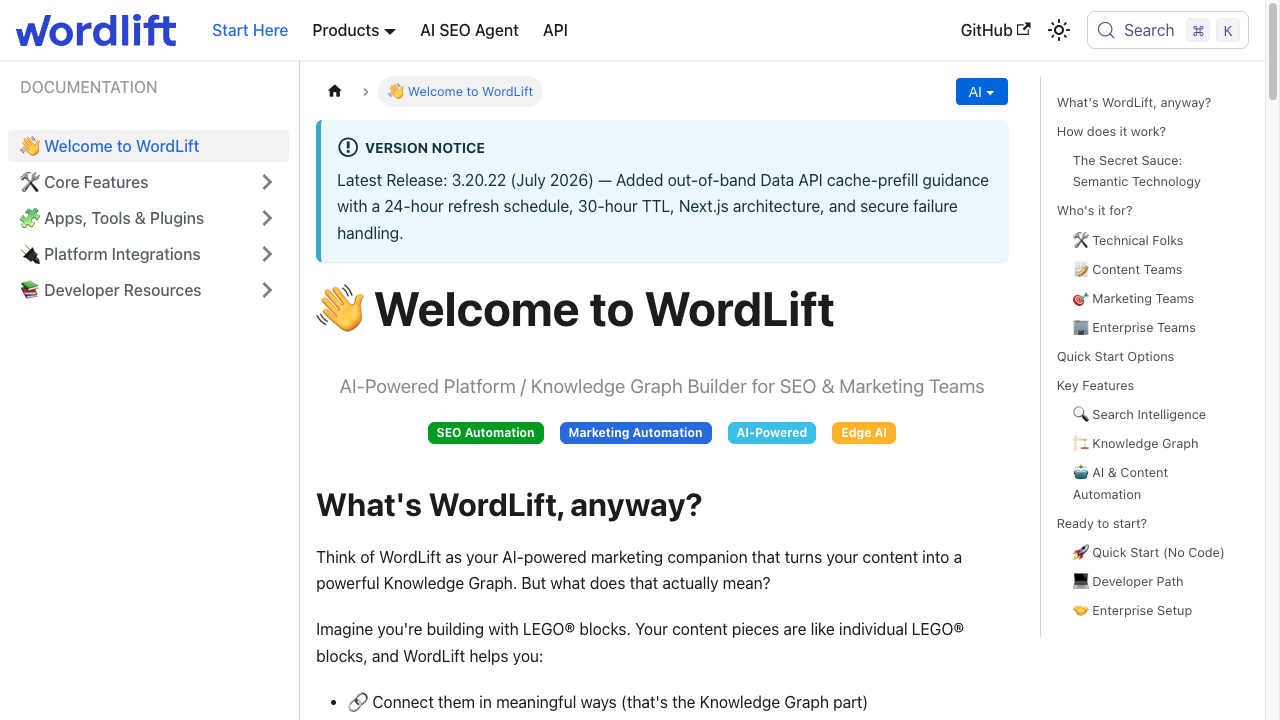
That is not always useful on third-party platforms because you may not control the site's code or schema. But it can be useful when you are publishing on an owned page, a partner page where markup is allowed, or a supporting article that points toward your parasite placement.
Best Use Case
Use WordLift when you want to make content easier for search engines and AI systems to understand through entity relationships and structured data.
It fits best when:
- you control the page
- you are building a topic cluster
- you want stronger entity mapping
- you are improving owned pages that support your third-party placements
If you only publish on platforms where you cannot edit schema or technical SEO elements, WordLift may be less important.
7. Serpstat
Serpstat is useful for keyword research, competitor analysis, backlink checks, and basic SEO planning.

For parasite SEO, Serpstat belongs before writing. The main question is not "Can we publish this page?" It is "Is this keyword and placement worth the effort?"
Serpstat helps you look at:
- keyword difficulty
- competing pages
- related keyword ideas
- backlink profiles
- content opportunities
That research can stop you from wasting time on keywords where a third-party placement has little chance of ranking. In practice, this is where a lot of campaigns should be killed early.
Best Use Case
Use Serpstat if you need a more affordable research layer before building the content brief.
It is not the tool to rely on for final writing quality, but it can help you choose better targets.
8. MarketMuse
MarketMuse is strongest for content planning, gap analysis, and topic authority work.

This is useful when parasite SEO is part of a broader campaign. For example, you might publish a third-party article for one commercial query, then support it with owned articles, comparison pages, and internal links from your site.
MarketMuse helps you see where the topic cluster is thin.
Best Use Case
Use MarketMuse when you are not just publishing one page. Use it when you are planning a cluster around a product, category, or niche.
It can help with:
- topic modeling
- content gap discovery
- brief creation
- prioritizing supporting pages
- identifying weak pages that need updates
For one-off parasite posts, it may be more than you need. For repeat campaigns, it becomes more useful.
9. NitroPack
NitroPack is not really a parasite SEO writing tool. It is a performance optimization tool.
So why include it?
Because parasite SEO often works better when it is part of a larger search system. You may publish on a third-party site, but you still need owned pages for brand trust, conversion, link equity, comparison content, and supporting topical coverage.
Google's page experience guidance says page experience is one of many factors, not a magic ranking lever. But performance still affects how people experience your pages, and weak owned pages can reduce the value of the traffic you earn from third-party placements.
Best Use Case
Use NitroPack for your own WordPress or WooCommerce pages, not for the parasite page itself.
It can help with:
- caching
- image optimization
- lazy loading
- Core Web Vitals improvements
- faster supporting pages and landing pages
If your parasite page sends traffic to a slow owned page, you are leaking value after the click.
10. Jasper
Jasper is best for fast marketing drafts, campaign variations, and repeatable content formats.

It can help when you need to produce several drafts around similar formats, such as:
- listicles
- product comparisons
- landing page sections
- ad-adjacent content
- short promotional explainers
For parasite SEO, Jasper's main advantage is speed. The risk is sameness. If every draft follows the same rhythm and generic benefits, the content starts to feel disposable.
Best Use Case
Use Jasper for first drafts and campaign variations, then edit heavily.
It works best when you give it a strong brief, real examples, product details, and a clear audience. It works poorly when you ask it to "write an SEO article" with no direction.
11. Outranking
Outranking combines AI writing with SEO brief and optimization features. It is useful if you want a guided writing environment rather than a blank AI chat window.
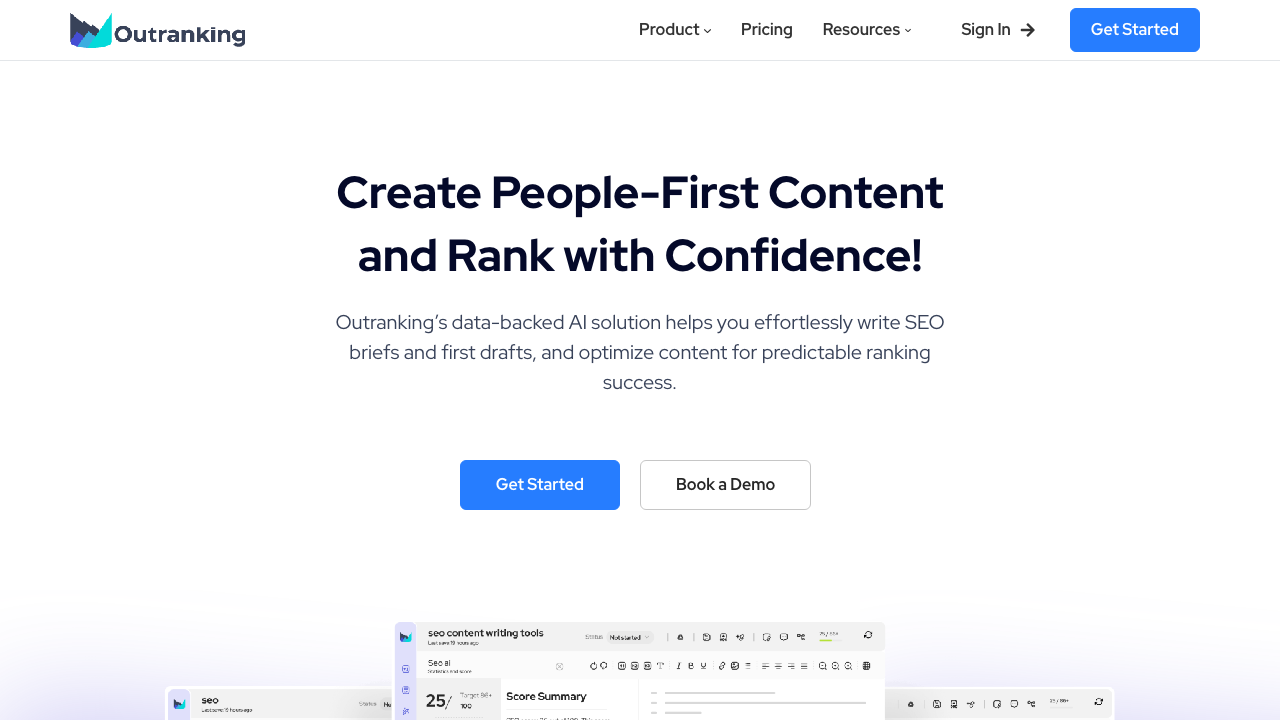
For parasite SEO, the most useful parts are the brief, outline, and optimization workflow. You can use it to turn SERP research into a more structured draft and then refine the page before publishing.
Best Use Case
Use Outranking when you want:
- AI-assisted SEO briefs
- outline generation
- content optimization suggestions
- readability improvements
- a more guided workflow than ChatGPT
It sits somewhere between a pure AI writer and a dedicated SEO optimization tool.
How to Choose the Right AI Tool for Parasite SEO
The easiest way to choose is to start with your bottleneck. I would not buy tools for every possible stage until one stage is clearly slowing the campaign down.
| If your bottleneck is... | Choose... |
|---|---|
| Finding keywords and angles | Junia AI, Serpstat, MarketMuse |
| Writing good first drafts | Junia AI, ChatGPT, Jasper |
| Optimizing before publishing | Junia AI, Surfer SEO, Clearscope, SEMrush Writing Assistant |
| Publishing faster | Junia AI |
| Building supporting owned pages | WordLift, NitroPack, Junia AI |
| Planning a full content cluster | MarketMuse, Junia AI |
If you are just starting, keep it simple:
- Use Junia AI as the main workflow.
- Use ChatGPT for extra ideation and editing.
- Add Surfer, Clearscope, or SEMrush Writing Assistant only if you need a dedicated optimization layer.
- Add Serpstat or MarketMuse when research and planning become the bottleneck.
That stack is enough for most campaigns. More tools usually add more review work before they add better judgment.
If you are comparing broader writing platforms, a general list of AI content generators can help you screen writers. Parasite SEO still needs more than a writer: judge tools by workflow fit, not just output speed.
A Practical AI Workflow for Parasite SEO
Here is a simple workflow that keeps the quality bar high without slowing everything down.
1. Pick the Placement Before Writing
Do not write the article first and then look for somewhere to put it. I have found this is one of the fastest ways to end up with a technically optimized article that feels out of place on the host site.
Different platforms reward different formats. A Medium-style post, guest article, partner page, and community post should not all read the same.
Before drafting, decide:
- Where will this be published?
- What does that platform's audience expect?
- Can the page include links?
- Can you edit images, formatting, schema, or CTAs?
- Does the platform allow the kind of content you want to publish?
This is where guest posting research and placement quality matter.
2. Build the Brief From the SERP
Use Junia AI, Serpstat, Surfer, Clearscope, or Outranking to understand the query.
Look for:
- search intent
- recurring subtopics
- product or brand entities
- questions people expect answered
- content format patterns
- weak spots in current ranking pages
The goal is not to copy the SERP. The goal is to understand the minimum expectations and then make the page more useful. If the brief only repeats what every ranking page already says, the AI draft will usually amplify that sameness.
3. Draft With AI, Then Add Human Specificity
AI can create the structure fast. It can also create forgettable filler fast.
After the first draft, add the things AI usually cannot know unless you supply them:
- tool-specific notes
- examples
- screenshots where useful
- current product context
- comparison tables
- clearer pros and cons
- stronger internal links
- a reason the page deserves to exist
If the article could apply to any tool, any platform, or any niche, it is not specific enough. This is the test I would use before publishing: can a reader tell why this page belongs on this host for this query?
4. Optimize Without Stuffing
Use the optimization tools to improve coverage, not to force every recommended term into the page.
Good parasite SEO content should be easy to read, easy to cite, and easy to summarize. That means short sections, direct answers, useful tables, and claims that are supported when they need support.
Google's helpful content guidance is still a useful filter here: write for the reader first, not just for ranking systems.
5. Publish and Track the Result
After publishing, track:
- indexation
- ranking movement
- traffic
- referral clicks
- assisted conversions
- whether the host page stays live
- whether links remain intact
This is where many parasite SEO campaigns get sloppy. Publishing is not the finish line. The result tells you which placements and formats are worth repeating.
Common Mistakes When Using AI for Parasite SEO
The biggest mistake is treating AI as a shortcut around strategy.
Host platforms still have quality bars. A guest editor, a community moderator, or Google's scaled-content rules can all reject the same thin draft. Speed is not a substitute for a page that deserves the placement.
Google's own Search Central team has been blunt about this: useful pages beat scaled filler.
Google Search Central: 3 ways to improve your content
Here are the ones to avoid:
| Mistake | Why it hurts |
|---|---|
| Publishing generic AI drafts | The page adds no reason to rank or be trusted |
| Using the same article across multiple platforms | It creates thin, repetitive content |
| Ignoring the host site's audience | The content feels misplaced and may be removed |
| Over-optimizing for a tool score | The article becomes stiff and keyword-heavy |
| Forgetting citations and examples | Claims feel unsupported |
| Sending traffic to weak owned pages | You lose value after the click |
| Choosing placements only by domain authority | Authority does not fix poor topical fit |
The better approach is slower but more durable: use AI for speed, then use editorial judgment to make the page worth publishing. That is not as exciting as promising instant rankings, but it is the version I would actually trust.
Final Recommendation
If you want one AI tool for parasite SEO, start with Junia AI. It covers the most important parts of the workflow: keyword research, writing, optimization, and publishing.
If you want a modular stack, use Junia AI or ChatGPT for drafting, Surfer SEO or Clearscope for optimization, Serpstat for research, and MarketMuse when you need deeper content planning.
Just do not confuse faster publishing with better SEO. Parasite SEO works best when the placement, topic, draft, and offer all make sense together. My rule of thumb: if you would not be comfortable showing the page to the host site's editor, it is not ready for search either.
AI can help you move faster. The ranking still depends on whether the page is useful enough to earn its spot.