
9 Best Surfer SEO Alternatives for Faster SEO Content in 2026

Yi
SEO Expert & AI Consultant

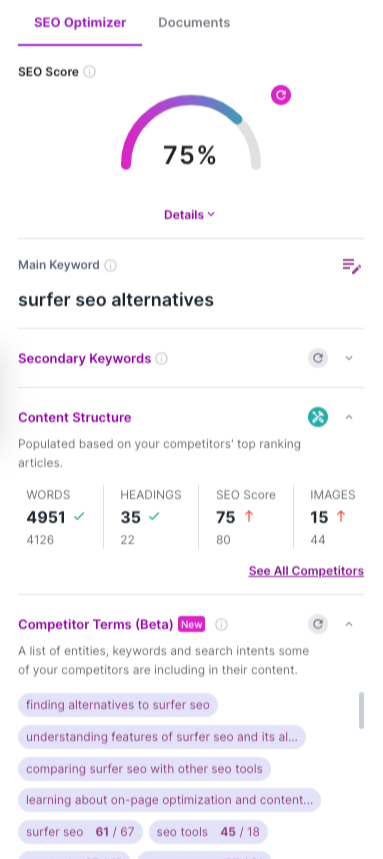
Surfer SEO is still one of the better-known content optimization tools. I still think it is useful when you want a SERP-based content score, term suggestions, outlines, audits, and a guided editor.
But it is not always the best fit anymore.
If you are searching for Surfer SEO alternatives in 2026, you are probably not asking, "Is Surfer bad?" You are asking a more practical question: "Is there a tool that fits my content workflow better, costs less, writes faster, supports AI search, or does more than score a draft?"
That distinction matters. In my experience, teams rarely replace Surfer because one score looks wrong. They replace it because the rest of the workflow around the score has become too slow, too expensive, or too fragmented.
After comparing the strongest options, my short answer is this:
Junia AI is the best Surfer SEO alternative for teams that want SEO research, AI writing, optimization, internal linking, images, and publishing in one workflow. If you only need a pure optimization editor, Frase, Clearscope, SE Ranking, and NeuronWriter are also worth comparing.
Quick Picks
| Need | Prefer | Notes |
|---|---|---|
| Full SEO articles faster | Junia AI | Best overall alternative in this list |
| SERP content score | Surfer | Still strong at on-page scoring |
| Broader research suite | Pair with Ahrefs/Semrush | Surfer is not a full link index |
If you do not want to read every review, start here:
| Use case | Best pick | Why |
|---|---|---|
| Best overall Surfer SEO alternative | Junia AI | Combines keyword research, SEO briefs, AI writing, optimization, internal linking, images, and CMS publishing |
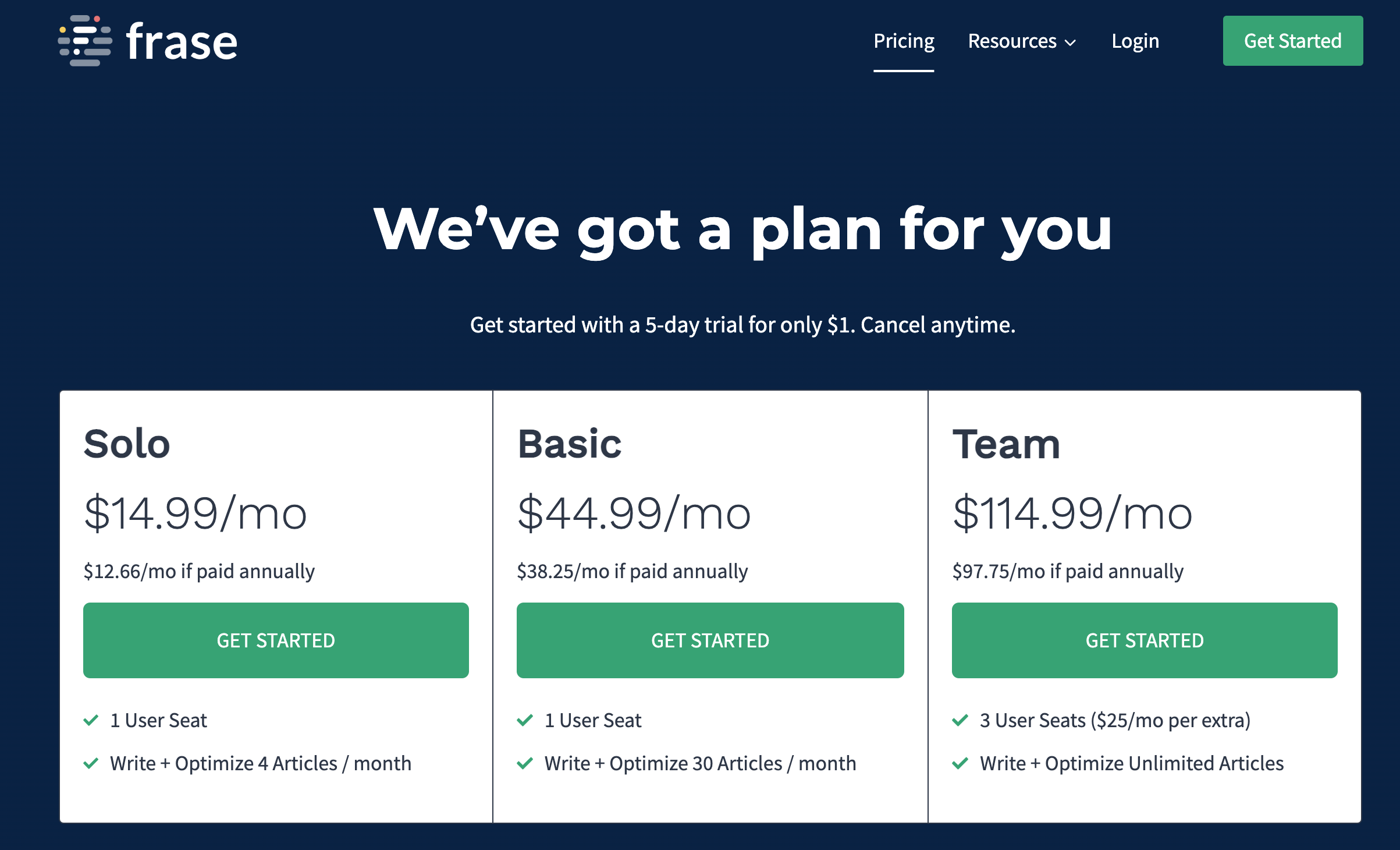
| Fast AI-assisted content production | Frase | Strong brief-to-draft workflow with SEO and GEO positioning |
| Broad SEO suite with content tools | SE Ranking | Rank tracking, audits, keyword research, reporting, and content marketing in one platform |
| Budget NLP optimization | NeuronWriter | Lower-cost content scoring and semantic optimization |
| Premium editorial optimization | Clearscope | Clean interface, reliable grading, and AI search visibility features |
| Strategy and topical authority | MarketMuse | Stronger for content planning, topic modeling, and authority gaps |
| Existing Semrush users | Semrush SEO Writing Assistant | Convenient if Semrush is already your main SEO platform |
| Keyword-first planning | WriterZen | Useful for topic discovery, keyword clustering, and content planning |
| Guided AI SEO workflows | Scalenut | AI visibility, GEO content creation, clusters, and auto-publishing features |
Why People Look for Surfer SEO Alternatives
Most teams leave Surfer for one of five reasons.
First, pricing can add up quickly. Surfer's public pricing page currently shows plans from Discovery at EUR 49/month billed yearly, Standard at EUR 99/month, Pro at EUR 182/month, Peace of Mind at EUR 299/month, and Enterprise at EUR 999/month. That can make sense for active SEO teams, but I would question it if you only optimize a few articles each month.

That cost pressure also shows up in real SEO communities. In one r/bigseo discussion about finding a cheaper alternative to Surfer SEO, the buyer had already paid for Semrush and did not want another expensive content tool layered on top.
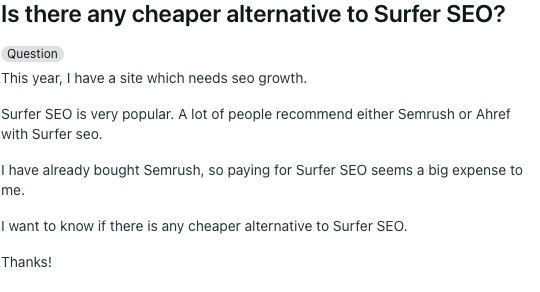
Second, Surfer is strongest at page-level optimization. If your bottleneck is keyword strategy, content briefs, AI drafting, internal links, or publishing, you may still need other tools around it.
Third, some writers over-follow content scores. A high score can be useful, but it can also push teams into awkward keyword usage if nobody is editing for reader value. I have seen strong drafts get worse when the final pass becomes a chase for two or three extra optimization points.
Fourth, AI search has changed the buying criteria. Teams now care about Google rankings, AI Overviews, ChatGPT, Perplexity, Gemini, Claude, brand mentions, citation readiness, and entity coverage. A tool that only helps with classic SEO may not be enough.
Finally, workflow matters. Agencies need reporting and collaboration. Publishers need speed. Solo creators need a lower monthly bill. In-house teams need cleaner editorial handoffs.
That is why the best Surfer alternative depends on the job you need the tool to do.
How I Compared the Tools
I looked at each tool through the lens of a real content workflow, not just a feature checklist. My bias is practical: a tool should either save meaningful production time or improve the final article enough to justify another subscription.
- Content optimization quality: Does it help improve a draft without encouraging keyword stuffing?
- SERP and competitor research: Does it turn search results into usable briefs, not just a word list?
- AI writing support: Can it help move from keyword to publishable draft faster?
- GEO and AI search support: Does it help content get cited or discovered in AI search surfaces?
- Workflow fit: Does it support planning, briefs, collaboration, internal links, CMS publishing, or reporting?
- Pricing fit: Does the tool make sense for freelancers, small teams, agencies, or enterprise content teams?
- Trust signals: Does the vendor publish clear feature and pricing details?
Surfer SEO Alternatives Compared
| Tool | Best for | Starting price shown publicly* | Main strength | Main tradeoff |
|---|---|---|---|---|
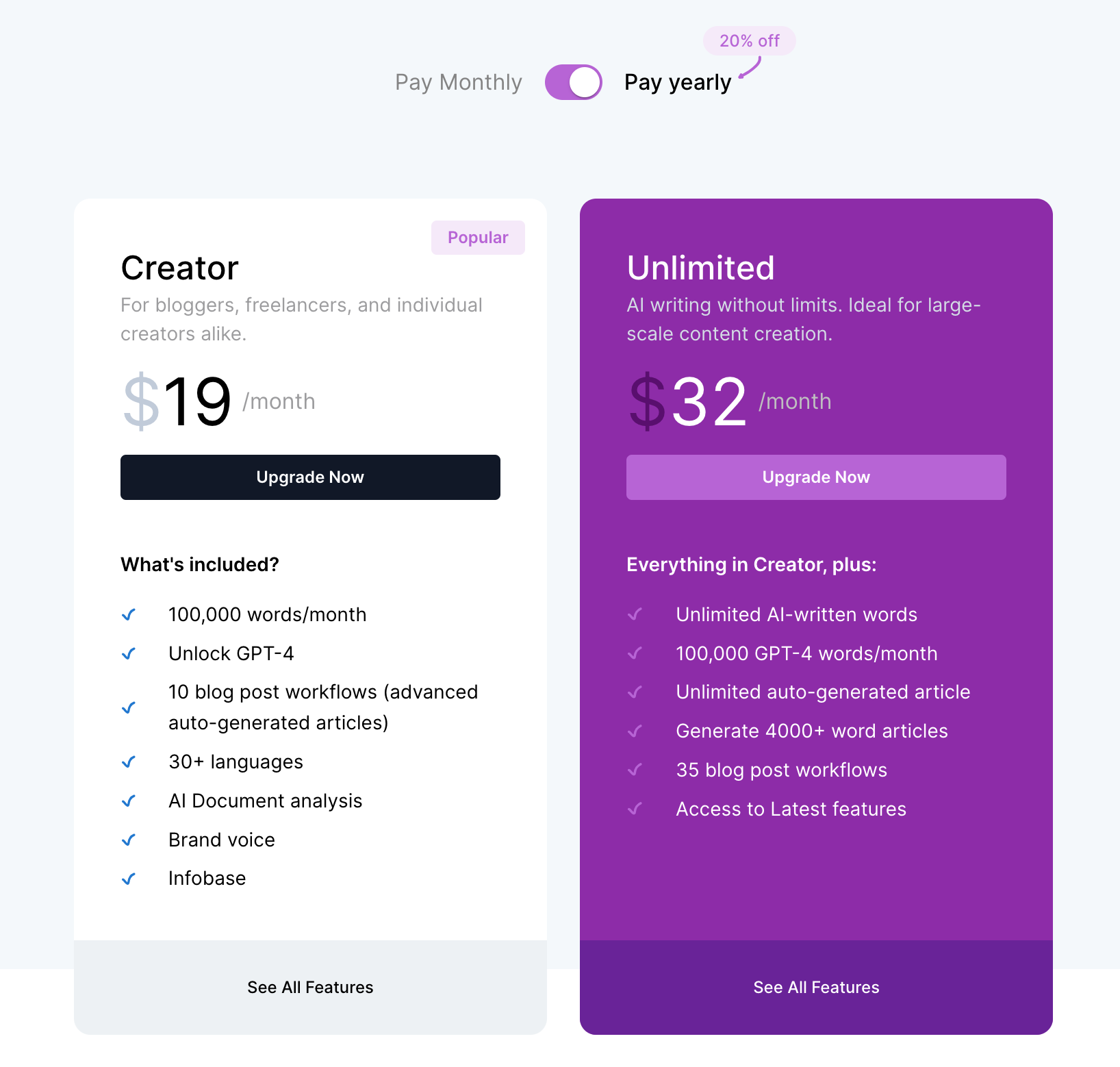
| Junia AI | SEO content production end to end | From $17/month on Junia's homepage | Research, writing, optimization, images, links, and publishing in one place | Broader platform, so pure editor-only users may not need every feature |
| Frase | Fast SEO + GEO workflows | From $39/month annual on Frase's pricing page | Briefs, AI writing, optimization, AI visibility, and publishing support | More production-focused than premium editorial-focused |
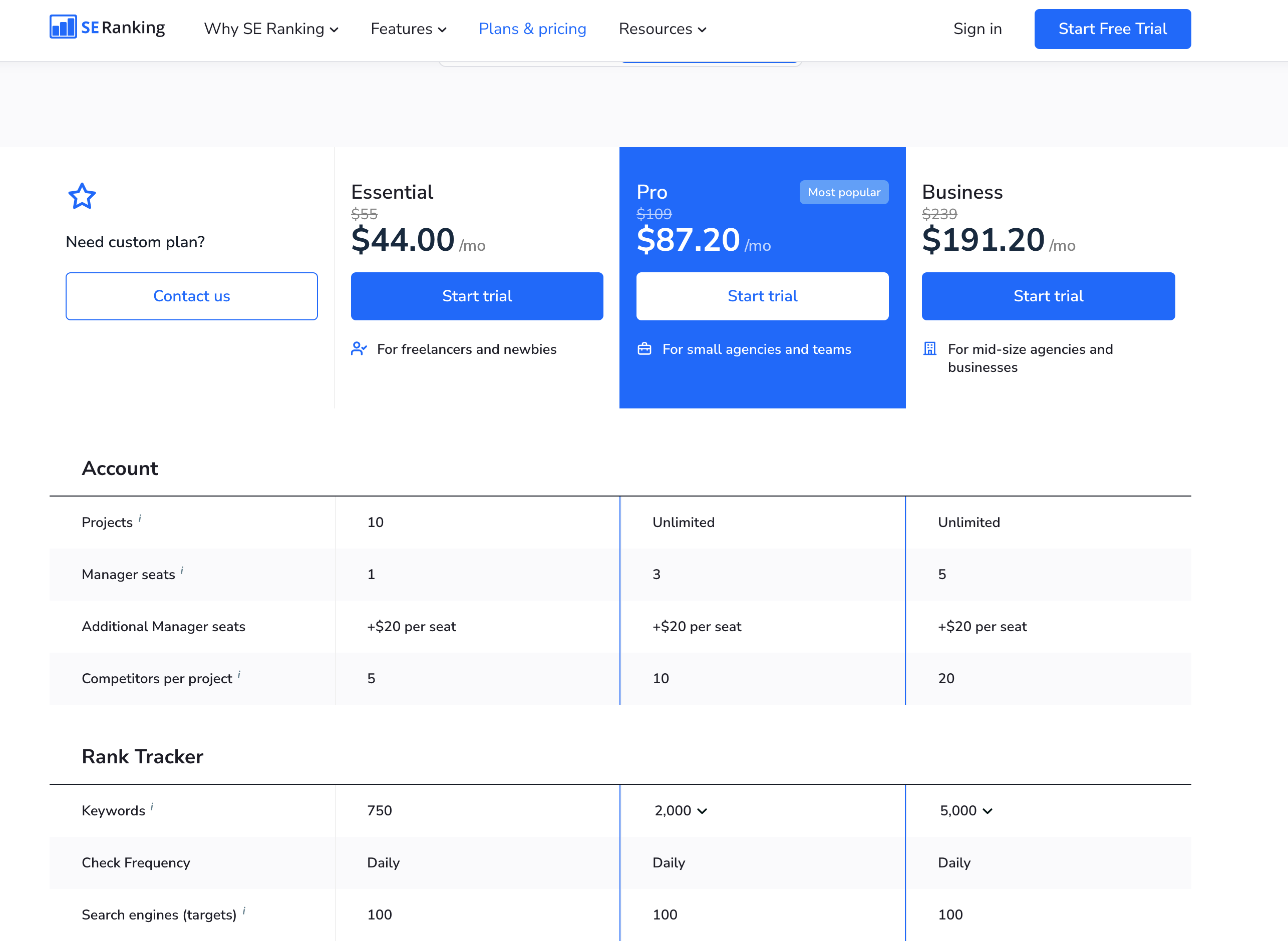
| SE Ranking | Broad SEO suite | From EUR 87.20/month annual on SE Ranking's pricing page | SEO + GEO tracking, audits, rank tracking, reports, and content tools | Content editor is one module inside a larger SEO platform |
| NeuronWriter | Budget content optimization | $23/month monthly on NeuronWriter's pricing page | Low-cost NLP optimization and content analysis | Less polished and less strategic than premium tools |
| Clearscope | Premium content grading | $129/month on Clearscope's pricing page | Clean editor, content inventory, topic exploration, and AI search visibility | Expensive for solo creators |
| MarketMuse | Content strategy | Free limited plan; paid plan details vary by package | Topic modeling, briefs, strategy docs, and authority gaps | More planning-heavy than fast drafting-heavy |
| Semrush Writing Assistant | Semrush users | Requires Semrush ecosystem access | Uses Semrush data inside a broader SEO workflow | Not the best standalone Surfer replacement |
| WriterZen | Keyword clustering | Pricing changes often; verify before buying | Topic discovery, keyword planning, and content workflows | Weaker if all you need is post-draft scoring |
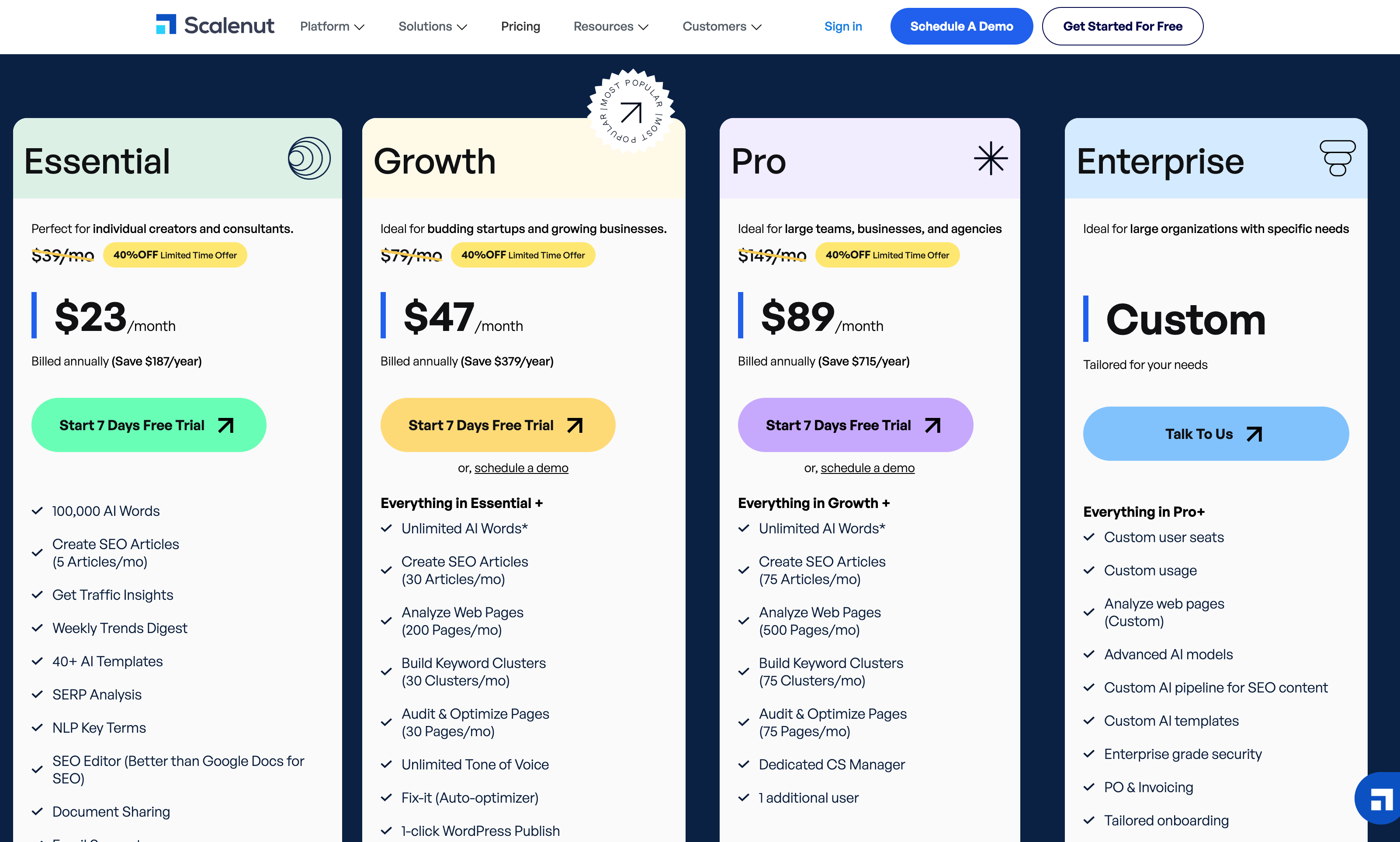
| Scalenut | Guided AI SEO execution | Starter shown at $59/month before promo on Scalenut's pricing page | GEO content creation, optimization, clustering, and auto-publishing | Pricing/promotions change often |
*Pricing changes often. I recommend verifying each vendor's pricing page before you buy.
1. Junia AI: Best Overall Surfer SEO Alternative
Keep Surfer in the comparison when you still need SERP-based content scoring. Switch when you need faster full-article workflows (Junia) or a different research stack.
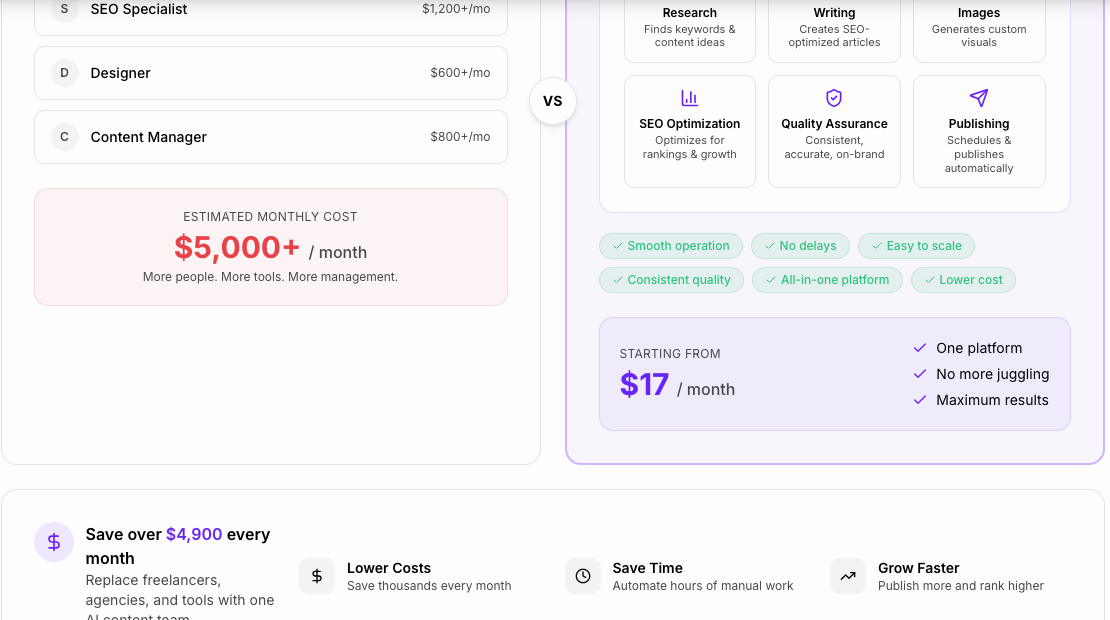
Junia AI is the strongest Surfer SEO alternative if your goal is not just to optimize a draft, but to produce SEO content from start to finish.
Surfer is useful once you already know the keyword and have a draft to improve. Junia AI is broader. It can help with keyword research, SEO content briefs, AI article writing, optimization, internal linking, images, metadata, and CMS publishing. That matters because most content teams do not struggle with scoring alone. They struggle with the whole path from topic selection to publishing.
That is also where I think Junia AI has the clearest argument. The less time a team spends moving content between disconnected tools, the more time it can spend improving the actual page.
Junia AI's homepage positions the product as an AI content team that researches, writes, optimizes, designs, and publishes from one platform. It also highlights CMS publishing support for WordPress, Blogger, Shopify, Webflow, Wix, and custom API workflows.
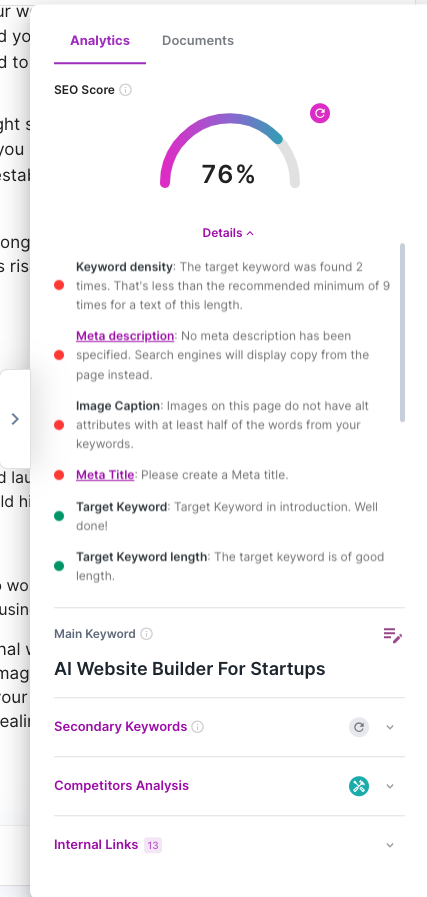
Where Junia AI beats Surfer SEO
The biggest difference is workflow depth.
With Surfer, you often use one tool for keyword research, another for writing, Surfer for optimization, another for images, another for internal links, and your CMS for publishing. Junia AI is built to reduce those handoffs. If you are deciding between just these two, the Junia AI vs Surfer SEO comparison lines up features, plans, and pricing side by side.
Junia AI is especially useful if you want:
- AI-assisted keyword research and article planning
- SEO content briefs before writing begins
- Long-form AI article generation
- Real-time SEO improvement suggestions
- AI internal linking as part of the publishing workflow
- Brand voice consistency across many articles
- Images and metadata generated in the same workflow
- Direct publishing to CMS platforms
I would choose Junia AI over Surfer when the goal is to publish more complete SEO content faster, not just improve a score on an existing draft. The AI SEO Agent is also a better fit for teams that want more automation around research, writing, optimization, and publishing.
Practical advantages
Junia AI's biggest advantage is that it keeps the editor, optimizer, metadata, links, and publishing steps close together. That makes it easier to create a repeatable workflow for a blog, affiliate site, SaaS content engine, or agency production pipeline. Personally, I value that more than another slightly different content score.
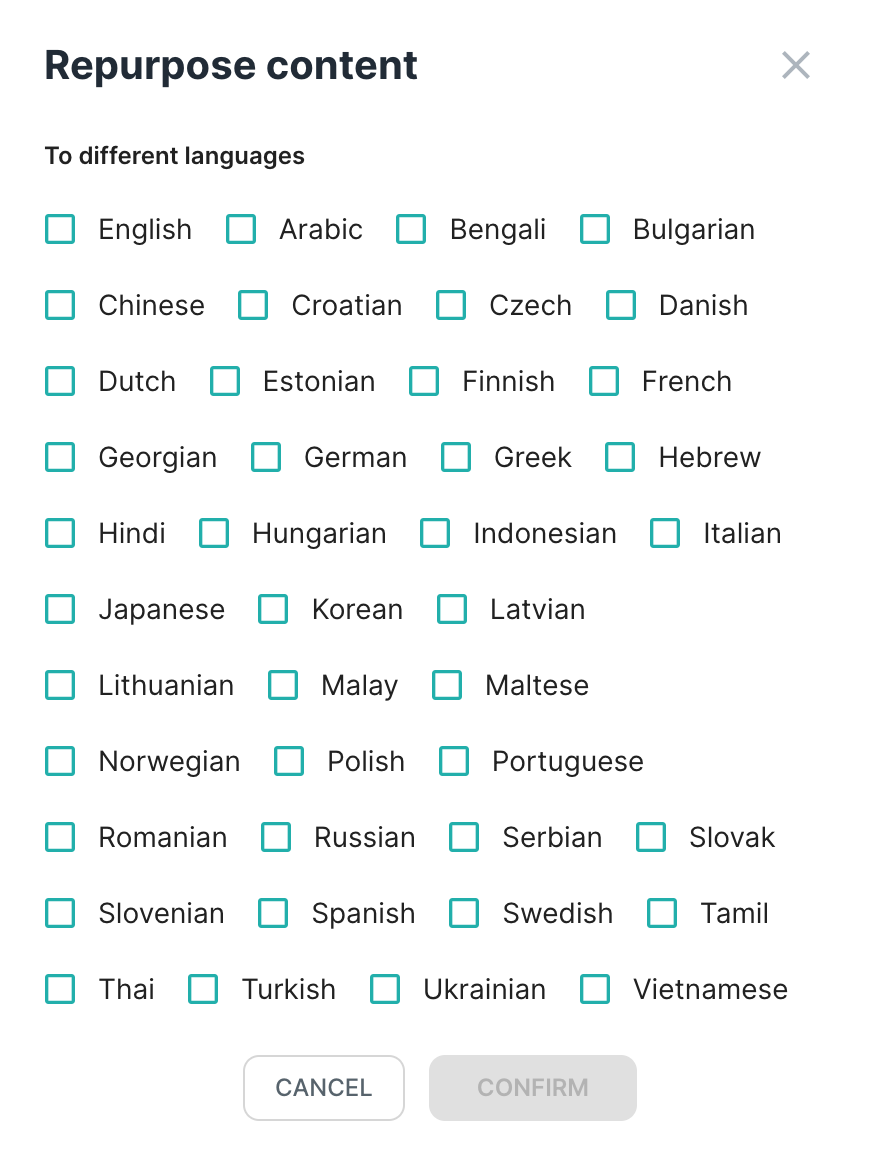
The AI article writer also makes Junia AI stronger than Surfer for users who want draft creation built into the main workflow. Surfer can help optimize and generate content, but Junia AI feels more built around content production from the beginning.
.png?token=eyJhbGciOiJIUzI1NiIsInR5cCI6IkpXVCJ9.eyJ1cmwiOiJ1c2VyLWdlbmVyYXRlZC1pbWFnZXMvZjJmOThkNWUtNjNjNC00MTJiLTkyY2QtZjgyNDI5NTE3YWRkL1NjcmVlbnNob3QgMjAyMy0xMC0xNCBhdCAyMy4yMCAxICgxKS5wbmciLCJpYXQiOjE2OTk0NTA2OTksImV4cCI6MTg1NzEzMDY5OX0.lyTKDaO_Fnuavu1GgmrXJucbpUmQGFAMBIsRZ_GVPNs)
Where Surfer may still be better
If your team already has writers, editors, keyword research tools, internal linking processes, and CMS workflows, you may only need a focused content optimization editor. In that case, Surfer, Clearscope, Frase, or NeuronWriter may be enough.
Junia AI is the better pick when you want the whole workflow in one place.
Best suited for
- bloggers, SaaS teams, SEO agencies, affiliate publishers, and content teams that want to produce optimized articles without stitching together many separate tools
This matters most when you're choosing a tool for bloggers, saas teams, seo agencies, affiliate publishers, and content teams that want to produce optimized articles wit….
2. Frase: Best for Fast Brief-to-Draft Workflows
Frase is one of the best Surfer alternatives if you want to move quickly from research to outline to draft to optimization.
Its current pricing page says every plan includes the same Frase AI Agent, SEO and GEO content optimization, AI visibility tracking, site audits, SERP research, competitor analysis, brand voice profiles, and API/MCP access. That makes Frase especially relevant in 2026 because many teams now care about both search rankings and AI citation readiness.
Where Surfer is known for content scoring, Frase leans harder into production speed. It is a good fit when you want one place to research the SERP, create a brief, draft content, optimize it, and track visibility. I would put it on the shortlist for teams that care more about moving from brief to publishable draft than polishing every recommendation inside a premium editor.
Where Frase beats Surfer SEO
Frase is stronger when speed matters. It helps teams get from keyword to working draft faster, and its SEO/GEO positioning makes it feel more current for AI search workflows.
It is useful for:
- Creating SEO briefs from SERP research
- Drafting content faster with AI
- Optimizing for search and AI answer visibility
- Running site audits and content opportunity checks
- Supporting agentic workflows through MCP access
Where Surfer may still be better
If you only care about a proven content scoring workflow for Google optimization, Surfer still has a strong brand and mature editor. Frase is more compelling when you want research, writing, optimization, AI visibility, and publishing to sit closer together.
Frase is a strong fit for solo marketers, content teams, and agencies that publish frequently and want speed without giving up optimization.
3. SE Ranking: Best Broad SEO Suite With Content Optimization
SE Ranking is not just a content optimizer. It is a broader SEO platform with keyword tracking, site audits, competitor research, backlink tools, reporting, and content marketing features.
That makes it a strong alternative if Surfer feels too narrow. Instead of paying for a content editor and then adding a separate rank tracker, audit platform, reporting tool, and competitor research tool, SE Ranking gives you a wider SEO stack.
On its pricing page, SE Ranking currently positions its Core plan as SEO + GEO for marketing teams with repeatable delivery, with limits for projects, keywords, prompts, audits, and API/MCP access. It also lists AI Search as an add-on for tracking and analyzing brand visibility across AI platforms.
Where SE Ranking beats Surfer SEO
SE Ranking is stronger if you need SEO operations around the article, not just article optimization. I like it most when content is only one part of the SEO job and reporting, audits, and rank tracking matter every week.
It can help with:
- Rank tracking
- Site audits
- Keyword research
- Backlink monitoring
- Competitor analysis
- Report building
- Content marketing workflows
- AI visibility tracking through add-ons
Where Surfer may still be better
Surfer is more focused if the only thing you want is an optimization editor. SE Ranking gives you more moving parts, which is useful for agencies and SEO teams but can feel unnecessary for a writer who only wants to optimize one article.
When SE Ranking fits
- agencies, consultants, and small SEO teams that want content optimization inside a full SEO toolkit
The biggest mistake I see is choosing SE Ranking when you really needed a different job is the real bottleneck.
4. Scalenut: Best for Guided AI SEO Execution
Scalenut is a good Surfer SEO alternative if you want a guided AI SEO workflow instead of a narrow optimization editor.
Its pricing page now emphasizes AI visibility, GEO content creation, GEO optimization, keyword clusters, content audits, internal linking, topic gaps, and auto-publishing to WordPress and Shopify on higher plans. That gives it a broader workflow than a classic content scoring tool.
Where Scalenut beats Surfer SEO
Scalenut is useful when you want the tool to guide more of the content execution process. My take is that Scalenut works best for users who want a system to follow, not just a blank editor with recommendations.
- AI visibility tracking prompts
- GEO-ready content creation
- GEO optimization for existing content
- Keyword clusters
- Content audits
- Internal linking
- Auto-publishing on supported plans
Where Surfer may still be better
Scalenut's broader platform can feel like more than you need if your process is already defined. Surfer may feel simpler for teams that only want a content editor and a score.
Best suited for
- small teams and content marketers that want AI-assisted planning, writing, optimization, and publishing features in one place
I would avoid this approach if a different job is the real bottleneck.
5. Clearscope: Best Premium Editorial Optimizer
Clearscope is the premium Surfer alternative for teams that care most about clean content grading and an editor that writers can actually use without fighting the interface.
Clearscope's pricing page currently lists Essentials at $129/month, Business at $399/month, and Enterprise as custom. The Essentials plan includes tracked topics, tracked prompts, pages, monthly topic explorations, and monthly drafts, which shows how Clearscope has moved beyond a basic keyword grader into SEO and AI search visibility.
Where Clearscope beats Surfer SEO
Clearscope is strong because it keeps the writing experience simple. You get content grading, topic recommendations, and a clean interface without asking writers to interpret too much technical noise. If I were managing a team of experienced writers, this is the kind of optimizer I would want them to actually enjoy using.
It is especially good for:
- In-house editorial teams
- Content teams with experienced writers
- Teams that want reliable recommendations without a cluttered UI
- Brands willing to pay more for smoother editorial adoption
Where Surfer may still be better
Surfer has more accessible entry pricing and a larger base of SEO-specific workflows. Clearscope makes more sense when the editor experience, recommendation quality, and team adoption are worth the premium.
Clearscope is a strong fit for mature content teams and enterprises that want a polished optimization workflow.
6. MarketMuse: Best for Content Strategy and Topical Authority
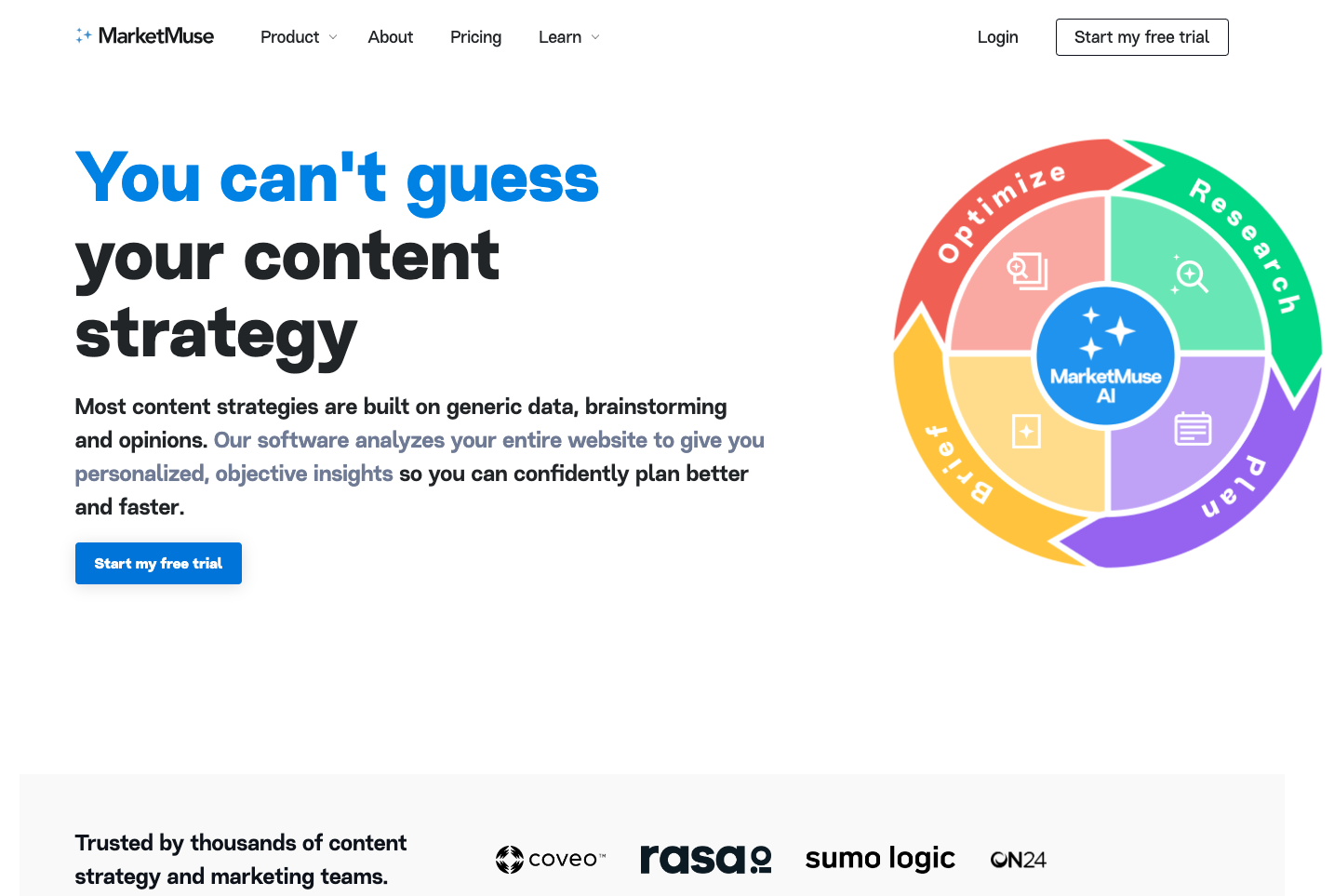
MarketMuse is a better Surfer alternative when the real problem is content strategy, not final-draft optimization.
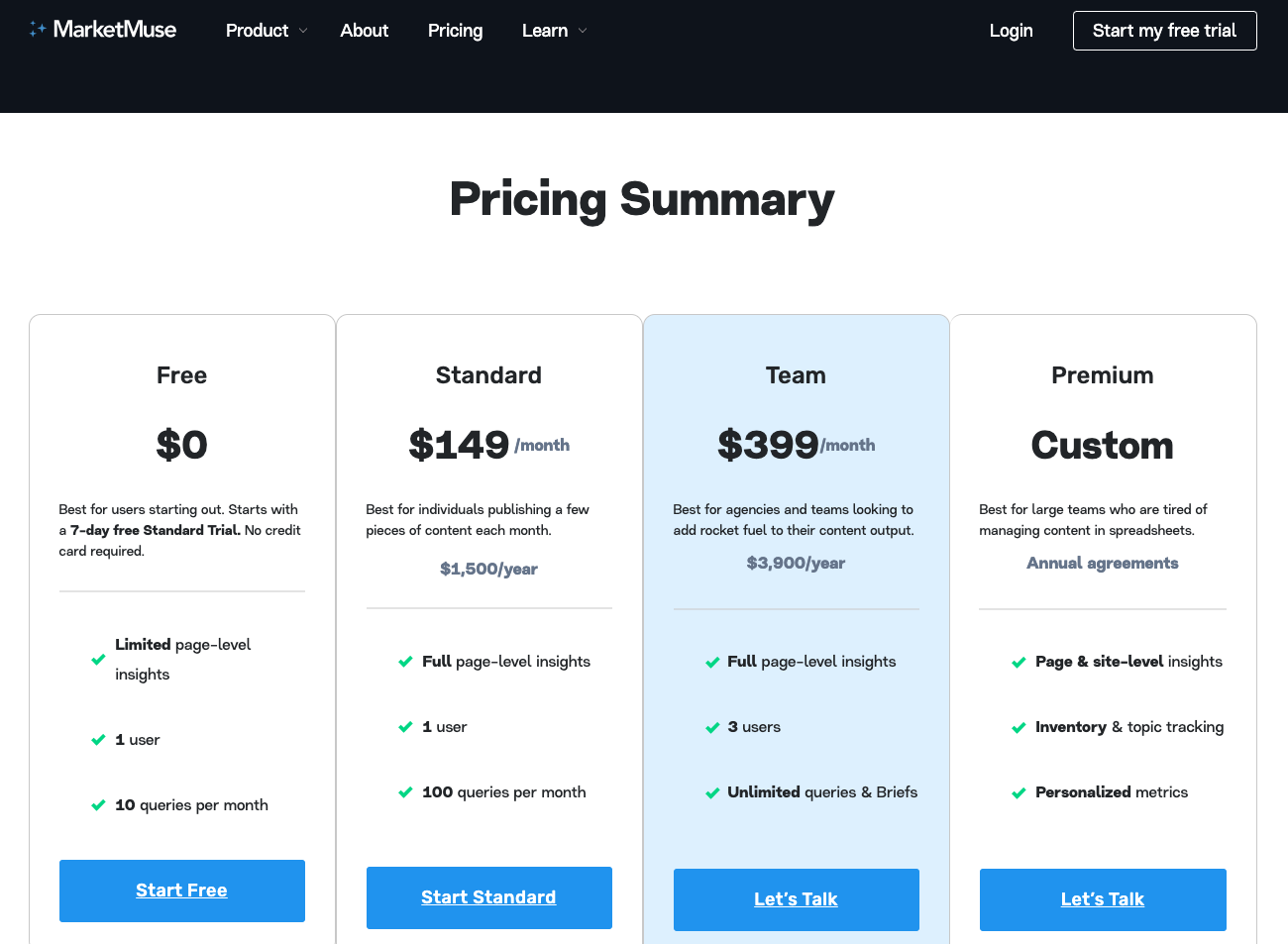
Surfer helps you improve a page. MarketMuse helps you understand what to create, expand, merge, or prioritize across a content library. Its pricing page lists a free limited plan plus packages around tracked topics, content briefs, and strategy documents.
Where MarketMuse beats Surfer SEO
MarketMuse is stronger for strategic content planning. It is not the tool I would reach for when a writer just needs to optimize one draft by Friday; it makes more sense when the question is what the site should publish next.
- Topic modeling
- Competitive content analysis
- Content briefs
- Content clusters
- Strategy documents
- Authority and coverage gaps
Where Surfer may still be better
If you want a lightweight optimizer for writers, Surfer is simpler. MarketMuse is more useful before writing starts, especially for teams managing a large content inventory.
When MarketMuse fits
- SEO strategists, enterprise content teams, and publishers building topical authority across many pages
Prefer MarketMuse for seo strategists, enterprise content teams, and publishers building topical authority across many pages — not when a different job is the real bottleneck.
7. NeuronWriter: Best Budget Surfer SEO Alternative
NeuronWriter is the clearest budget pick if the main thing you want from Surfer is NLP-style content optimization.
Its pricing page currently lists monthly plans starting at $23/month for Bronze, with higher plans adding more projects, analyses, AI credits, integrations, content management, and API access. The annual pricing is lower.
Where NeuronWriter beats Surfer SEO
NeuronWriter wins on affordability. It gives you content analysis, semantic recommendations, AI credits, and optimization support at a much lower entry price than most premium tools. I would not expect the same polish as Clearscope or the same workflow depth as Junia AI, but for budget-conscious users, that tradeoff can be perfectly reasonable.
It is useful if you want:
- SERP-based content optimization
- NLP term suggestions
- Content scoring
- AI writing assistance
- A lower monthly bill
Where Surfer may still be better
Surfer is more polished and established. If you need a smoother interface, larger ecosystem, better training materials, or more advanced workflows, Surfer may justify its cost.
Best suited for
- freelancers, bloggers, and small site owners who want optimization without a premium subscription
This matters most when you're choosing a tool for freelancers, bloggers, and small site owners who want optimization without a premium subscription.
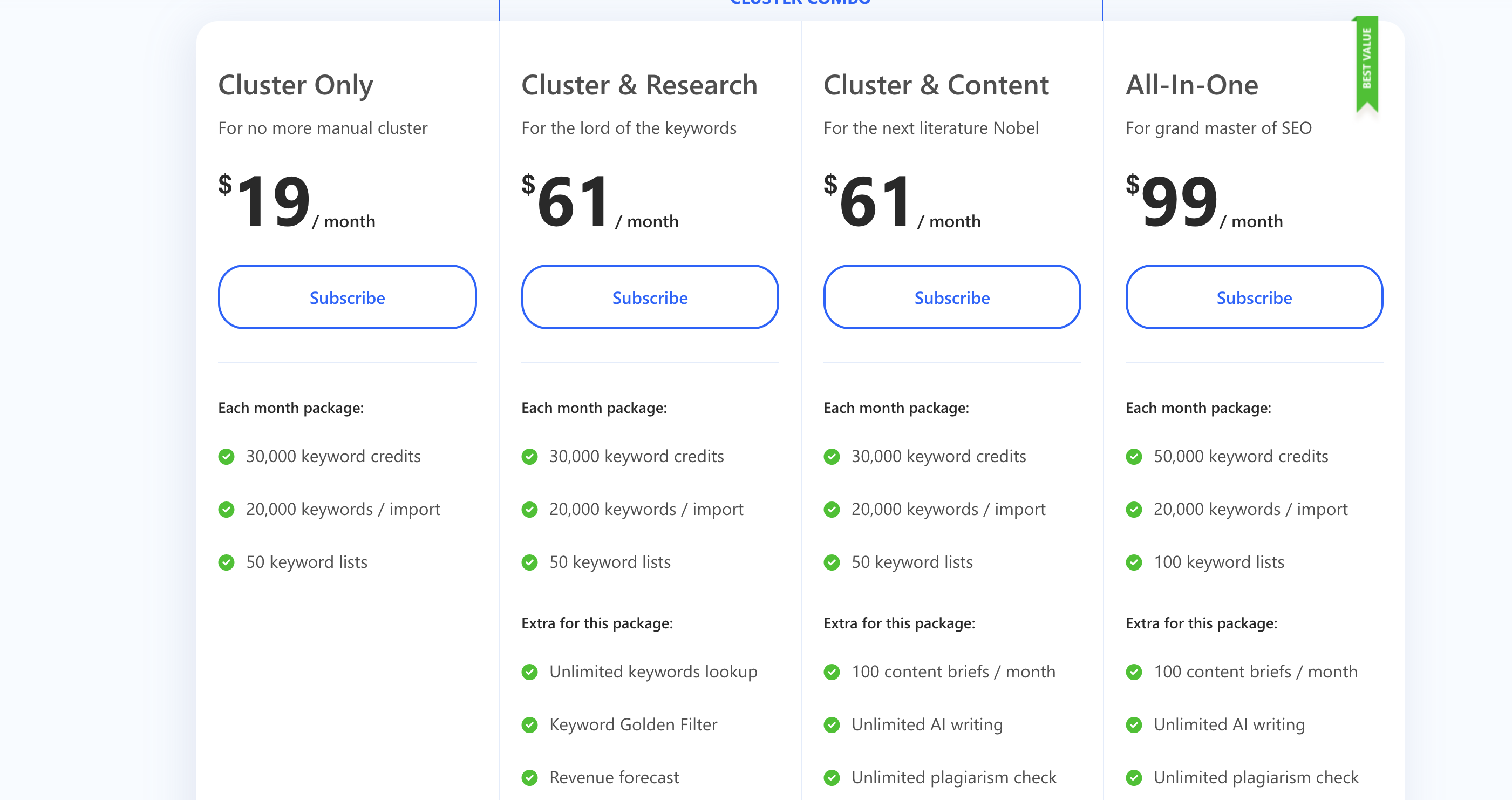
8. WriterZen: Best for Keyword-First Planning
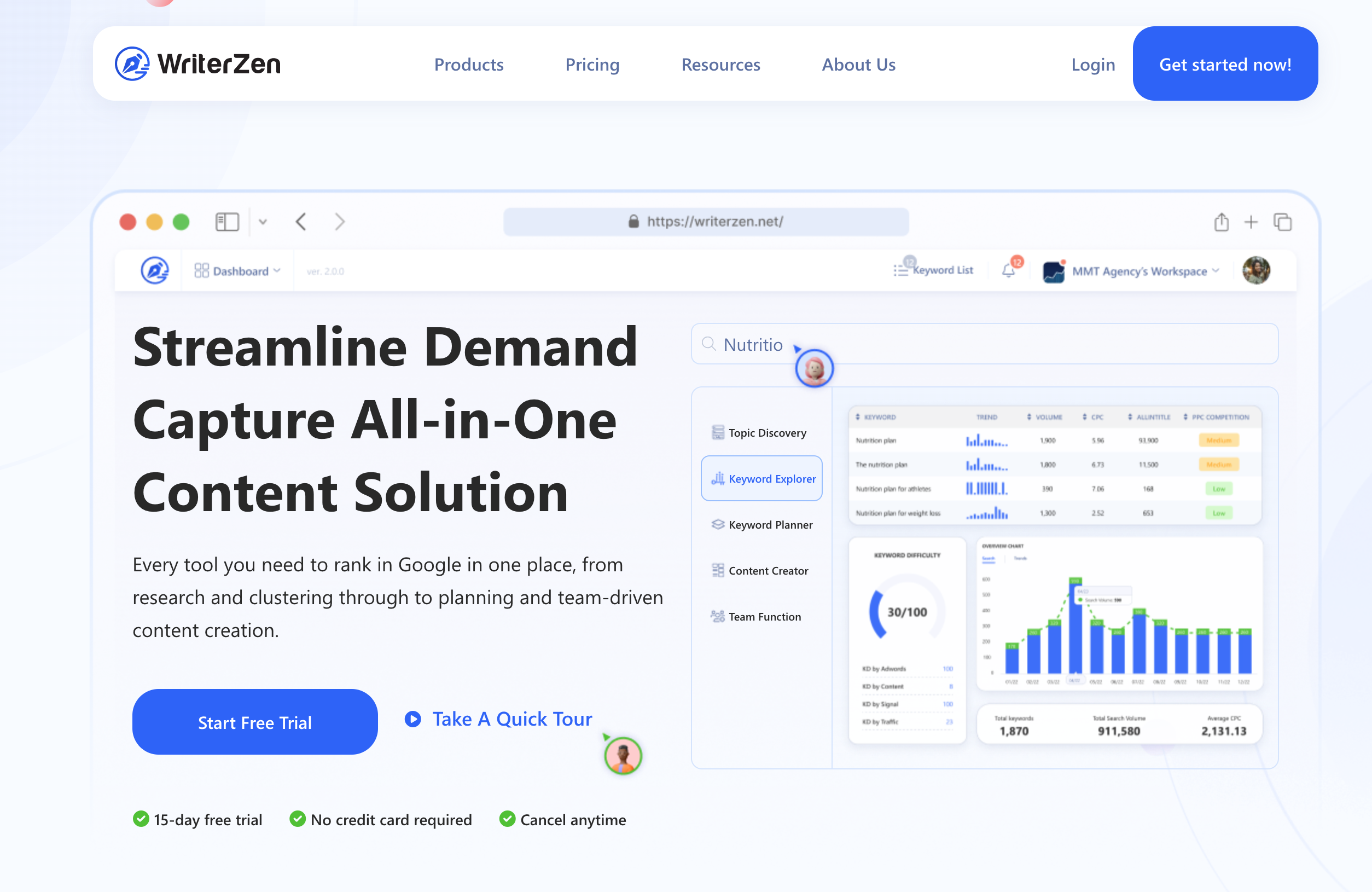
WriterZen is a good Surfer SEO alternative if your workflow starts with keyword research and clustering rather than final draft optimization.
The tool is useful for finding topics, grouping keywords, planning content, and building article outlines before a writer starts drafting. That makes it more of an upstream content planning platform than a direct one-to-one Surfer clone. I see it as a planning companion more than a final optimization layer.
Where WriterZen beats Surfer SEO
WriterZen is helpful when you need to organize a content calendar around topic clusters:
- Topic discovery
- Keyword exploration
- Keyword clustering
- Content outlines
- AI writing support
- Plagiarism checks on some plans
Where Surfer may still be better
Surfer is better if your main task is optimizing a finished page against the SERP. WriterZen is better when the hard part is choosing topics and building a content plan.
WriterZen is a strong fit for keyword-first SEOs, bloggers planning topic clusters, and teams that need stronger research before drafting.
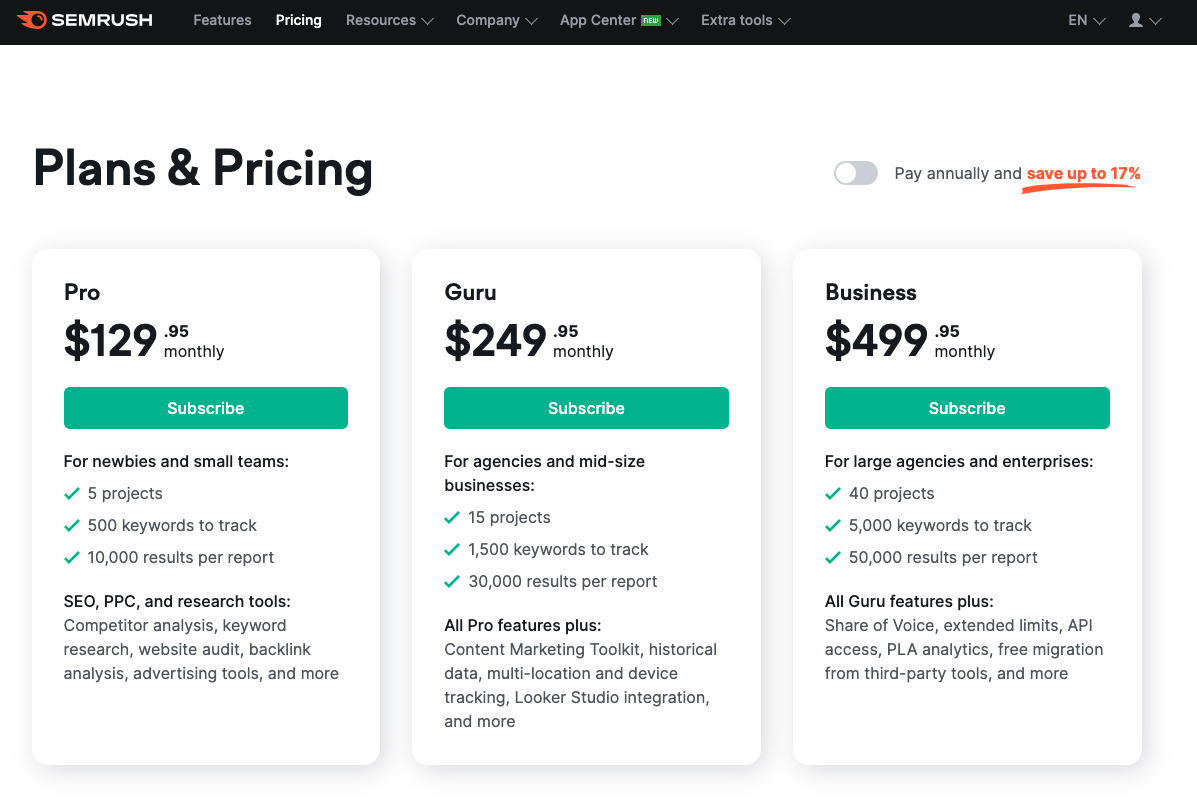
9. Semrush SEO Writing Assistant: Best if You Already Use Semrush

Semrush SEO Writing Assistant is a practical Surfer alternative only if Semrush is already part of your stack.
It gives you content recommendations, readability checks, tone guidance, originality checks, and SEO suggestions connected to Semrush's broader keyword and competitive data. That is convenient if your team already uses Semrush for keyword research, audits, competitor analysis, and reporting.
Where Semrush beats Surfer SEO
Semrush wins when you want content guidance inside a broader SEO platform:
- Keyword data
- Competitor analysis
- SEO audits
- Backlink data
- Content recommendations
- Google Docs and WordPress workflow support
Where Surfer may still be better
I would not buy Semrush only to replace Surfer. If content optimization is the main job, a dedicated content tool is cleaner. Semrush makes sense when your SEO team already lives inside the Semrush ecosystem.
When Semrush SEO Writing Assistant fits
- teams already paying for Semrush that want lighter content optimization without adding another standalone tool
The biggest mistake I see is choosing Semrush SEO Writing Assistant when you really needed a different job is the real bottleneck.
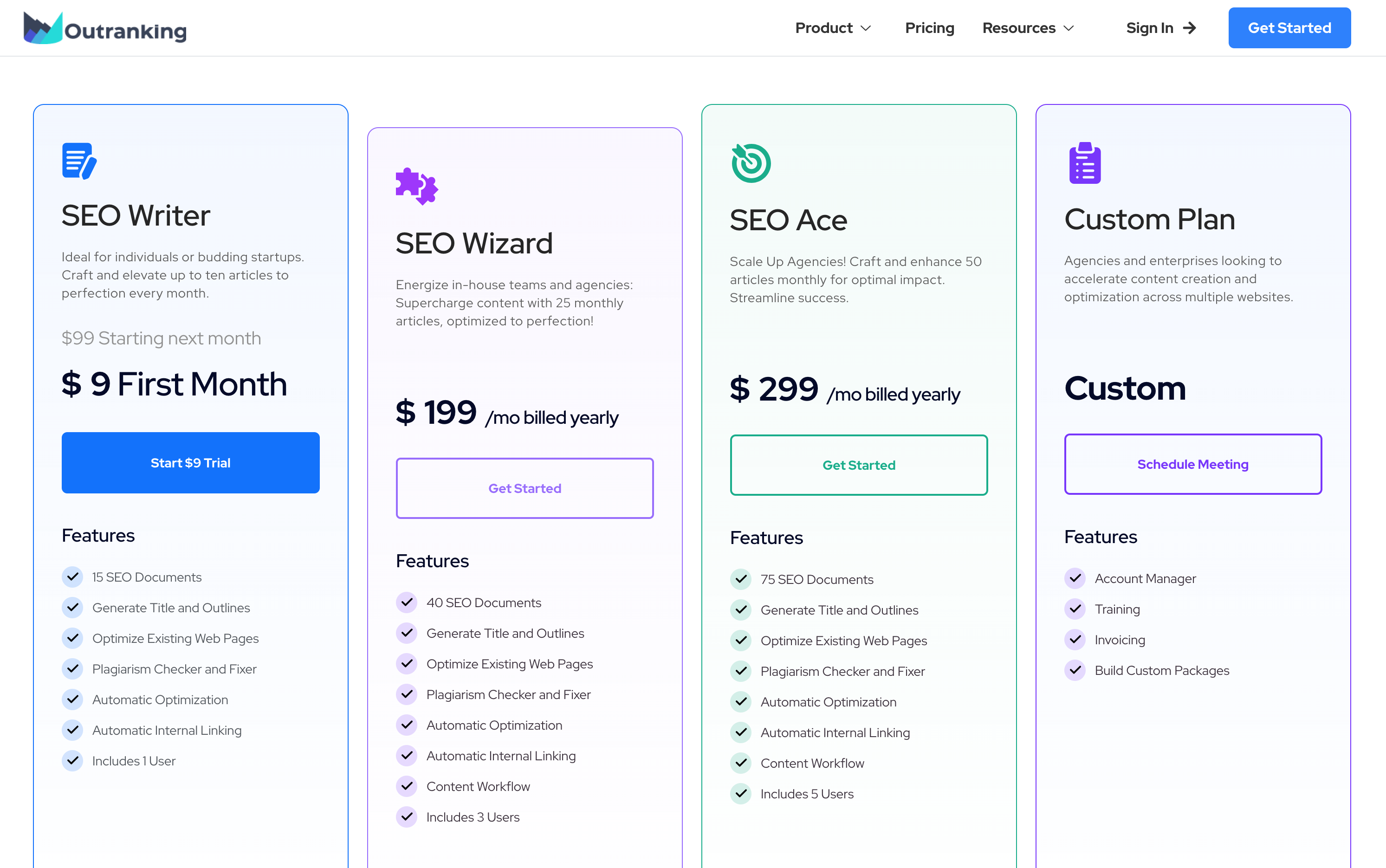
Honorable Mention: Outranking

Outranking is still worth mentioning for guided AI SEO workflows, especially if you want help moving through research, outlining, drafting, and on-page optimization with a more structured process.
I did not keep it in the top nine because the 2026 market has shifted toward tools with stronger AI visibility, GEO, publishing, or broader SEO suite features. Still, it can be useful if you like guided workflows and want a more step-by-step content process.
How to Choose the Right Surfer SEO Alternative
Do not choose based on the longest feature list. Choose based on the bottleneck in your content workflow. This is where many comparisons go wrong: they reward the tool with the most boxes checked instead of the one that removes the most friction.
If your bottleneck is publishing complete SEO content faster, choose Junia AI. It handles more of the workflow: research, writing, optimization, internal linking, metadata, images, and publishing. That makes it especially useful for teams building a repeatable AI SEO agent workflow.
If your bottleneck is optimizing finished drafts, choose Clearscope, Frase, Surfer, or NeuronWriter. These tools are closer to the classic content editor model.
If your bottleneck is price, start with NeuronWriter or compare lower-tier Frase and Scalenut plans. Budget tools can be enough if you already have a strong editorial process.
If your bottleneck is SEO operations, choose SE Ranking or Semrush. They are better when rank tracking, audits, reports, and competitor research matter as much as content scoring.
If your bottleneck is strategy, choose MarketMuse or WriterZen. They help more before the draft exists, especially when topic clusters and content planning are the real issue.
What Makes a Good Surfer SEO Replacement?
A good Surfer SEO replacement should help you produce better content, not just higher scores.
Look for these things:
- Clear SERP research: The tool should show what top pages cover and where your article can add something better.
- Search intent guidance: It should help you understand whether the query needs a list, guide, product comparison, template, or direct answer.
- Readable optimization: Recommendations should improve the article without making it sound stuffed with terms.
- AI search readiness: In 2026, content should be structured so Google and AI systems can understand, summarize, and cite it.
- Workflow fit: The best tool should match how your team actually works, whether that means briefs, writing, editing, internal links, images, or publishing.
- Transparent pricing: Pricing pages should make it clear what you get, what limits apply, and what costs extra.
A strong tool will not replace editorial judgment. It should make judgment easier by showing gaps, patterns, and opportunities you might miss manually. The best setup, in my opinion, is still software plus a human editor who knows when to ignore the software.
My Verdict
For most users looking for the best Surfer SEO alternative, I would start with Junia AI.
The reason is simple: Surfer mostly solves the optimization step. Junia AI solves more of the content production workflow. If you want to research keywords, build briefs, write long-form content, improve SEO, add internal links, create metadata, include images, and publish to a CMS, Junia AI is the more complete choice.
If I were replacing Surfer today, I would start by asking whether I need a better optimizer or a better publishing workflow. For many teams, the second problem is the expensive one.
That said, the best choice depends on your use case:
- Choose Junia AI if you want the best overall AI SEO content workflow.
- Choose Frase if you want fast brief-to-draft production with SEO and GEO support.
- Choose SE Ranking if you want a broader SEO suite.
- Choose NeuronWriter if price matters most.
- Choose Clearscope if you want premium editorial optimization.
- Choose MarketMuse if strategy and topical authority matter most.
- Choose WriterZen if keyword clustering drives your planning.
- Choose Semrush Writing Assistant if you already use Semrush.
- Choose Scalenut if you want guided AI SEO execution and publishing features.
Surfer SEO is still a capable tool. But if your workflow has outgrown a content score, the alternatives above give you better ways to plan, write, optimize, and publish content in 2026.