
Bulk AI Content Generation in 2026: Scale Without Killing Quality

Thu
AI SEO Specialist, Full Stack Developer

I have used bulk AI content generation as a publishing system, not as a shortcut for producing hundreds of similar articles. That sounds like a small distinction. In practice it is the difference between a scalable content program and a very fast cleanup project.
The promise is real. AI can turn keyword lists, briefs, templates, brand rules, and source material into drafts much faster than a manual writing process. The risk is just as real. If every page has the same structure, the same examples, and no original judgment, you are not scaling content. You are scaling editing debt.
That matters even more in 2026 because search engines and AI answer systems are better at spotting pages that exist mainly to fill a keyword gap. Google's own guidance says generative AI can help with research and structure, but using it to generate many pages without adding value can violate its scaled content abuse policy. The practical standard is simple: each page still needs to help a real reader better than the alternatives already ranking.
TL;DR
Bulk AI content generation is worth using when you have repeatable content types, clear inputs, and a human review layer. It is risky when you use it to publish large volumes of thin, interchangeable pages.
Here is the clean version:
| Question | Best answer |
|---|---|
| What is bulk AI content generation? | A workflow for creating many drafts, pages, or content variants from structured inputs such as keywords, briefs, templates, brand voice rules, and data. |
| When does it work best? | SEO clusters, product descriptions, location pages, localization, content refreshes, and repeatable blog formats where quality rules can be standardized. |
| What is the biggest risk? | Repetition. If the system does not add unique context, examples, sources, or editorial judgment, the output can become low-value scaled content. |
| What should humans review? | Search intent, factual accuracy, originality, brand voice, internal links, examples, and whether the page deserves to exist. |
| What tool should you start with? | Use Junia AI's bulk content creation workflow if your main goal is structured long-form SEO content with briefs, outlines, optimization, and publishing controls in one process. |
My rule: do not ask "how many articles can we generate?" Ask "how many useful pages can we properly brief, review, improve, and maintain?"
What Bulk AI Content Generation Actually Means
Bulk AI content generation is the process of creating multiple content assets at once with AI. Those assets might be blog posts, landing pages, ecommerce descriptions, social posts, video scripts, translated pages, comparison pages, or content refreshes.
The key word is "bulk." A normal AI article writer helps with one draft at a time. A bulk workflow uses repeatable inputs so you can produce a whole set of drafts from the same system.
Common inputs include:
- A keyword list or topic cluster
- A search-intent label for each page
- A content brief or outline
- Product, service, or location data
- Brand voice rules
- Internal linking guidance
- Source URLs or notes
- Metadata rules
- Human review criteria
The best bulk workflows are not just "prompt plus article." They look more like a production line: plan the page set, generate structured briefs, draft in batches, review by risk level, optimize, publish, then refresh based on performance.
When Bulk AI Content Makes Sense
Bulk generation is strongest when the content type is repeatable but the pages still need meaningful differences.
For example, a SaaS company may need dozens of comparison pages. An ecommerce team may need hundreds of product descriptions. A local business network may need location pages. A global brand may need translated and localized versions of existing content. A publisher may need first drafts for a cluster of informational posts.
Those are reasonable use cases because the format can be standardized. The mistake is assuming the insight can be standardized too.
| Use case | Good bulk workflow | Bad bulk workflow |
|---|---|---|
| SEO topic clusters | Generate briefs and first drafts, then add examples, screenshots, expert judgment, and internal links. | Publish many generic articles that repeat the same definition and benefits. |
| Ecommerce descriptions | Use product data, attributes, audience needs, and category context. | Spin manufacturer copy with slightly different wording. |
| Location pages | Add real service details, local proof, reviews, staff, pricing notes, and area-specific FAQs. | Swap city names across the same template. |
| Localization | Translate, then adapt examples, units, search phrasing, cultural references, and local SERP intent. | Machine-translate every page and publish without review. |
| Content refreshes | Identify outdated claims, missing sections, weak rankings, and new sources before updating. | Ask AI to "make it better" with no performance data. |
Bulk content is useful when AI handles the repeatable drafting work and humans handle the parts that make the page worth reading. I would be skeptical of any workflow that promises scale but has no clear owner for examples, source checks, and final judgment.
How Bulk AI Content Generation Works
Most bulk content systems follow the same broad process, even if the interface looks different.
- Input collection: You provide keywords, topics, URLs, products, audience data, or a spreadsheet of page targets.
- Brief creation: The system turns those inputs into outlines, search-intent notes, headings, questions, and metadata.
- Draft generation: AI writes multiple drafts or sections from the same rules.
- Optimization: The tool checks structure, keywords, headings, readability, links, schema opportunities, or SERP coverage.
- Review: A human checks factual accuracy, usefulness, originality, brand fit, and risk.
- Publishing: Approved pages move into a CMS, schedule, or export workflow.
- Refresh: Performance data tells you what to prune, merge, expand, or update.
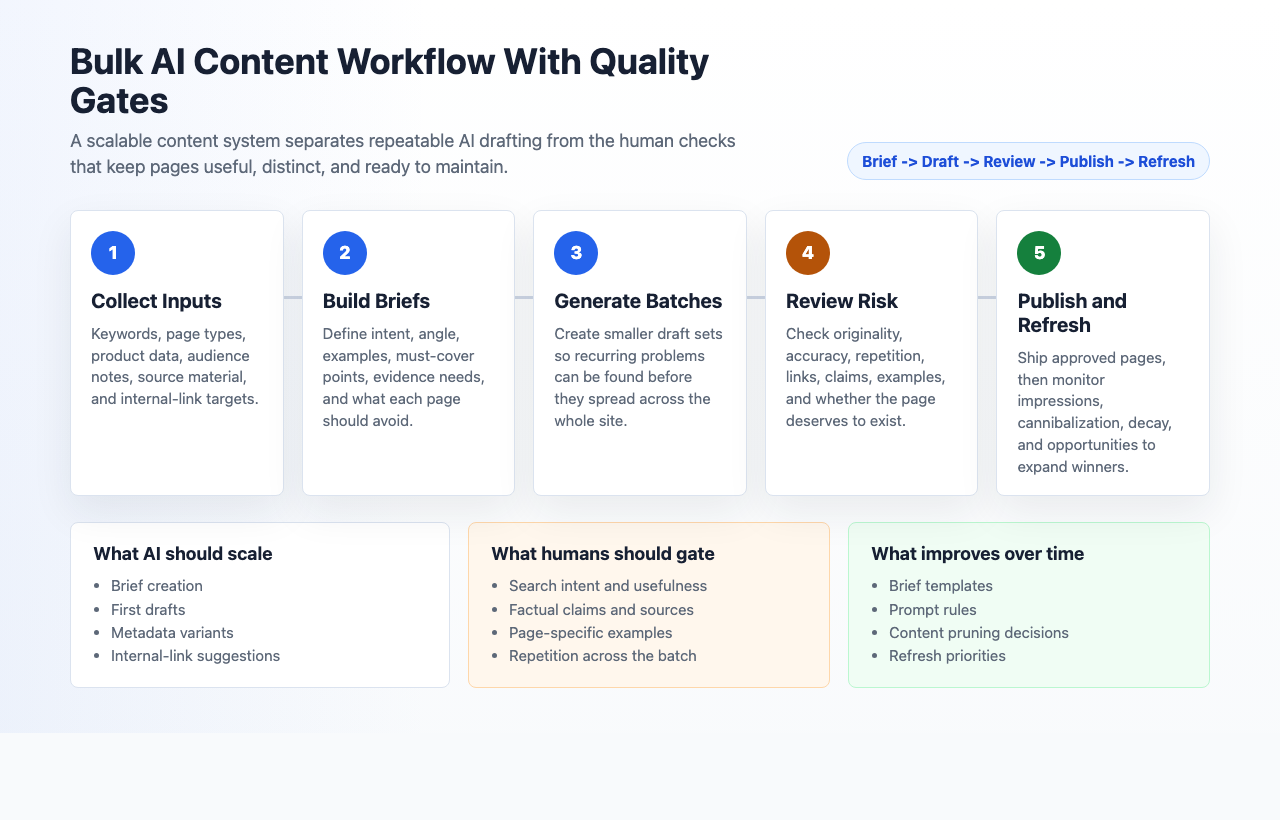
The technical layer usually combines large language models, prompt orchestration, retrieval, templates, structured data, and post-processing rules. You do not need to understand every model detail to use the workflow well. You do need to understand the operating principle: weak inputs produce weak patterns at scale.
If your brief is vague, the AI will fill the gaps with generic claims. If your template is too rigid, every article will feel identical. If your source material is thin, the draft will sound confident without saying much. I have seen the biggest gains come from improving the inputs, not from chasing a cleverer prompt after the batch is already drafted.
The Quality Risk Most Teams Underestimate
The biggest problem with bulk AI content is not that AI writes badly. The bigger problem is that AI can write fluent content that looks finished before it has earned trust. That is why I do not treat a clean draft as a finished draft.
That is how teams end up with pages that pass a quick skim but fail the reader:
- The introduction says the topic is "important" without proving why.
- The headings match the keyword but not the real search intent.
- The article has no examples from the actual product, audience, or industry.
- Every paragraph says something broadly true but not especially useful.
- Internal links feel inserted for SEO instead of helping the reader move forward.
- Sources are missing, weak, or added after the fact.
- The conclusion repeats the introduction.
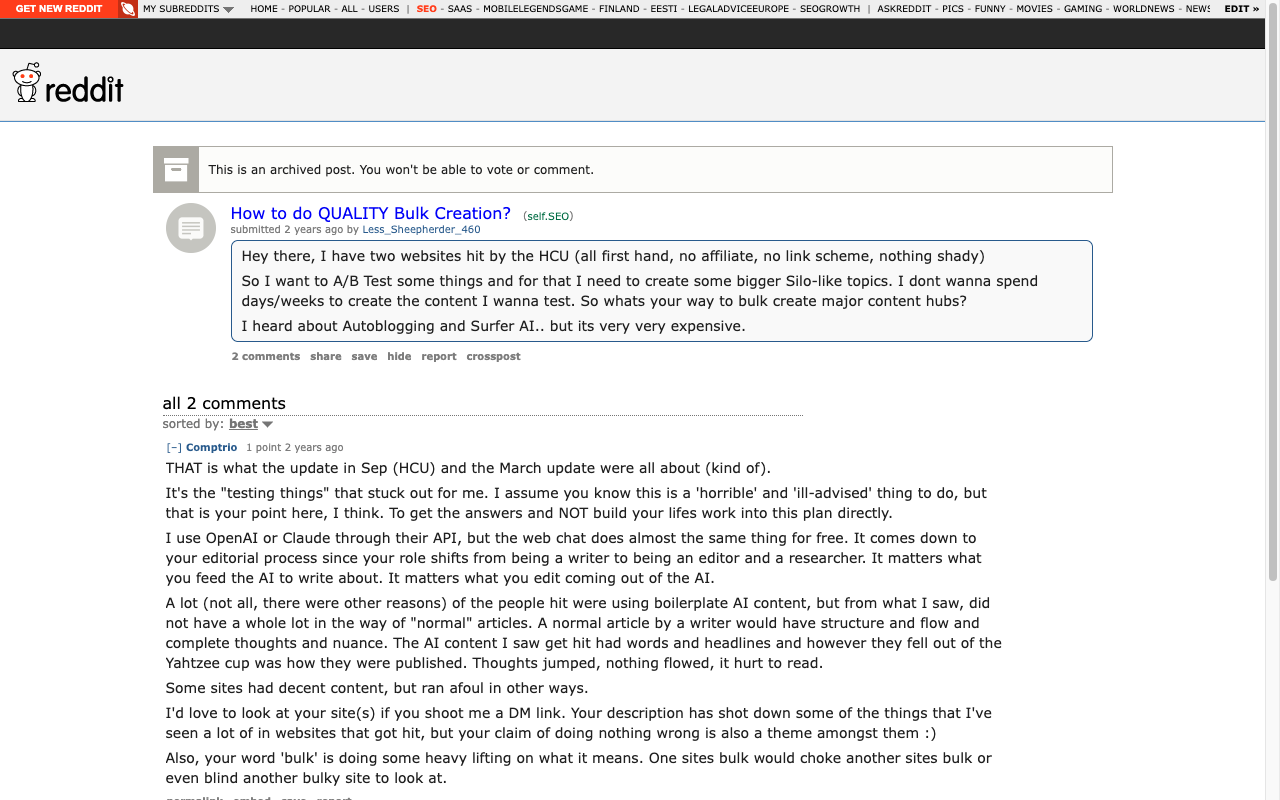
Google's guidance on using generative AI content is useful here because it does not say AI content is automatically bad. The issue is whether the content is helpful, reliable, and made for people. Google's spam policies are stricter when many pages are created mainly to manipulate search rankings without adding value.
Google Search Central on auto-generated content and scaled low-value pages
Scale the process, not identical pages. A shared brief template is useful. A shared article body is not. If two URLs only swap a keyword, you did not scale a content system. You scaled sameness.
So the question is not "can AI content rank?" It can. The better question is whether your AI-assisted page has enough original value to compete. That is the real issue behind whether AI content can rank in Google: the ranking risk usually comes from thin execution, not from the use of AI itself. Personally, I would rather publish fewer AI-assisted pages that have a clear reason to exist than a larger batch that merely looks complete.
A Practical Bulk Content Workflow
Here is the workflow I would use before publishing AI-generated content at scale.
1. Start With Page Types, Not Just Keywords
A keyword list is not a content strategy. Before generating anything, group pages by format and intent:
- How-to guides
- Comparison pages
- Product-led articles
- Programmatic landing pages
- Glossary entries
- Local pages
- Templates
- Refreshes
Each type needs different rules. A comparison page needs selection criteria and tradeoffs. A how-to guide needs steps and examples. A programmatic page needs a strong data source and a reason each page is distinct. When teams skip this step, the drafts usually reveal it quickly: every page starts making the same generic argument in slightly different clothes.
If you are building hundreds of search pages from structured data, use a dedicated programmatic SEO workflow rather than forcing every page through a generic blog template.
2. Build Strong Briefs Before Drafting
Bulk generation improves dramatically when the brief is specific. A good brief should tell the AI:
- Who the reader is
- What decision or task the page should help with
- What the page should not cover
- What evidence or examples must be included
- Which internal pages should be considered
- What tone and level of expertise to use
- What claims need source checks
I would rather generate 50 strong briefs and 20 publishable articles than 500 shallow drafts. The brief is where you prevent sameness before it spreads.
A SEO content brief generator can speed up this step, but the final brief still needs editorial judgment. Do not let the tool decide the entire angle for every page.
3. Add Brand Voice Rules That Are Specific Enough to Use
"Professional, friendly, and informative" is not a brand voice. It is a default setting.
Useful voice rules are more concrete:
- Use short paragraphs.
- Avoid hype phrases like "revolutionize" and "game-changing."
- Give examples before broad advice.
- Say "we recommend" when giving a judgment call.
- Mention tradeoffs, not just benefits.
- Do not use fake urgency.
For larger teams, a shared brand voice system helps keep batches consistent without making every article sound identical. The goal is recognizable editorial standards, not cloned phrasing.
4. Generate in Smaller Batches
Do not generate and publish 300 articles in one pass. Start with a small batch, review it, identify recurring problems, then adjust the briefs and prompts before scaling. My preference is to treat the first batch as a diagnostic run, not a production push.
I usually look for patterns like:
- Are intros too generic?
- Are headings repeating across articles?
- Are examples missing?
- Are claims unsupported?
- Are internal links awkward?
- Are conclusions thin?
- Are the same phrases appearing in every draft?
This is where bulk workflows become more efficient over time. You are not just editing individual articles. You are improving the system that creates them. That is the compounding benefit most teams miss.
5. Review by Risk Level
Not every page needs the same review depth. A low-risk social caption does not need the same process as a medical, finance, legal, or high-traffic SEO article. I like this kind of tiering because it keeps review standards high without pretending every asset carries the same risk.
Use a simple review matrix:
| Risk level | Examples | Review needed |
|---|---|---|
| Low | Social posts, rough outlines, internal notes | Brand voice and clarity pass |
| Medium | Blog posts, product descriptions, template pages | Editorial review, SEO review, link review |
| High | YMYL topics, pricing claims, legal/compliance pages, original data | Expert review, source verification, policy review |
For SEO content, I would always check search intent, originality, internal links, factual claims, and whether the page adds something competitors do not.
6. Publish With a Refresh Plan
Bulk content should never be "set and forget." Before publishing a large batch, decide what happens after launch:
- Which pages will be checked after 30, 60, and 90 days?
- Which pages should be merged if they cannibalize each other?
- Which pages should be pruned if they get no impressions?
- Which pages need new examples or sources?
- Which articles deserve human expansion after early traction?
This is also where a content calendar matters. A content calendar generator is useful when it turns a big batch into a manageable publishing and refresh schedule instead of dumping everything live at once.
Best Bulk AI Content Generation Tools
The right tool depends on what you are scaling. Some tools are better for SEO articles. Others are stronger for ads, product content, or video. Make that decision based on the workflow you need to repeat every week, not the flashiest demo.
Junia AI
Junia AI is the strongest fit when bulk generation is part of an SEO content system. It is built around long-form content, outlines, optimization, brand voice, internal linking, and repeatable publishing workflows.
That makes it more useful than a plain writing assistant when you need dozens of articles that still need structure and quality control. For example, you can use Junia to build a cluster, generate drafts, improve on-page SEO, and connect related pages without treating each article as a separate one-off task. In practice, that matters more than another generic "write me a blog post" button.
Where Junia fits best:
- SEO blog clusters
- Long-form articles
- Bulk content briefs
- Programmatic SEO support
- Multilingual content expansion
- Internal-linking workflows
- AI-assisted refreshes
At scale, internal linking becomes easy to overlook. A tool for AI internal linking can help surface relevant connections, but the final link still needs to make sense in the paragraph. A link should support the reader's next step, not interrupt the article.
DeepBrain AI

DeepBrain AI is a better fit for teams that need video as part of the content workflow. It can support avatar-led videos, training materials, explainers, and promotional assets.
I would not choose it as the main tool for scaling SEO articles. I would consider it when the written page needs a companion video or when a team wants to repurpose content into visual formats.
Jasper

Jasper is useful for marketing teams that create content across campaigns, ads, emails, and brand messaging. Its appeal is format flexibility and team workflow support.
For bulk SEO content, compare it carefully against tools that are more search-focused. A flexible writing platform can still produce good drafts, but long-form SEO workflows need briefs, structure, optimization, links, and refresh discipline.
Writesonic
Writesonic is a practical option for lean teams that need many draft types quickly, especially when the content mix includes blog drafts, ads, landing pages, and social posts.
The tradeoff is that faster drafting can create more review work if the inputs are thin. Use it for first drafts and campaign variants, then run a tighter editorial pass before publishing anything that needs to rank.
Quick Tool Comparison
| Tool | Best for | Watch out for |
|---|---|---|
| Junia AI | Structured long-form SEO, bulk briefs, content clusters, internal linking | Still needs human review for originality, examples, and sources |
| DeepBrain AI | Video-led content and repurposing | Not the best primary choice for SEO article batches |
| Jasper | Campaign copy and multi-format marketing teams | SEO structure may need extra editorial control |
| Writesonic | Fast draft generation across formats | Quality can vary if briefs are weak |
The tool matters, but the operating system matters more. A strong process with an average tool will usually beat a powerful tool with no review workflow. That is an opinion, but it is one I would stand behind after seeing how quickly weak processes turn good tools into content mills.
How to Avoid Repetitive AI Content
Repetition is the silent failure mode of bulk publishing. It does not always look like duplicate content. Sometimes it looks like 80 articles with different titles but the same opening logic, same examples, same list structure, and same conclusion. Readers feel that sameness before they can name it.
To avoid that, give each page a unique job:
- One page answers a beginner question.
- One page compares options.
- One page shows a workflow.
- One page gives examples.
- One page targets a specific industry.
- One page handles objections or mistakes.
Then add page-specific inputs. If the article is about ecommerce AI content, include product-data examples. If it is about SaaS SEO, include feature-page and comparison-page examples. If it is about localization, include language and market differences.
Tools can help polish the output, but they cannot replace this thinking. A humanizer may improve rhythm, but it will not fix a page that has no original point.
An AI text detector can be a useful signal during review, but it should not be treated as a publishing decision by itself. I would use it as a prompt to inspect the draft more closely, not as a pass/fail gate. The real test is whether the article is accurate, useful, and specific.
Internal Linking in Bulk Content
Internal links are especially important in bulk content because large batches can either strengthen your topic architecture or turn into a messy pile of isolated pages.
The right approach is to plan links before generation:
- Which hub page should each article support?
- Which related articles genuinely help the reader?
- Which links belong in the brief?
- Which links should be avoided because they create cannibalization?
- Which anchors sound natural in the sentence?
This is where bulk generation can actually improve quality. If each brief includes the right internal-link targets, writers and editors do not have to guess later. Done well, the linking system becomes part of the reader journey instead of an SEO chore added at the end.
Still, do not let links lead the writing. If a paragraph only exists to insert a link, remove or rewrite it. A useful internal link should sit inside a useful idea.
Bulk Content and AI Search Visibility
AI Search does not change the fundamentals as much as some people claim. Google's generative AI search guidance says the same core SEO practices still matter because AI features rely on Google's search and quality systems. I am wary of any advice that treats AI visibility as a separate game with secret rules.
That means bulk content should be easy for both humans and machines to understand:
- Answer the main question early.
- Use descriptive headings.
- Include concise definitions where helpful.
- Add comparison tables when the reader needs a decision.
- Use examples that can be quoted or summarized.
- Support risky claims with sources.
- Keep pages crawlable and indexable.
- Avoid inventing AI-only optimization tricks.
The early TL;DR, tables, checklists, and direct definitions in this article are not just for skimming. They also make the page easier for AI systems to parse and summarize accurately.
Bulk AI Content QA Checklist
Before publishing any AI-generated page from a bulk workflow, run a QA pass like this:
| Check | What to ask |
|---|---|
| Search intent | Does the page answer the real query, or just the keyword? |
| Original value | What does this page add that competitors do not? |
| Accuracy | Are facts, dates, prices, features, and claims checked? |
| Specificity | Are there examples, workflows, screenshots, tables, or concrete decision rules? |
| Repetition | Does the article reuse the same phrasing or structure as other pages in the batch? |
| Internal links | Do links help the reader move to relevant next steps? |
| Brand voice | Does the page sound like your site, not a generic AI article? |
| Metadata | Does the title and description match the actual page promise? |
| AI Search readiness | Is the answer clear enough to be cited, summarized, or extracted? |
| Maintenance | Is there a refresh date, owner, or performance trigger? |
For larger programs, the review checklist should be part of the workflow, not something editors remember manually. Junia's AI autoblogging workflow is most useful when the publishing system has a brake as well as an accelerator. Without that brake, automation mostly helps you publish mistakes faster.
That brake should be explicit: an AI content quality control checklist that editors can apply before drafts go live.
How Many AI-Generated Articles Should You Publish?
There is no universal safe number. The right publishing volume depends on your review capacity, topic depth, site authority, and ability to maintain pages after launch.
If your team can properly review five articles per week, publishing 50 AI drafts per week is not a growth plan. It is a backlog. I have found this to be the most honest capacity test: count what you can improve, not what you can generate. If your templates are strong, your topics are distinct, and your editors can review efficiently, a higher volume can work.
Use these limits:
- Publish fewer pages when the topic is complex, high-risk, or source-heavy.
- Publish more pages only when the format is repeatable and the data is strong.
- Slow down if pages start sounding similar.
- Merge or prune pages that target the same intent.
- Refresh winners before expanding weak areas.
The deeper question of how many AI-generated blog posts to publish per day depends less on AI speed and more on editorial capacity. Quality control is the real bottleneck.
Common Mistakes to Avoid
The first mistake is using bulk generation before you have a content strategy. AI can multiply a plan, but it cannot rescue a weak one.
The second mistake is using the same prompt for every page. That creates sameness even when the topics look different.
The third mistake is skipping source checks. AI can sound certain about outdated features, wrong pricing, fake statistics, and unsupported claims. This is one of the places where I would be strict, because a single confident error can undermine an otherwise useful page.
The fourth mistake is overlinking. Bulk content often creates link stuffing because teams try to connect every article to every related page. Strong internal links are selective.
The fifth mistake is publishing without a refresh plan. Large batches age quickly, especially if they mention tools, pricing, policies, or search behavior.
The final mistake is assuming AI Search needs a separate trick. It does not. It needs clear, useful, well-structured content that deserves to be referenced. If your page cannot help a human quickly, it probably will not be a strong source for AI systems either.
Final Recommendation
Bulk AI content generation is worth using in 2026 if you build the workflow around quality from the start. Used carefully, it makes an editorial team faster. Used carelessly, it hides weak thinking behind polished sentences.
Use AI for briefs, outlines, drafts, metadata, internal-link suggestions, and refresh ideas. Keep humans on judgment: what the page should say, what deserves to be published, what needs evidence, and what should be cut.
If I were starting from scratch, I would begin with 10 to 20 pages, review every draft closely, fix the workflow, then scale. That is the real benefit of AI for me: faster production without giving up editorial control.
The goal is not more words. The goal is more useful pages than your team could produce by hand, without letting quality collapse as volume increases.